 By admin
 INTRODUCTION:
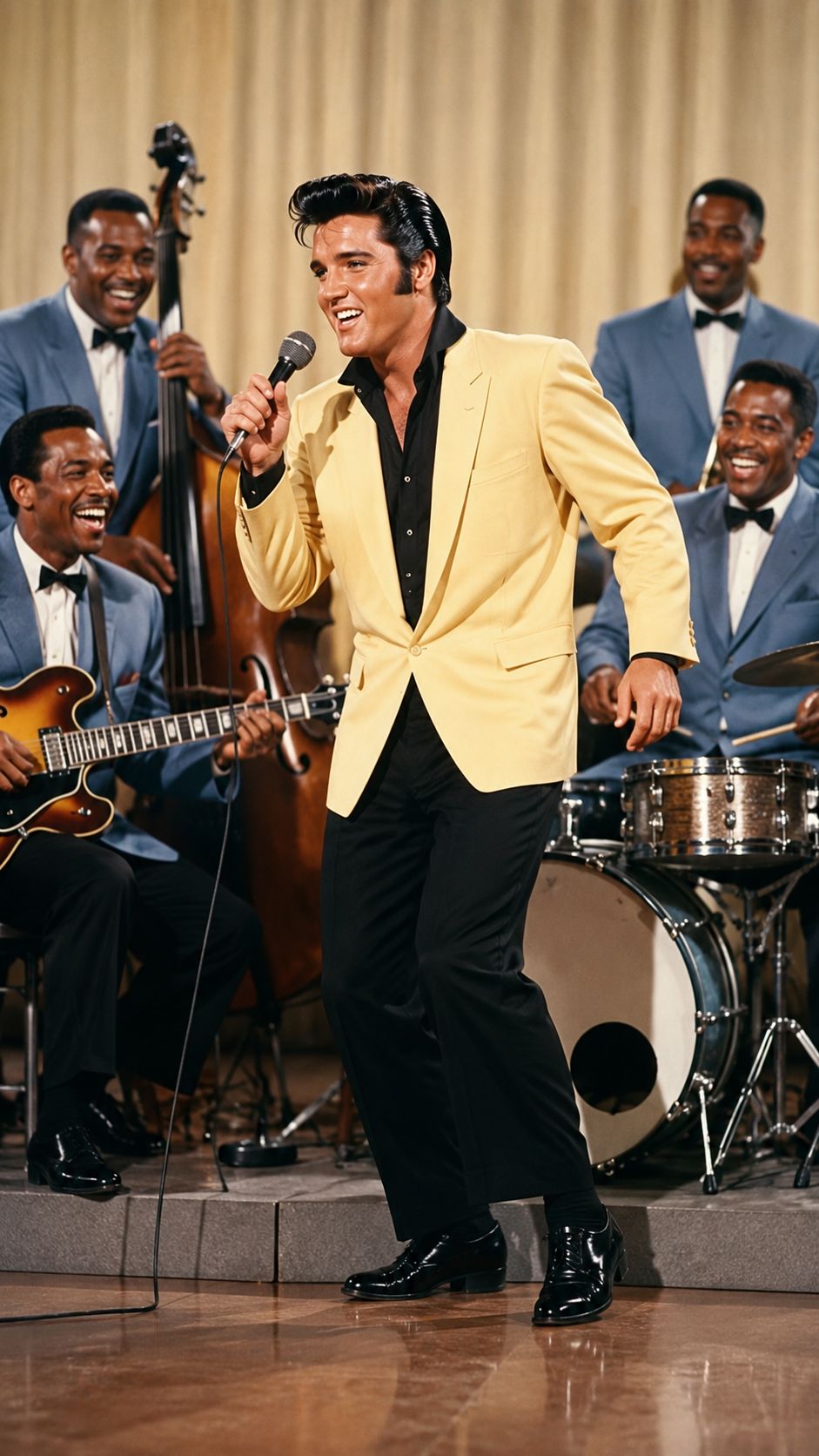
Few figures in American music history have been debated, dissected, praised, and condemned as intensely as Elvis Presley. For decades, a simplified narrative has echoed through documentaries, opinion columns, social media debates, and cultural commentary: that Elvis became famous by stealing Black music, repackaging it for white audiences, and profiting from a culture that was not his own.
It is a story that sounds powerful. It is a story that fits modern conversations about race, privilege, and cultural ownership. Most importantly, it is a story that is easy to tell.
The problem is that history is rarely easy.
The real relationship between Elvis Presley and Black music is far more complex, more human, and ultimately more revealing than the popular myth. It is a story rooted in the segregated American South, where musical traditions crossed invisible racial boundaries long before the media noticed. It is a story about admiration, influence, friendship, and artistic exchange. And it is also a story about how later generations sometimes rewrote history to fit contemporary political and cultural narratives.
Understanding Elvis requires more than slogans. It requires looking at the world that created him—a world where Blues, Gospel, Rhythm and Blues, Country Music, and Rock and Roll collided to form something entirely new.
What emerges is not the story many people were taught.
The Simplified Narrative That Took Over
For years, a common claim has circulated that Elvis Presley simply took music created by Black artists and made it commercially successful because he was white.
The argument sounds straightforward: Black musicians created Rock and Roll, Elvis copied it, and the music industry rewarded him while ignoring the original creators.
But this version of history leaves out crucial facts.
First, Rock and Roll itself was never the creation of a single artist, race, or community. The genre emerged from an extraordinary blend of Blues, Gospel, Country Music, Western Swing, and Rhythm and Blues. It was a musical crossroads rather than a single invention.
Second, Elvis never hid his influences.
In interviews throughout his career, he openly praised Black performers who inspired him. He repeatedly acknowledged artists such as Arthur Crudup, B.B. King, Sister Rosetta Tharpe, Big Mama Thornton, and numerous Gospel singers whose music shaped his style.
“The truth is that Elvis talked about his influences far more than many of his critics ever talk about them today.”
The irony is striking. Many modern commentators accuse Elvis of erasing Black artists while simultaneously reducing those same artists to supporting characters in a simplified political narrative.
Growing Up in a Musical Crossroads
To understand Elvis, one must understand Memphis.
During the 1940s and early 1950s, Memphis, Tennessee was one of America’s most important musical melting pots. Sounds flowed between neighborhoods, churches, radio stations, and performance halls.
Elvis Presley grew up listening to Black Gospel choirs, Blues musicians, and Country performers. He attended services where Gospel music moved audiences emotionally and spiritually. He listened to radio broadcasts that crossed cultural boundaries despite the realities of segregation.
This was not unusual.
Many musicians of the era learned from anyone who sounded good, regardless of race. Musical influence traveled faster than social acceptance.
When Elvis later recorded songs like That’s All Right, originally written by Arthur Crudup, he was not attempting to disguise the song’s origins. In fact, the recording helped introduce Crudup’s work to millions of listeners who otherwise may never have encountered it.
Critics often frame this as appropriation. Historically, it looked much more like musical interpretation—the same process that had defined American music for generations.
The Forgotten Testimony of Black Musicians
One of the most overlooked aspects of the Elvis debate is what many Black musicians themselves actually said about him.
B.B. King, who knew Elvis personally, repeatedly spoke positively about him. He described Elvis as someone who respected Black artists and genuinely loved their music.
Similarly, several musicians from the Blues and Rhythm and Blues communities viewed Elvis less as a thief and more as a bridge. His enormous popularity exposed white audiences to sounds they had often ignored because of racial prejudice.
That does not mean every Black musician agreed.
Some felt frustrated that white performers received greater commercial opportunities. Those frustrations were understandable and reflected real inequalities within the music industry.
However, there is a significant difference between criticizing an unfair industry and accusing Elvis personally of malicious exploitation.
The media often blurred that distinction.
The industry was discriminatory. That does not automatically mean every successful white artist was a villain.
What the Media Rarely Discusses
The music business of the 1950s was deeply unequal.
Record labels, radio stations, promoters, and television networks often favored white performers. Black artists frequently received less promotion and fewer opportunities.
These realities deserve acknowledgment.
But many modern narratives commit a historical error: they transfer the sins of an industry directly onto Elvis himself.
Elvis did not own the record labels.
Elvis did not control radio programming.
Elvis did not create segregation.
What he did do was absorb influences from multiple traditions and create a style that connected with millions of people.
His music contained elements of Country Music, Blues, Gospel, and Rhythm and Blues simultaneously. That fusion became one of the defining characteristics of Rock and Roll.
Rather than representing theft, Elvis represented the messy and complicated process through which American music evolved.
The Rewriting of Cultural Memory
The most fascinating part of the Elvis debate may be how dramatically public memory changed over time.
During the height of his career, critics often attacked Elvis for sounding too Black.
This historical detail is frequently forgotten.
Many conservative commentators in the 1950s viewed his performances as dangerous precisely because they reflected Black musical influences. His vocal style, stage movements, and song choices shocked audiences accustomed to racial and cultural separation.
In other words, Elvis was once criticized for bringing Black musical traditions into mainstream white culture.
Decades later, some critics began accusing him of the opposite.
The shift reveals how cultural narratives evolve. Each generation tends to reinterpret historical figures according to contemporary concerns.
As discussions about race and representation intensified in modern America, Elvis became a symbolic target. Complex history was compressed into a simple morality play.
Unfortunately, reality rarely cooperates with such simplicity.
The Legacy Beyond the Headlines
The lasting significance of Elvis Presley lies not in ownership but in connection.
His career demonstrated how music can cross barriers that society struggles to overcome. He grew up immersed in sounds created by people from different backgrounds and transformed those influences into something that resonated globally.
None of this diminishes the contributions of Black pioneers.
Artists such as Chuck Berry, Little Richard, Fats Domino, Sister Rosetta Tharpe, and Muddy Waters remain foundational architects of modern music. Their achievements deserve recognition, celebration, and historical accuracy.
But recognizing those pioneers does not require distorting Elvis’s role.
History is large enough to acknowledge multiple truths simultaneously.
Elvis Presley was influenced profoundly by Black music.
Black artists helped shape the foundations of Rock and Roll.
The music industry contained systemic inequalities.
And Elvis himself was neither the villain nor the caricature that later narratives sometimes portrayed.
The real story is not about theft. It is about influence, admiration, cultural exchange, and the extraordinary power of music to travel where society says it cannot.
When we move beyond slogans and examine the historical record, the picture becomes clearer. Elvis was not the man who stole Black music. He was one of the most visible products of a uniquely American musical conversation—one that had been happening for generations before he arrived and continued long after he was gone.
The media’s greatest mistake was not criticizing Elvis.
It was reducing a complicated cultural history into a simple story that was easier to sell than the truth.