 By admin
 INTRODUCTION:
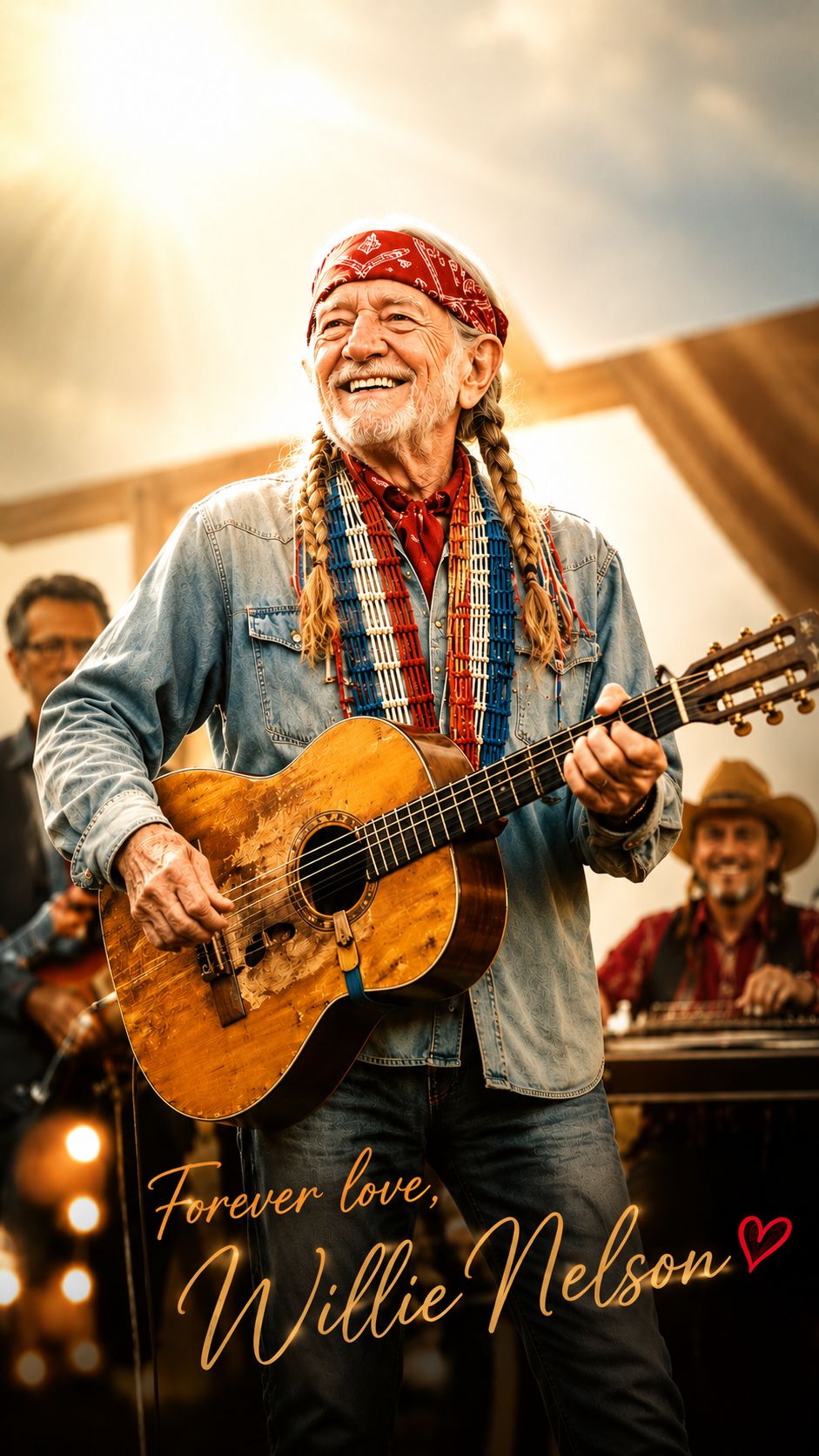
Some artists become stars. A few become legends. But once in a generation, a musician emerges who changes the very language of music itself. That man is Willie Nelson.
To many, he is instantly recognizable: the weathered face, the braided hair, the ever-present bandana, and the battered acoustic guitar known as Trigger. These symbols have become cultural landmarks, as iconic as the music he created. Yet behind those familiar images lies something far more remarkable—a brilliant creative mind that quietly transformed the course of Country Music, challenged industry conventions, and helped redefine what it meant to be an American songwriter.
For more than six decades, Willie Nelson has stood at the crossroads of tradition and rebellion. He refused to follow the rules of Nashville when everyone expected him to. He wrote songs that felt less like commercial products and more like personal confessions. He blurred the boundaries between Country, Folk, Western Swing, Jazz, and even Rock, creating a sound that was uniquely his own.
The story of Trigger and the bandana is not merely a tale of image or branding. It is the story of artistic freedom, creative courage, and an unwavering commitment to authenticity. It is the story of a man whose genius changed American music forever—and whose influence continues to echo through every generation that followed.
The Guitar Called Trigger: More Than an Instrument
Few instruments in music history have achieved the mythical status of Trigger.
Purchased in 1969 after Nelson’s previous guitar was damaged, the Martin N-20 classical guitar would become his lifelong companion. Named after the horse ridden by the legendary cowboy Roy Rogers, Trigger was never treated as a replaceable tool. Instead, it became an extension of Nelson himself.
Over decades of performances, the guitar developed a massive hole near its soundboard, worn away by constant playing. Most musicians would have retired such an instrument years ago. Willie Nelson refused.
Why?
Because Trigger carried something no new guitar could offer: history.
Every scratch represented a concert. Every mark represented a song. Every imperfection represented a life lived through music.
“The wear on Trigger isn’t damage. It’s a map of a lifetime.”
The guitar became a powerful symbol of Nelson’s philosophy. Perfection was never the goal. Truth was.
That mindset would define his entire career.
The Bandana That Became a Flag of Rebellion
Just as recognizable as Trigger is the red bandana that became part of Nelson’s identity.
At first glance, it appears simple—a practical accessory for a touring musician. Yet culturally, it evolved into something much bigger.
During the polished and highly controlled era of Nashville Country Music in the late 1960s and early 1970s, artists were expected to look clean-cut and predictable. Suits, carefully styled hair, and industry-approved images dominated the landscape.
Then came Willie Nelson.
With long hair, a beard, casual clothing, and a bandana, he represented the exact opposite of what the industry wanted.
His appearance wasn’t a marketing strategy. It was a declaration of independence.
The bandana became a visual statement that said:
“I will make music on my terms.”
That attitude helped launch an entire movement.
The Architect of the Outlaw Country Revolution
Long before he became a superstar performer, Willie Nelson was already one of America’s greatest songwriters.
He penned classics such as “Crazy”, famously recorded by Patsy Cline, as well as “Night Life” and “Funny How Time Slips Away.”
Yet despite his songwriting success, Nelson struggled to fit into the Nashville system.
The industry preferred highly orchestrated productions and strict commercial formulas. Nelson envisioned something different—music with space, emotion, and artistic freedom.
His breakthrough came with the rise of Outlaw Country.
Alongside artists such as Waylon Jennings, Kris Kristofferson, and Johnny Cash, Nelson helped create a movement that challenged Nashville’s control over creative decisions.
Instead of following corporate expectations, these artists insisted on recording music their own way.
The result was revolutionary.
Albums such as “Red Headed Stranger” demonstrated that minimalist storytelling could be more powerful than elaborate production.
The success of Outlaw Country fundamentally changed the music business by proving that artists could thrive outside traditional industry structures.
A Songwriter Unlike Any Other
What separated Willie Nelson from many of his contemporaries was his extraordinary understanding of melody and language.
His songwriting rarely relied on complexity.
Instead, he mastered emotional precision.
Listen closely to “Blue Eyes Crying in the Rain”, “Always on My Mind”, or “Angel Flying Too Close to the Ground.”
The lyrics feel conversational.
The melodies feel effortless.
Yet beneath that simplicity lies remarkable craftsmanship.
Nelson understood something many songwriters never learn:
The most powerful songs often sound inevitable.
His compositions created emotional universes using only a handful of carefully chosen words.
Great songwriting doesn’t impress the listener. It reaches them.
This ability transformed him from a country singer into one of America’s greatest musical storytellers.
Blending Genres Before It Was Popular
Modern artists are celebrated for crossing genres, but Willie Nelson was doing it decades earlier.
His music incorporated elements of Country, Western Swing, Folk, Blues, Jazz, and Rock without sounding forced.
In fact, many of his phrasing techniques came directly from jazz musicians.
Unlike conventional country singers who followed strict vocal rhythms, Nelson often sang behind or ahead of the beat, creating a conversational flow that felt spontaneous and intimate.
This approach gave his recordings a unique emotional texture.
It also expanded the possibilities of what Country Music could become.
Many contemporary artists who blur genre boundaries owe a creative debt to Nelson’s pioneering vision.
The Human Being Behind the Legend
Part of Nelson’s enduring appeal comes from his humanity.
He never presented himself as perfect.
He openly acknowledged mistakes, struggles, and personal flaws.
Rather than weakening his image, this honesty strengthened it.
Fans connected with him because he felt real.
In an era increasingly dominated by carefully managed celebrity personas, Willie Nelson remained refreshingly authentic.
That authenticity became one of his greatest artistic assets.
People trusted him.
When he sang about heartbreak, they believed him.
When he sang about freedom, they felt it.
When he sang about life itself, they heard their own stories reflected back at them.
The Lasting Legacy
Today, Willie Nelson stands as one of the most influential figures in the history of American music.
His impact extends far beyond Country Music.
He helped reshape artist independence.
He expanded genre boundaries.
He elevated songwriting to an art form of profound emotional depth.
Most importantly, he proved that authenticity can outlast trends.
The worn guitar called Trigger and the famous bandana endure because they symbolize something larger than celebrity. They represent artistic integrity.
They remind us that true greatness rarely comes from fitting in.
It comes from having the courage to be different.
Long after trends fade and charts are forgotten, the artists who tell the truth remain.
And that is why the story of Willie Nelson is not simply the story of a country star.
It is the story of a visionary whose brilliant mind changed American music forever.