 By admin
 INTRODUCTION:
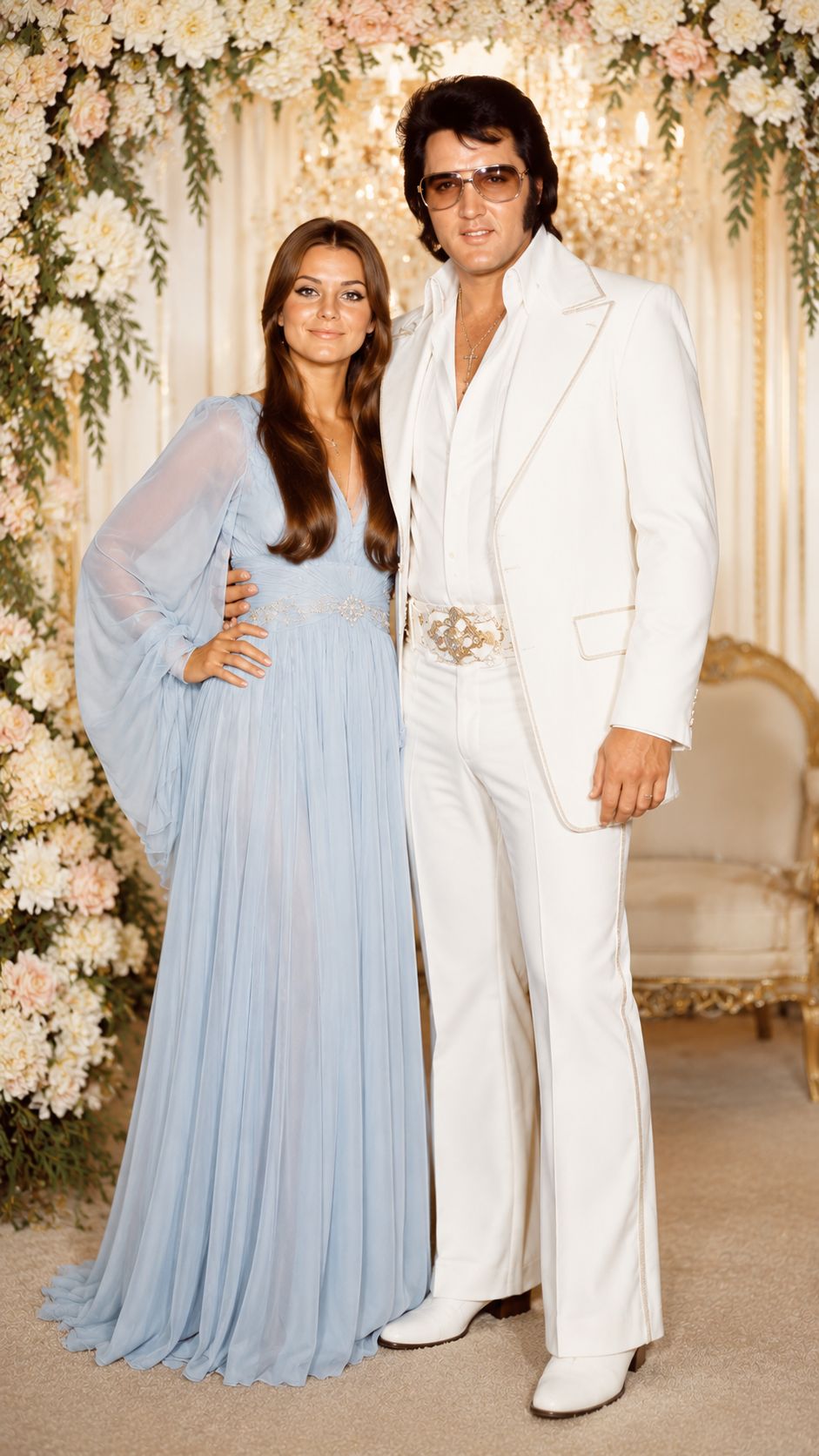
Few love stories in the history of popular culture have been romanticized as intensely as the relationship between Priscilla Presley and Elvis Presley. To generations of fans, they represented a dream: the beautiful young bride and the undisputed King of Rock and Roll, living inside the gates of Graceland like royalty in a modern American fairytale.
But beneath the photographs, the magazine covers, and the carefully crafted public image existed a far more complicated reality.
Their story was not simply a romance. It was a story about power, fame, control, loneliness, and emotional dependence. It was a relationship born under circumstances that would ignite controversy in any era, yet somehow became normalized because of the extraordinary celebrity surrounding Elvis Presley. What many fans once viewed as glamorous now appears deeply unsettling when examined through a modern lens.
The tragedy of their relationship is that genuine affection likely existed between them. Priscilla Presley often spoke of loving Elvis, while those close to the couple described moments of tenderness and devotion. Yet love alone was never enough to overcome the enormous imbalance that defined their world.
Decades after their divorce, their relationship continues to fascinate audiences because it forces us to confront an uncomfortable truth: some of history’s most celebrated romances were also deeply troubled. And perhaps no story illustrates that contradiction more vividly than the haunting saga of Priscilla and Elvis.
The Beginning That Still Raises Questions
The story began in 1959 when Elvis Presley, then one of the most famous entertainers on Earth, was serving in the U.S. Army in Germany. There he met Priscilla Beaulieu, a young American girl living with her military family.
The age difference has become one of the most debated aspects of their relationship. While Elvis was already a global superstar in his twenties, Priscilla was still in her early teens.
Today, this reality often shocks audiences.
What makes the story particularly disturbing is not simply the age gap itself, but the enormous power imbalance surrounding it. Elvis Presley possessed wealth, influence, fame, and an almost mythical status. Priscilla entered his orbit as an impressionable teenager encountering one of the most desired men in the world.
She wasn’t just meeting a celebrity. She was entering a universe completely controlled by him.
Over time, she became increasingly integrated into the world of Elvis Presley, eventually moving to Graceland under arrangements approved by her parents. What appeared to outsiders as a dream opportunity would later reveal a much darker emotional complexity.
The Creation of an Ideal Woman
One of the most troubling themes in Priscilla Presley’s recollections involves the extent to which Elvis allegedly shaped nearly every aspect of her appearance and identity.
From clothing choices to hairstyles, makeup, and personal presentation, Priscilla often described a relationship in which she was expected to conform to Elvis’s ideal vision of femininity.
Many biographers have argued that he wasn’t simply in love with Priscilla as an individual.
He was creating a version of her.
This distinction matters.
Healthy relationships typically allow both partners to grow into themselves. In contrast, numerous accounts suggest that Priscilla spent years becoming the person Elvis wanted her to be.
The deeper she entered his world, the more difficult it became to discover where Elvis’s expectations ended and her authentic identity began.
This dynamic transformed what many fans viewed as romance into something closer to emotional molding.
Fame as a Prison
The mythology surrounding Graceland often focuses on luxury and glamour. Yet many accounts describe it as a surprisingly isolating environment.
While millions of fans dreamed of being close to Elvis Presley, those who actually lived within his inner circle often encountered a world governed by his routines, moods, and insecurities.
Priscilla Presley frequently found herself waiting.
Waiting for attention.
Waiting for affection.
Waiting for Elvis to return from movie shoots, tours, recording sessions, or nights spent with his entourage.
Ironically, the very fame that attracted people to Elvis also made authentic intimacy difficult.
The pressures of being the biggest star in Rock and Roll created emotional barriers that neither partner seemed capable of overcoming.
As Elvis’s fame grew, so did the distance between the fantasy and reality of their marriage.
The Infidelity and Emotional Distance
Another painful aspect of their relationship involved repeated reports of infidelity.
Throughout his career, Elvis Presley was surrounded by admirers, actresses, models, and fans. Stories of romantic encounters followed him almost everywhere he went.
For Priscilla, this created a painful contradiction.
She was expected to embody loyalty and devotion while living with a husband whose lifestyle often seemed incompatible with monogamy.
Many historians and biographers have noted that emotional intimacy appeared increasingly absent from the marriage.
Even more troubling were accounts suggesting that Elvis struggled with viewing women simultaneously as romantic partners and idealized figures.
Some researchers have argued that once relationships became deeply domestic, his attraction often diminished. Whether fully accurate or not, this interpretation appears repeatedly throughout discussions of his personal life.
The woman he dreamed about and the woman he lived with often seemed unable to coexist in his mind.
For Priscilla, this emotional distance became increasingly difficult to endure.
The Shadow of Prescription Drug Dependency
No analysis of Elvis Presley’s later life can ignore the devastating impact of prescription drug dependency.
By the late 1960s and 1970s, the pressures of superstardom, relentless touring, insomnia, and personal struggles were taking a visible toll.
His health deteriorated.
His emotional stability fluctuated.
His relationships suffered.
The marriage between Elvis and Priscilla existed within this larger crisis.
As his dependence on medication intensified, many aspects of family life became increasingly unstable. The glamorous image projected to the public concealed a household struggling beneath the weight of addiction, exhaustion, and emotional disconnection.
What fans saw on stage during performances of classics like “Can’t Help Falling in Love”, “Love Me Tender”, and “Suspicious Minds” was often very different from what existed behind closed doors.
Why Priscilla Finally Walked Away
When Priscilla Presley ultimately left the marriage, many observers viewed it as shocking.
After all, she was leaving Elvis Presley.
But from another perspective, her departure represented an act of self-discovery.
For years, she had lived within an identity largely defined by someone else’s expectations. Leaving forced her to confront a difficult question:
Who was she without Elvis?
The answer required courage.
Divorcing the most famous man in music history meant stepping away from unimaginable privilege and global fascination. Yet it also meant reclaiming autonomy.
Their divorce in 1973 was notably more respectful than many celebrity breakups. Both maintained affection for one another, and both remained connected through their daughter, Lisa Marie Presley.
That lingering affection is what makes their story so tragic.
Neither person appears to have been a simple villain.
Neither was entirely innocent.
Instead, they became trapped inside a relationship shaped by fame, power, fantasy, and emotional needs that neither could fully satisfy.
The Legacy of a Troubling Love Story
Today, cultural attitudes have changed dramatically. Modern audiences often view the relationship through a more critical lens, questioning dynamics that previous generations overlooked.
Yet reducing the story to a simple narrative of victim and perpetrator misses its deeper complexity.
The relationship between Priscilla Presley and Elvis Presley reveals how celebrity can distort human connections. It shows how power can quietly reshape intimacy. It demonstrates how love can coexist with control, affection with dysfunction, and devotion with profound unhappiness.
Most importantly, it reminds us that glamorous public images often conceal painful private realities.
Behind the gates of Graceland stood one of the most famous couples in music history. But behind the legend was a young woman searching for herself and a global icon struggling to escape the prison of his own fame.
That tension between fantasy and reality is why the story of Priscilla and Elvis continues to captivate audiences decades later. It is not merely a romance from the golden age of Rock and Roll. It is a cautionary tale about power, identity, and the hidden cost of living inside someone else’s dream.