 By admin
 INTRODUCTION:
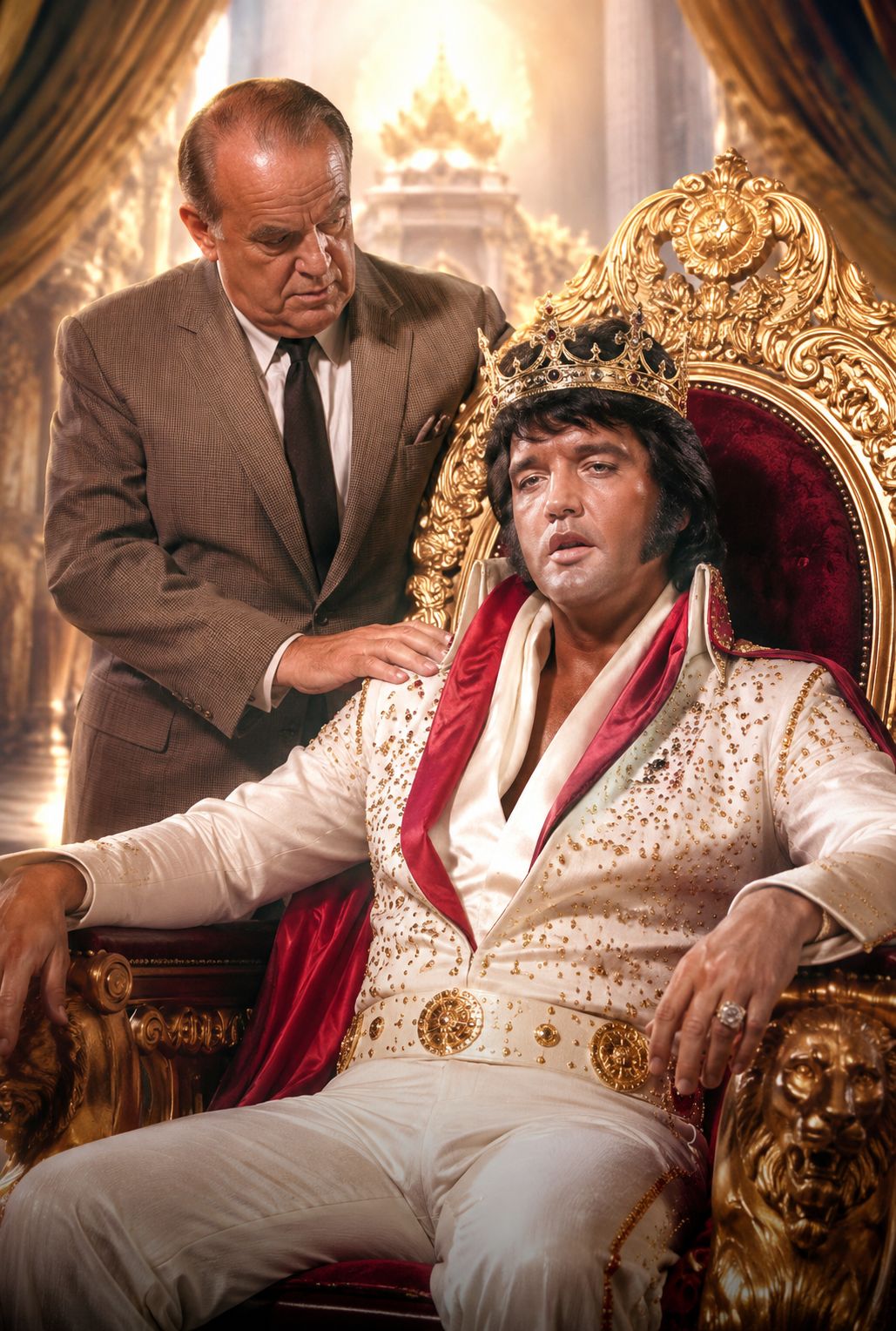
There are few stories in music history more tragic than that of Elvis Presley, the poor Southern boy who rose from obscurity to become the undisputed King of Rock and Roll. To millions of fans, Elvis seemed to have everything—wealth, fame, adoration, and a throne no performer could ever challenge.
But behind the glittering jumpsuits, sold-out arenas, and screaming fans lurked a darker truth.
A truth that many historians, biographers, and insiders still debate today.
The man who built Elvis Presley may also have been the man who slowly destroyed him.
That man was Colonel Tom Parker.
For decades, Parker was presented as the mastermind who transformed a truck-driving singer from Memphis into the most famous entertainer on Earth. Yet the deeper one looks into their relationship, the more unsettling the picture becomes.
Was Parker a genius manager?
Or was he a puppet master who kept the King trapped inside a golden cage?
The Day Elvis Found His Keeper
When Elvis first met Tom Parker in the mid-1950s, he was a young artist with limitless potential. His raw talent was undeniable. His voice blended gospel, blues, country, and rock in a way nobody had ever heard before.
Parker immediately recognized something valuable.
Not Elvis the artist.
Elvis the product.
The manager understood that America wasn’t simply buying songs—they were buying a phenomenon.
And Parker intended to control every part of it.
At first, his influence seemed beneficial. He secured lucrative deals, negotiated television appearances, and helped elevate Elvis from regional sensation to national superstar.
But with every contract signed, Parker tightened his grip.
Soon, Elvis wasn’t just represented by Parker.
He depended on him.
The Manager Who Took More Than Anyone Else
One of the most shocking aspects of their partnership was Parker’s financial arrangement.
Most managers in the music industry earned around 10% to 15%.
Tom Parker demanded far more.
In some deals, he reportedly took as much as 50%.
Think about that.
Half.
Half of the money generated by the biggest entertainer in the world.
While Elvis performed night after night, Parker’s fortune grew alongside him.
And because Parker controlled so many aspects of Elvis’s business affairs, very few people dared challenge the arrangement.
The King of Rock and Roll was becoming one of the richest stars alive.
But many believe someone else was getting rich right beside him.
The Secret That Changed Everything
The darkest chapter of Parker’s influence may have stemmed from a secret he desperately wanted to keep hidden.
Tom Parker wasn’t actually Colonel Parker.
In fact, he wasn’t even American.
Years later, investigations revealed that Parker had been born in the Netherlands and had likely entered the United States illegally.
He spent much of his life concealing his true identity.
That secret would eventually have devastating consequences for Elvis.
Because Parker feared international travel.
If he left the United States, there was a risk that immigration authorities could scrutinize his background.
And if Parker couldn’t travel internationally…
Neither could Elvis.
The World Tour That Never Happened
Imagine being the most famous performer on Earth and never truly touring the world.
While artists today perform across continents, Elvis remained largely confined to America.
Fans in Europe, Asia, Australia, and countless other countries dreamed of seeing him live.
Many opportunities emerged.
Promoters offered enormous sums.
International demand was overwhelming.
Yet somehow, the tours never happened.
Official explanations varied, but many observers later concluded that Parker’s personal fears played a major role.
Instead of allowing Elvis to conquer the globe, Parker kept him close.
Safe.
Controlled.
Profitable.
The result was one of the greatest missed opportunities in entertainment history.
“The world wanted Elvis. But the world never got him.”
Many historians believe Elvis himself understood this frustration.
As the years passed, he increasingly realized how much of his career had been shaped by someone else’s decisions.
Hollywood’s Golden Prison
Parker’s control extended beyond touring.
It reached Hollywood.
Throughout the 1960s, Elvis starred in movie after movie.
Some were successful.
Many were forgettable.
Critics often mocked them.
Even devoted fans admitted that the films frequently recycled the same formula—beautiful beaches, predictable plots, catchy songs, and little artistic growth.
Why?
Because Parker prioritized quantity over quality.
The movies generated money.
They generated merchandise.
They kept the Elvis brand alive.
Whether they fulfilled Elvis creatively was another matter entirely.
The young rebel who had once shocked America with his originality was becoming trapped inside repetitive projects he didn’t even enjoy.
Friends later described a man growing increasingly frustrated with his own career.
A superstar who felt powerless.
A legend who couldn’t escape his own image.
The Comeback That Changed Everything
In 1968, Elvis finally fought back.
The famous NBC Comeback Special became a turning point.
Gone were the silly movie characters.
Gone were the formulaic scripts.
For the first time in years, audiences saw the real Elvis again.
Dressed in black leather.
Passionate.
Dangerous.
Alive.
The special reignited his career and reminded the world why he had become a cultural earthquake in the first place.
Many believed it marked the beginning of a new chapter.
Perhaps Elvis would finally take control.
Perhaps he would break free.
But Parker had other plans.
Las Vegas: Success or Captivity?
After the comeback, Parker steered Elvis toward an extended Las Vegas residency.
Initially, it seemed brilliant.
The performances sold out.
The money poured in.
Fans flocked to Nevada.
Yet over time, the residency became relentless.
Night after night.
Month after month.
Year after year.
The schedule was exhausting.
The pressure never stopped.
Elvis became a prisoner of his own success.
Instead of exploring new creative directions, he found himself repeating the same routines for demanding audiences.
The glittering stages concealed a painful reality.
Behind the curtain stood a man growing physically and emotionally exhausted.
“The King was still wearing the crown, but the crown had become unbearably heavy.”
The Cost of Control
As the 1970s progressed, Elvis’s health deteriorated.
Prescription medications became a growing issue.
Stress mounted.
Relationships suffered.
His marriage to Priscilla ended.
His confidence fluctuated.
And while many factors contributed to his decline, critics continue to question Parker’s role.
Could a different manager have encouraged rest?
Could someone else have pushed for international tours?
Could another advisor have prioritized Elvis’s health over relentless performances?
Those questions still haunt fans today.
Because the tragedy of Elvis Presley isn’t simply that he died at 42.
It’s that so many people believe he never fully experienced the freedom his success should have provided.
The Legacy of a Complicated Relationship
History rarely offers simple villains.
Tom Parker undoubtedly helped create Elvis Presley the superstar.
Without Parker, the King’s rise may never have happened.
But the relationship carried a painful contradiction.
The same man who opened the door to greatness may have locked it behind him.
Parker saw Elvis as a phenomenon.
A business empire.
A brand.
But sometimes he failed to see the human being underneath.
The young dreamer from Tupelo.
The singer who loved gospel music.
The artist who wanted to grow.
The man who longed for freedom.
And that may be the greatest tragedy of all.
Because when Elvis Presley died in August 1977, the world mourned the loss of a legend.
Yet many couldn’t shake one haunting thought.
What might the King have become if he had ever truly ruled his own kingdom?
More than four decades later, that question still echoes through music history.
The crown made Elvis immortal.
But the man who placed it on his head may also have ensured he could never escape its weight.
VIDEO: