 By admin
 INTRODUCTION:
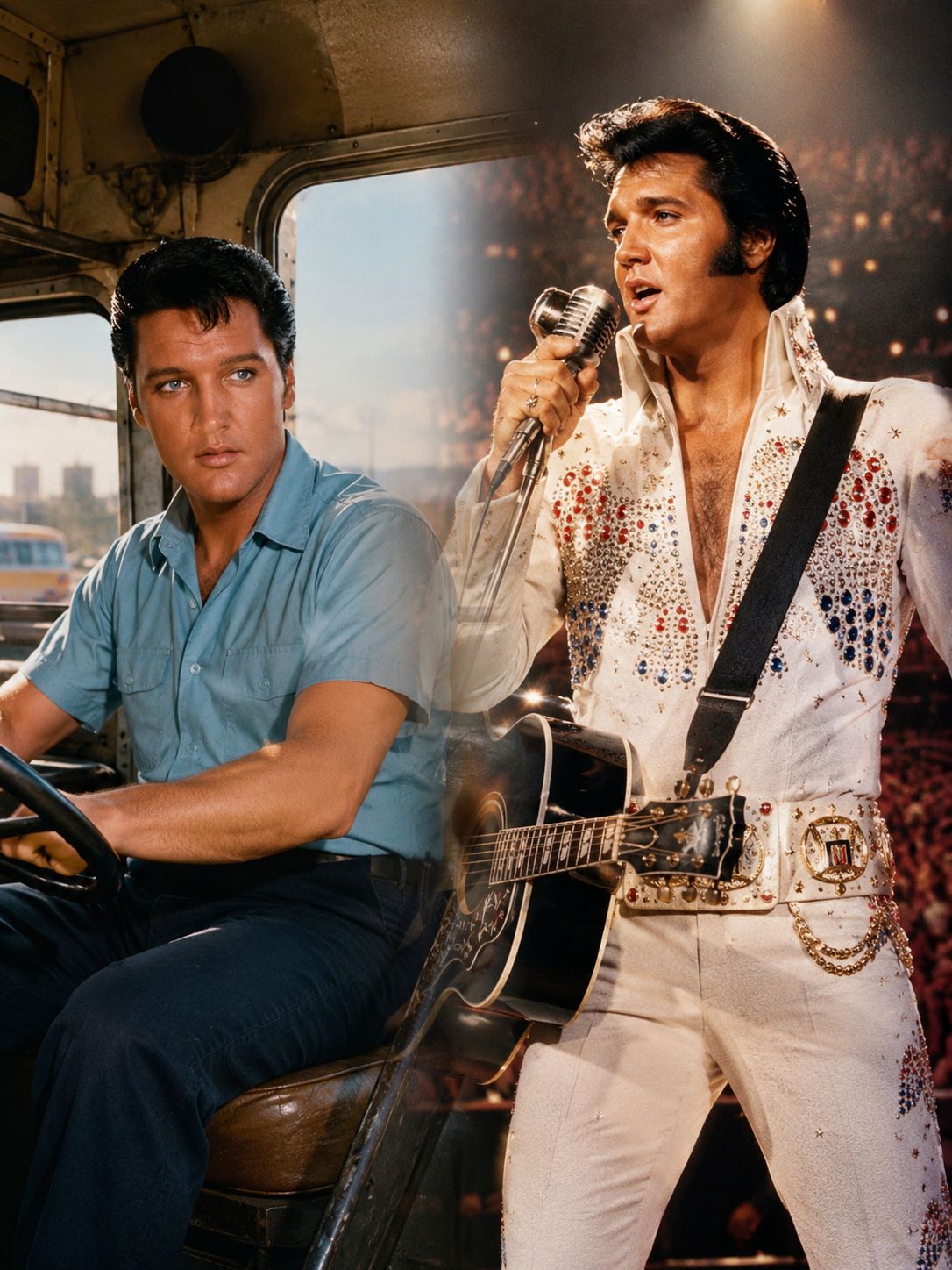
There are moments in history when a single voice changes everything.
Not a politician.
Not a king.
Not a billionaire.
Just a teenager with a dream, a guitar, and the courage to sound different.
Long before the sold-out stadiums, the screaming fans, and the gold records, he was simply a poor young man trying to survive. He drove trucks for $1.25 an hour, lived in a working-class neighborhood, and carried ambitions that seemed far larger than his circumstances.
Nobody could have imagined that this shy teenager would one day become one of the most influential figures in modern culture.
That teenager was Elvis Presley.
And his journey from poverty to worldwide fame would do more than create a superstar—it would permanently challenge one of America’s deepest social divisions.
The Boy From Tupelo
The story begins in a tiny house in Tupelo, Mississippi.
Elvis Aaron Presley was born into a family that knew hardship intimately. Money was scarce. Opportunities were limited. Success seemed like something reserved for other people.
Yet from an early age, Elvis found refuge in music.
He listened everywhere.
Church hymns.
Country music broadcasts.
Blues records.
Gospel quartets.
The sounds of America blended together in his imagination long before anyone else believed they should.
What made this remarkable was the era in which he grew up.
The American South of the 1940s and early 1950s was heavily segregated. Music, like much of society, was often divided along racial lines. Record labels categorized songs by race. Radio stations targeted separate audiences.
But music itself refused to obey those rules.
And neither did Elvis.
The Outsider Nobody Understood
When the Presley family moved to Memphis, Tennessee, Elvis found himself caught between worlds.
He didn’t look like the traditional country stars.
He didn’t sound like the established crooners dominating the charts.
He dressed differently.
He acted differently.
Even his classmates thought he was strange.
Many teenagers spend their lives trying to fit in.
Elvis spent his trying to express who he really was.
That decision would eventually change history.
Years later, people would remember his confidence. What they often forget is how much rejection came first.
Before fame arrived, Elvis was frequently told he wasn’t good enough.
He auditioned.
He failed.
He performed.
People laughed.
He dreamed.
Others doubted.
Yet somehow he kept going.
A Truck Driver With A Secret Dream
After high school, Elvis worked various jobs before becoming a truck driver.
The pay wasn’t glamorous.
At roughly $1.25 an hour, he spent long days delivering supplies and wondering whether music would ever become more than a fantasy.
Imagine him sitting behind the wheel.
No private jet.
No mansion.
No Graceland.
Just another young worker trying to make ends meet.
The distance between that truck and global superstardom seemed impossible to cross.
Yet destiny was quietly approaching.
In 1953, Elvis walked into Sun Studio in Memphis.
The visit seemed insignificant.
History would prove otherwise.
The Recording That Changed America
At Sun Studio, producer Sam Phillips had spent years searching for a performer capable of bridging musical worlds.
He admired Black artists and the incredible emotional power of rhythm and blues music. Yet the music industry remained deeply segregated.
Then Elvis arrived.
Something happened.
Nobody could fully explain it.
He sang country.
He sang blues.
He sang gospel.
He blended influences that many industry executives believed should remain separate.
The result felt fresh, exciting, and impossible to ignore.
“It wasn’t just a new sound. It was a new idea.”
That idea frightened some people.
It inspired millions more.
Breaking The Color Barrier
One of the most important aspects of Elvis’s story is often oversimplified.
He did not invent Black music.
He never claimed to.
His greatest musical influences came from artists and traditions that had existed long before his arrival.
What Elvis did was something different.
He became a bridge.
At a time when many Americans rarely crossed racial and cultural boundaries, his music introduced broader audiences to sounds they might never have otherwise encountered.
For some listeners, it was their first exposure to styles rooted in African American musical traditions.
For others, it was proof that music could unite people despite social divisions.
The cultural impact was enormous.
Not everyone celebrated it.
Many radio stations resisted.
Some television executives worried about his performances.
Certain critics viewed him as dangerous.
But every attempt to stop the movement only seemed to make it stronger.
The Rebel America Could Not Ignore
Elvis wasn’t controversial because he sang loudly.
He was controversial because he represented change.
His energetic performances shocked older generations.
His movements became national headlines.
Parents worried.
Teenagers cheered.
The divide was immediate.
Yet underneath the controversy was something deeper.
Young people saw freedom.
They saw authenticity.
They saw someone refusing to become what society expected him to be.
That spirit resonated far beyond music.
“Elvis gave an entire generation permission to be different.”
In many ways, that may be his greatest legacy.
From Memphis To The World
Success arrived with astonishing speed.
Hit records followed one after another.
Crowds grew larger.
Television appearances attracted millions.
Soon Elvis Presley was no longer merely a singer.
He was a cultural phenomenon.
His influence spread across continents.
Future legends watched closely.
Rock musicians.
Country artists.
Pop stars.
Even performers who sounded nothing like Elvis often cited him as an inspiration.
The reason was simple.
He proved that a person from humble beginnings could reshape an entire industry.
Every aspiring musician suddenly had a new blueprint.
Dream bigger.
Take risks.
Ignore the critics.
Keep going.
The Human Behind The Legend
The myth of Elvis eventually became so large that many people forgot there was a real person underneath.
A son.
A friend.
A dreamer.
A man who never completely lost touch with the struggles that shaped him.
Even after becoming one of the most recognizable faces on Earth, traces of the truck driver remained.
The uncertainty.
The vulnerability.
The desire to connect.
Perhaps that explains why audiences still relate to him decades later.
His story isn’t merely about fame.
It’s about possibility.
Why The Story Still Matters Today
More than half a century later, new generations continue discovering Elvis Presley.
Many are surprised to learn that before the gold records and sold-out arenas, he earned $1.25 an hour driving a truck.
They are even more surprised to learn how much resistance he faced.
The world often remembers success.
It rarely remembers the struggle that came first.
Yet that’s where the real inspiration lives.
The teenager who felt different.
The worker who dreamed bigger than his circumstances.
The performer who challenged expectations.
The young man who helped blur cultural lines through the universal language of music.
That story remains powerful because it reminds us of a timeless truth.
Great change rarely begins with the powerful.
It begins with ordinary people willing to be extraordinary.
And few examples illustrate that better than Elvis Presley.
From a truck driver earning $1.25 an hour to a global icon whose influence still echoes across generations, his journey became more than a personal success story.
It became a cultural revolution.
A revolution powered by courage, music, and the refusal to accept boundaries that others considered permanent.
And that is why the legend of Elvis Presley continues to endure—not simply because he became famous, but because he helped change what America believed was possible.
VIDEO: