 By admin
 INTRODUCTION:
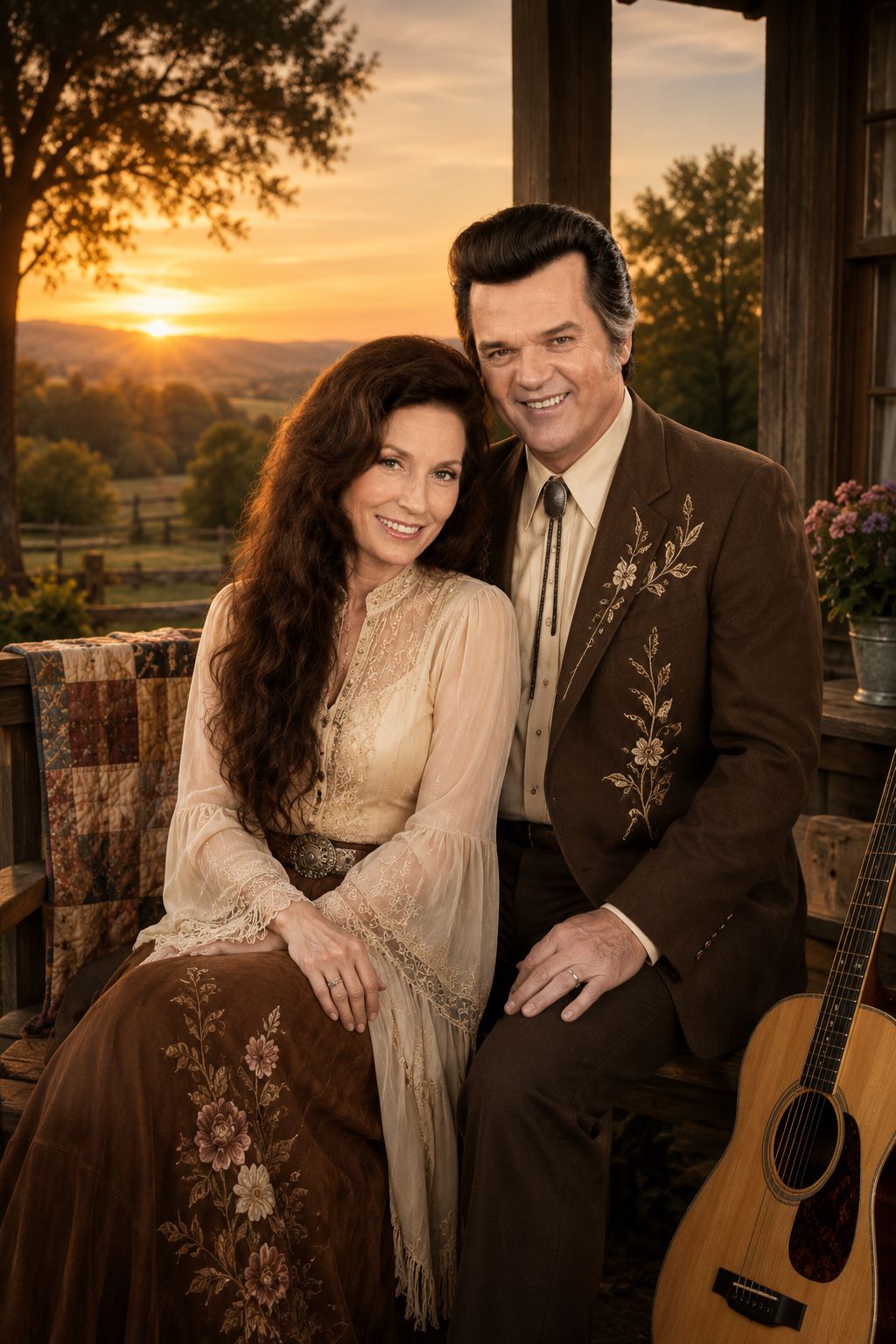
Country music has always thrived on stories. Stories of heartbreak. Stories of redemption. Stories of impossible love.
But perhaps no story in country music history has fascinated fans more than the relationship between Conway Twitty and Loretta Lynn.
For decades, audiences watched them stand shoulder to shoulder beneath stage lights, trading verses that felt less like performances and more like private confessions. Their chemistry was so convincing, so effortless, that millions became convinced they were more than duet partners.
Then came the statement that fueled generations of speculation.
“I love Conway.”
Those words, spoken by Loretta Lynn herself, sent fans into an emotional frenzy. Did the “Coal Miner’s Daughter” secretly harbor romantic feelings for her musical partner? Were the greatest duets in country history built upon an unspoken love story?
Or was the entire image simply one of the most brilliant pieces of marketing Nashville had ever created?
Nearly thirty years after Conway’s death, the question still lingers.
A Partnership Born at the Perfect Moment
By the late 1960s, both artists were already stars.
Loretta Lynn had become the fearless voice of working-class women. Her songs challenged convention while remaining deeply rooted in traditional country values.
Conway Twitty, meanwhile, had successfully reinvented himself from rock-and-roll singer to country superstar. With his velvet voice and undeniable stage presence, he possessed a charisma few performers could match.
When producer Owen Bradley suggested pairing them, nobody could have predicted what would happen next.
Their first major duet, “After the Fire Is Gone,” exploded.
The song wasn’t merely successful.
It felt real.
Listeners didn’t hear two singers reading lyrics. They heard two people living them.
Suddenly, country music had found its golden couple.
And America fell hopelessly in love.
The Chemistry Nobody Could Ignore
Watch old footage today and it’s easy to understand why rumors never died.
Conway gazed at Loretta with an intensity that seemed impossible to fake. Loretta often smiled at him with a warmth that felt deeply personal.
Their performances possessed something modern audiences rarely see:
authentic emotional connection.
“They didn’t sing to the audience. They sang to each other.”
Fans packed arenas hoping to witness something beyond music.
Night after night, Conway and Loretta delivered.
Songs like “As Soon As I Hang Up The Phone,” “Lead Me On,” and “Louisiana Woman, Mississippi Man” blurred the line between performance and reality.
People began asking the inevitable question:
Were they in love?
Loretta’s Famous Admission
Years later, Loretta openly acknowledged her deep affection for Conway.
She famously said:
“I loved Conway.”
Those words instantly reignited decades of speculation.
But context matters.
Loretta often clarified that her love for Conway was profound, genuine, and deeply emotional—but not romantic in the traditional sense.
She repeatedly emphasized that they respected each other’s marriages and families.
Still, fans struggled to accept that explanation.
How could two people create such extraordinary intimacy onstage without romantic feelings entering the picture?
The answer may reveal something powerful about both artists.
The Soulmate Theory
Perhaps Conway and Loretta represented a different kind of soulmate.
Not lovers.
Not secret partners.
Artistic soulmates.
Throughout history, some creative partnerships produce a magic that transcends ordinary relationships.
Think of great cinematic pairings, legendary songwriting teams, or iconic acting duos. Occasionally, two people simply unlock something extraordinary in one another.
That appears to have happened with Conway and Loretta.
Loretta herself often described Conway as one of the closest friends she ever had.
He understood timing instinctively. He knew exactly how to phrase a lyric, when to pull back, when to lean in, and when silence spoke louder than words.
Together, they created an emotional language uniquely their own.
“You don’t have to marry your soulmate to find one.”
For many fans, this explanation feels both comforting and heartbreaking.
Because it suggests that some of life’s deepest loves exist outside romance.
Or Was It Marketing Genius?
Skeptics argue something entirely different.
Nashville has always understood the power of storytelling.
And few stories sell records better than romance.
The music industry quickly realized audiences adored the idea of Conway and Loretta as star-crossed lovers. Promotional photos emphasized their closeness. Interviews often played into the chemistry without directly confirming or denying rumors.
Concert audiences kept growing.
Albums kept selling.
The speculation became part of the brand.
From a business perspective, it was brilliant.
Fans weren’t simply buying songs.
They were investing emotionally in a relationship.
Some industry insiders have long believed that both artists understood this perfectly and wisely allowed mystery to flourish.
After all, uncertainty can be commercially irresistible.
As long as nobody gave a definitive answer, audiences kept wondering.
And wondering kept people listening.
The Cost of the Rumors
Yet the constant speculation wasn’t always easy.
Both Conway and Loretta were married.
Rumors inevitably affected their families.
Loretta was famously devoted to her husband, Oliver “Doolittle” Lynn, despite their often turbulent marriage. Conway also maintained a strong commitment to his family life.
Repeatedly having to deny romantic involvement reportedly became exhausting.
Still, neither performer ever displayed bitterness toward fans.
They understood that audiences asked these questions because the music had touched them so deeply.
In many ways, the rumors represented the ultimate compliment.
People believed.
Completely.
Conway’s Death Changed Everything
When Conway Twitty unexpectedly died in 1993, Loretta lost more than a duet partner.
She lost someone who had shared countless miles, stages, laughs, and memories.
Friends say she grieved deeply.
In interviews after his death, Loretta frequently became emotional discussing him.
Her words carried unmistakable tenderness.
“There’ll never be another Conway.”
That statement wasn’t marketing.
It was grief.
Real grief.
And perhaps that’s where the answer to the soulmate dilemma ultimately lies.
Whether romantic or platonic, Conway occupied a unique place in Loretta’s heart.
No replacement ever emerged.
No subsequent duet partnership ever captured the same lightning.
The magic ended with Conway.
Why Fans Still Care Today
In an age dominated by carefully manufactured celebrity relationships and social media performances, Conway and Loretta represent something increasingly rare:
mystery.
No leaked text messages.
No tabloid confessions.
No tell-all documentaries revealing every private detail.
Just songs.
Chemistry.
And unanswered questions.
Perhaps fans continue debating because the story allows everyone to believe what they want.
Romantics see hidden love.
Realists see extraordinary friendship.
Industry veterans see masterful branding.
Maybe all three are correct.
Because human relationships rarely fit neatly into categories.
Love itself is complicated.
And the greatest country songs have always understood that.
So, was Conway Twitty truly Loretta Lynn’s soulmate?
Only Loretta knew for certain.
But one thing remains undeniable:
Whatever existed between them changed country music forever.
And decades later, millions are still listening, still wondering, and still believing.
Some partnerships sell records.
Conway and Loretta created legend.
VIDEO:
https://youtu.be/ib6Fs6w_Vfk?si=NHNywfKatzcElb-n