 By admin
 INTRODUCTION:
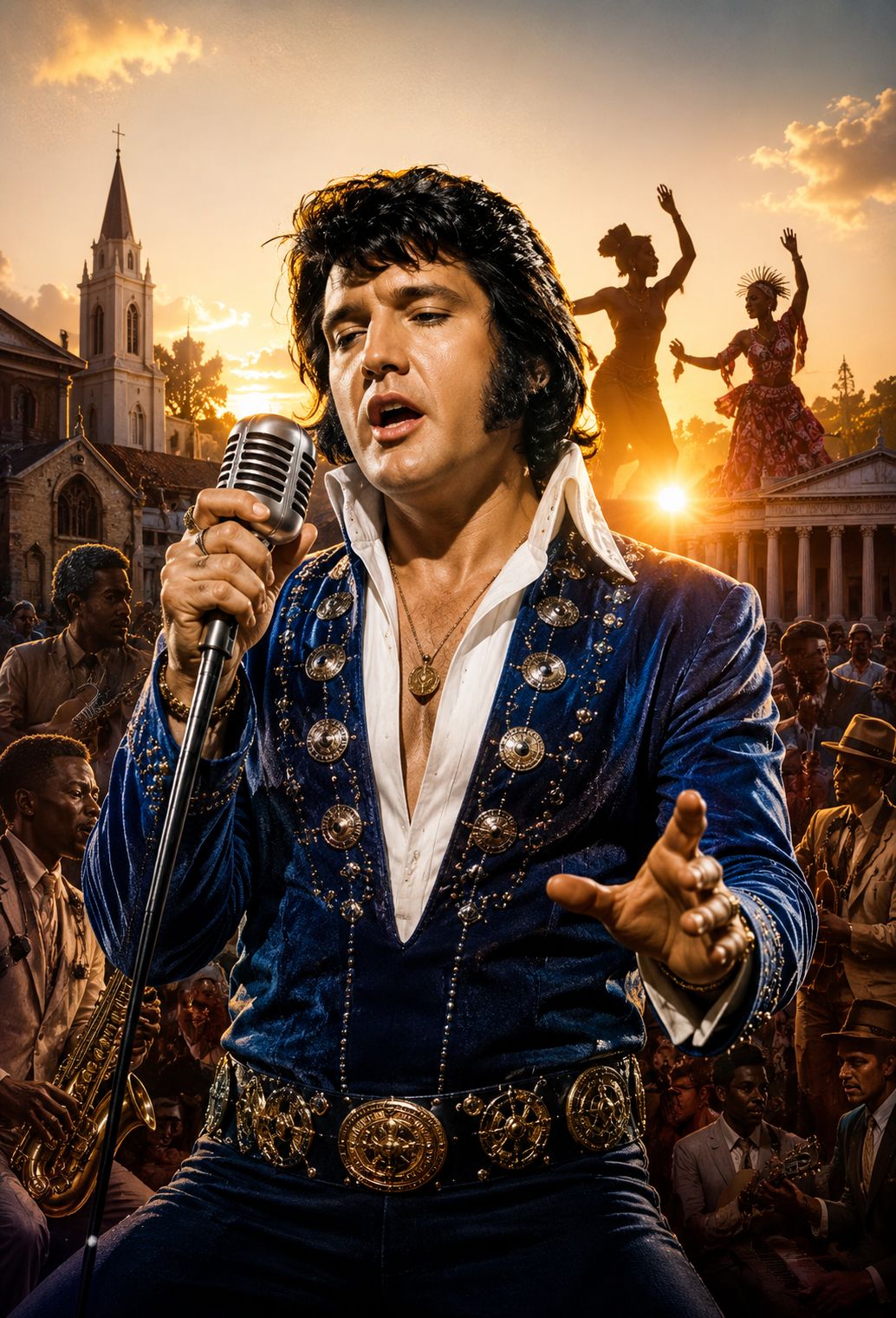
There may never be another figure in American music as beloved—or as controversial—as Elvis Presley.
To millions, he remains The King of Rock and Roll, the young man from Mississippi whose voice, charisma, and electrifying performances changed popular music forever. His records still sell. His image still dominates merchandise, documentaries, and social media decades after his death. Even in 2026, new generations continue discovering his music.
But beneath the glittering jumpsuits, screaming fans, and legendary performances lies a question that has haunted Elvis’s legacy for more than seventy years:
Was Elvis Presley a cultural genius who united America through music—or was he a musical thief who became rich and famous by borrowing from Black artists who never received the same recognition?
The debate is not merely academic.
It touches race, history, inequality, and the very foundation of American popular music.
And depending on whom you ask, Elvis is either one of history’s greatest cultural bridge-builders—or one of its most visible examples of cultural appropriation.
The truth, as always, is far more complicated.
The Sound That Shocked America
In the mid-1950s, America was still deeply segregated.
Radio stations were often divided by race. Black musicians frequently performed for Black audiences, while white performers dominated mainstream television and major record sales.
Then came a young truck driver from Tupelo.
When Elvis walked into Sun Records in Memphis, producer Sam Phillips immediately recognized something extraordinary. Here was a white Southern singer who sounded unlike any white performer on the radio.
His voice carried unmistakable influences from Black gospel, blues, and rhythm-and-blues traditions.
Songs like “That’s All Right,” “Hound Dog,” and “Mystery Train” exploded onto the airwaves.
Many listeners reportedly assumed Elvis was Black the first time they heard him.
And that was precisely what made him revolutionary.
“If I could find a white man who had the Negro sound and the Negro feel, I could make a billion dollars.” — Sam Phillips
Those words remain among the most controversial quotes in music history.
Because they reveal an uncomfortable truth:
America was eager to embrace Black musical styles—but often only when delivered by a white face.
The Shadow Behind the Hits
Perhaps no song symbolizes this controversy more than “Hound Dog.”
Today, many people automatically associate the song with Elvis.
Yet the original recording belonged to blues legend Big Mama Thornton, whose powerful 1952 version carried a raw emotional intensity very different from Elvis’s later interpretation.
Thornton’s recording was a major R&B success.
But Elvis’s 1956 version became a worldwide phenomenon.
Suddenly, millions knew “Hound Dog.”
Few knew Big Mama Thornton.
For critics, this pattern repeated throughout Elvis’s career.
Songs rooted in Black musical traditions often reached vastly larger audiences once performed by Presley.
The disparity reflected broader inequalities within the entertainment industry.
Black artists frequently faced restricted radio exposure, limited television appearances, and systemic discrimination.
As a result, many historians argue that Elvis benefited from a system already stacked in his favor.
“Elvis did not invent rock and roll. Black artists laid the foundation long before he arrived.”
This criticism continues to resonate today.
The Artists Elvis Admired
Yet reducing Elvis to a simple “thief” ignores enormous parts of the story.
Unlike some performers who concealed their influences, Elvis openly discussed them.
He repeatedly acknowledged the impact of Black musicians on his life and artistry.
Growing up in Memphis, Elvis spent countless hours listening to gospel quartets, attending all-night church services, and absorbing blues music from Beale Street.
He admired artists such as B.B. King, Arthur Crudup, Sister Rosetta Tharpe, and Fats Domino.
B.B. King himself recalled seeing Elvis around Memphis long before fame arrived.
The two later developed mutual respect.
Many Black musicians who personally knew Elvis rejected accusations that he was racist or intentionally exploitative.
Fats Domino once remarked that people had long been performing rock and roll before Elvis, but acknowledged that Presley helped bring the sound to mainstream audiences.
Even Little Richard—whose relationship with Elvis was complicated—recognized that Elvis possessed extraordinary talent.
The crucial distinction, supporters argue, is this:
Elvis did not steal music in secret.
He absorbed influences exactly as musicians have done throughout history.
Country borrowed from blues.
Blues borrowed from folk traditions.
Gospel shaped soul.
Jazz influenced rock.
Music has always evolved through exchange.
A Bridge Across America’s Deepest Divide
Perhaps Elvis’s greatest historical contribution was not invention.
It was translation.
At a time when racial barriers remained rigid, Elvis introduced millions of white Americans to sounds they might otherwise never have encountered.
Young white listeners who bought Elvis records often began exploring the artists who inspired him.
For many, Presley served as an unexpected gateway into blues, gospel, and rhythm-and-blues traditions.
That cultural exchange mattered.
Profoundly.
In an era of segregation, shared musical experiences quietly challenged social boundaries.
Parents frequently condemned Elvis precisely because his music sounded “too Black.”
His movements, vocal style, and energy frightened conservative America.
Ironically, the same critics who now accuse Elvis of appropriation often overlook the intense backlash he endured simply for embracing Black musical traditions publicly.
Elvis wasn’t merely crossing musical lines—he was crossing racial lines in 1950s America.
That was revolutionary.
The Question That Refuses to Die
So, was Elvis Presley a cultural genius?
Absolutely.
Few artists have ever transformed global culture so dramatically.
His stage presence redefined performance. His recordings reshaped popular music. His influence remains immeasurable.
Was he also a beneficiary of racial privilege?
Undeniably.
The America that elevated Elvis frequently denied equal opportunities to many Black pioneers whose innovations made rock and roll possible.
Both realities can exist simultaneously.
And perhaps that is why the debate remains so emotionally charged.
Because Elvis’s story mirrors America’s own complicated history.
A nation capable of extraordinary cultural fusion—and profound inequality.
The Real Legacy of The King
Maybe the greatest mistake is framing the conversation as either/or.
Either Elvis was a hero.
Or Elvis was a thief.
History rarely works that way.
Elvis Presley was an immensely gifted artist shaped by Black musical traditions, Southern culture, gospel spirituality, and the racial realities of twentieth-century America.
He neither created rock and roll alone nor simply stole it.
He amplified it.
Commercialized it.
Humanized it.
And in doing so, he changed the world.
The challenge for modern listeners is not to tear down Elvis.
It is to widen the spotlight.
Celebrate Elvis Presley—but also celebrate Big Mama Thornton, Sister Rosetta Tharpe, Chuck Berry, Arthur Crudup, Little Richard, and countless others whose brilliance built the foundation beneath The King’s throne.
Because the full story of American music has always belonged to all of them.
And perhaps that truth makes Elvis’s legacy not smaller—but infinitely richer.
VIDEO: