 By admin
 INTRODUCTION:
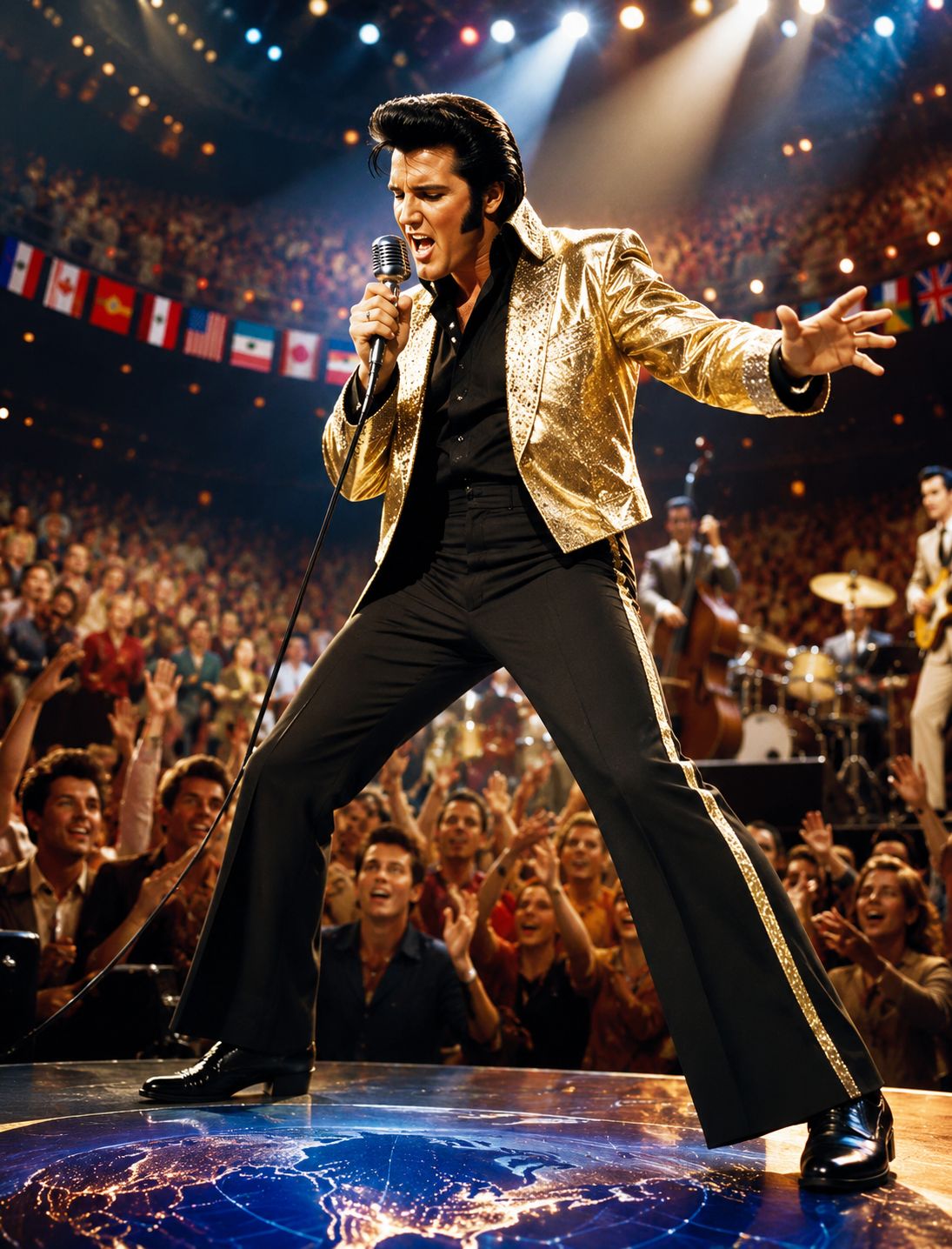
There are moments in history when the world changes quietly. And then there are moments when change explodes onto a stage wearing a rhinestone suit, shaking its hips, and singing with a voice that sounds like both heaven and rebellion.
That moment belonged to Elvis Presley.
Long before social media, streaming platforms, or viral videos, Elvis became something the world had never seen before: a cultural earthquake. He didn’t simply become famous. He transformed the very idea of what a global superstar could be.
But to understand how Elvis “stole” the stage and altered pop culture forever, we must return to a time when America—and much of the world—wasn’t ready for him.
A Young Man From Mississippi With an Impossible Dream
In the early 1950s, the music industry was neatly divided.
Country music belonged largely to rural white audiences. Rhythm and blues was marketed primarily to Black listeners. Pop music was polished, safe, and carefully controlled.
Then came a shy truck driver from Tupelo, Mississippi.
Elvis walked into Sun Studio in Memphis with little more than ambition and an extraordinary voice. What happened next would forever blur the lines between musical genres.
Producer Sam Phillips famously searched for a white performer who could capture the emotional intensity and soul of Black music while reaching mainstream audiences. Elvis unexpectedly became that bridge.
He absorbed influences from gospel churches, country radio, blues clubs, and Southern traditions. The result wasn’t imitation—it was fusion.
For perhaps the first time in modern popular music, millions of listeners heard country, blues, gospel, and rock collide in a single performance.
“Elvis didn’t just sing songs. He united musical worlds that had been kept apart.”
Songs like “That’s All Right,” “Heartbreak Hotel,” and “Hound Dog” shattered expectations. Young listeners had never heard anything quite like it.
Neither had their parents.
The Performances That Shocked America
If Elvis had simply possessed a remarkable voice, he might have become another successful singer.
Instead, he became a phenomenon.
His live performances electrified audiences.
Women screamed.
Teenagers fainted.
Parents panicked.
Television executives worried.
Elvis moved differently. He sang differently. He dressed differently. Most importantly, he represented a new kind of freedom.
When he appeared on national television during the 1950s, millions watched in disbelief.
His famous hip movements became so controversial that some broadcasts famously filmed him only from the waist up.
Critics called him dangerous.
Religious leaders condemned him.
Newspapers labeled him a corrupting influence.
But young people saw something else entirely.
They saw themselves.
“For an entire generation, Elvis wasn’t merely entertainment—he was permission to be different.”
In post-war America, where conformity was often expected, Elvis symbolized rebellion, individuality, and youthful energy.
That cultural shift would echo across decades.
How Elvis Redefined Celebrity
Before Elvis, singers were stars.
After Elvis, performers became icons.
Modern celebrity culture owes an enormous debt to Elvis Presley.
He understood something revolutionary: music was only one part of the experience.
Everything mattered.
The hairstyle.
The clothing.
The stage presence.
The attitude.
The mystique.
His pompadour hairstyle inspired millions. His fashion choices—from leather jackets to dazzling jumpsuits—became instantly recognizable around the globe.
Today, artists carefully construct visual identities. In the 1950s, Elvis had already mastered that art.
He wasn’t simply selling records.
He was selling a dream.
A lifestyle.
A persona.
Every global superstar who followed—from Michael Jackson to Madonna, from Prince to contemporary pop artists—operates in a world Elvis helped create.
From Memphis to the Entire Planet
Few artists have crossed international boundaries the way Elvis did.
His records traveled far beyond the United States.
Europe embraced him.
Asia embraced him.
Latin America embraced him.
Even in countries where listeners barely understood English, they understood Elvis.
Music historians often note that Elvis became one of America’s most powerful cultural exports during the twentieth century.
He represented possibility.
Modernity.
Freedom.
Excitement.
For millions living far from American shores, Elvis embodied a new cultural language.
His image appeared on posters, magazines, lunch boxes, television screens, and movie theaters worldwide.
He became, quite simply, global.
“Long before globalization became a buzzword, Elvis Presley had already become a citizen of the world.”
Hollywood, Fashion, and the Birth of Pop Culture as We Know It
Elvis did not limit himself to music.
He conquered Hollywood.
Beginning with films such as Love Me Tender, he quickly evolved into one of the era’s biggest box-office attractions.
His movies reached audiences who may never have attended a concert.
His style influenced fashion trends across continents.
Leather jackets surged in popularity.
Sideburns became fashionable.
Sequined stage costumes redefined performance wear.
Entire industries emerged around Elvis merchandise.
Today, celebrity branding generates billions of dollars annually.
Elvis pioneered much of that model decades earlier.
He demonstrated that a performer could dominate multiple entertainment industries simultaneously.
Singer.
Actor.
Fashion icon.
Brand.
Cultural symbol.
No blueprint existed.
Elvis created one.
The Critics, The Controversies, and The Complex Legacy
No honest examination of Elvis can ignore controversy.
For decades, scholars and critics have debated his relationship to Black musical traditions.
Some accused him of appropriating styles pioneered by African American artists.
Others argue that Elvis introduced wider audiences to musical forms that had previously been marginalized by mainstream institutions.
The truth remains complex.
Elvis himself repeatedly acknowledged the influence of Black musicians on his career and expressed admiration for artists whose music shaped him.
Yet his extraordinary success also reflected broader social realities and inequalities existing in America at the time.
History rarely offers simple heroes or villains.
What cannot be denied, however, is the transformative impact Elvis had on global music.
He changed what popular music sounded like.
He changed who listened.
He changed who could become a star.
Why The World Still Cannot Let Go
Nearly five decades after his death, Elvis remains astonishingly present.
New generations continue discovering his music.
Documentaries, films, books, tribute performances, and social media clips introduce him to audiences who were born decades after he passed away.
Why?
Because Elvis represented something timeless.
He embodied the dream that an ordinary person from humble beginnings could alter the world through talent, charisma, and relentless ambition.
He made audiences feel excitement.
Wonder.
Hope.
And perhaps most importantly, he reminded people that art can break barriers society insists are permanent.
“Elvis Presley didn’t simply steal the stage. He changed the stage itself.”
The modern entertainment landscape—with its superstar branding, genre fusion, global fandoms, and larger-than-life performers—still bears his fingerprints.
Every artist who dares to challenge conventions, merge musical traditions, or reinvent performance stands, in some small way, in the shadow of The King.
And that may be Elvis Presley’s greatest legacy of all.
He didn’t just change music.
He changed culture itself.
VIDEO: