 By admin
 INTRODUCTION:
There are voices that entertain us.
There are voices that comfort us.
And then there are voices that change us forever.
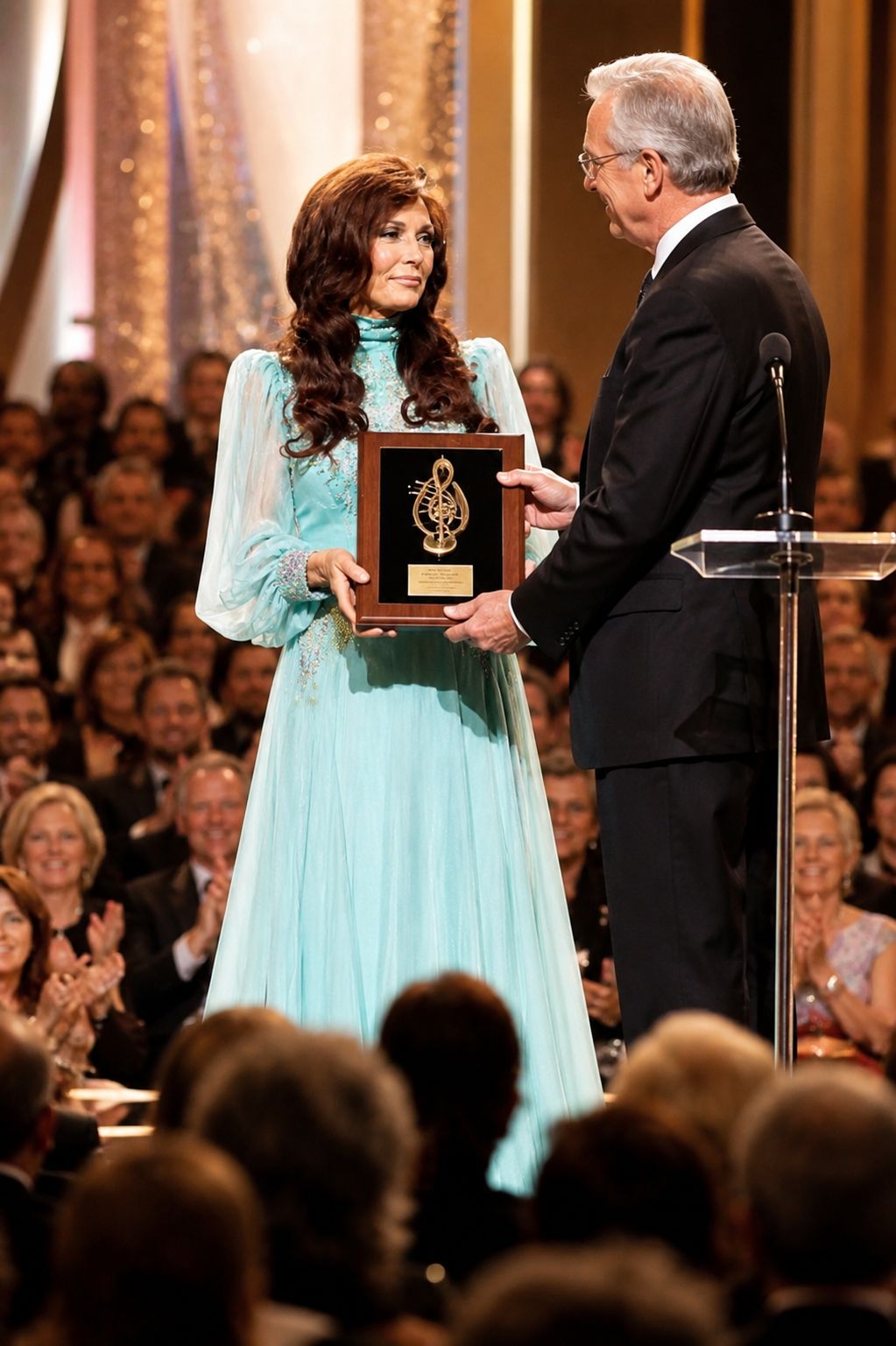
Few artists in the history of American music can claim the kind of cultural impact that Loretta Lynn achieved over a remarkable six-decade career. Eighteen years ago, when the legendary country icon was inducted into the Songwriters Hall of Fame, it wasn’t merely another trophy placed on an already crowded shelf. It was a long-overdue acknowledgment that one woman from the hills of Kentucky had fundamentally transformed the language of country music.
Today, as fans look back on that historic honor, the significance feels even greater.
Because Loretta Lynn did far more than write songs.
She gave millions of women permission to tell the truth.
From Butcher Hollow to Music Immortality
Long before awards, sold-out arenas, and platinum records, there was simply a young girl growing up in Butcher Hollow, Kentucky.
Born into poverty, Loretta Webb married Oliver “Doolittle” Lynn at just fifteen years old. By the time she was in her early twenties, she was already raising multiple children while navigating the hardships of rural life.
Most people would have accepted those circumstances as their destiny.
Loretta turned them into songs.
And those songs would eventually reshape an entire genre.
When she first arrived in Nashville in the early 1960s, country music was largely dominated by male perspectives. Women certainly sang hit records, but few were writing songs that openly confronted marriage struggles, motherhood, infidelity, birth control, double standards, and female independence.
Loretta didn’t ask permission.
She simply started telling her story.
“I’m not writing stories. I’m writing my life.”
That honesty became her greatest strength.
The Songs That Shocked Nashville
It is almost impossible for younger listeners to fully appreciate just how revolutionary Loretta Lynn truly was.
Today, artists routinely sing about personal struggles, relationships, and social issues. In the 1960s and 1970s, many of those subjects were considered taboo—especially for women.
Yet Loretta marched straight into controversy.
Songs like “Don’t Come Home A-Drinkin’ (With Lovin’ on Your Mind)”, “Rated ‘X'”, and especially “The Pill” challenged social expectations and stunned country radio programmers.
“The Pill,” released in 1975, discussed reproductive freedom from a woman’s perspective—something virtually unheard of in mainstream country music at the time.
Several radio stations refused to play it.
Critics condemned it.
Fans made it a massive hit.
“Loretta Lynn wasn’t following country music. She was forcing country music to catch up with reality.”
That fearlessness made her more than a star.
It made her a movement.
Why the Songwriters Hall of Fame Honor Mattered
On the surface, Loretta Lynn’s induction into the Songwriters Hall of Fame in 2008 may have seemed inevitable.
After all, she had already earned countless accolades:
- Multiple Grammy Awards.
- Numerous CMA and ACM honors.
- Membership in the Country Music Hall of Fame.
- Presidential recognition.
- Global admiration.
Yet the Songwriters Hall of Fame carried a different emotional weight.
This honor specifically celebrated the words.
The stories.
The pen.
And for Loretta, songwriting had always been the beating heart of everything she accomplished.
Unlike many artists who relied heavily on outside writers, Loretta frequently wrote or co-wrote songs rooted directly in her own experiences. Her lyrics resonated because they were authentic.
Women heard themselves in her music.
Working-class families heard themselves.
Ordinary Americans heard themselves.
Her induction acknowledged that some of the most important songwriting in American history did not come from New York or Los Angeles.
It came from a coal miner’s daughter who refused to stay silent.
“She wrote what others were afraid to say—and generations are still singing those words.”
The Legacy That Continues to Inspire
Perhaps the most remarkable aspect of Loretta Lynn’s career is how relevant she remains.
Long after many artists fade from public memory, Loretta’s influence continues to grow.
Modern country stars from Miranda Lambert to Carrie Underwood, from Kacey Musgraves to countless emerging female songwriters, openly credit Loretta as a guiding inspiration.
Without Loretta Lynn, it is difficult to imagine today’s country landscape.
Her honesty created space for future generations to explore difficult emotions, challenge conventions, and embrace vulnerability in songwriting.
And it wasn’t only women who learned from her.
Male artists also recognized the extraordinary power of authentic storytelling that transcended commercial formulas.
Country music has changed dramatically since Loretta first stepped onto the Grand Ole Opry stage.
But the core principle she championed remains timeless:
Tell the truth.
More Than Awards
As fans commemorate eighteen years since her Songwriters Hall of Fame induction, many find themselves reflecting on a deeper truth.
Awards eventually gather dust.
Records are broken.
Charts are forgotten.
But stories endure.
Loretta Lynn’s greatest achievement was never simply becoming famous.
It was making millions of people feel less alone.
Through heartbreak, poverty, motherhood, marital struggles, resilience, laughter, and faith, she sang about life exactly as she lived it.
And listeners loved her because they recognized themselves within those songs.
Even after her passing in 2022, that connection remains unbroken.
A young songwriter picking up a guitar in 2026 still hears Loretta’s influence.
A grandmother still hums “Coal Miner’s Daughter.”
Families still gather around old records.
The songs still speak.
“Legends don’t disappear. They echo.”
Eighteen years after the Songwriters Hall of Fame honored Loretta Lynn, the recognition feels more meaningful than ever.
Because history has proven what her fans always knew:
Loretta Lynn was never simply a country singer.
She was one of America’s greatest storytellers.
And her voice—honest, fearless, and unmistakably human—will continue to inspire generations yet to come.
VIDEO: