 By admin
 INTRODUCTION:
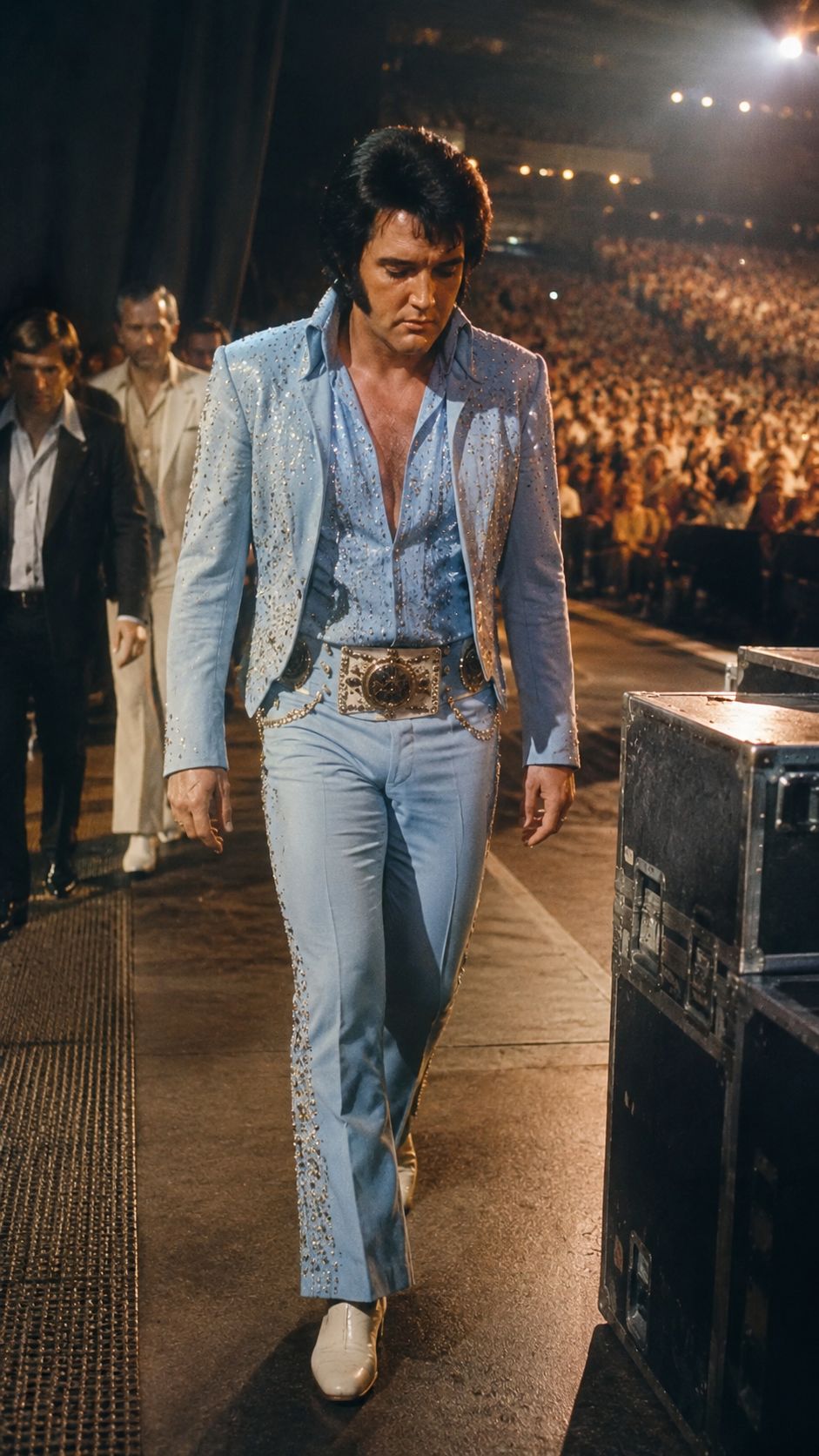
On the evening of June 26, 1977, thousands of fans packed into the Market Square Arena in Indianapolis expecting what they had experienced so many times before: another unforgettable night with Elvis Presley.
What they didn’t know—what no one in that arena could have known—was that they were witnessing the final performance of the most influential entertainer of the twentieth century.
No farewell announcement was made.
No grand curtain call followed.
There was no dramatic speech, no final bow signaling the end of an era.
There was only Elvis.
And then, suddenly, there wasn’t.
As the final notes echoed through the arena and the crowd slowly made its way toward the exits, few realized they had just become part of history.
Because just seven weeks later, Elvis Presley would be gone forever.
A King Still Fighting
By the summer of 1977, Elvis was no longer the young rebel who had electrified America in the 1950s. The swagger remained, but time had left its mark.
Years of relentless touring, health struggles, prescription medication, and emotional exhaustion had taken an undeniable toll. Critics had begun to whisper that the King’s reign was ending. Some newspapers cruelly mocked his appearance. Others questioned whether he should still be performing at all.
But Elvis kept going.
Perhaps because performing was all he had ever truly known.
Perhaps because the stage was the only place where he still felt completely alive.
Or perhaps because he simply couldn’t imagine life without an audience.
Those closest to him often described a man carrying invisible burdens—loneliness, pressure, and an overwhelming sense of responsibility to the fans who had loved him for more than two decades.
Yet every night, when the lights came on, he transformed.
The magic returned.
The crowd still roared.
And for a little while, Elvis was once again untouchable.
“The stage was where Elvis escaped everything else. No matter what was happening in his life, once he heard that audience, something changed.”
Indianapolis: An Ordinary Night That Became Extraordinary
The June 26 concert wasn’t advertised as historic.
In fact, it was just another stop on an exhausting tour schedule.
Fans arrived carrying cameras, homemade signs, and dreams of seeing their hero up close. Families brought children. Older couples recalled the first time they’d heard “Heartbreak Hotel” on the radio decades earlier.
Inside Market Square Arena, anticipation filled the air.
When Elvis finally appeared, dressed in his now-iconic concert attire, the audience erupted.
Witnesses later recalled that he appeared tired, but also surprisingly engaged. There were moments throughout the evening when the old charisma flashed brilliantly.
He smiled.
He joked.
He connected.
And, most importantly, he sang.
Songs like “Love Me,” “Fairytale,” “Jailhouse Rock,” and “Can’t Help Falling in Love” reminded everyone why Elvis Presley had become more than a performer.
He had become part of America’s emotional landscape.
Every lyric carried memories.
Every gesture represented an era.
Every note seemed to bridge generations.
For many in attendance, it was simply another wonderful Elvis concert.
For history, it became something much larger.
The Final Song
Near the end of the show came the moment that would later haunt millions of fans.
Elvis closed with “Can’t Help Falling in Love,” the song that had accompanied countless endings throughout his career.
At the time, it felt routine.
Looking back, it feels almost poetic.
As he sang:
“Wise men say, only fools rush in…”
No one knew those words would become his final public farewell.
There was no hint that these would be the last lyrics audiences would ever hear him perform live.
No indication that history was quietly unfolding.
The audience cheered.
Elvis thanked the crowd.
Then he walked offstage.
Just like he always had.
Only this time, he never returned.
“Nobody cried that night because nobody knew it was goodbye.”
That simple truth remains one of the most heartbreaking aspects of Elvis’s final concert.
The world didn’t lose Elvis gradually.
It lost him suddenly.
Seven Weeks Later
On August 16, 1977, the unimaginable happened.
News broke that Elvis Presley had died at Graceland at the age of just 42.
Shock swept across America.
Radio stations abandoned their regular programming.
Fans gathered outside Graceland in stunned silence.
Telephone lines jammed.
Newspapers rushed out special editions.
For millions, it felt impossible.
Elvis wasn’t merely a singer.
He represented youth, rebellion, romance, faith, Southern roots, and the soundtrack of countless personal memories.
People remembered where they were when they heard the news.
Many still do.
And almost immediately, attention turned back to Indianapolis.
Back to June 26.
Back to that final night.
Suddenly, ticket stubs became treasured heirlooms.
Photographs became historical artifacts.
Memories became sacred.
Those who had attended realized they had witnessed something no one else would ever see again.
The final concert of Elvis Presley.
The Fans Who Were There
Over the decades, countless fans who attended the Indianapolis show have shared remarkably similar stories.
Many describe an atmosphere they still struggle to explain.
Some recall feeling that Elvis seemed unusually reflective.
Others insist his voice sounded stronger than expected.
Still others remember simply feeling grateful to have seen him one more time.
But perhaps the most common sentiment is regret—not because the concert was disappointing, but because they didn’t know to savor every second.
Had they known, they would have stayed longer.
Cheered louder.
Taken more photographs.
Memorized every word.
Instead, they walked out believing there would always be another Elvis concert.
There wouldn’t be.
“If we’d known it was the last time, none of us would have left our seats.”
Why That Final Concert Still Matters
Nearly five decades later, Elvis’s final performance continues to fascinate historians, music lovers, and devoted fans.
Not because it was technically his greatest concert.
It wasn’t.
Not because it represented him at his physical peak.
It didn’t.
It matters because it reminds us of something profoundly human:
We rarely know when a final moment is happening.
The last concert.
The last conversation.
The last embrace.
The last goodbye.
Life seldom announces these moments in advance.
Elvis walked off that stage expecting future performances. Fans expected future tours.
History had other plans.
And perhaps that is why the Indianapolis concert remains so emotionally powerful.
It wasn’t staged as a farewell.
It became one.
The Legacy Lives On
Today, Elvis Presley remains one of the most celebrated artists in history.
His recordings continue to sell.
His influence still echoes through country, rock, gospel, and popular music.
Young listeners continue discovering him.
Older fans continue mourning him.
And every June, memories return to that arena in Indianapolis.
To the cheers.
To the music.
To the final wave.
To a tired but determined performer giving everything he still had.
When Elvis Presley stepped off the stage on June 26, 1977, nobody inside Market Square Arena knew they had just witnessed the end of an era.
But history remembers.
And somewhere in the collective memory of music lovers everywhere, the King is still taking that final bow—still smiling, still singing, and still reminding us why legends never truly leave.
They simply walk offstage.
And live forever in the applause.
VIDEO: