 By admin
 INTRODUCTION:
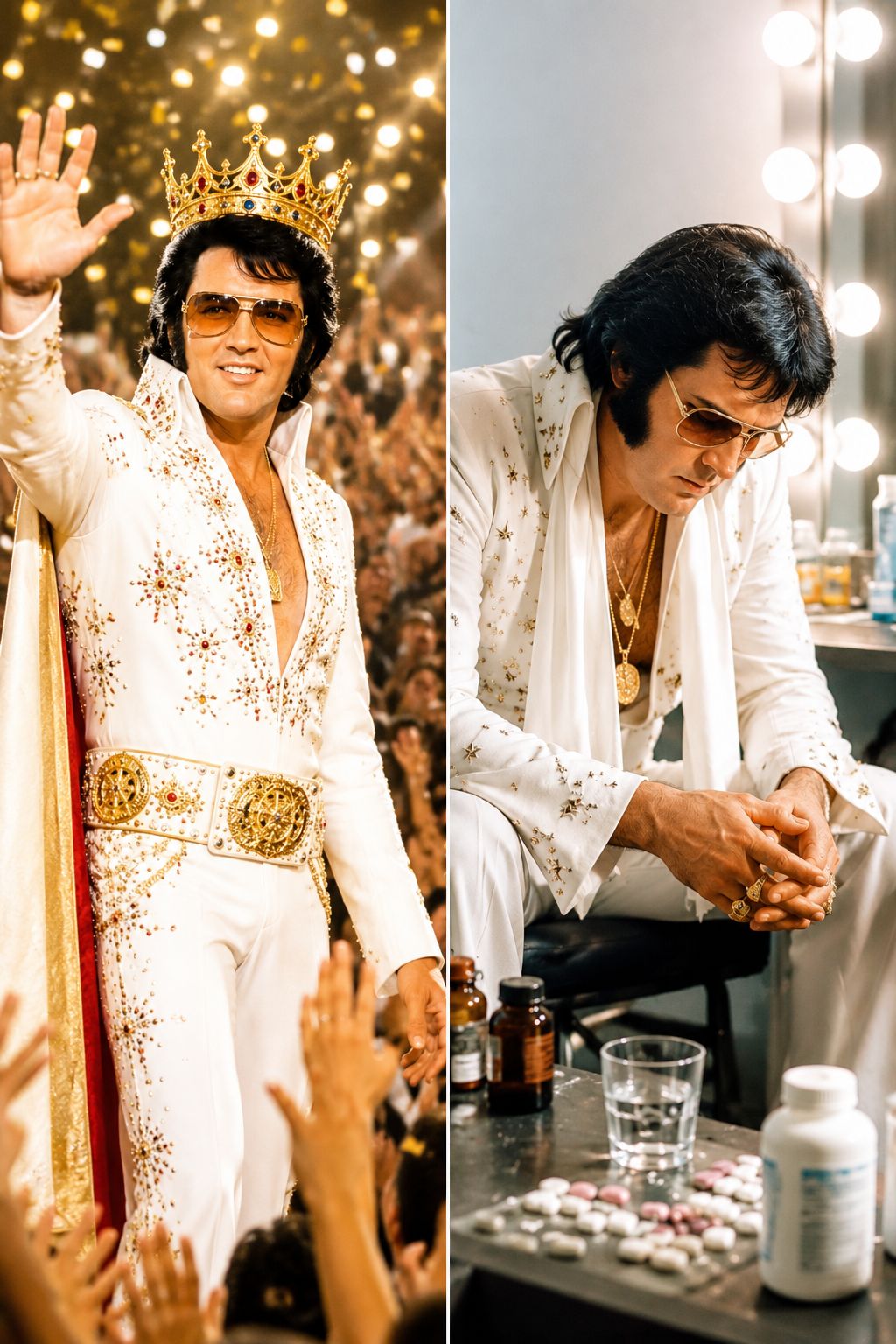
There are few titles in the history of popular music as powerful as “The King.” For generations, the moment someone says those two words, only one name comes to mind: Elvis Presley.
But what if the greatest irony of all is that Elvis himself never truly wanted the crown?
What if the title that elevated him into immortality also imprisoned him?
Behind the dazzling jumpsuits, screaming fans, sold-out arenas, and global superstardom was a shy, deeply sensitive Southern boy who never asked to become an icon. The world wanted a king. America needed a symbol. And in many ways, Elvis spent the rest of his life trying—and failing—to escape the throne that had been built around him.
The tragedy of Elvis Presley is not simply that he died young.
It is that somewhere along the way, the man named Elvis Aaron Presley disappeared beneath the legend known as “The King.”
The Boy From Tupelo Never Dreamed of a Crown
Long before Graceland, before Hollywood, before the gold records and television specials, Elvis was simply a poor kid growing up in Tupelo, Mississippi.
He was painfully shy.
Friends from his childhood often described him as polite, humble, and eager to please. He adored his mother, Gladys Presley, and remained emotionally attached to her throughout his life. Music was his refuge, not his ambition for world domination.
Elvis never set out to conquer America.
He simply wanted to sing.
He absorbed sounds from church gospel choirs, country radio, blues musicians, and neighborhood gatherings. Music gave him comfort, identity, and joy.
No one—not even Elvis himself—could have imagined what would happen after he walked into Sun Studio in 1953.
Within months, everything changed.
By 1956, America was witnessing something entirely new.
Elvis wasn’t merely a singer.
He was a cultural earthquake.
Teenagers screamed. Parents panicked. Television networks argued over whether his movements were appropriate for family audiences. Churches condemned him. Young people worshipped him.
And suddenly, a 21-year-old kid from Mississippi was carrying the expectations, fears, dreams, and fantasies of millions.
“I don’t know anything about music. In my line, you don’t have to.”
The quote became famous because it sounded carefree. But beneath Elvis’s humor was a profound truth: he had never been prepared for what fame was about to demand from him.
America Created “The King”
The title didn’t come from Elvis.
It came from everyone else.
Fans, journalists, promoters, and television personalities slowly transformed him from a talented performer into something larger than human.
He became The King of Rock and Roll.
Once that happened, there was no going back.
The problem with becoming an icon is that icons are rarely allowed to be ordinary.
Elvis discovered this quickly.
Every hairstyle, every friendship, every relationship, every performance became public property. Millions projected their own hopes onto him. Millions expected perfection.
And Elvis, perhaps because of his generous and people-pleasing nature, desperately tried to give everyone what they wanted.
That pressure never truly ended.
The Loneliness Inside Graceland
To the outside world, Graceland represented success beyond imagination.
The mansion symbolized wealth, power, and achievement.
Yet many who knew Elvis described Graceland differently.
They described isolation.
As fame intensified, Elvis’s world became increasingly smaller. Trust became difficult. Genuine friendships became rare. Security concerns, constant attention, and relentless schedules gradually separated him from ordinary life.
The mansion that fans viewed as a palace often functioned more like a sanctuary—and sometimes, a prison.
“The loneliness of fame is that everyone knows you, but very few truly know you.”
Elvis was surrounded by people almost constantly. Friends, employees, bodyguards, family members, business associates—the famous “Memphis Mafia” rarely left his side.
Yet even in crowded rooms, loneliness persisted.
Who could speak honestly to The King?
Who could tell him “no”?
Who could see Elvis the man rather than Elvis the phenomenon?
As years passed, those questions became increasingly important.
The Death That Changed Everything
If there was one event that permanently altered Elvis’s emotional world, it was the death of his beloved mother, Gladys, in 1958.
Her loss devastated him.
Witnesses recalled seeing Elvis inconsolable at her funeral. Friends later said he never completely recovered.
Many biographers believe that after Gladys died, a profound emotional emptiness settled over Elvis.
He continued performing. He continued making movies. He continued smiling for cameras.
But something essential had changed.
“She was the only woman who ever truly understood me.”
Whether entirely accurate or not, the sentiment reflects how deeply Elvis depended on his mother emotionally.
The crown remained.
But the foundation beneath it had begun to crack.
Hollywood, Expectations, and Exhaustion
Throughout the 1960s, Elvis became one of Hollywood’s most bankable stars.
The films generated enormous profits.
Yet artistically, many left him frustrated.
Movie after movie followed nearly identical formulas. Elvis increasingly expressed dissatisfaction with repetitive scripts and lightweight musical numbers.
The artist who once revolutionized popular music often felt trapped by commercial expectations.
He wanted meaningful material.
He wanted artistic growth.
Instead, business considerations frequently prevailed.
By the late 1960s, many critics believed Elvis had become irrelevant.
Then came the astonishing 1968 Comeback Special.
Dressed in black leather, stripped of Hollywood excess, Elvis reminded the world who he truly was: one of the greatest live performers in history.
For a brief moment, the man seemed to reclaim himself from the myth.
And audiences responded with overwhelming passion.
But reclaiming oneself is easier on stage than in private life.
The Price of Never Being Allowed to Fail
As the years progressed, the demands intensified.
Tours multiplied.
Expectations grew impossible.
Fans didn’t merely want Elvis.
They wanted perfection.
Night after night.
Year after year.
Without weakness.
Without aging.
Without vulnerability.
No human being can sustain that burden indefinitely.
The pressure contributed to cycles of exhaustion, emotional strain, and increasing dependence on prescription medications prescribed to help manage sleep, energy, anxiety, and chronic health issues.
The public saw rhinestones.
The public saw standing ovations.
The public saw The King.
Few saw the struggling man underneath.
The Final Years: Legend Versus Humanity
In his final years, Elvis remained immensely beloved.
Concert audiences still filled arenas. Fans still cried when he sang.
Yet physically and emotionally, he was carrying enormous burdens.
His health declined.
Relationships fractured.
The gap between Elvis the person and Elvis the symbol widened.
Perhaps that was the cruelest consequence of extraordinary fame.
The world loved The King so intensely that it sometimes forgot to protect the man.
On August 16, 1977, Elvis Presley died at just 42 years old.
The shock reverberated around the globe.
Millions mourned.
Millions still mourn.
Because despite everything—the fame, the mythology, the controversies—people sensed something authentic in Elvis.
They recognized the vulnerable young man who had once stood nervously in a recording studio simply hoping to sing.
More Than a King
Today, nearly half a century after his death, Elvis Presley remains one of the most influential artists in history.
But perhaps the greatest tribute we can offer is not simply to celebrate The King.
It is to remember the human being behind the crown.
A shy boy from Mississippi.
A devoted son.
A gifted artist.
A lonely superstar.
A man who gave the world unforgettable music while quietly sacrificing pieces of himself along the way.
Elvis never asked to be a king. He only wanted to sing. Yet history placed a crown upon his head—and that crown, magnificent as it was, proved unbearably heavy.
And perhaps that is why his story still breaks our hearts.
Because beneath the legend, Elvis Presley was simply a man.
VIDEO: