 By admin
 INTRODUCTION:
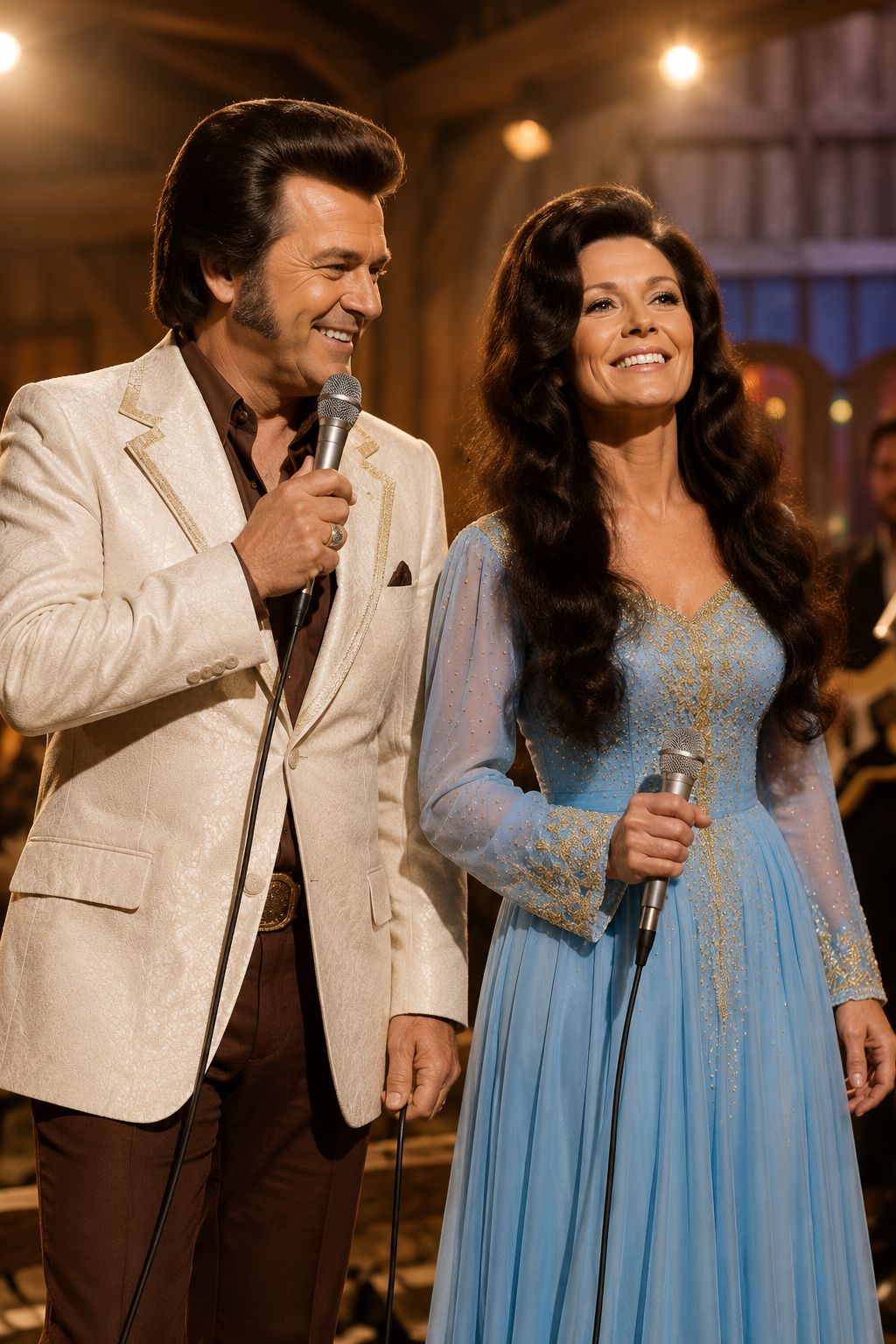
For decades, Conway Twitty and Loretta Lynn have been remembered as one of the greatest partnerships country music ever produced.
Their voices seemed almost too perfectly matched.
His deep, aching baritone.
Her raw, unmistakably human voice.
Together, they could make a simple country song feel like a private conversation between two people who had loved, fought, forgiven, and lost each other a hundred times.
But that is exactly where the story becomes complicated.
Because the more people look back at Conway Twitty and Loretta Lynn, the more questions seem to appear.
Were they really as close as they appeared?
Was the chemistry between them purely musical?
Why did some people believe their partnership created tension outside the recording studio?
And why, decades later, do fans still insist there was something about Conway and Loretta that the public never completely understood?
The answer may be less scandalous—and far more fascinating—than the rumors.
THE CHEMISTRY WAS REAL. THE ROMANCE WASN’T NECESSARILY.
The first thing to understand is that the legendary chemistry between Conway and Loretta was not imaginary.
It was powerful enough to turn their records into country classics.
Their partnership produced major hits including “After the Fire Is Gone,” “Louisiana Woman, Mississippi Man,” and “Feelins’.” The Country Music Hall of Fame notes that the pair won a Grammy and four CMA awards for their series of classic duets.
And their success was enormous.
They weren’t simply two stars who happened to record together.
They became a musical identity.
When Conway sang toward Loretta, he sounded like a man trying desperately to hide his feelings.
When Loretta answered him, she sounded like a woman who already knew exactly what he was thinking.
That emotional tension became their trademark.
They didn’t have to be lovers to sound like they had lived through a love story.
That distinction matters.
Because over the years, some fans began confusing the emotional reality of their performances with the reality of their private lives.
The songs were dramatic.
The chemistry was undeniable.
But the assumption that the two secretly carried on a romance is not something the historical record establishes.
In fact, Loretta’s connection with Conway was often described as a genuine friendship and professional partnership.
And that truth may actually be more remarkable than the rumor.
THE SONG THAT CHANGED EVERYTHING
In 1971, “After the Fire Is Gone” became their first No. 1 country hit together.
The song was about two people trapped in a relationship where the passion had disappeared—and the dangerous temptation of finding that passion somewhere else.
It was hardly innocent material.
And Conway and Loretta sang it with such conviction that listeners could almost forget they were listening to performers.
The record felt intimate.
Almost uncomfortable.
Almost too real.
The song reached No. 1 on March 27, 1971, marking the beginning of one of the most successful duet partnerships in country music history.
That success created a strange phenomenon.
The more convincingly they performed complicated relationships in songs, the more audiences wanted to believe there was a complicated relationship behind the microphone.
And that is where mythology began to overtake history.
THE “DARK SIDE” WASN’T A SECRET AFFAIR—IT WAS THE PRESSURE OF PERCEPTION
There is a darker side to their story, but it isn’t necessarily the scandal that internet rumors sometimes suggest.
It was the pressure of being watched.
Conway was already one of country music’s biggest stars. His official biography describes a career spanning decades, from his early rock-and-roll years to his extraordinary run of country hits.
Loretta, meanwhile, was breaking barriers as a woman who wrote and sang openly about marriage, motherhood, infidelity, independence, and the frustrations of ordinary women.
She was not simply singing romantic songs.
She was exposing uncomfortable truths.
Her official biography describes her as a songwriter whose material drew heavily from her own experiences and addressed subjects that pushed against Nashville’s boundaries.
So when she stood beside Conway and sang about forbidden love, audiences naturally wondered:
Was there something more behind it?
But sometimes the most convincing performers are precisely the people who understand the difference between acting and living.
Loretta knew how to inhabit a character.
Conway knew how to make a lyric sound like a confession.
Together, they created something that felt almost dangerously authentic.
AND THEN CAME THE RUMORS
One of the persistent stories surrounding the pair was that Loretta’s closeness with Conway caused friction in Conway’s marriage.
This is where caution becomes essential.
There is no good reason to transform old rumors into established fact.
What is documented is that Loretta herself maintained that Conway was a very good friend to both her and her husband, Doo. Entertainment Weekly, looking back at Loretta’s career, also noted the close friendship among the three and the professional relationship they built together.
That detail changes the emotional shape of the story.
Imagine what it must have been like.
Every night, Conway and Loretta walked onto a stage and performed songs filled with temptation, jealousy, betrayal, longing, and desire.
Then they walked offstage and returned to their real lives.
The audience saw the fantasy.
The performers had to live with the consequences of people believing the fantasy was real.
The greatest illusion in country music may have been convincing millions of people that a song was a confession.
DOO LYNN WAS MORE IMPORTANT TO THE STORY THAN MANY PEOPLE REALIZE
One of the fascinating details often lost in the Conway-and-Loretta mythology is the role played by Loretta’s husband, Doo Lynn.
According to the retrospective account published by Entertainment Weekly, Doo was not simply standing on the sidelines while the partnership developed. He was involved professionally as well, and he helped guide the duo toward some of their biggest opportunities.
That makes the simplistic “secret romance” narrative much harder to sustain.
The reality was more complicated.
There was friendship.
There was business.
There was performance.
There was family.
And there was an audience hungry to believe that the emotional intensity they heard in the records had to come from somewhere outside the studio.
But sometimes chemistry is chemistry.
A great singer can make you believe something without having personally experienced every emotion in the lyric.
WHY DO PEOPLE STILL TALK ABOUT THEM?
Because something about Conway and Loretta remains almost impossible to reproduce.
Modern country music has countless collaborations.
There are superstar duets.
There are carefully produced videos.
There are enormous stages and sophisticated technology.
But Conway and Loretta belonged to a different musical world.
They didn’t need elaborate production to create tension.
They needed two voices.
A microphone.
A great song.
And enough emotional restraint to let the audience fill in the blanks.
That is why their performances still feel intimate.
Their granddaughter Tayla Lynn and Conway’s grandson Tre Twitty have carried that legacy forward through their own musical partnership, performing their grandparents’ songs and telling audiences about the family connection behind the music. Their official project describes their performances as an attempt to tell their grandparents’ story through their own story.
The fact that another generation is still performing those songs says something important.
The fascination wasn’t simply about gossip.
It was about chemistry.
THE REAL TRAGEDY IS THAT THERE WASN’T ENOUGH TIME
Conway Twitty died in June 1993.
His official biography describes his death as untimely after a career that included an extraordinary run of country success.
Loretta Lynn lived much longer, eventually becoming one of the most celebrated figures in country music history before her death in 2022.
And perhaps that is why their story feels unfinished.
There was no final chapter explaining everything.
No dramatic confession that suddenly made every lyric make sense.
No secret revelation that could neatly settle every rumor.
Instead, there are recordings.
There are performances.
There are photographs.
There are memories.
And there are millions of listeners who still hear something in those songs that they cannot quite explain.
DON’T BELIEVE EVERYTHING YOU HEAR—LISTEN TO THE MUSIC
Maybe the biggest mistake is believing that every great country story needs a scandal.
Sometimes the truth is more beautiful.
Conway Twitty and Loretta Lynn didn’t need a secret romance to create unforgettable music.
They needed trust.
They needed timing.
They needed two voices capable of turning ordinary words into emotional drama.
And they needed the courage to sing songs that many artists would have been afraid to touch.
The official history confirms that they became one of country music’s most celebrated male-female duos, while Loretta’s own career demonstrated why she was so powerful as a songwriter and performer.
So when someone says they know “the dark secret” behind Conway and Loretta, perhaps the smartest response is simple:
Don’t believe everything they tell you.
Listen again.
Put on “After the Fire Is Gone.”
Then listen to “Louisiana Woman, Mississippi Man.”
Hear the hesitation.
Hear the confidence.
Hear the teasing.
Hear the pain.
Hear two legendary performers creating a world that exists for three or four minutes—and disappears when the song ends.
Maybe the mystery was never what happened between Conway and Loretta.
Maybe the mystery is how two people could make millions of strangers believe they were standing inside the same heartbreak.
And that is why, even after all these years, people still talk about them.
Not because every rumor is true.
But because the music was.
And sometimes, in country music, the truth inside a song can feel more powerful than the truth outside it.
VIDEO: