 By admin
 INTRODUCTION:
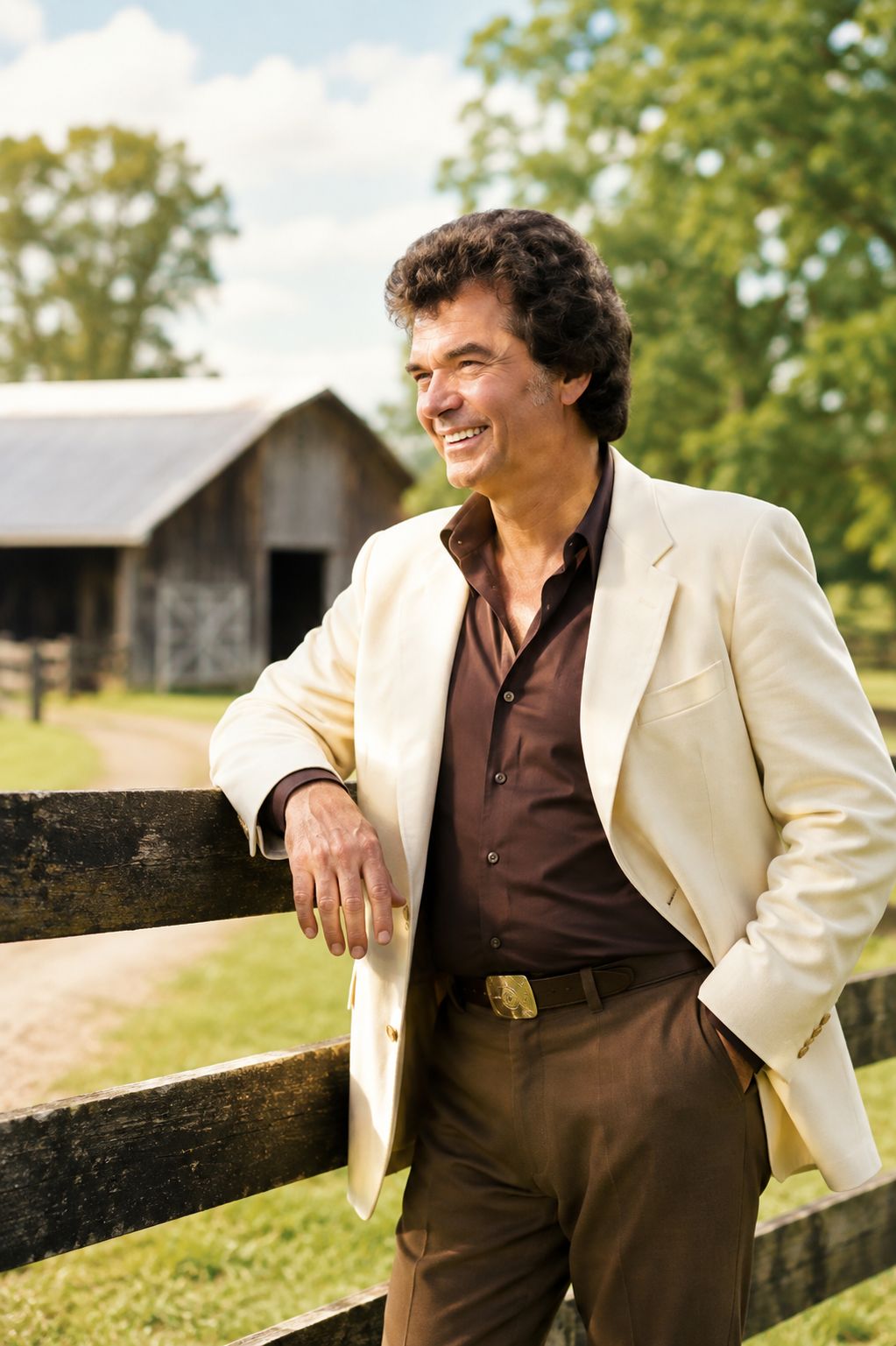
There are country singers you remember because of a voice. There are others you remember because of a song. And then there are artists like Conway Twitty, whose entire career seems almost impossible when you stop and look at it closely.
For decades, fans knew him as the smooth-voiced country superstar behind songs like “Hello Darlin’,” “It’s Only Make Believe,” “You’ve Never Been This Far Before,” and “Linda on My Mind.” They knew the perfectly styled hair, the deep voice, the confident stage presence, and—of course—the unforgettable chemistry he shared with Loretta Lynn.
But the familiar story leaves out something important.
Conway Twitty was never simply the country singer people thought they knew.
His career was built on reinvention, risk, persistence, and an almost stubborn refusal to stay inside one musical box.
And when you look closer, the real story becomes even more fascinating.
The Man Behind “Conway Twitty” Wasn’t Conway Twitty
Before the velvet voice and legendary stage name, there was Harold Lloyd Jenkins.
Born September 1, 1933, in Friars Point, Mississippi, Jenkins grew up with music around him. The Country Music Hall of Fame notes that he learned guitar from his grandfather and a neighborhood blues musician and was already broadcasting on radio as a child.
That alone should change the way we see him.
He wasn’t manufactured overnight in Nashville.
He was performing before the world knew his name.
And music wasn’t even his only dream.
Baseball was another passion, and he was talented enough to attract attention from the Philadelphia Phillies before military service interrupted that possibility. After his Army service, however, another young man’s music changed his direction: Elvis Presley.
That moment sent Jenkins toward Memphis—and eventually toward a career that initially had almost nothing to do with the country superstar he would become.
The First Big Surprise: Conway Was a Rock ‘n’ Roll Star
Ask casual country fans what genre Conway Twitty belonged to, and most will immediately say country.
Technically, that’s true.
Historically, it’s incomplete.
Before conquering country radio, Twitty was a major rock ‘n’ roll performer. His 1958 recording “It’s Only Make Believe” became a massive international success.
This wasn’t some obscure experiment.
It was a genuine pop and rock breakthrough.
And that’s where the Conway Twitty story takes its first remarkable turn.
He could have remained a rock star.
He could have chased the sound that had already made him successful.
Instead, he eventually made one of the most important decisions of his career: he walked away from the rock ‘n’ roll identity and pursued country music.
According to the official Conway Twitty biography, after years of performing for younger rock audiences, Twitty realized that his musical future was elsewhere. He wanted to compete with the country artists he had admired for years.
“He didn’t abandon rock because he couldn’t succeed there. He left because country music was where he believed he belonged.”
That distinction matters.
Conway wasn’t escaping failure.
He was choosing a different definition of success.
Nashville Didn’t Give Him an Easy Victory
The second misconception is that Conway Twitty simply arrived in Nashville and immediately became a superstar.
It didn’t happen that way.
After signing with Decca in the 1960s, Twitty released a series of recordings before “Next in Line” became his first country No. 1 in 1968. From there, his country career exploded.
The numbers became extraordinary.
The Country Music Hall of Fame describes his stardom as lasting across five decades and notes that he had more No. 1 records than any country artist had achieved at the time. Eleven of those No. 1s were songs he had written himself.
That’s not merely longevity.
That’s domination.
Yet his greatest achievement may have been something less measurable:
He made reinvention look natural.
He Was More Than the “Ladies’ Man” Image
Conway Twitty’s image has sometimes been reduced to the romantic side of his music.
And yes, his catalog was filled with songs about desire, heartbreak, temptation, regret, loneliness, and complicated relationships.
But that image can obscure the craftsman underneath.
Twitty had an extraordinary instinct for songs.
He understood how to take a lyric and make it feel personal, almost conversational.
He didn’t need to overpower a song.
He could simply lean into a phrase, lower his voice, and suddenly a listener felt as though Conway were singing directly to them.
That was part of his magic.
The voice didn’t scream for attention.
It assumed you were already listening.
And Then There Was Loretta
No story about Conway Twitty is complete without Loretta Lynn.
But even here, the popular memory sometimes simplifies what actually happened.
They weren’t simply two famous singers who happened to record together.
They became one of country music’s most successful duet teams.
Their first major duet, “After the Fire Is Gone,” reached No. 1 in 1971 and helped launch one of the most celebrated partnerships in country music history. They went on to record songs including “Lead Me On,” “Louisiana Woman, Mississippi Man,” “As Soon as I Hang Up the Phone,” and “Feelins’.”
Between 1972 and 1975, Lynn and Twitty won the CMA Vocal Duo of the Year award four consecutive times.
Listen to those recordings today and the chemistry remains startling.
There’s tension.
There’s humor.
There’s vulnerability.
And sometimes there’s the feeling that you’re overhearing an argument between two people who know exactly where the other’s emotional weak spots are.
That was the secret.
They didn’t sound identical.
They sounded like opposites who somehow made sense together.
“Conway brought the shadow. Loretta brought the fire. Together, they created a sound neither could have produced alone.”
And that’s why their recordings still feel alive.
The “Conway and Loretta Romance” Needs a Reality Check
This is where the mythology can become misleading.
Because their performances were so emotionally convincing, audiences naturally wondered about the relationship behind the microphones.
Were they secretly in love?
Was there something more than friendship?
The performances certainly encouraged speculation.
But the historical record gives us something much more interesting than a simple secret-romance narrative: two extraordinary performers who understood exactly how to create believable emotional tension in a song.
Their chemistry was real.
Their musical partnership was real.
Their success was real.
But turning every emotionally charged performance into evidence of a hidden romance risks missing the artistic achievement itself.
Loretta Lynn was already a groundbreaking country star in her own right, and Twitty was already a major solo performer. Their collaboration didn’t create either artist.
It amplified both.
The Biggest Lie About Conway? That His Success Came Easily
This may be the most important part of the story.
Looking backward, legendary careers always seem inevitable.
They aren’t.
Twitty had to survive changing musical fashions.
He had to reinvent himself.
He had to move from rock to country.
He had to establish credibility in a genre where tradition mattered enormously.
And then he had to maintain that success for decades.
The Country Music Hall of Fame describes him as one of country music’s most diverse stylists and a major songwriting talent.
That diversity is easy to overlook because his country identity eventually became so dominant.
But perhaps that’s precisely what makes his story remarkable.
He didn’t simply find his sound. He kept finding new ways to use it.
His Voice Wasn’t the Whole Secret
It’s tempting to explain Conway Twitty through his famous baritone.
But plenty of singers have great voices.
Far fewer understand storytelling.
Twitty had an instinct for emotional pacing.
He knew when to hold a note.
When to pull back.
When to let silence do some of the work.
And when a lyric needed to sound almost painfully ordinary.
That is why songs such as “Hello Darlin’” continue to resonate.
The song doesn’t require elaborate storytelling.
A simple greeting becomes loaded with history.
That’s the Conway Twitty trick.
He could make a familiar emotion feel like a private confession.
The Tragedy Is How Quickly It Ended
After building a career spanning decades, Conway Twitty died on June 5, 1993, at just 59 years old.
And perhaps that’s another reason his legend feels strangely frozen in time.
There was no long period of decline.
No decades of slowly fading from public memory.
His career simply ended.
Yet the catalog remained.
The voice remained.
The duets remained.
And generations continued discovering him.
Today, his musical legacy is still being carried forward by family members and younger performers. Tre Twitty, his grandson, has collaborated with Tayla Lynn, Loretta Lynn’s granddaughter, continuing the musical connection between the two families.
There’s something poetic about that.
The partnership that once connected two country legends now echoes through another generation.
So, Was Everything We Thought We Knew About Conway Twitty a Lie?
Not exactly.
The truth is more interesting.
He really was the romantic country superstar.
He really did possess one of the most recognizable voices in country music.
He really did create an extraordinary musical partnership with Loretta Lynn.
And he really did dominate country radio on a scale few artists have matched.
But what we often forget is everything underneath the familiar image.
Harold Jenkins was a Mississippi kid who loved baseball and music.
He became a rock ‘n’ roll star.
Then he walked away from that identity.
He entered country music.
He struggled before finding his breakthrough.
He became a songwriter.
He became a producer.
He became a country institution.
And he kept evolving.
That is the real Conway Twitty story.
“The greatest surprise isn’t that Conway Twitty became a country legend. It’s that he could have become something completely different—and chose not to.”
Perhaps that’s why his music still hits differently.
Because behind the polished hair, the velvet voice, the romantic songs, and the legendary duets was a man who understood something many artists never learn:
A career isn’t built by becoming what people expect. It’s built by knowing when to become something else.
And maybe that is the part of Conway Twitty’s story fans have been missing all along.
Not the myth.
Not the rumors.
Not the nostalgia.
The man who kept reinventing himself until the world finally realized there was no single version of Conway Twitty.
There was only the next chapter.
VIDEO: