 By admin
 INTRODUCTION:
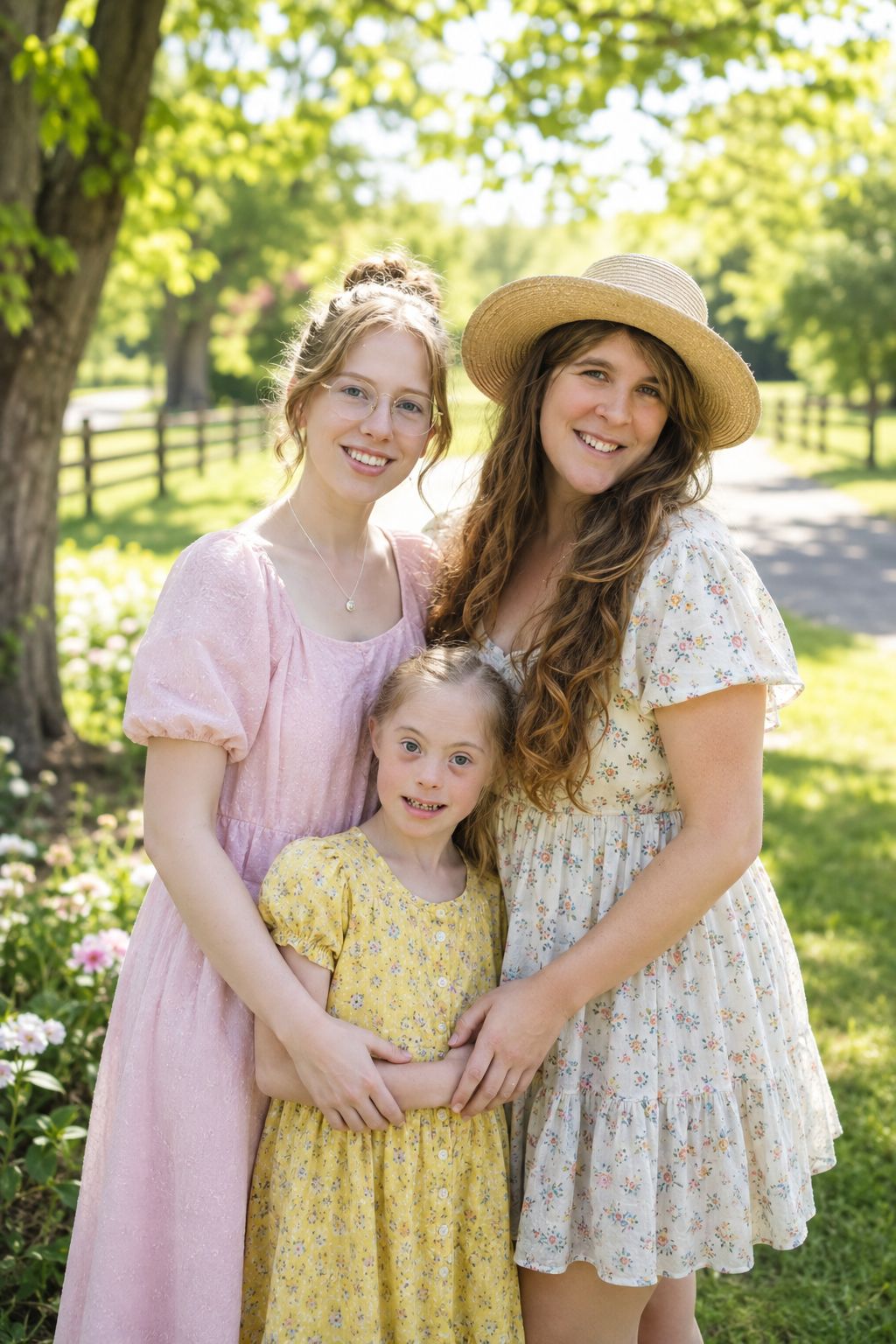
For years, the story of Rory Feek and his three daughters seemed to represent one of country music’s most complicated but deeply human family journeys.
There was Heidi, the eldest daughter who grew up around music and eventually found her own creative voice. There was Hopie, whose life took an unexpected turn when a DNA test revealed a truth about her biological father that changed the way she understood her family history. And then there was Indiana, the youngest, born to Rory and his late wife, country singer Joey Feek, whose childhood has unfolded under an extraordinary spotlight.
Together, their stories form something much larger than a celebrity-family headline.
They tell a story about fatherhood, grief, identity, forgiveness, privacy and the difficult question of what makes someone a family.
And in 2025, one of those questions became painfully personal when Hopie revealed that Rory was not her biological father.
Three daughters. Three very different stories.
Rory became a father to Heidi and Hopie during his marriage to Tamara Gilmer. Heidi was born in 1986, followed by Hopie in 1988. After Rory and Gilmer divorced in 1992, Rory raised the two girls as a single father for much of their childhood.
Years later, Rory married Joey Feek. The couple became one of country music’s most beloved husband-and-wife duos, performing together as Joey + Rory.
In February 2014, their daughter Indiana Boone Feek was born.
Just two years later, the family’s world was shattered when Joey died from metastatic cervical cancer at age 40.
Rory was suddenly raising another daughter alone.
That history matters because each daughter represents a different chapter of Rory’s life — and because the relationship between those chapters has become increasingly complicated.
Heidi Feek: The daughter who followed the musical path
Heidi, born Oct. 3, 1986, grew up in Nashville and inherited a natural connection to music.
She performed alongside Rory and Joey during her younger years and eventually built a musical career of her own with her husband, Dillon Hodges. The couple performs as firekid, and their work has earned major recognition, including a Daytime Emmy in 2024 for an original song featured on PBS’s Reconnecting Roots.
For many years, Heidi’s relationship with her youngest sister appeared affectionate and close.
But that relationship became central to a public family dispute.
Heidi and Hopie have said that their access to Indiana became increasingly limited. Heidi told PEOPLE in 2024 that Indiana had previously spent significant time with her and Hodges, including regular visits to their Alabama home.
“This is a devastating change for her, because we’ve been in her life since the day she was born.”
That statement captured something deeper than a disagreement between adults.
For Heidi, the issue was not simply about her relationship with her father. It was about a little sister she believed had been an important part of her life.
The dispute eventually became legal and involved allegations surrounding the community where Indiana lives. Those allegations have been disputed, and Homestead Heritage denied claims made against it.
The result has been a painful fracture in a family that once appeared extraordinarily close.
Hopie Feek: The DNA discovery that changed everything
Then came the revelation that stunned fans.
Hopie — Rory’s second daughter — revealed in February 2025 that a genetic test had shown that Rory was not her biological father.
The discovery reportedly came through a 23andMe test.
Hopie identified her biological father as a man she referred to as B.C. and said she had grown closer to him after discovering the connection.
Imagine receiving that information as an adult.
The father you grew up knowing.
The man who raised you.
The memories.
The family photographs.
The childhood stories.
The name.
Suddenly, the word “father” acquires another dimension.
For Hopie, however, the discovery did not erase her history with Rory.
It complicated it.
Rory said publicly that he had actually suspected for years that he might not be Hopie’s biological father. According to his account, the timing surrounding her birth had caused him to question whether he could have been her biological parent because of his military deployment.
But when Hopie confirmed the DNA result, Rory said the revelation did not change how he felt about her.
He expressed the sentiment that, regardless of biology, she remained his daughter.
That is perhaps the emotional heart of the entire story.
“I love you as my daughter and I always will.”
Yet Hopie experienced the public conversation differently.
She said she had asked her father to treat her mother’s history with kindness and not shame her, but felt that details of her family’s private past had instead been made public through Rory’s blog.
She also revisited another painful chapter: her 2014 coming-out experience and the way she felt her story was handled in Rory’s 2018 memoir.
Hopie’s reaction made clear that discovering one’s biological origins is not merely a scientific event.
It can reopen old wounds.
It can force someone to reconsider childhood memories while simultaneously trying to protect the people they love.
And it can raise an uncomfortable question:
Who owns a family’s story when one person is a public figure and the other members are not?
Indiana Feek: The little sister at the center of everything
Then there is Indiana.
Born Feb. 17, 2014, Indiana was Rory and Joey’s only child together.
Her arrival was a source of immense joy for the couple, but her childhood was soon marked by tragedy when Joey died in 2016.
Indiana was born with Down syndrome and a congenital heart condition. Rory has spoken publicly over the years about raising her and about creating an environment where she could thrive.
In 2026, Indiana’s health became the subject of another major chapter in the family’s story.
She underwent open-heart surgery and later experienced a serious complication that resulted in an emergency hospitalization. According to PEOPLE, she was eventually able to return home after an eight-day hospital stay and was described by Rory as doing remarkably well.
For any parent, that kind of experience would be terrifying.
For Rory, it also came amid already strained relationships with Heidi and Hopie.
The older sisters have publicly criticized the way Indiana’s medical journey has been shared online, arguing that their younger sister’s vulnerable moments should remain private because she cannot consent to having those experiences turned into public content.
Rory, meanwhile, has continued to share updates about Indiana and his family life with his audience.
That disagreement highlights one of the hardest realities of modern celebrity families:
Sometimes love and privacy collide with storytelling.
The family story behind the headlines
It is tempting to reduce the Feek family story to a collection of dramatic headlines:
DNA revelation.
Estranged daughters.
A family dispute.
A child facing serious health challenges.
But doing so misses what makes the story resonate.
At its center are four people trying, in very different ways, to define family.
For Rory, fatherhood appears to have always been rooted heavily in responsibility and the act of raising his children.
For Hopie, the discovery of her biological father introduced an entirely new dimension to her identity.
For Heidi, the relationship with Indiana has become inseparable from questions about family access and protection.
And for Indiana, the youngest daughter, much of her story is being written by adults around her while she grows up in the middle of an extraordinary family history.
That is why the story feels so emotionally complicated.
There are no easy heroes.
There are no simple villains.
There are only people carrying different memories of the same family.
Biology versus belonging
Perhaps the most powerful lesson in Hopie’s revelation is that biological fatherhood and emotional fatherhood are not necessarily identical.
DNA can answer one question.
It cannot answer every question.
It can tell someone where their genetic lineage comes from.
It cannot tell them who held their hand when they were frightened.
It cannot explain who helped them through childhood.
It cannot erase decades of memories.
And it cannot automatically determine what the word “Dad” means.
Rory’s response focused on precisely that distinction.
Yet Hopie’s reaction demonstrates another truth: even when love remains, the discovery can still hurt.
Both realities can exist simultaneously.
A person can love the man who raised them and still want answers about the man whose DNA they carry.
They can appreciate their childhood and still question parts of it.
They can forgive someone and still establish boundaries.
That complexity is what makes Hopie’s story so much more than a DNA-test headline.
Three daughters, one unforgettable family legacy
The Feek family story has changed dramatically over the decades.
Heidi grew into an artist.
Hopie discovered a biological connection she never expected.
Indiana grew up as the daughter of Joey Feek, carrying the memory of a mother who became an icon of love and resilience in the final years of her life.
And Rory has remained at the center of all three stories.
Today, the family relationships are far more complicated than the nostalgic photographs might suggest.
But perhaps that is the reality of families everywhere.
Behind the photographs are conversations nobody else hears.
Behind the smiles are disagreements.
Behind the public stories are private memories.
And behind the word “family” are questions that cannot always be answered by blood.
The most heartbreaking part may be that all three daughters appear to be connected by something they cannot escape: they are part of the same family story, even when they remember that story differently.
And perhaps that is the ultimate lesson of Rory Feek’s three daughters.
Family is not simply about where your DNA comes from.
It is about history.
It is about love.
It is about loss.
It is about the people who stay.
And sometimes, it is about learning how to love one another even when the story you thought you knew suddenly changes.
“Blood” can explain where we come from. But it does not always explain who we become.
For Rory, Heidi, Hopie and Indiana, that question remains deeply personal.
And for country music fans who have followed their journey for years, it is a reminder that behind every public story is a family still trying to find its way through the next verse.
VIDEO: