 By admin
 INTRODUCTION:
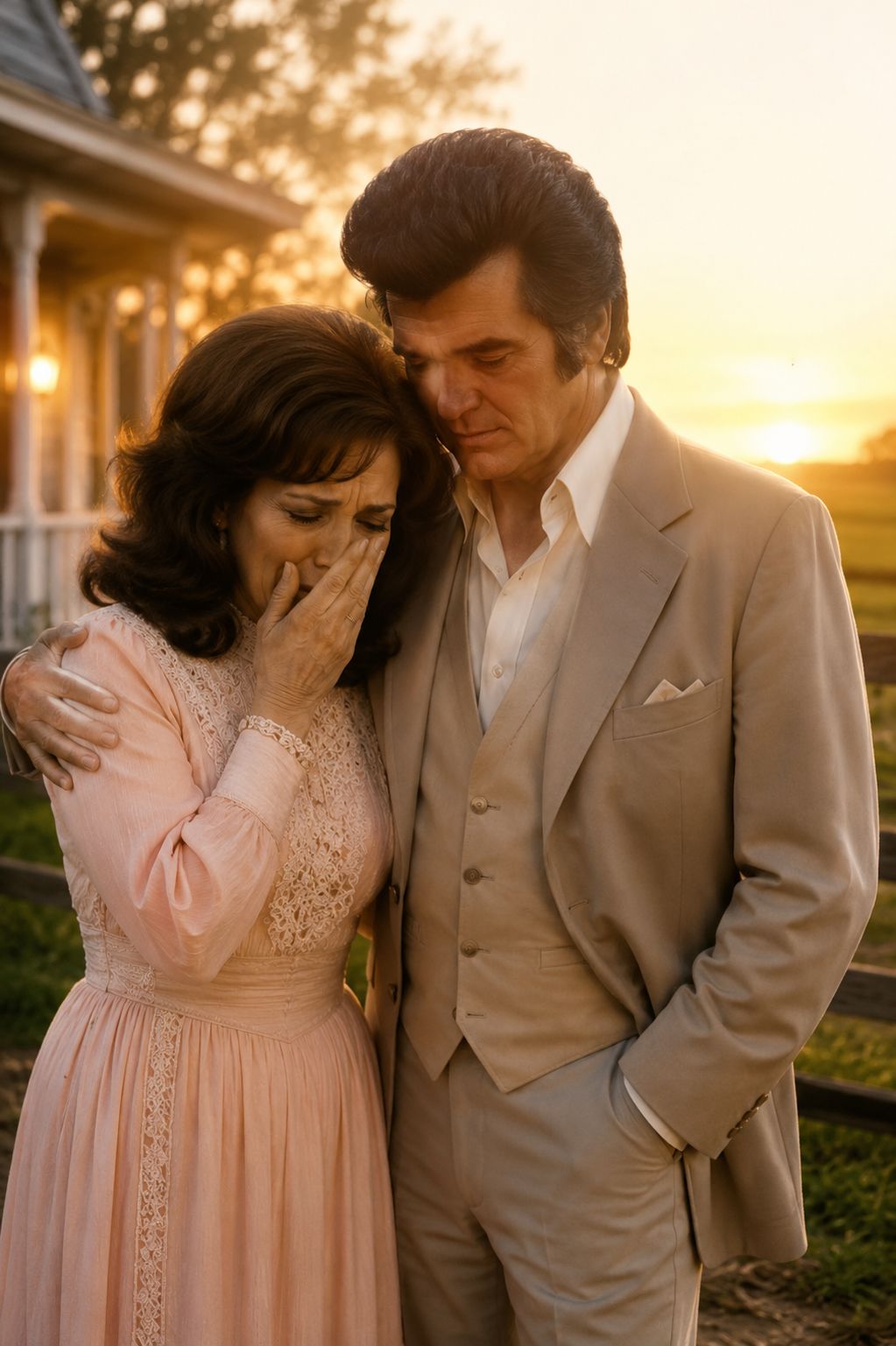
There are some goodbyes that arrive with warning.
There is time for a final conversation. Time for one more handshake, one more laugh, one more “I’ll see you down the road.”
And then there are the goodbyes that come without permission.
For Loretta Lynn, the loss of Conway Twitty belonged to that second kind.
Their voices had spent more than a decade together, creating some of the most unforgettable duets in country music history. Their chemistry was so convincing that fans sometimes believed the emotions in their songs reflected a secret romance. But Lynn repeatedly corrected that assumption. She said they were friends, and she made clear that her relationship with Conway was built on affection, trust, humor, and music—not a hidden love affair.
That distinction makes their story even more powerful.
Because sometimes the deepest friendships are the ones that never need to become anything else.
And on the night Conway Twitty died, Loretta Lynn was close enough to see him one last time—but not close enough to know that it would be goodbye.
A PARTNERSHIP THAT SOUNDED LIKE LOVE
When Loretta Lynn and Conway Twitty sang together, something happened that neither artist could quite create alone.
Their voices seemed to argue, flirt, challenge, forgive, and surrender—all within the space of a few minutes.
Songs such as “After the Fire Is Gone” became country classics precisely because their performances felt intensely personal. The 1970 recording reached No. 1 on the country charts, and Lynn later recalled that listeners assumed the two singers had something romantic going on.
They didn’t.
“Me and Conway were friends. We wasn’t lovers.”
That was Loretta’s own explanation when asked about the rumors surrounding their duets.
But friendship did not make the bond less important.
If anything, it made it more enduring.
The two performers recorded together for roughly a dozen years, producing a remarkable catalog of duets and becoming one of country music’s defining vocal partnerships. Their work earned them multiple CMA Vocal Duo of the Year awards and a Grammy for “After the Fire Is Gone.”
Behind the microphones, however, there was something much more ordinary—and much more precious.
They laughed.
They traveled.
They told stories.
They shared stages and dressing rooms.
And Loretta’s husband, Oliver “Doolittle” Lynn, loved Conway too.
Loretta remembered how Doolittle would tell Conway outrageous stories—many of them exaggerated—and Conway would laugh so loudly that Loretta knew exactly where the laughter was coming from.
“He was Doo’s best friend too.”
That memory reveals the kind of relationship Loretta actually had with Conway: not a secret romance, but a friendship woven into the fabric of her family and career.
THEN CAME THE NIGHT EVERYTHING CHANGED
In early June 1993, Conway Twitty was performing in Branson, Missouri.
He was 59 years old and still working with the relentless schedule that had defined his career.
After performing, Conway became critically ill. He collapsed and was rushed toward Cox Medical Center in Springfield, Missouri, where doctors discovered that he was suffering from an abdominal aortic aneurysm. He died in the early hours of June 5.
But there was an extraordinary coincidence surrounding those final hours.
At the very same hospital was Loretta Lynn.
She wasn’t there because of Conway.
She was there because Doolittle was recovering from serious health problems, including heart surgery.
Loretta had no idea that fate was about to place her and Conway in the same building for one final time.
She later remembered seeing Conway’s bus arrive.
She thought he was simply coming to visit Doolittle.
So Loretta did what a friend would do.
She went downstairs to meet him.
She expected to help him find the room.
She expected another conversation.
Perhaps another joke.
Perhaps another laugh.
Instead, she saw Conway being brought inside in terrible condition.
“Conway couldn’t focus his eyes, he couldn’t see me that well…”
Those words, recalled by Loretta years later, carry a devastating simplicity.
She had gone downstairs expecting to greet her friend.
She was witnessing his final hours.
THE PROMISE THAT WAS NEVER FINISHED
This is where the idea of “the promise Conway never got to keep” becomes so emotionally powerful.
There is no reliable evidence that Conway made Loretta a specific dramatic final promise before his death.
But there was something larger than a single sentence.
There was an assumption shared by longtime friends everywhere:
There would always be another time.
Another show.
Another conversation.
Another song.
Another laugh.
Another reunion.
Country musicians of that generation lived on the road. They were accustomed to leaving one town and heading toward another. Goodbye was rarely permanent.
Until suddenly, it was.
Conway had built a career around motion. He toured constantly, recorded constantly, and continued performing at a pace that would have exhausted most people.
Then, almost without warning, the road stopped.
And Loretta was left with the memories.
“I THOUGHT HE WAS GOING TO…”
Loretta’s later recollections reveal just how shocking the news was.
In an interview with Dan Rather, she described the moment she learned that Conway had died while her husband was still fighting for his own health.
Her words were not polished like a prepared tribute.
They were raw.
“When they told him Conway just died, I thought he was goin’ too…”
She was referring to Doolittle, whose condition was already extremely serious.
Imagine that moment.
One man she loved was fighting to survive in a hospital room.
Another man she loved as a dear friend had just died somewhere in the same building.
There was no emotional distance.
No time to prepare.
The two tragedies collided in the same place.
And suddenly, the familiar sound of Conway’s laughter was gone.
THE LAST GLIMPSE BECAME A LIFETIME MEMORY
For Loretta, the cruelest part may have been how ordinary the beginning of that final encounter seemed.
She didn’t know she was seeing Conway for the last time.
She wasn’t dressed for a farewell.
She wasn’t prepared to say goodbye.
She wasn’t standing on a stage beneath spotlights.
She was simply Loretta—walking through a hospital because a friend had arrived.
That is often how grief works.
The final moment rarely announces itself.
The last hug looks like every other hug.
The last conversation sounds like every other conversation.
The last “I’ll see you later” feels like it means exactly that.
Until it doesn’t.
And suddenly, the ordinary becomes sacred.
WHAT LORETTA LOST WAS MORE THAN A SINGING PARTNER
It would be easy to describe Conway Twitty’s death only as the end of a famous musical partnership.
But Loretta’s memories suggest something deeper.
She lost someone who understood the strange life of a touring country artist.
Someone who had stood beside her professionally.
Someone her husband respected.
Someone whose laughter had become part of her memories of the road.
Their professional partnership had already largely ended years earlier, with the two pursuing their individual careers, although they remained friends and reunited for occasional performances. They even recorded together again in 1988 with “Making Believe.”
That is important.
Because it means their relationship survived the spotlight.
They didn’t need another No. 1 hit to validate the friendship.
They didn’t need another album.
They simply remained part of each other’s lives.
And then one day, one of them was gone.
WHY THEIR DUETS STILL HURT
Listen to Loretta Lynn and Conway Twitty today and the performances can feel almost haunting.
Their voices still meet perfectly.
Loretta’s direct, unmistakable delivery.
Conway’s smooth, intimate baritone.
Two voices that sound as though they are having a private conversation.
That is the strange magic of great country music.
The singers disappear.
The story remains.
Their songs continue to make listeners wonder about the relationship behind the microphones, but Loretta’s own testimony gives us a different answer: the emotional power came from friendship, trust, chemistry, and extraordinary musical instinct.
Perhaps that is why the recordings endure.
They were never pretending to be something they weren’t.
They were simply two gifted friends who knew exactly how to make a song feel real.
A GOODBYE THAT COUNTRY MUSIC NEVER FORGOT
Conway Twitty’s death shocked country music.
He had become one of the genre’s most successful hitmakers, eventually recording 50 No. 1 country singles during his career, according to contemporary accounts.
But statistics cannot explain what his death meant to Loretta.
Charts cannot measure friendship.
Awards cannot measure memory.
And a discography cannot measure the pain of seeing someone you care about being carried into a hospital—and realizing only afterward that you were watching the end.
Loretta would eventually continue singing.
She would continue performing, recording, remembering, and telling stories.
But Conway’s absence became part of the story too.
The man who once stood beside her on stages across the country was suddenly only a memory.
The laughter was gone.
The road continued.
The music continued.
But something had changed forever.
THE PROMISE WAS NEVER REALLY ABOUT A SENTENCE
Maybe the most heartbreaking way to understand the story is this:
The “promise” Conway never got to keep was not necessarily something he said.
It was the promise we all make without realizing it.
There will be another day.
There will be another conversation.
Another reunion.
Another song.
Another chance to say what matters.
For Loretta Lynn, that assumption disappeared in a hospital corridor in 1993.
She had gone downstairs to greet an old friend.
Instead, she witnessed the final chapter of his life.
And decades later, that moment still feels impossible.
Because Conway Twitty was supposed to walk through that door as Conway—the singer, the friend, the man who made Doolittle laugh.
He wasn’t supposed to leave the world that night.
But he did.
And Loretta was left carrying the memory.
“I never thought anything was wrong…”
That sentiment, reflected in her later recollections, may be the most painful truth of all.
We rarely recognize the last moment while we are living it.
We only understand afterward.
And perhaps that is why the voices of Loretta Lynn and Conway Twitty still feel so alive.
Because every time they sing together, Conway is there again.
For a few minutes, the years disappear.
The stage lights come back on.
Loretta takes her place beside him.
The band begins.
And the two friends sing as though tomorrow is guaranteed.
It wasn’t.
But the music remains.
And sometimes, that is the closest thing we get to keeping a promise.
VIDEO: