 By admin
 INTRODUCTION:
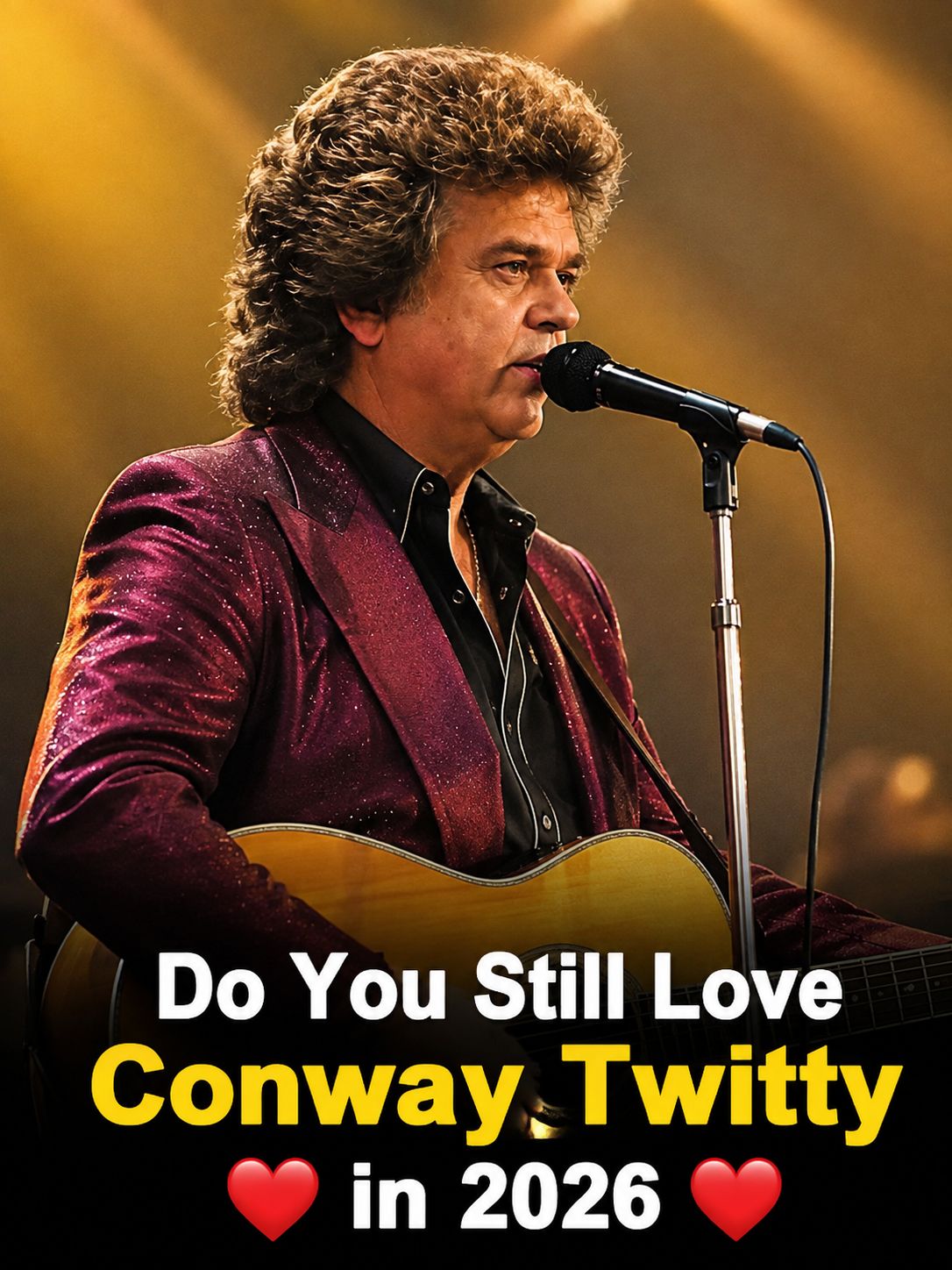
Few voices in country music ever carried the weight, warmth, and unmistakable emotion of Conway Twitty.
For decades, his deep voice became the soundtrack to heartbreak, romance, regret, and second chances. He was the man behind songs such as “Hello Darlin’,” “Tight Fittin’ Jeans,” “Linda on My Mind,” and countless other country classics. He conquered charts, packed theaters, recorded with legends, and built a relationship with his audience that few performers could match.
But on a June night in 1993, everything changed.
Conway Twitty was only 59 years old.
And what happened in his final hours was so sudden that the country music world struggled to understand how a man who seemed to have so much music left in him could disappear almost overnight.
THE MAN WHO REFUSED TO SLOW DOWN
By the beginning of the 1990s, Conway Twitty had already lived several musical lives.
Born Harold Lloyd Jenkins in 1933, he first found success as a rock-and-roll performer before making one of the boldest career transformations in American music. His 1958 smash “It’s Only Make Believe” made him a pop sensation, but instead of remaining trapped in the world of teenage rock fame, Twitty eventually turned toward country music.
That decision changed everything.
His country career became extraordinary. The Country Music Hall of Fame notes that Twitty achieved more No. 1 records than any country artist had reached at that time, and that 11 of those No. 1 songs were written by Twitty himself.
He wasn’t simply a singer.
He was a storyteller.
And perhaps more importantly, he understood what country audiences wanted to feel.
His voice could sound confident one moment and completely broken the next.
That ability made songs about love and loss feel personal.
“He was a song’s best friend, because he could really sing.”
That was how fellow country star Mel Tillis remembered him after his death.
It was an extraordinary compliment—and one that captured the essence of Twitty’s career.
HIS VOICE WAS STILL WORKING
Perhaps the most heartbreaking part of Conway Twitty’s story is that he wasn’t preparing to disappear.
He was still working.
Still recording.
Still performing.
Still moving forward.
His career had not faded into nostalgia.
In fact, the Country Music Hall of Fame records that Twitty remained active in the early 1990s, scoring Top Ten hits including “Crazy in Love” and “I Couldn’t See You Leavin’.” He had also continued recording and was working with material that would appear after his death.
His final studio album would carry a title that, in hindsight, feels almost painfully prophetic:
Final Touches.
It was recorded before his death and released later in 1993.
At the time, however, nobody could have known how haunting that title would become.
JUNE 4, 1993 — THE NIGHT EVERYTHING CHANGED
On June 4, 1993, Twitty performed in Branson, Missouri.
It was another night on the road for an artist who had spent much of his life traveling from stage to stage.
But there were warning signs.
Contemporary reports indicate that Twitty experienced stomach discomfort that day, yet he performed anyway. After the show, he boarded his tour bus as he began the journey toward Tennessee.
He was heading toward Hendersonville, Tennessee, and the Nashville area.
He never made it home.
During a stop in southwest Missouri, Twitty collapsed on the bus.
The man who had spent decades commanding enormous stages suddenly needed emergency medical help.
He was rushed to Cox Medical Center-South in Springfield, Missouri.
Doctors discovered a ruptured abdominal aneurysm.
Emergency surgery followed.
The situation was critical.
And suddenly, the country music world was waiting for news.
A FAMILY WAITING AT THE HOSPITAL
The final hours were devastatingly different from the life Twitty had known on stage.
There were no bright lights.
No cheering audience.
No microphone in his hand.
Instead, there was a hospital room and a family hoping that the legendary singer would somehow pull through.
His wife, Dee Henry, relatives, and members of his band were with him at the hospital. Reports said his family was summoned as doctors fought to save him.
Twitty was only 59.
For someone who had spent his career singing about the fragility of love, life was suddenly confronting him with its own fragility.
And there was another painful connection.
Loretta Lynn, his legendary duet partner and close friend, was also in the same hospital because her husband, Mooney Lynn, was recovering from heart surgery.
The news devastated her.
“I’ve not only lost a great singing partner but also a great friend.”
Those were Loretta Lynn’s words after Twitty’s death.
For fans, Conway and Loretta had been one of country music’s defining partnerships.
For Loretta, Conway was something much more personal.
A friend was gone.
THE END CAME TOO SOON
On June 5, 1993, Conway Twitty died.
He was 59.
The cause was complications from emergency surgery after the abdominal aneurysm ruptured.
The news spread through Nashville with stunning speed.
A man who had spent nearly four decades reinventing himself, performing for audiences, recording songs, and building one of country music’s greatest legacies was suddenly gone.
The timing made the tragedy even harder to comprehend.
He had been on the road.
He had been performing.
He was still making records.
He was still having hits.
There was no long farewell tour.
No final announcement telling fans that the end was near.
There was simply a performance in Branson—and then a hospital.
That is why Conway Twitty’s death remains one of the most shocking endings in country music history.
THE VOICE THAT NEVER NEEDED TO SHOUT
Twitty’s influence wasn’t built on spectacle alone.
He had a rare ability to make a listener feel as though he were singing directly to them.
He understood silence.
He understood restraint.
And he understood that sometimes the quietest voice could deliver the biggest emotional blow.
His partnership with Loretta Lynn produced some of the most celebrated country duets of the era. Together, they won the CMA Vocal Duo of the Year four consecutive times from 1972 through 1975, and their 1971 recording “After the Fire Is Gone” won a Grammy.
But his legacy extended far beyond duets.
He had successfully crossed from rock and roll into country music.
He survived changing musical fashions.
He continued finding songs that connected with listeners.
And he became one of the most commercially successful country artists of his generation.
THE IRONY OF “FINAL TOUCHES”
There is something almost unbearably poignant about the title of Conway Twitty’s final album.
Final Touches.
He could not have known how those words would sound after June 5.
To fans, the title eventually became more than the name of a record.
It became a reminder of a career interrupted before the artist was ready to stop.
Twitty had not reached the end because his audience had stopped listening.
He had not retired because his voice had failed.
He was still working.
Still performing.
Still recording.
His story simply ended before anyone expected it to.
WHAT CONWAY TWITTY LEFT BEHIND
The Country Music Hall of Fame inducted Conway Twitty in 1999, six years after his death.
But awards and Hall of Fame plaques only tell part of the story.
His real legacy lives in the recordings.
It lives in the singers who learned from him.
It lives in the songwriters who understood that Twitty could take a great song and make it unforgettable.
It lives in the fans who still hear the opening notes of “Hello Darlin’” and instantly remember another time, another place, another person.
And perhaps that is the greatest measure of a country artist.
Not how long they lived.
But how long their voice stayed with people after they were gone.
“He didn’t do a lot of talking on stage. He said he let his music do his talking.”
Mel Tillis’s observation has become almost prophetic.
Because Conway Twitty is still talking.
Every time an old record spins.
Every time a forgotten love story is remembered.
Every time someone hears that unmistakable baritone and realizes that heartbreak sounded different when Conway sang it.
A LEGACY THAT REFUSED TO DIE
Conway Twitty’s final days were tragic precisely because they were so unexpected.
He wasn’t a fading legend waiting quietly for the curtain to fall.
He was still moving.
Still creating.
Still performing.
Still reaching people.
And then, in the space of one night, the road home became the final journey.
More than three decades later, his death remains heartbreaking—but it is no longer the most important part of his story.
The important part is what came before it.
The transformation from Harold Jenkins to Conway Twitty.
The leap from rock and roll to country.
The unforgettable duets with Loretta Lynn.
The countless chart successes.
The songs that became emotional landmarks for generations of listeners.
And that voice.
That deep, unmistakable voice.
Conway Twitty may have left the stage in 1993.
But he never really left country music.
Because legends do not disappear when the lights go out.
They remain in the songs.
And Conway Twitty left behind enough songs to keep his voice alive for generations.
“If you do what you love and you’re able to take care of the people you love, it doesn’t matter what you do. You’re a successful man.”
Those words, preserved through Twitty’s official legacy, may ultimately be the most fitting epitaph for a man whose career was built on exactly that philosophy.
He loved music.
He loved his audience.
He kept working.
And when the final curtain came far too early, country music was left with something that could never be taken away:
the voice of Conway Twitty.
VIDEO: