 By admin
 INTRODUCTION:
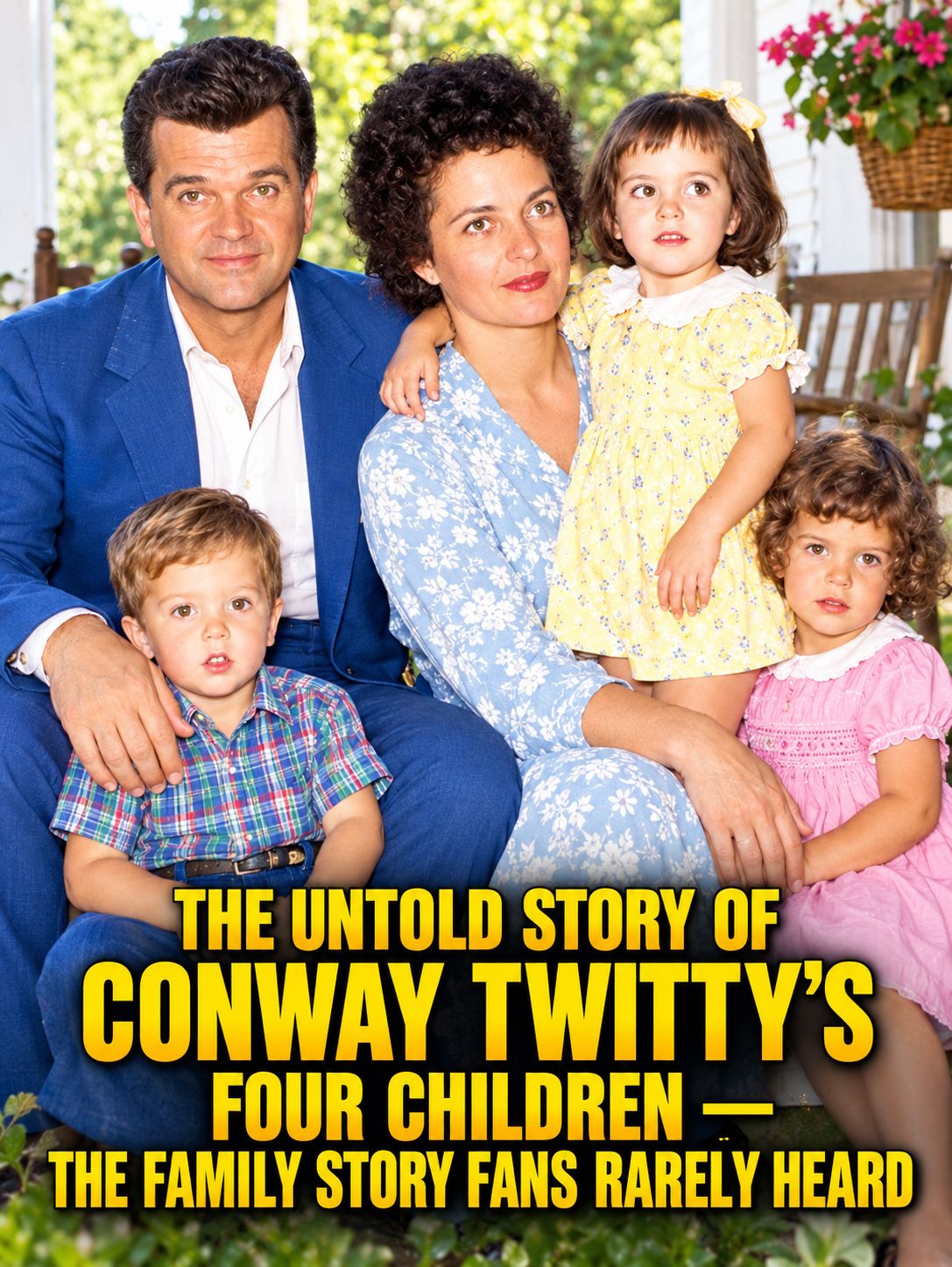
For millions of country music fans, Conway Twitty was the unmistakable voice behind heartbreak, romance, longing, and the complicated emotions that men and women often struggled to say out loud.
He was the man who could walk onto a stage, pick up a microphone, and make an arena full of strangers feel as though he were singing directly to one person.
But behind the spotlight was another Conway Twitty — a father.
And while fans spent decades learning his songs, watching his performances, and following his legendary career, much less attention was given to the four children who lived behind the famous name: Michael, Joni, Kathy, and Jimmy.
When Conway died suddenly on June 5, 1993, at only 59 years old, the public conversation naturally centered on the loss of a country music giant. Contemporary reports confirmed that his four children survived him.
Yet behind that headline was something far more personal.
A family had lost a father.
And unlike the millions of fans who could replay Conway’s records whenever they wanted, his children could never simply turn on the radio and hear him without remembering the man behind the voice.
The world lost Conway Twitty the superstar. His children lost Conway the father.
That distinction is the beginning of a family story that rarely receives the same attention as his music.
THE MAN BEHIND THE LEGEND
Before Conway Twitty became one of country music’s most successful artists, he was Harold Lloyd Jenkins.
Born in Friars Point, Mississippi, in 1933, he grew up in Arkansas and developed an extraordinary love for music. He learned guitar at a young age and formed his first band when he was only 10. Later, he would briefly chase baseball before music ultimately became his destiny.
His career was anything but ordinary.
He began in rock and roll, scored a massive pop hit with “It’s Only Make Believe,” and eventually made the daring transition into country music. The decision transformed him into one of the defining voices of Nashville.
By the height of his career, Conway had accumulated an extraordinary number of No. 1 records and had become a fixture of country radio. The Country Music Hall of Fame notes that his stardom endured across five decades and that he achieved more No. 1 records than any country artist had achieved at the time.
But success came with a price.
Conway spent enormous amounts of time performing, recording, traveling, and building his business empire.
And that makes the story of his children particularly fascinating.
Because they didn’t grow up simply as the children of a famous singer.
They grew up inside the world of Conway Twitty.
FOUR CHILDREN, FOUR DIFFERENT PATHS
Conway’s four children were Michael, Joni, Kathy, and Jimmy.
Contemporary accounts reported that all four were living at Twitty City around the time of their father’s death.
That detail is important because Twitty City was more than a tourist attraction.
Opened in Hendersonville in 1982, the nine-acre complex became a remarkable reflection of Conway’s world. It contained performance facilities, homes for family members, business operations, and attractions built around the singer’s career. Conway’s official biography describes the homes of his four adult children as part of the complex.
Imagine growing up with your father’s name literally surrounding you.
Fans came to see the legend.
But you knew the man who came home.
You knew the voice from another side.
You knew the person who wasn’t standing beneath stage lights.
And that difference can change everything.
MICHAEL TWITTY — THE SON WHO FOLLOWED THE MUSIC
Among Conway’s children, Michael Twitty was one of those who stepped toward the family musical legacy.
According to Wide Open Country, Michael began pursuing country music in the 1970s and recorded singles for Capitol Records, including “Mississippi Rolling Stone” and “The Closest Thing to You.”
Following a famous father into the same profession is never easy.
The audience doesn’t simply hear your voice.
They hear your father’s voice.
Every similarity becomes a comparison.
Every difference becomes a criticism.
And every performance carries an invisible question:
Can you ever escape the shadow of Conway Twitty?
For Michael, the answer was not necessarily about escaping it.
Perhaps it was about learning to live with it.
JONI LEE — THE VOICE FANS REMEMBER
Then there was Joni Lee, Conway’s daughter and one of the children who became publicly associated with music.
Her connection to her father produced one of the most memorable musical moments involving a Twitty child: “Don’t Cry Joni.”
The song became a major hit and remains one of the most recognizable examples of Conway performing alongside one of his children.
What made the recording so powerful wasn’t simply the melody.
It was the story.
A father and daughter were sharing a musical moment, but listeners could hear something beyond the production — a relationship being transformed into a song.
For fans, it became entertainment.
For a family, it was a memory.
That is one of the strange things about celebrity families: the public remembers the recording, while the people involved remember the day.
KATHY — THE DAUGHTER WHO DEFENDED HER FAMILY
Kathy Twitty represents another fascinating part of the family’s story.
Unlike the polished image of country music, the years following Conway’s death brought difficult family and estate issues into public view.
In 1999, Kathy publicly addressed criticism surrounding her family after Conway’s induction into the Country Music Hall of Fame and disputed claims about why the children had not accepted the honor in person. Her statement also discussed the family’s lengthy legal battle concerning their father’s estate.
This is where the glamorous image of a country music dynasty collided with reality.
Conway had left behind music, property, business interests, copyrights, memorabilia, and a famous name.
But a legacy isn’t always simple to divide.
Sometimes the hardest part of inheriting a legend is not the money.
It is deciding what that legend means.
JIMMY — THE CHILD WHO CHOSE A QUIETER ROAD
And then there was Jimmy Twitty.
While Michael, Joni, and Kathy became associated with music to varying degrees, Jimmy appears to have remained much further from the center of the country music spotlight.
Wide Open Country describes Jimmy as the fourth child and notes that he seemed content away from the country music spotlight.
His quieter path is an important reminder.
Being born into a famous family does not mean everyone wants fame.
Some children inherit a name.
Others inherit memories.
And some simply want to live their own lives.
THE FAMILY’S GREATEST CHALLENGE CAME AFTER CONWAY’S DEATH
Perhaps the most painful chapter wasn’t during Conway’s years of fame.
It came after he was gone.
On June 5, 1993, Conway collapsed while traveling home after a performance in Branson, Missouri. He was taken to a Springfield hospital and died at age 59 from complications following surgery after a blood vessel ruptured in his stomach. Reports said members of his family were with him.
Think about the timing.
At 59, Conway still seemed like someone who belonged on the road.
There were more songs.
More concerts.
More years that fans assumed were waiting.
But suddenly, there weren’t.
For his children, the future had been rewritten in a single moment.
And then came the responsibility of protecting what their father had built.
The four children eventually became involved in lengthy legal disputes concerning the estate. A 1999 report described appellate-court victories involving several major estate issues and noted that the children’s fight had lasted years.
That part of the story is rarely included when people talk about “Hello Darlin’” or “You’ve Never Been This Far Before.”
But it is part of the legacy.
THE LEGACY WAS NEVER JUST THE RECORDS
There is an irony in the way history remembers musicians.
We measure them in awards.
Chart positions.
Record sales.
No. 1 singles.
Hall of Fame inductions.
Conway certainly had all of those.
The Country Music Hall of Fame recognizes him as one of the most successful and diverse stylists in country music history.
But perhaps the most meaningful measure of his life was never printed on a chart.
It was his children.
The people who knew him before the audience knew his name.
The people who saw him when the stage lights were off.
The people who could call him Dad instead of Conway.
A superstar can belong to millions of fans. A father belongs to his children in a completely different way.
That is why the story of Michael, Joni, Kathy, and Jimmy deserves to be remembered.
Not because they were simply Conway Twitty’s children.
But because they were individuals who had to build their own identities underneath one of the biggest names in country music.
THE FINAL MEMORY OF A FATHER
Today, when Conway Twitty’s voice comes through the speakers, it is easy to imagine the superstar.
The deep voice.
The perfectly controlled emotion.
The songs about love and loss.
The unmistakable stage presence.
But somewhere behind that public image was a man who had children waiting for him to come home.
And when Conway died, the world mourned the singer.
His children had to mourn something much more personal.
They weren’t saying goodbye to an icon.
They were saying goodbye to their father.
That may be the greatest untold chapter of the Conway Twitty story.
Because the history books can document the records.
They can document the awards.
They can document the tours, the hits, the duets with Loretta Lynn, and the extraordinary career that eventually earned him induction into the Country Music Hall of Fame in 1999.
But no chart can measure what a child remembers about a parent.
No award can capture the sound of a father’s voice at home.
And no biography can fully explain what it meant for four children to lose the man behind the legend.
Michael. Joni. Kathy. Jimmy.
Four children.
One extraordinary father.
And a family story that reminds us that behind every country music legend is a human being — and behind every famous name, there may be a family carrying memories the public will never completely know.
Perhaps that is why Conway Twitty’s music still feels so personal decades later.
He spent his career singing about the things people couldn’t say.
And in the end, his own children were left carrying a story that words could never completely capture.
VIDEO: