 By admin
 INTRODUCTION:
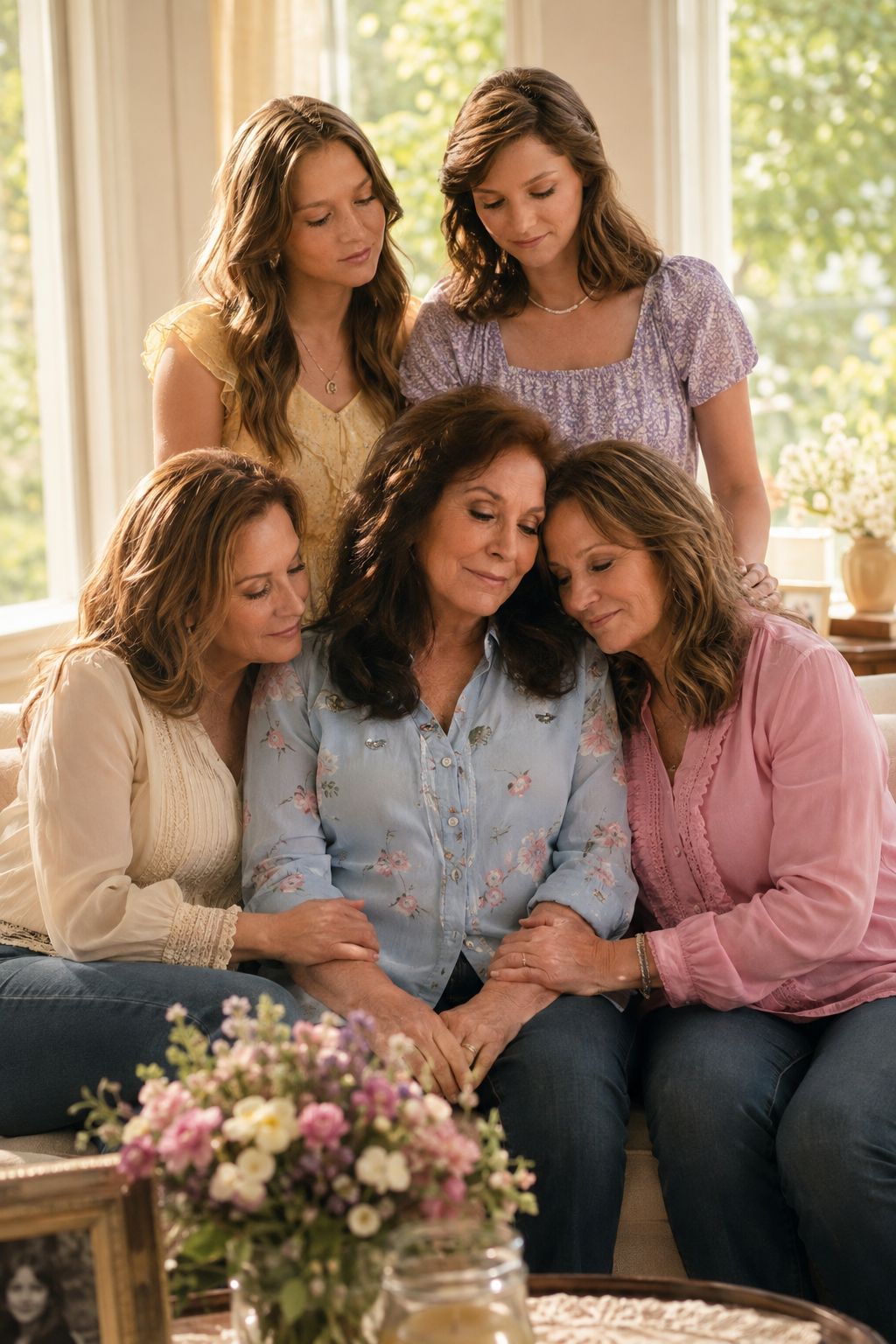
For decades, the world knew Loretta Lynn as the woman who could turn a hard life into a country song.
She was the Coal Miner’s Daughter. The fearless voice behind songs about marriage, heartbreak, motherhood, betrayal, poverty, faith, and survival. She stood on enormous stages, collected honors, inspired generations of women, and became one of the most recognizable figures country music has ever produced.
But to her daughters, she was not a legend.
She was Momma.
And that difference changes everything.
After Loretta Lynn died on October 4, 2022, at the age of 90, the public mourned an icon. Her daughters, particularly twins Patsy and Peggy Lynn, mourned the woman whose voice had been part of their lives long before it became part of American musical history. Their memories reveal a side of Loretta that the stage lights could never completely capture.
“WE DIDN’T GET OUR MOTHER”
Perhaps the most heartbreaking part of the Lynn daughters’ story is not that their mother was famous.
It is that she belonged to everyone.
Patsy and Peggy grew up surrounded by country music, but they also grew up understanding that their mother’s career demanded enormous sacrifices. In a 1998 interview, Patsy put that complicated childhood into words that still resonate:
“You know what I got? I didn’t get my mother. I shared my mother with millions of people.”
That sentence contains an entire childhood.
Loretta was building a career while raising six children. Her daughters saw the glamour, but they also saw the price of it. They understood that the woman audiences celebrated as a country-music pioneer had to spend long stretches away from home.
Peggy later acknowledged the same painful contradiction: they had extraordinary opportunities because of their mother, but Loretta herself had sacrificed enormously to make those opportunities possible.
That is the part of Loretta Lynn’s story that can disappear beneath the awards, hit records, rhinestones, and photographs.
Her daughters remember the cost.
BEFORE THEY WERE THE LYNNS, THEY WERE JUST TWO FARM GIRLS
Patsy and Peggy did not grow up believing they were destined to become famous musicians.
In fact, when they eventually began performing together professionally, they deliberately tried to establish themselves without leaning on their mother’s name.
They spent time performing at Nashville’s Tootsie’s Orchid Lounge under the name the Honk-a-Billies. They wanted audiences to hear their music before discovering whose daughters they were.
“We didn’t want anybody to know of our lineage because it has to be about the music, period,” Peggy explained during their early career.
That decision says a great deal about how Loretta raised them.
They were surrounded by fame, but they were not encouraged to believe fame was an entitlement.
Patsy and Peggy remembered being raised with the grounding of ordinary country life. Their father, Mooney Lynn, expected them to work, attend school, go to church, and understand the value of earning their way.
Even as daughters of a superstar, they were still farm girls.
And that was exactly how they wanted people to see them.
THE LITTLE MEMORIES THAT HURT THE MOST
After a parent dies, the memories that remain are often not the dramatic ones.
They are the ordinary ones.
A phone call.
A familiar laugh.
A favorite expression.
A birthday song.
For Patsy, one of the hardest losses was astonishingly simple.
On the first birthday she and Peggy experienced without their mother, she remembered that Loretta was no longer there to make the call and sing “Happy Birthday.”
“It’s always the little things we miss the most.”
That reflection is devastating precisely because it is so ordinary.
The world remembers Loretta Lynn performing on the Grand Ole Opry.
Her daughters remember hearing their mother’s voice on a birthday phone call.
The world remembers “Coal Miner’s Daughter.”
Her daughters remember Momma.
And sometimes, the second memory is the one that hurts more.
THEIR MOTHER WAS THEIR BIGGEST INFLUENCE — AND THEIR BIGGEST CRITIC
When Patsy and Peggy formed The Lynns, they faced an obvious problem.
How do you establish an identity when your mother is one of the most influential women in country music history?
They understood that comparisons were inevitable.
But they also never tried to pretend Loretta wasn’t their influence.
Peggy openly called their mother their biggest influence “both in life and in art.” Patsy similarly acknowledged that listeners would hear Loretta in their music—but wanted them to finish the record knowing who The Lynns were.
That balance became central to their story.
They didn’t want to escape Loretta Lynn.
They wanted to honor her without disappearing inside her shadow.
And Loretta herself understood that tension.
According to Patsy and Peggy, their mother could be both their greatest supporter and their toughest critic. That combination may have been one of the reasons their musical relationship remained so meaningful.
She didn’t simply want her daughters to inherit her name.
She wanted them to earn their own.
THE STAGE WAS NEVER JUST A STAGE
For Patsy, some of her earliest memories of Nashville were connected to Tootsie’s.
She recalled going there as a little girl with her twin sister and their father. He would sit them on the bar while he talked, creating childhood memories that would eventually become part of the family’s musical mythology. PBS later featured Patsy recalling those memories in American Masters: Loretta Lynn — Still a Mountain Girl.
Years later, Patsy and Peggy would return to that same world as performers.
There is something almost poetic about it.
The little girls sitting in a Nashville honky-tonk eventually became professional musicians themselves.
The daughters who watched their mother perform eventually stood beside her.
And the children who had once been backstage became part of the story.
LOVE, LOSS, AND THE FAMILY THAT KEPT GOING
Loretta’s family history was not free from tragedy.
She lost her son Jack Benny in 1984 and her daughter Betty Sue in 2013. Her husband, Oliver “Doolittle” Lynn, died in 1996 after years of health problems. These losses became part of the emotional landscape surrounding the family.
Yet Loretta continued.
That resilience became one of the defining characteristics her daughters inherited.
Patsy once described the emotional complexity surrounding her parents’ marriage and remembered a period when divorce was discussed. For her father, the possibility was devastating; for her mother, separation was ultimately not going to happen. The story captures the complicated, sometimes contradictory love that existed inside the Lynn household.
Loretta’s songs often contained those contradictions.
She could sing about female independence while remaining deeply attached to a complicated marriage.
She could write about heartbreak while choosing reconciliation.
She could become a symbol of strength while admitting vulnerability.
Her daughters saw all of it.
HER LEGACY IS BIGGER THAN THE SONGS
The Country Music Hall of Fame has documented how deeply Loretta’s musical influence traveled through her family. Her daughter Patsy became a performer and producer, while grandchildren such as Tayla Lynn and Emmy Rose Russell also continued the family’s musical tradition.
That may ultimately be Loretta’s most powerful legacy.
Not the trophies.
Not the chart positions.
Not even the songs.
The legacy is the people.
The children who learned from her.
The grandchildren who listened to her stories.
The musicians who absorbed her honesty.
And the fans who found pieces of their own lives in her words.
Loretta Lynn once said she wanted to be remembered for songwriting, because she would rather write a song than sing it.
Her daughters now carry those songs forward—but they also carry something more personal.
They carry the memory of the woman who existed before the spotlight.
THE WOMAN BEHIND “COAL MINER’S DAUGHTER”
It is tempting to reduce Loretta Lynn to a handful of familiar images: the Kentucky girl, the country superstar, the woman in the rhinestone dress, the fearless songwriter.
But her daughters remind us that every legend has an ordinary life hidden behind the public one.
Loretta Lynn was the woman who could command a stage in front of thousands.
She was also the mother whose daughters waited for her phone call.
She was the artist who changed country music.
She was also the woman her children watched struggle, work, love, lose, forgive, laugh, and keep moving.
And perhaps that is why their memories feel so powerful.
Because when Patsy and Peggy speak about their mother, they aren’t trying to create another legend.
They are trying to remember their mom.
The world may forever call her Loretta Lynn.
But to the daughters who knew the woman behind the microphone, she will always be something much simpler—and infinitely more precious:
Momma.
And long after the final applause has faded, that may be the most important part of her story.
VIDEO: