 By admin
 INTRODUCTION:
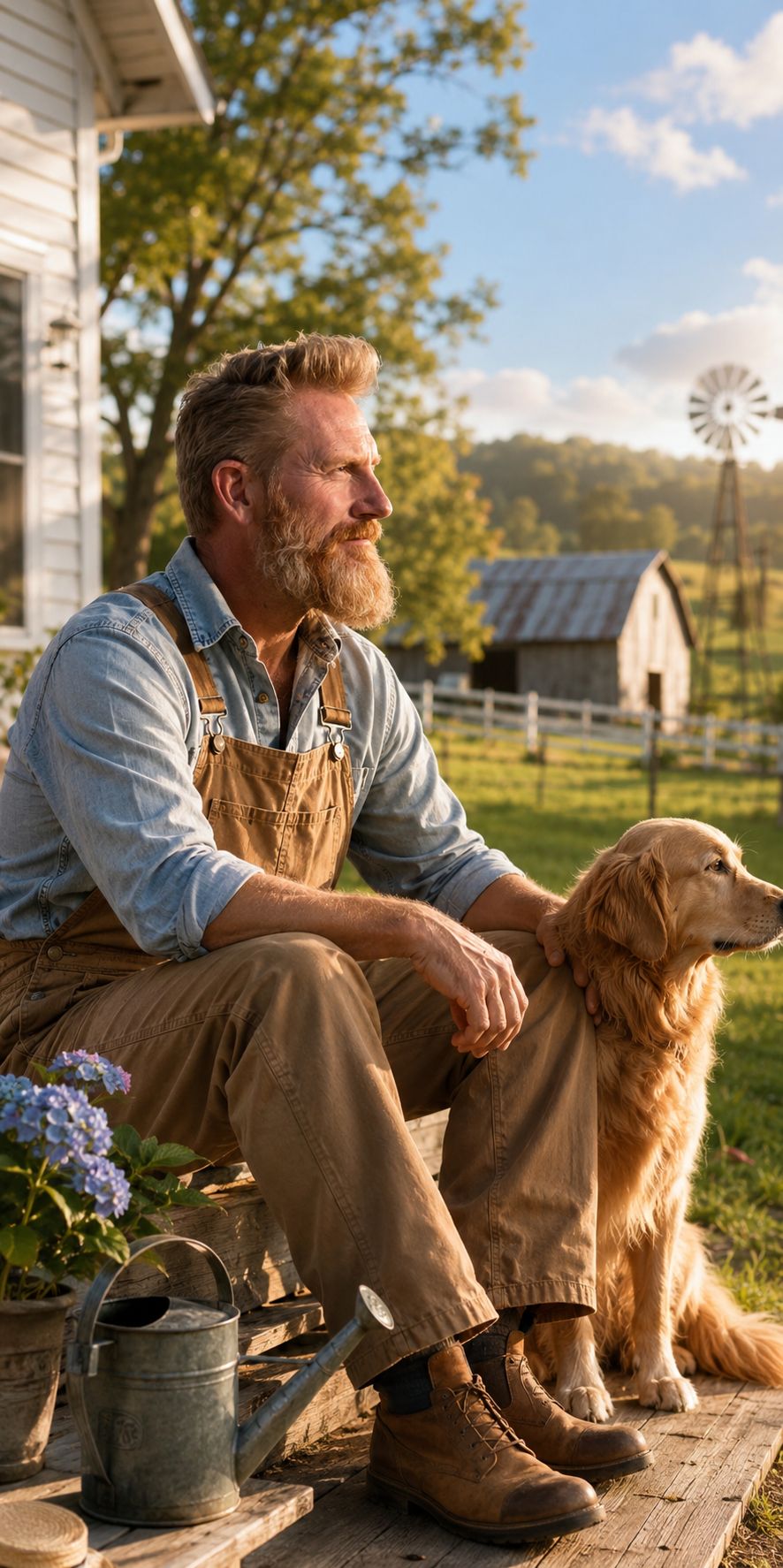
There are some country music stories that seem destined for stadium lights.
And then there is Rory Feek’s story.
It is quieter. More complicated. More human.
Away from Nashville’s red carpets and the machinery of celebrity, Feek has built a life around an old Tennessee farmhouse, fields, animals, family, faith, music, and memories that refuse to disappear. His Hardison Mill homestead, roughly an hour south of Nashville along the Duck River, has become far more than a place to live. It has become a living chapter in a story about love, devastating loss, fatherhood, remembrance, and the possibility of beginning again.
For Feek, the farm was never simply an escape from the music business.
It was home.
And after losing his wife and musical partner, Joey Feek, to cancer in March 2016, home became something even more profound: a place where grief could exist without having to become the whole story.
“Just because things don’t work out the way that you hoped they would, doesn’t mean that God isn’t still in charge.”
That philosophy has been central to the way Rory has described his life after Joey’s death. His faith did not erase the pain. Instead, he has often presented faith as the thing that allowed him to keep walking through it.
The Farm That Became Part of the Family Story
Long before tragedy transformed Rory’s public life, Hardison Mill was already part of his personal history.
In 1999, Feek used royalties from the first song he had recorded to purchase the historic farmhouse and approximately 30 acres. Over the following decades, the property grew into a roughly 100-acre homestead containing gardens, barns, a greenhouse, a concert venue, a schoolhouse, and other community spaces.
That evolution matters.
Because Rory did not simply retreat to the countryside after becoming famous.
He had been building toward this life for years.
The homestead reflects a philosophy that seems almost deliberately opposite to the modern celebrity lifestyle: slow down, grow things, teach children, gather people, make music, share food, and remember what matters.
The official Hardison Mill description captures that vision as a place where life moves more slowly, where the world becomes a classroom, and where people are encouraged to return to a more home-centered existence.
It is difficult to imagine a more fitting setting for a man whose life would eventually become so deeply intertwined with memory.
When Love Became Loss
Rory and Joey’s relationship was never merely a musical partnership.
They were husband and wife, parents, collaborators, and best friends whose story became inseparable from the music they created together.
Their country career brought them recognition, but their final years together transformed their story into something much larger.
Joey was diagnosed with cervical cancer after the birth of their daughter, Indiana. As her illness progressed, the couple continued to document their lives, their faith, their family, and their hopes.
Their final album together, Hymns That Are Important to Us, carried particular emotional weight because the project was deeply connected to Joey’s faith and the hymns she had grown up singing. She lived long enough to see the album released and become the biggest commercial success of their career.
Then came the goodbye no husband or father is ever prepared to make.
Joey died at 40.
Rory was left to navigate a life that suddenly looked nothing like the one he had imagined.
There was no longer a wife beside him.
No musical partner.
No mother beside their young daughter.
There was only the farm, the memories, the children—and the question of how to continue.
Grief Was Never Something Rory Tried to Hide
Perhaps the most remarkable thing about Rory’s approach to grief is that he never seemed interested in pretending that everything was fine.
He talked about Joey.
He listened to her music.
He watched old videos.
He allowed himself to cry.
And he allowed his daughter to remember her mother.
In an interview after Joey’s death, Rory explained that music could sometimes make him smile and other times make him emotional while he was doing something as ordinary as preparing breakfast. Rather than running from those feelings, he described embracing them as part of the process.
That is an important distinction.
Healing is not the same as forgetting.
For Rory, remembering Joey became one of the ways healing could happen.
He has spoken about Indiana recognizing her mother’s voice when one of Joey and Rory’s songs played on the radio. The moment was painful, but also strangely beautiful: a little girl recognizing the voice of a mother she was too young to fully remember through ordinary childhood experiences.
The farm became a place where those memories could remain alive.
Joey was not reduced to an old photograph on a wall.
Her presence remained woven into the landscape, the music, the family stories, and the childhood of her daughter.
Turning Pain Into Something That Could Help Others
Rory’s response to loss has also been creative.
He wrote.
He filmed.
He told stories.
His blog, This Life I Live, began before Indiana was born and eventually became a deeply personal record of the family’s journey through love, illness, loss, and faith. His official biography describes him not simply as a songwriter but as a father, farmer, author, artist, and storyteller.
His books continued that mission.
This Life I Live explored the story of Rory and Joey while also examining Rory’s own history and the experiences that shaped him. His later work, Once Upon A Farm, went deeper into his reflections on love, life, hope, and the lessons he had learned.
In other words, the story did not end when the music stopped.
It changed form.
The songwriter became a memoirist.
The performer became a storyteller.
The grieving husband became a father determined to preserve a mother’s memory for her child.
And the farm became a stage of a different kind—not for celebrity, but for ordinary life.
A Schoolhouse Built From Grief
One of the most powerful examples of Rory transforming loss into something constructive is the one-room schoolhouse at Hardison Mill.
After Joey died, people around the world sent cards, letters, encouragement, and financial gifts to the family. According to Hardison Mill, nearly $100,000 was received.
Rather than simply treating that generosity as personal support, Rory used the money to build a schoolhouse for Indiana—and ultimately for children from the wider community.
That decision says something profound about redemption.
Redemption does not necessarily mean finding a happy ending.
Sometimes it means taking something broken and asking:
What good can grow here?
A little girl lost her mother.
A father lost his wife.
A family lost its center.
And from that heartbreak came a place where children could learn together.
The school was intentionally modeled after old-fashioned one-room schoolhouses, with a small enrollment and an emphasis on community, character, practical learning, and faith.
The symbolism is almost impossible to miss.
A building for the future was born from money given in response to a devastating loss.
The Meaning of “Home” Changed
For Rory, home eventually became more than four walls.
It became a philosophy.
Hardison Mill now encompasses farming, education, gatherings, music, food, storytelling, and community. The property raises animals and grows food, while also hosting events designed around sustainable living and a more intentional family life.
That may explain why Rory’s story resonates so strongly with country music audiences.
Country music has always understood the emotional power of ordinary places.
A porch.
A kitchen.
A dirt road.
An old barn.
A family cemetery.
A farmhouse where someone remembers the person who used to sit beside them.
Rory’s life after Joey feels like an extension of that tradition.
There is no artificial separation between the extraordinary and the ordinary.
The same man who once stood on country stages now spends his life surrounded by the sounds of farm animals, children, machinery, music, and family.
And somehow, that feels more country than anything a spotlight could provide.
Faith Did Not Give Him Easy Answers
One of the biggest misconceptions about faith in stories of grief is that faith is supposed to make suffering disappear.
Rory’s own words suggest something very different.
He has acknowledged that he does not understand everything. Yet he has continued to believe that his life belongs to something larger than his own plans.
That makes his faith feel less like certainty and more like endurance.
“Faith requires faith, and that never really stops.”
There is something deeply country about that sentiment.
You do not control the weather.
You do not control the harvest.
You cannot control illness.
You cannot control death.
But you can decide what you will do with the next morning.
You can plant something.
You can feed someone.
You can teach a child.
You can write a song.
You can remember someone you loved.
You can keep going.
The Story Is Still Being Written
Rory’s life has continued to evolve in ways that would have been impossible to predict during the Joey+Rory years.
He has continued writing, farming, creating films and books, and sharing stories from the homestead. His life today is not a museum dedicated to the past. It is still moving forward.
And that may be the most important part of the story.
Because remembrance and moving on are not opposites.
You can remember someone and still build a new life.
You can miss the past and still be grateful for the future.
You can carry grief without allowing grief to carry you.
And perhaps that is what Rory Feek’s quiet farm life ultimately represents.
Not an escape from loss.
But a way of living with it.
The fields do not erase Joey.
The music does not erase Joey.
The schoolhouse does not erase Joey.
Indiana growing older does not erase Joey.
Instead, each new chapter becomes another place where her memory can live.
And that is why Rory’s story remains so compelling to country music fans.
It is not really a story about a celebrity disappearing from the spotlight.
It is a story about a man discovering that the most important songs of his life might not be the ones he performed onstage.
They might be the ones he lives every day.
A father teaching his daughter where she came from.
A farmer tending the land.
A storyteller refusing to let love become forgotten.
A believer continuing despite unanswered questions.
A man learning that redemption sometimes looks remarkably ordinary.
A sunrise over a Tennessee field.
A child laughing.
A song playing from an old recording.
A memory that still hurts.
And another morning that begins anyway.
“There are some things in life we don’t get to choose. But we do get to choose what we do with the life we’ve been given.”
That may be the quietest—and most powerful—lesson in Rory Feek’s story.
The music changed.
The family changed.
The future changed.
But the song never truly ended.
It simply moved from the stage to the soil, from the microphone to the kitchen table, from the applause of strangers to the laughter of a child.
And somewhere on that Tennessee farm, surrounded by the land he has spent decades nurturing, Rory Feek continues to write the next verse.
Not a story without loss.
A story that proves loss does not have to be the final word.
VIDEO: