 By admin
 INTRODUCTION:
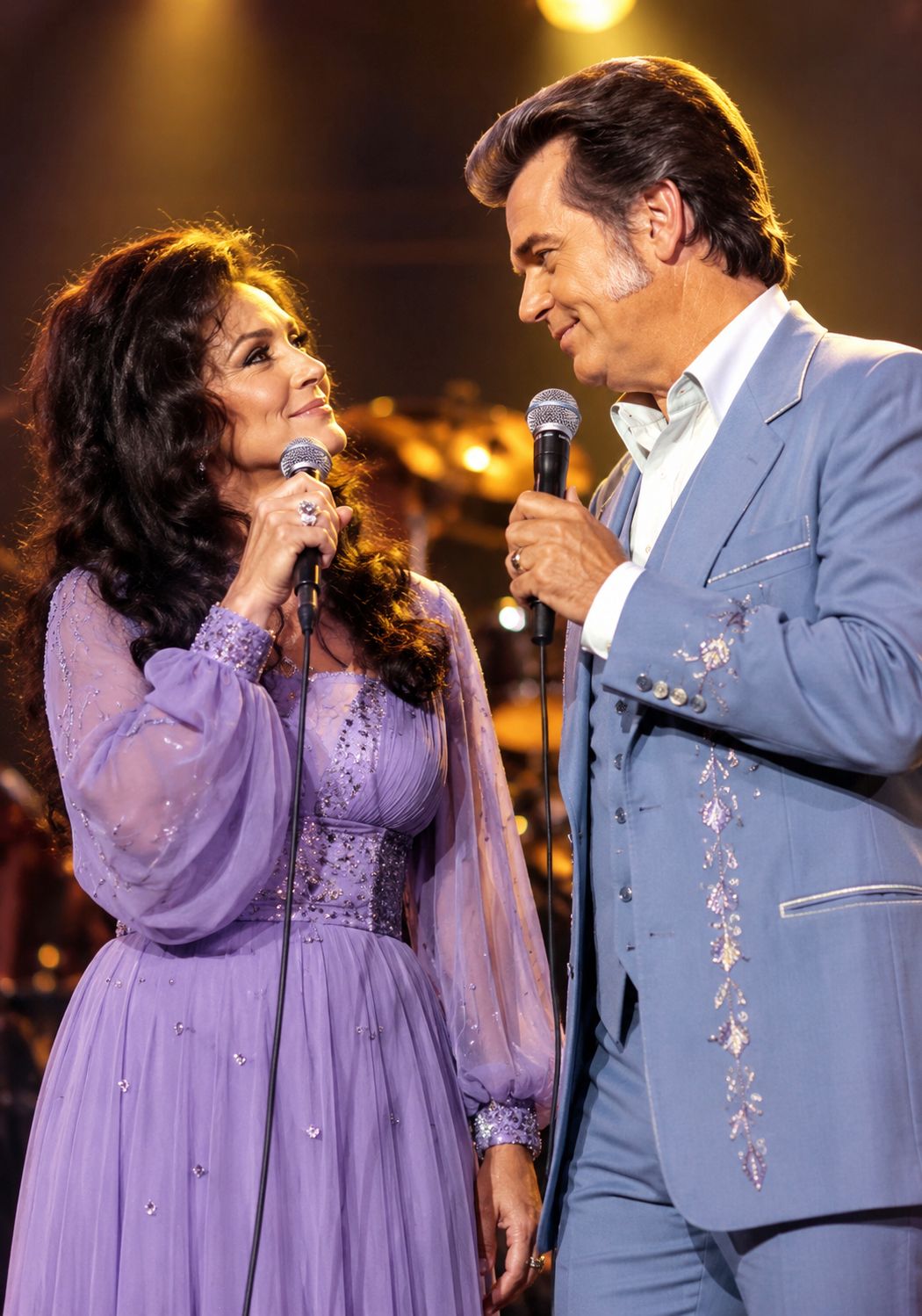
There are performances that entertain an audience.
And then there are performances that seem to change the temperature in the room.
Conway Twitty had a rare gift for creating the second kind.
He could walk onto a stage in front of thousands of people, say almost nothing, and still command every pair of eyes in the building. His voice did the talking. His pauses did the talking. Even a glance could become part of the performance.
But when Loretta Lynn was standing nearby, something different happened.
The legendary partnership between Twitty and Lynn had always carried a special kind of electricity. They weren’t simply two successful country singers sharing a microphone. They had developed a musical chemistry so convincing that audiences sometimes wondered whether there was something more behind the scenes.
Loretta herself later put those rumors to rest.
“I loved Conway as a friend, and my husband loved him.”
Yet friendship did nothing to diminish what audiences felt when the two performers shared a stage.
In fact, it may have made the chemistry even more remarkable.
The Man Who Could Own a Room Without Saying Much
By the time Conway Twitty became one of country music’s biggest stars, he had perfected a performance style built around restraint.
The Country Music Hall of Fame describes his singing as intensely emotional, while noting that his concerts had a dramatic, minimalist quality. His crowds could become almost revival-like in their enthusiasm.
Twitty wasn’t the kind of performer who needed endless jokes between songs or long speeches about his career.
His philosophy was simple.
“I do talk, but the communication is through my music.”
That philosophy explains why a moment as simple as turning toward another singer could carry so much weight.
He understood that an audience watches what happens between the words.
And nobody understood that better than Conway Twitty.
Then There Was Loretta
Loretta Lynn was a completely different kind of force.
Her voice carried the plainspoken honesty of the country life she had lived and written about. She could sing about marriage, heartbreak, motherhood, temptation, poverty, pride and resilience without making any of it feel artificial.
Put her beside Conway, and the contrast became irresistible.
He brought the smooth, controlled voice.
She brought the earthy, fearless edge.
Together, they sounded like two people having a conversation that the audience had accidentally been allowed to overhear.
Their partnership became one of the most successful male-female collaborations in country music history. Twitty and Lynn recorded eleven studio albums together between 1971 and 1988, produced multiple No. 1 hits, and won the CMA Vocal Duo of the Year award four consecutive times from 1972 through 1975.
Their success wasn’t based on gimmicks.
It was chemistry.
And chemistry is something an audience can recognize almost instantly.
The Turn That Could Change Everything
Imagine the scene.
The lights are on.
The band is playing.
The crowd is already completely invested.
Conway Twitty stands at center stage, delivering a song with that unmistakably controlled voice. Thousands of people are watching him, waiting for the next line.
Then, almost casually, he turns.
Not toward the audience.
Toward Loretta.
Suddenly, the song feels different.
That’s the magic behind so many Twitty-Lynn performances.
Twitty frequently performed “Hello Darlin’” directly to Loretta when they appeared together. The song itself had become his signature, his standard concert opener, and one of the defining recordings of his career.
And “Hello Darlin’” wasn’t an ordinary love song.
It was a song about encountering an old flame, pretending everything was fine, and then admitting that the heart never really moved on.
When Twitty sang those words toward Loretta, the performance naturally took on another layer.
The audience knew the two performers had an extraordinary history together.
They knew the records.
They knew the duets.
They knew the awards.
And they knew the rumors.
So when his attention shifted from the crowd to Loretta, listeners didn’t necessarily need another word.
The look itself became part of the story.
Why Fans Couldn’t Look Away
There was always an illusion of intimacy when Conway and Loretta performed together.
That doesn’t mean the romance was real.
It means they were extraordinarily good at storytelling.
Their songs required them to sound like two people caught in complicated relationships, pulled together by desire, frustration, humor and circumstance.
“After the Fire Is Gone” is a perfect example.
“Louisiana Woman, Mississippi Man” is another.
The latter became one of their signature songs, and the pair’s ability to play off one another vocally helped make their recordings unforgettable.
The audience wasn’t simply listening to two singers.
They were watching characters come alive.
And Conway knew exactly how to make that illusion work.
A pause.
A smile.
A turn toward Loretta.
A perfectly timed lyric.
That was enough.
The Rumors Were Part of the Phenomenon
The public fascination with Conway and Loretta became so intense that people naturally wondered about their relationship.
Were they secretly in love?
Was their chemistry more than professional?
Was there something happening backstage?
Loretta’s answer was remarkably straightforward: no.
She described Conway as a friend and emphasized that her husband, Doo, loved and respected him as well.
That distinction matters.
Because their chemistry didn’t need a real-life romance to be powerful.
If anything, the fact that two friends could create such convincing emotional tension through music says even more about their talent.
They were actors without scripts.
They were storytellers without costumes.
And their stage was a country-music concert.
The Silence Was the Point
That’s why the imagined “silence” in moments like these feels so powerful.
It isn’t necessarily a documented silence where thousands of people literally stopped breathing at the exact same second.
Rather, it’s the emotional silence created when an audience suddenly realizes that something meaningful is happening.
The crowd has been singing along.
People are cheering.
The band is playing.
Then Conway turns toward Loretta.
For one second, the spectacle disappears.
There are no awards.
No chart statistics.
No record sales.
No Nashville politics.
Just two country singers who knew exactly how to tell a story.
And suddenly, everyone is watching them.
A Partnership That Outlived the Stage
The remarkable thing about Conway Twitty and Loretta Lynn is that their musical partnership has continued to resonate decades after they stopped performing together regularly.
The pair eventually stopped touring together full-time in 1981. Twitty died in 1993, but the music never disappeared.
Today, their grandchildren Tre Twitty and Tayla Lynn continue to perform as Twitty & Lynn, celebrating the musical legacy of their grandparents.
Their show deliberately recreates the spirit of those classic performances, allowing new generations to experience songs such as “Louisiana Woman, Mississippi Man,” “After the Fire Is Gone,” and “Hello Darlin’.”
That may be the clearest evidence of all.
The magic wasn’t dependent on one particular decade.
It wasn’t dependent on television technology or elaborate production.
It lived inside the songs.
What Made Conway and Loretta Different?
Country music has produced countless famous duos.
But Conway and Loretta had something unusually difficult to manufacture: believable emotional tension.
Neither performer had to overpower the other.
Twitty’s restraint gave Lynn room to respond.
Lynn’s emotional directness gave Twitty something to play against.
One voice pulled.
The other answered.
One looked.
The other reacted.
And the audience filled in the story.
That’s what great country music has always done.
It leaves enough space for listeners to bring their own memories into the song.
Decades Later, the Moment Still Works
Maybe that’s why these performances continue to circulate among country fans.
A modern audience can watch an old clip and still understand immediately what made the moment special.
The clothes may look dated.
The stage may look smaller.
The cameras may move differently.
But when Conway Twitty turns toward Loretta Lynn, the emotional language remains universal.
A glance can still mean longing.
A smile can still mean mischief.
A lyric can still feel personal.
And two voices can still make an entire room believe in a story for three minutes.
That was the genius of Conway Twitty and Loretta Lynn.
They didn’t have to convince the audience that they were lovers.
They only had to convince the audience that, for the length of a song, these two characters mattered.
And they did.
Perhaps that’s why the most unforgettable moments between them weren’t always the biggest notes or loudest cheers.
Sometimes it was simply Conway singing to the crowd…
…and then turning toward Loretta.
For a heartbeat, the entire performance seemed to narrow down to just the two of them.
And that was when the real magic began.
VIDEO: