 By admin
 INTRODUCTION:
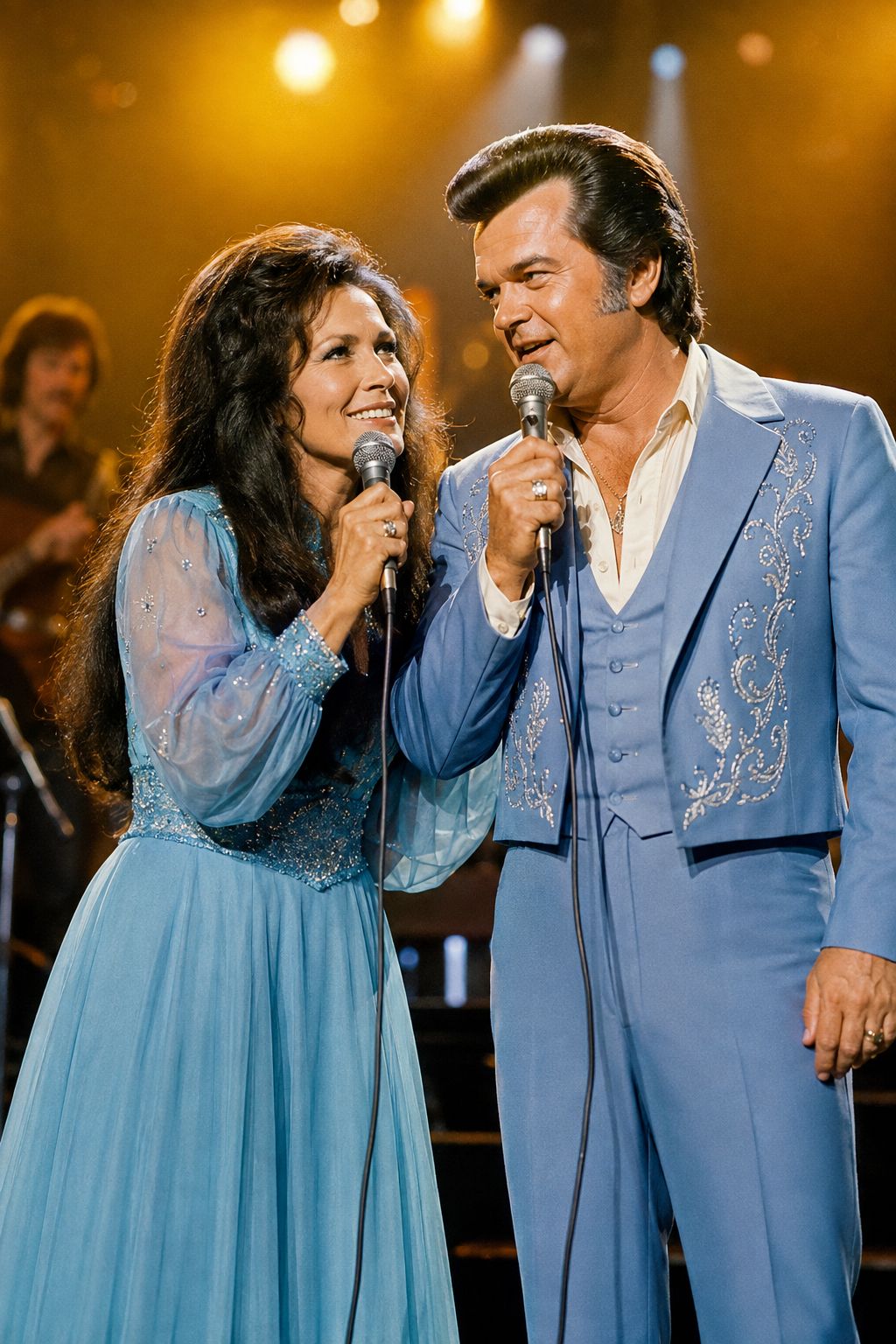
There are great singers.
There are great songs.
And then there are rare musical partnerships that make an audience forget, for a few minutes, that they are watching a performance at all.
That was Conway Twitty and Loretta Lynn.
When the two walked onto a stage together, something changed. The room seemed smaller. The distance between singer and audience disappeared. And when their voices met, it could sound less like two country stars singing a duet and more like two people caught in the middle of a very private conversation.
That illusion was one of the greatest achievements in country music.
And perhaps the most remarkable part?
They weren’t lovers. They were friends.
Loretta herself later made that distinction very clear. But their ability to make millions believe every word they sang became part of the legend.
The Moment the Magic Began
The story didn’t begin with some carefully manufactured superstar pairing.
According to Loretta Lynn, she and Conway Twitty began singing together in dressing rooms while they were overseas performing. Something about the voices worked.
So they decided to take the experiment back to Nashville.
Their producer, Owen Bradley, heard them.
His response was essentially: Get into the studio.
And country music history changed.
Their first major collaboration was “After the Fire Is Gone,” released in 1971. The song became their first No. 1 country hit together and ultimately earned them a Grammy.
But the song itself was almost dangerous.
It wasn’t a sweet love song.
It wasn’t innocent.
It told the story of two people whose relationships had lost their passion—and who found themselves drawn toward one another.
And Conway and Loretta didn’t sing it like actors reading lines.
They made it feel real.
That was the secret.
“They Weren’t Lovers”—But Audiences Couldn’t Stop Believing
Listen closely to the best Twitty-Lynn performances and you’ll notice something extraordinary.
They rarely needed exaggerated gestures.
They didn’t have to manufacture drama.
A glance could do it.
A pause could do it.
One singer finishing the other’s line could do it.
Their voices seemed to anticipate each other.
That chemistry became so convincing that audiences began wondering whether there was something more between them.
Loretta Lynn eventually addressed the rumors directly:
“Everybody thought me and Conway had a thing going.”
But she explained that they were friends, not lovers.
And that makes their performances even more fascinating.
Because what the audience was witnessing wasn’t necessarily romantic chemistry.
It was musical trust.
They trusted each other enough to become vulnerable inside the song.
Conway Had the Restraint. Loretta Had the Fire.
This is where the partnership becomes a masterclass in country music.
Conway Twitty had one of the most recognizable voices in the genre. His delivery could be smooth, intimate and almost conversational.
Loretta Lynn brought something different.
There was steel in her voice.
Experience.
Defiance.
Tenderness.
Pain.
When they sang together, those qualities didn’t compete.
They collided.
And somehow, they fit.
Conway could make a lyric sound like a confession whispered after midnight.
Loretta could make the same lyric sound like an admission someone had been carrying for years.
That contrast created tension.
And tension is what makes a duet unforgettable.
Then Came “Louisiana Woman, Mississippi Man”
If “After the Fire Is Gone” showed audiences the emotional side of Conway and Loretta, “Louisiana Woman, Mississippi Man” showed them the fun.
The song turned romance into a musical tug-of-war.
He’s from Mississippi.
She’s from Louisiana.
The river is between them.
But apparently, not even the Mississippi River can keep these two apart.
The title track became another No. 1 hit, and their partnership continued to grow. PBS notes that they ultimately recorded 11 studio albums together, produced five No. 1 songs, and won the CMA Vocal Duo of the Year award four consecutive times from 1972 through 1975.
Think about that for a moment.
This wasn’t one magical song.
It wasn’t a lucky studio experiment.
It was a partnership that lasted for years.
The Stage Was Where Everything Became Bigger
Records can be polished.
A recording studio gives artists the opportunity to repeat a line until it’s perfect.
A live stage gives them nowhere to hide.
And that’s precisely why Conway and Loretta were so captivating together.
They had to listen to each other.
They had to react.
They had to feel the room.
Their performances often had an almost conversational quality. One would deliver a line, and the other would answer.
It wasn’t simply:
Singer A + Singer B = Duet.
It was:
Question + Answer.
Challenge + Response.
Pain + Understanding.
The audience wasn’t just hearing a song.
They were watching a relationship unfold.
And country music has always been at its strongest when it makes the listener feel like they’re overhearing something they weren’t supposed to hear.
Why Their Chemistry Felt So Dangerous
There’s an important distinction between performing emotion and feeling emotion.
The greatest country singers understand that distinction.
Conway and Loretta could sing about jealousy without being jealous.
They could sing about forbidden love without being involved in an affair.
They could sing about heartbreak without necessarily experiencing the exact heartbreak described in the lyric.
Their genius was making the audience believe the characters.
That is acting.
That is storytelling.
That is country music.
Their songs were filled with complicated adult emotions—desire, regret, temptation, loneliness, reconciliation.
And they never treated those emotions as simple.
That’s why the performances still have power decades later.
Behind the Legend Was Genuine Respect
Conway Twitty’s official biography describes the partnership with Loretta as one of the most celebrated male-female duet collaborations in country music history.
But there was something deeper than commercial success.
The two understood each other’s strengths.
Conway knew how to give a lyric space.
Loretta knew how to make that space emotionally explosive.
Neither needed to dominate.
That may be one of the most important lessons from their partnership.
Great duets aren’t about winning.
They’re about listening.
The singer who knows when to step forward is important.
But the singer who knows when to step back can be just as powerful.
Conway and Loretta understood both.
And Then the Audience Would Lean In
Imagine the scene.
The band begins.
The first few notes ring through the room.
Conway steps toward the microphone.
Loretta answers.
The audience recognizes the song.
Maybe it’s “After the Fire Is Gone.”
Maybe it’s “Louisiana Woman, Mississippi Man.”
Maybe it’s one of their other celebrated collaborations.
And suddenly, people aren’t talking anymore.
They’re listening.
Because they know what is coming.
That moment when the two voices meet.
That moment when Conway’s lower register wraps around Loretta’s unmistakable country twang.
That moment when a lyric that looked ordinary on paper suddenly becomes devastating.
That’s the moment.
That’s what people remember.
Not the stage lights.
Not the costumes.
Not even the applause.
The connection.
The Greatest Trick Was That It Felt Effortless
The irony of their partnership is that what sounded effortless almost certainly required enormous musical discipline.
Conway’s official biography notes that he was known for carefully arranging the pacing of his live performances and communicating through music rather than relying heavily on stage banter.
That philosophy fits the Twitty-Lynn partnership perfectly.
They didn’t need to explain the emotion.
They sang it.
They didn’t need to tell the audience that something complicated was happening.
They created the feeling and let the audience decide what it meant.
And audiences did.
Sometimes they saw romance.
Sometimes heartbreak.
Sometimes humor.
Sometimes two old friends having fun.
But whatever they saw, they believed it.
What Conway and Loretta Really Gave Country Music
Their legacy isn’t simply a collection of No. 1 singles.
It’s a lesson in what happens when two completely established artists are willing to make room for one another.
Conway already had an extraordinary solo career.
Loretta was already one of country music’s defining female voices.
Neither needed the other to become famous.
That’s precisely why their partnership mattered.
They chose to collaborate.
And together, they created something neither could have created alone.
Their five No. 1 duet singles became part of the foundation of modern country duet tradition.
Even decades later, descendants Tre Twitty and Tayla Lynn have continued performing and recording music inspired by the legacy of their grandparents, demonstrating how powerful the original partnership remains in country culture.
The Unforgettable Truth
Maybe the most beautiful thing about Conway Twitty and Loretta Lynn isn’t that audiences once wondered whether they were secretly in love.
It’s that they didn’t have to be.
They simply understood how to tell a love story.
They understood how to make a lyric breathe.
They understood that sometimes the strongest musical connection comes from two people who know exactly when to sing—and exactly when to listen.
And when they stood together beneath those stage lights, something happened that cannot be manufactured by record executives, producers or marketing departments.
For a few minutes, Conway became the man in the song.
Loretta became the woman in the song.
And everyone watching became a witness.
Two voices. Two legends. One unforgettable connection.
That’s why their performances still matter.
That’s why those old recordings continue to pull listeners back.
And that’s why, when Conway Twitty and Loretta Lynn took the stage together, the audience didn’t simply hear a duet.
They believed they were watching a story happen right in front of them.
And maybe that is the highest compliment a country singer can ever receive.
They made us believe.
VIDEO: