 By admin
 INTRODUCTION:
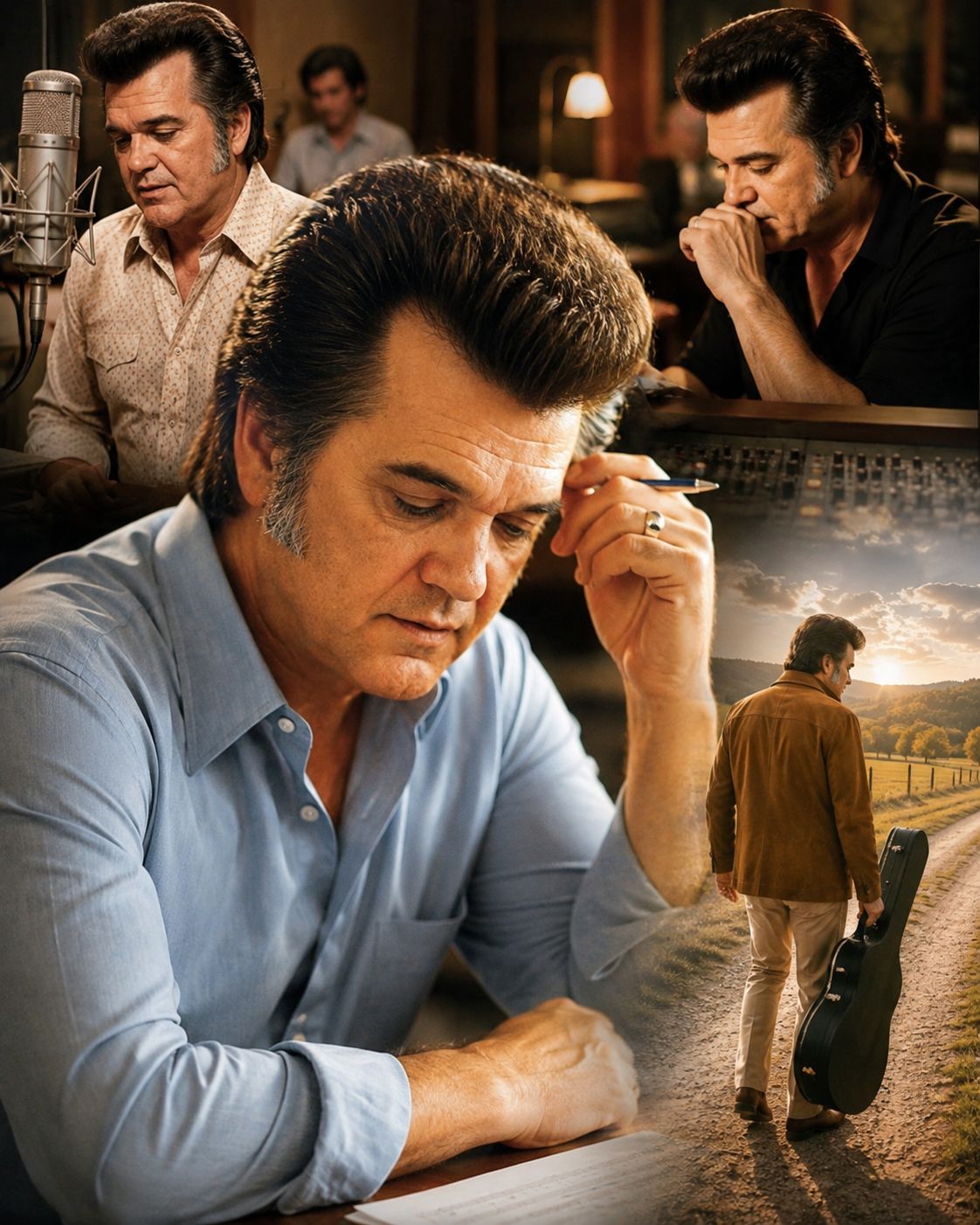
There are certain moments in music history that seem almost too ordinary to become legendary.
A singer walks into a studio.
A song is written in a hurry.
A producer makes a decision.
A record is released with little expectation.
And then, somehow, everything changes.
For Conway Twitty, one of those moments arrived in 1958 with “It’s Only Make Believe.” Long before he became one of country music’s most dominant stars, before the string of No. 1 country hits, before the rhinestone suits and sold-out arenas, Twitty was still trying to figure out exactly where he belonged.
He had already tasted the excitement of rock and roll. He had recorded for Sun Records, worked with legendary producer Sam Phillips, and watched some of his early releases fail to become the breakthrough everyone hoped for. Eventually, after more disappointments, Twitty found himself back home in Arkansas, working on his father-in-law’s farm.
Then came the song that almost disappeared before the world ever had a chance to hear it.
And that is what makes the story so fascinating.
The Song Nobody Expected to Change His Life
“It’s Only Make Believe” was not born under glamorous circumstances.
Twitty had written the song with Jack Nance while on tour in Canada, reportedly during a break in the middle of a performance schedule. It was not presented as some grand declaration that would reshape popular music.
It was simply a song.
A feeling.
A melody.
A few words written down before the moment passed.
When Twitty recorded it, the song did not even receive the treatment of an obvious centerpiece. It was released as the B-side of another single, “I’ll Try.” The record company expected the A-side to attract attention.
Instead, radio DJs began doing something that would alter music history.
They flipped the record over.
Suddenly, the song everyone had overlooked was the song listeners couldn’t stop requesting.
As the record gathered momentum, the quiet B-side became a national sensation. It eventually reached No. 1 and became Twitty’s first million-selling record. The Washington Post later recalled that the song had been recorded during a period when Twitty’s career was struggling, only to explode unexpectedly on the charts.
“Sometimes the song everyone overlooks is the one that changes everything.”
That may be the most important lesson hidden inside Conway Twitty’s story.
Because success rarely announces itself.
Conway Twitty Wasn’t Yet the Conway Twitty We Remember
Today’s listeners often imagine Conway Twitty as if he was always destined to become the legendary country singer we know.
He wasn’t.
Born Harold Lloyd Jenkins, Twitty initially pursued baseball and was scouted by the Philadelphia Phillies before military service interrupted those plans. After hearing Elvis Presley and becoming fascinated with the emerging rock-and-roll sound, he pursued music instead. The Country Music Hall of Fame describes him as one of the most diverse stylists in country history, but that identity took years to develop.
His early career was anything but guaranteed.
There were record deals that didn’t deliver.
There were singles that failed.
There were moments when the dream must have seemed far less glamorous than outsiders imagined.
At one point, Twitty found himself back on a farm, far removed from the image of a future superstar. The irony is almost cinematic: the man who would eventually collect an astonishing number of country No. 1s was temporarily living a life that looked nothing like the one he had envisioned.
Then a song he had not even expected to become the main attraction started climbing.
And climbing.
And climbing.
One Flip of the Record Changed Everything
Imagine being the person responsible for the record.
The A-side is supposed to be the hit.
The B-side is almost an afterthought.
Then a disc jockey flips it over.
The audience reacts.
Another station plays it.
Then another.
Suddenly, listeners are hearing something in Twitty’s voice that the people around the record may not have fully anticipated.
There was vulnerability.
There was longing.
There was tension.
And there was that unmistakable voice.
The song eventually reached No. 1 on the U.S. charts and became a major international success. American Songwriter notes that it topped charts in the United States, the United Kingdom and other countries, helping put the then-young performer firmly on the musical map.
This was not merely another successful single.
It was proof that Conway Twitty could connect.
And once an artist discovers that connection, everything becomes possible.
“He only needed one song to prove that people were listening.”
The Strange Beauty of an Accidental Hit
There is something almost poetic about “It’s Only Make Believe” becoming successful in such an unexpected way.
Music history is filled with carefully planned releases.
Big promotional campaigns.
Expensive studio sessions.
Songs executives believe are guaranteed hits.
But every once in a while, the audience decides for itself.
That is what happened here.
The people who bought the record did not care which side the label wanted them to hear.
The radio stations did not care which song was supposed to be the star.
Listeners simply found the song that spoke to them.
And they turned it into a phenomenon.
That is why the story continues to resonate decades later.
Conway Twitty himself would eventually become famous for understanding the extraordinary importance of a song. In an interview preserved by the University of Nevada, Las Vegas, he emphasized that the song mattered more than the singer and explained that he searched for material that expressed what men wanted to say to women but sometimes couldn’t find the words to say themselves.
That philosophy helps explain his career.
Twitty didn’t simply sing songs.
He inhabited them.
He made listeners feel as though the words belonged to their own lives.
From Rock Star Hopeful to Country Legend
The success of “It’s Only Make Believe” did not immediately turn Twitty into the country legend he would eventually become.
His journey was much longer.
In the 1960s, he gradually moved toward country music. After signing with Owen Bradley at Decca, he scored his first country No. 1 with “Next in Line” in 1968. From there, his career entered an extraordinary period of consistency.
Eventually came “Hello Darlin’,” “You’ve Never Been This Far Before,” “I’d Love to Lay You Down,” and dozens of other recordings that established him as one of country music’s most recognizable voices.
His official biography credits him with 55 No. 1 singles and more than 50 million records sold.
But every legend has a beginning.
And sometimes that beginning is much less dramatic than we expect.
For Conway Twitty, one of the most important chapters began with a song that wasn’t even supposed to be the main event.
What If He Had Walked Away?
This is where the story becomes bigger than one recording.
What if Twitty had stopped?
What if the disappointments had convinced him that music was no longer worth pursuing?
What if the song had remained buried on a B-side?
What if that DJ had never flipped the record?
We will never know.
But we do know what happened next.
Twitty kept going.
The unexpected success gave him momentum, recognition and a reason to believe that his voice had a place in popular music. Eventually, he would reinvent himself, moving from the world of rock and roll toward country music and building one of the most remarkable careers the genre has ever seen.
The Country Music Hall of Fame notes that his stardom endured across five decades of changing musical fashions and that he eventually accumulated more No. 1 records than any country artist had achieved at the time.
That’s why “It’s Only Make Believe” matters.
Not simply because it was a hit.
Because it was evidence.
Evidence that Conway Twitty could survive uncertainty.
Evidence that an overlooked song could become a defining moment.
And evidence that sometimes the door to a legendary career opens in the least expected way.
The Real Lesson Behind the Song
Years later, fans remember the finished record.
They remember the voice.
They remember the melody.
They remember the name Conway Twitty.
But they rarely think about the uncertainty that came before the success.
That’s the part worth remembering.
Because artists don’t experience their careers with the benefit of hindsight.
They don’t know which song will work.
They don’t know which performance will become iconic.
They don’t know whether tomorrow will bring another rejection.
They simply have to decide whether to keep going.
Conway Twitty did.
And that decision eventually led to one of the greatest careers country music has ever witnessed.
“Before a song becomes history, it is simply a choice someone has to make.”
Maybe that’s why this story still feels so powerful.
The legend came later.
The certainty came later.
The millions of fans came later.
First came doubt.
Then came a song.
Then came a DJ willing to turn the record over.
And suddenly, Conway Twitty’s life was moving in a completely different direction.
He didn’t know it at the time, but the song that seemed like an afterthought would become one of the foundations of his legacy.
That is the beautiful mystery of music.
Sometimes the song you almost overlook becomes the song everyone remembers.
Sometimes the moment you think is the end becomes the beginning.
And sometimes, somewhere between walking away and giving it one more chance, a legend is born.
For Conway Twitty, that moment was “It’s Only Make Believe.”
And thankfully for generations of country music fans, he didn’t walk away.
VIDEO: