 By admin
 INTRODUCTION:
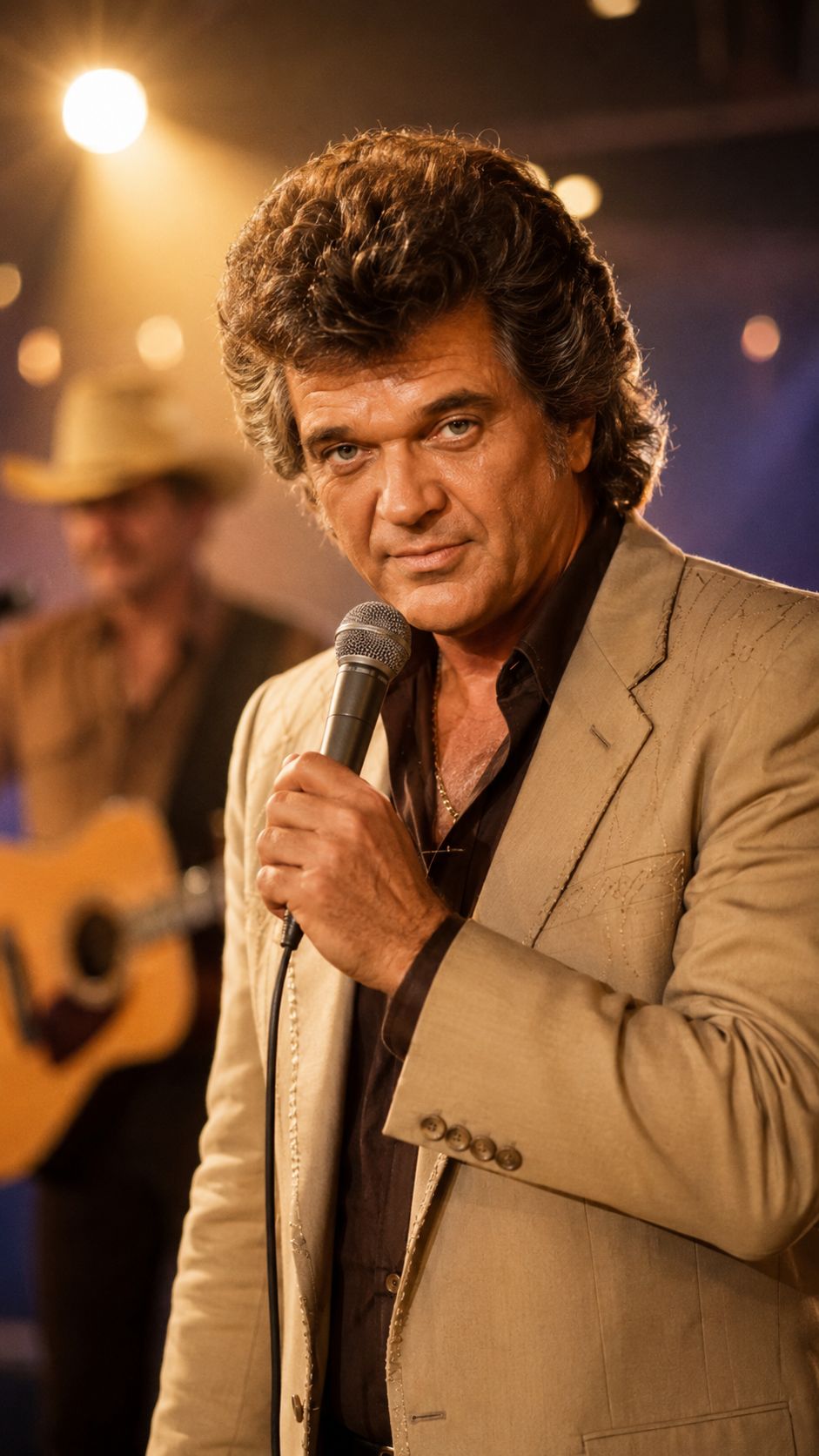
There are some names in country music that sound as though they were destined to become famous.
Conway Twitty is one of them.
The name rolls off the tongue with a certain mystery. “Conway” feels polished and Southern. “Twitty” is unusual enough to make you remember it after hearing it only once. Put the two together, and it sounds less like an ordinary name and more like the identity of a man who was born to stand beneath a spotlight.
But here is the twist: Conway Twitty wasn’t born Conway Twitty at all.
He entered the world as Harold Lloyd Jenkins on September 1, 1933, in Friars Point, Mississippi. The boy who would eventually become one of country music’s most recognizable voices had a completely different name—and, for a time, no guarantee that the world would ever know him.
And the story behind the name he eventually chose is almost wonderfully simple.
It involved a map.
Before Conway Twitty, There Was Harold Jenkins
Long before the rhinestone suits, romantic ballads and country chart records, Harold Jenkins was simply a talented Mississippi boy with music in his blood.
His musical ability appeared early. According to the official Conway Twitty biography, he received a guitar as a child and began demonstrating his gift almost immediately. After his family moved to Helena, Arkansas, he performed on local radio and formed the Phillips County Ramblers.
He wasn’t just interested in music, either.
Baseball was another passion. Jenkins became good enough to attract the attention of the Philadelphia Phillies after high school. But military service intervened, sending him into the Army rather than directly into professional baseball. Even there, music remained part of his life.
Then Elvis Presley changed everything.
The explosion of rock and roll in the 1950s convinced Jenkins that music might actually be his future. He headed toward Memphis and Sun Studios, where he encountered the musical world surrounding Presley, Johnny Cash, Carl Perkins and Jerry Lee Lewis.
But there was a problem.
Harold Jenkins didn’t sound like a superstar’s name.
At least, that’s what the people around him believed.
“Harold Jenkins” Needed a Little Help
The music business of the 1950s was brutally competitive.
Record labels were looking for artists who could grab attention quickly. Radio DJs received stacks of records. Performers needed something that could stick in a listener’s mind.
And according to contemporary accounts, manager Don Seat thought “Harold Jenkins” simply wasn’t memorable enough.
TIME reported in 1958 that Seat believed the young singer needed a different “handle,” while the Los Angeles Times later described the new stage name as part of Jenkins’ attempt to create a distinctive identity in the crowded rock-and-roll world.
Jenkins understood the logic.
He didn’t necessarily hate his birth name.
He simply realized that show business was a business of memory.
If a DJ announced an artist’s name and listeners couldn’t remember it five minutes later, the battle was already lost.
So Jenkins went looking for something different.
And instead of hiring a branding consultant, he apparently turned to something far more ordinary:
a map.
Two Towns. One Legendary Name.
The story most consistently documented by biographies and music-history sources is that Jenkins combined the names of two places:
Conway, Arkansas
and
Twitty, Texas.
The result?
Conway Twitty.
The Country Music Hall of Fame confirms that Jenkins created the professional name by combining Conway, Arkansas, and Twitty, Texas. His official biography tells essentially the same story.
It was almost absurdly simple.
No elaborate family connection.
No mysterious aristocratic ancestry.
No Hollywood executive inventing a glamorous identity.
Just two names from a map.
And yet that little decision would eventually become one of the most recognizable names in American music.
“I picked two towns: Conway, Arkansas, and Twitty, Texas. It was as simple as that.”
There is something almost poetic about that sentence.
Because it wasn’t simple at all—not in the end.
That name would eventually become attached to decades of hit records, countless performances and one of the most extraordinary careers country music has ever produced.
The Name Was Clever. The Talent Had to Do the Rest.
A stage name can open a door.
It cannot make the audience stay.
That part still requires talent.
And Conway Twitty had plenty of it.
His first major breakthrough came not in country music, but in rock and roll. In 1958, “It’s Only Make Believe” became a massive hit, reaching No. 1 and turning the newly renamed Conway Twitty into a genuine star. His official biography notes that the record topped charts in 22 countries and eventually sold millions of copies.
Suddenly, the name that had been assembled from two small-town place names was everywhere.
Conway Twitty.
On radio.
On records.
On posters.
In movie theaters.
And eventually, on the country charts.
But there was an irony hiding underneath all that success.
Twitty had never stopped loving country music.
The Rock Star Who Wanted to Come Home
For several years, Twitty lived the life of a rock-and-roll idol.
But country music was still calling him.
He had grown up surrounded by Southern musical traditions. Gospel, country, blues and the sounds of the Mississippi Delta had all influenced him. The Los Angeles Times recalled Twitty describing the impact of hearing blues and gospel music around him as a child.
Eventually, he made a decision that could easily have destroyed his career.
He switched genres.
In 1965, Conway Twitty abandoned his position as a successful rock-and-roll performer and began pursuing country music seriously. The transition was not immediately welcomed. Country radio had doubts about a former pop and rock star trying to enter its territory.
But Twitty kept going.
And slowly, the skeptics disappeared.
The man who had once been a rock-and-roll heartthrob became one of country music’s greatest hitmakers.
The stage name stayed.
The musical identity changed.
“Conway Twitty” Became More Than a Name
This is perhaps the most fascinating part of the entire story.
The name was originally created to make Harold Jenkins more marketable.
But eventually, Conway Twitty became the real identity the public knew.
The Country Music Hall of Fame notes that his stardom endured across five decades and that he achieved more No. 1 records than any country artist had achieved at that point. He was inducted into the Hall of Fame in 1999, six years after his death.
He also became inseparable from the golden era of country duets through his work with Loretta Lynn.
Their chemistry was something special.
Onstage, their voices could sound playful, vulnerable, flirtatious and deeply emotional within the same performance. Their partnership produced a string of major successes and helped define an important chapter of country music.
And through songs such as “Hello Darlin’,” “Tight Fittin’ Jeans,” “Linda on My Mind” and many others, Twitty established himself as a master of romantic country storytelling.
The voice became iconic.
The phrasing became recognizable.
The emotional delivery became his signature.
And eventually, nobody needed to explain who Conway Twitty was.
The Man Behind the Name Never Disappeared
There is something deeply human about the story.
Because behind the famous name was still Harold Jenkins—the Mississippi-born kid who loved music, played baseball and dreamed about making something of himself.
The stage name didn’t erase him.
It simply became the vehicle through which the world discovered him.
Perhaps that’s why the story remains so compelling decades later.
We often imagine legendary performers as though they arrived fully formed.
They didn’t.
They experimented.
They struggled.
They changed direction.
They took advice.
Sometimes they made decisions that looked almost ridiculous at the time.
A young singer staring at a map and borrowing the names of two towns doesn’t sound like the beginning of a Hall of Fame career.
Yet that’s exactly what happened.
The Beautiful Irony of “Conway Twitty”
There’s one final irony that makes the story even better.
The name was invented because Harold Jenkins wasn’t distinctive enough.
But eventually, Conway Twitty became so distinctive that the name itself became impossible to imitate.
You hear “Conway Twitty,” and you don’t think about Arkansas or Texas.
You think about that deep, expressive voice.
You think about romantic country songs.
You think about the unforgettable “Hello Darlin’.”
You think about Loretta Lynn.
You think about a performer who could move from rock and roll to country and somehow become legendary in both worlds.
And perhaps most importantly, you think about perseverance.
Because the clever name was only the beginning.
The map gave him a name. The music gave that name meaning.
That may be the real lesson hidden inside the Conway Twitty story.
A name can help someone get noticed.
But eventually, the person behind the name has to prove that they deserve to be remembered.
Harold Jenkins did exactly that.
He took two ordinary place names, turned them into Conway Twitty, and then spent the rest of his life making those words mean something.
When he died in 1993 at age 59, the career he left behind was already enormous. He had crossed musical boundaries, survived changing fashions and accumulated an extraordinary number of chart successes.
The name that once seemed like a clever marketing trick had become something much bigger.
It had become history.
And perhaps that’s why the story still resonates.
Conway Twitty wasn’t born with a legendary name.
He created one.
And then, through talent, ambition, reinvention and an unmistakable voice, he made sure the world would never forget it
VIDEO: