 By admin
 INTRODUCTION:
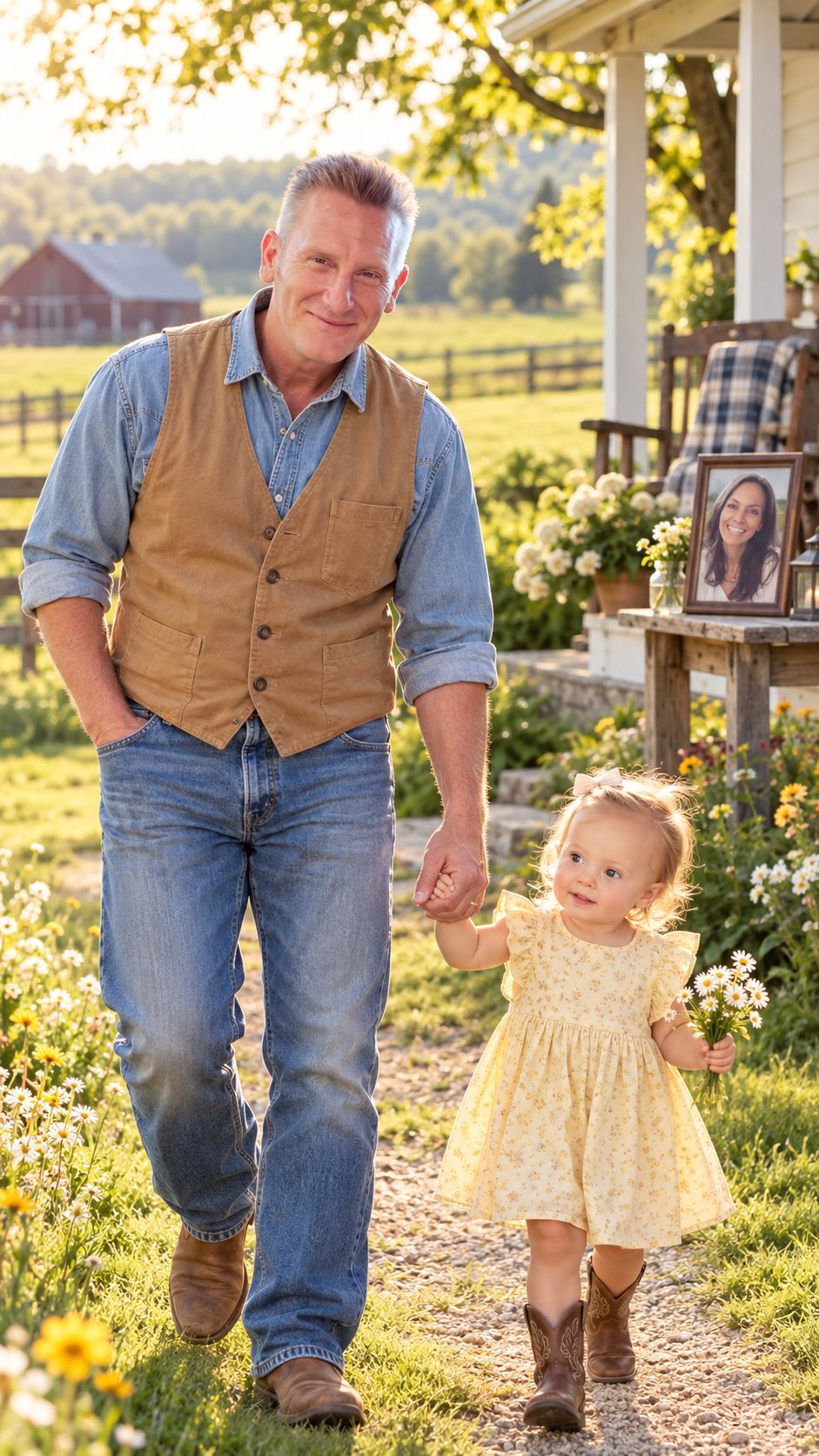
There are some love stories that end when the music stops.
And then there are the rare ones that somehow keep singing.
For Rory Feek, losing his wife and musical partner, Joey Feek, in March 2016 did not mean closing the book on their life together. In many ways, it meant opening a different chapter — one filled with grief, fatherhood, memories, faith, silence, and the enormous responsibility of carrying a love story forward after one half of it was gone.
Joey was only 40 when she died following her battle with cervical cancer. Their daughter, Indiana, was just two years old. Rory was suddenly facing a life he had never planned for: raising their little girl without the woman who had been his wife, singing partner, best friend, and the heart of their home.
But what Rory did next revealed something profound.
He didn’t try to erase Joey from his life.
He tried to make sure she remained part of it.
That distinction is at the heart of why the story of Rory and Joey continues to resonate with country music fans years later.
He Chose to Keep Joey’s Story Alive
In the weeks following Joey’s death, Rory could have stepped away from the public eye completely.
Instead, he continued telling their story.
Through his writing, photographs, home videos, music, and eventually film, Rory preserved the ordinary moments that made their relationship extraordinary. Their story wasn’t simply about cancer, fame, or tragedy. It was about a marriage built around a farm, a family, music, faith, laughter, and everyday life.
Rory later explained that he had spent roughly two and a half years filming their lives, without fully understanding at the time how important that footage would become. After Joey died, those recordings became something much more precious than entertainment.
They became memories he could return to.
And memories he could give to Indiana.
“My wife came to life.”
That idea captures what Rory was trying to do. He wasn’t simply preserving archival footage. He was preserving a mother for a daughter who was too young to fully remember her.
ABC News reported that Rory eventually turned their story into the documentary To Joey, With Love, using footage from the final years of their life together.
The title itself said almost everything.
It wasn’t Goodbye to Joey.
It was To Joey, With Love.
Even after death, Rory was still speaking to her.
He Went Home to the Farm
Perhaps one of the most revealing things Rory did after Joey’s death was also one of the simplest:
He stayed home.
The farm that had once represented their shared dream became the setting for Rory’s new reality with Indiana.
There were empty chairs.
An empty side of the bed.
An absence at the dinner table.
But there was also a little girl who needed her father.
Rory wrote openly about the painful adjustment he and Indiana were making after Joey’s death, describing the challenge of returning to a home suddenly filled with reminders of someone who was no longer there.
That is where Rory’s story became bigger than celebrity.
He wasn’t simply a grieving husband.
He was a father trying to create a safe childhood for a little girl while carrying his own enormous grief.
And instead of running from the farm because it reminded him of Joey, he gradually found ways to live there differently.
He Took Care of Joey’s Garden
Few details illustrate their relationship more beautifully than Rory’s decision to continue tending Joey’s garden.
Joey had loved gardening.
For her, it wasn’t just a chore. It was part of who she was.
After she died, Rory began working the soil himself.
He admitted that he would never be the gardener Joey had been. But that wasn’t really the point.
He was doing it because she had loved it.
In an interview with Country Living, Rory described taking on the garden after Joey’s death and explained how deeply connected the work was to her memory.
Think about what that means.
Love after loss isn’t always dramatic.
Sometimes it looks like picking up a garden tool.
Sometimes it means planting something because the person you miss would have planted it.
Sometimes it means doing an ordinary task and suddenly realizing that every movement carries the memory of someone who used to stand beside you.
Rory wasn’t trying to become Joey.
He was learning how to carry pieces of her forward.
He Made a Film So People Could See Joey Living — Not Just Dying
Perhaps the most powerful thing Rory did was change the way people remembered his wife.
For millions of fans, Joey’s final chapter had become inseparable from cancer.
They had watched her battle illness.
They had watched Rory document the painful final months.
They knew the hospital rooms, the uncertainty, the prayers, and the goodbye.
But Rory wanted people to remember something else.
He wanted them to see Joey before the illness.
He wanted them to laugh with her again.
To hear her sing.
To watch her become a mother.
To see her as a wife.
To remember the woman rather than only the disease.
In his own writing, Rory explained that he wanted people to have the chance to see his wife “live” — not simply witness the final months of her life.
That decision says something extraordinary about their marriage.
He wasn’t interested in making Joey’s death the most important part of her story.
He wanted her life to be bigger than her death.
He Raised Indiana Inside the Love They Built
There was another reason Rory couldn’t simply walk away from the past.
Indiana.
Joey and Rory’s daughter was born in February 2014, shortly before Joey was diagnosed with cancer. Their little girl was only two when her mother died.
So Rory had a responsibility beyond remembering Joey for himself.
He had to help Indiana know the mother she was too young to fully remember.
That meant stories.
Photographs.
Videos.
Family traditions.
The farm.
The songs.
The places Joey had loved.
The little things.
This is perhaps where Rory’s grief became an act of parenting.
Every memory he preserved became a piece of Indiana’s inheritance.
Not financial inheritance.
Emotional inheritance.
The inheritance of knowing:
Your mother loved you.
Your mother was here.
Your mother mattered.
Your mother is still part of our story.
He Turned Grief Into Storytelling
Rory had always been a songwriter and storyteller, but after Joey’s death, storytelling became something much deeper.
It became a way of surviving.
His blog, This Life I Live, had originally begun as a record of the couple’s simple life together. After Joey’s diagnosis, it became a window into their battle with cancer, faith, family, and love. Later, Rory continued using storytelling to make sense of the life that remained.
He eventually expanded his storytelling through books, documentaries, television, and life on the farm.
In doing so, Rory discovered something painful but beautiful:
You don’t always move on from someone you love.
Sometimes you move forward with them.
That is different.
Moving on can sound like leaving the past behind.
Moving forward means carrying the past with you.
The Love Was Never Measured by How Long Joey Stayed
Rory and Joey were married for nearly 14 years.
By ordinary standards, that might sound like a lifetime.
But after Joey’s death, Rory’s actions demonstrated that the length of a marriage isn’t necessarily what defines its power.
The real measure is what remains after the person is gone.
Does their voice still influence you?
Do their values still shape your decisions?
Do you still tell their stories?
Do you still see them in your children?
Do the places you built together still feel sacred?
For Rory, the answer appeared to be yes.
Again and again.
He kept the farm.
He kept telling the stories.
He kept Joey’s memory alive for Indiana.
He returned to her garden.
He preserved their videos.
He made a film.
And he continued building a life around the things they had once dreamed about together.
That wasn’t forgetting.
That was remembering through action.
The Most Powerful Goodbye Wasn’t a Goodbye at All
Perhaps that is why the Rory and Joey story continues to affect country music fans.
It wasn’t perfect.
It wasn’t easy.
It wasn’t a fairy tale protected from suffering.
It was something much more human.
Two people met.
They fell in love.
They made music.
They built a home.
They became parents.
They faced devastating news.
And when their story was forced to change, Rory refused to pretend the love had disappeared simply because Joey had.
That may be the deepest lesson hidden inside everything he did afterward.
Love doesn’t necessarily end when someone’s heartbeat does.
Sometimes it changes form.
It becomes a song.
A photograph.
A garden.
A story told at the dinner table.
A child’s memory.
A quiet walk across a farm.
A movie played years later.
A father’s answer when his daughter asks about her mother.
And sometimes, love becomes the courage to wake up the next morning and keep living the life you once promised to share.
Rory could not save Joey.
He could not change the ending.
But he could protect what their love had created.
And that is exactly what he did.
“I just want to lift my bride up… and continue to tell her beautiful story, while Indy and I live out the new one that God is now writing.”
Those words may be the simplest explanation for everything that followed.
Rory didn’t spend his life trying to replace Joey.
He spent it remembering her.
And perhaps that is why their story still feels so powerful.
Because in a world where fame often fades and celebrity relationships become headlines for a season, Rory and Joey left behind something much harder to manufacture:
A love that continued to matter even after the music stopped.
Joey was gone.
But the life they built together wasn’t.
And Rory made sure of that.
VIDEO: