 By admin
 INTRODUCTION:
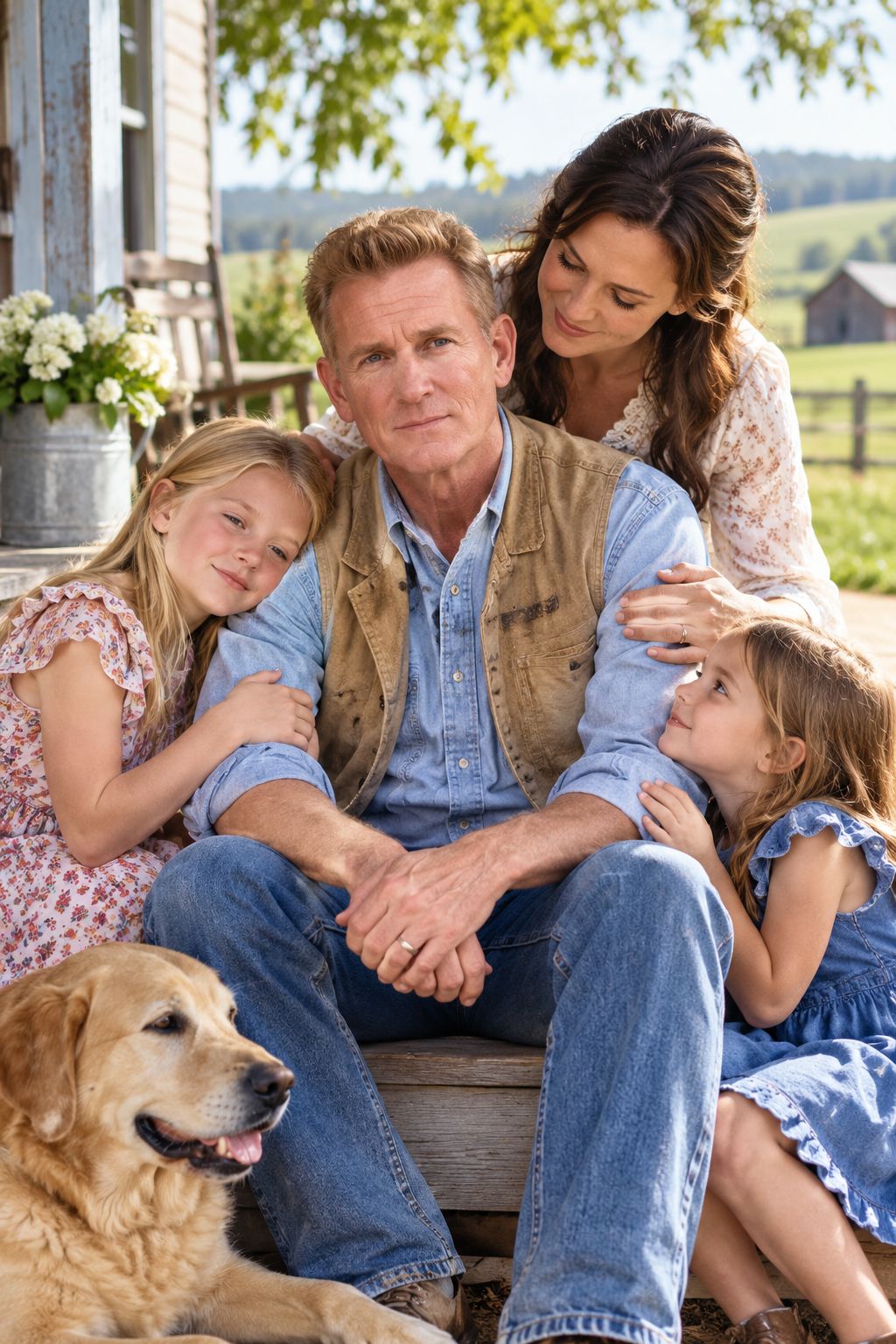
For Rory Feek, marriage was never simply about finding someone to love again.
By the time he stood beside Rebecca in Montana on July 14, 2024, he had already lived through the kind of losses that can permanently change a person. He had experienced divorce, single fatherhood, the rise and fall of a music career, the extraordinary love story he shared with Joey Feek, and the devastating loss of Joey to cancer in 2016. He had also spent years raising his youngest daughter, Indiana, after becoming a widower while she was still a toddler.
So when Rory eventually chose to marry Rebecca, the story was never going to be as simple as widower finds love again.
There were children to consider.
There were memories to honor.
There were old wounds that had never completely disappeared.
And, perhaps most difficult of all, there was a public that had spent years watching his life unfold.
Rory wasn’t merely choosing a wife.
He was choosing whether to allow himself to begin another chapter.
And that decision came with a price.
The Shadow of Joey Was Always There
For many country music fans, Rory and Joey Feek represented something almost impossibly beautiful.
Their relationship became part of their music, their family life became part of their public story, and their final years together were followed by fans who watched Joey battle cervical cancer with extraordinary courage.
When Joey died in March 2016, Rory was left to raise Indiana alone. Their daughter was only two years old.
Suddenly, Rory’s identity changed.
He was no longer simply half of Joey + Rory.
He was a grieving husband.
A father.
A caretaker.
And a man trying to explain death to a little girl who was too young to fully understand what had happened.
That kind of grief does not disappear simply because years pass.
Instead, it becomes part of the architecture of a person’s life.
For Rory, moving forward therefore carried an uncomfortable question:
Could loving someone new ever feel like betraying someone he had lost?
That question wasn’t necessarily something fans asked him directly.
But it hovered over everything.
A new relationship would inevitably be compared with Joey.
A new wife would inevitably be compared with Joey.
And Rory himself would inevitably be judged for how quickly—or how slowly—he chose to rebuild his life.
He had already learned that grief doesn’t belong exclusively to the person experiencing it.
Sometimes, the public thinks it owns a piece of it too.
He Had More Than His Own Heart to Protect
Rory’s situation was even more complicated because he wasn’t making decisions for himself alone.
He was raising Indiana.
And his two older daughters, Heidi and Hopie, were part of the larger family story as well.
Rory had already experienced single fatherhood before Joey entered his life. He had raised Heidi and Hopie after his first marriage ended, before marrying Joey in 2002.
Then came Indiana.
Then came Joey’s illness.
Then came widowhood.
By the time Rebecca entered the picture, Rory wasn’t simply asking, Can I love again?
He had to ask:
What will this mean for my children?
That is an entirely different question.
A romantic relationship can be private.
Parenthood rarely is.
Every decision affects children. Every new person entering the family can change the emotional balance of the household.
And Indiana was especially important because she had grown up without her mother.
Rory had previously described his experience raising Indiana as similar to raising his older daughters, emphasizing that he wanted her childhood to be filled with normalcy rather than limitations.
That instinct—to protect a child’s sense of belonging—helps explain why his decision to remarry carried such enormous emotional weight.
Then Rebecca Entered the Story
Rebecca wasn’t simply a stranger who appeared late in Rory’s life.
She was already connected to the family. She had been Indiana’s teacher and was described as a longtime family friend before their relationship became romantic.
That detail matters.
Because Rory’s situation wasn’t necessarily about suddenly replacing one family structure with another.
It was about allowing someone who already knew his world to become more deeply involved in it.
For a widowed father, that can make all the difference.
Rebecca already understood Indiana.
She understood the environment Rory had created.
She understood that Joey wasn’t simply an ex-wife whose memory belonged in the past.
Joey was Indiana’s mother.
She was part of Rory’s history.
And she would always be part of the family’s story.
A new marriage couldn’t erase that.
It had to coexist with it.
But Public Judgment Was Inevitable
Once Rory and Rebecca became a couple, the questions came quickly.
Was it too soon?
Was he moving on?
What would Joey’s fans think?
What would his children think?
Was Rebecca becoming part of a family that still belonged emotionally to Joey?
Those questions reveal one of the cruelest realities of being a public figure:
People often believe they are entitled to judge how someone grieves.
Rory had already shared deeply personal chapters of his life with the public. Fans had watched Joey’s illness. They had watched Rory care for her. They had watched him raise Indiana.
That intimacy created a strange expectation.
Some people began to feel as though they knew what Rory should do next.
But grief doesn’t follow a script.
Neither does love.
The person mourning is the only one who knows what it feels like to wake up every morning inside the life that remains.
And Rory’s life continued.
Indiana still needed a father.
The farm still needed work.
The music still existed.
The memories still existed.
And, eventually, love appeared again.
The Wedding Was More Than a Ceremony
On July 14, 2024, Rory and Rebecca married in Greycliff, Montana, in an intimate ceremony under a timber-frame pavilion.
To outsiders, it was a wedding.
To Rory, it represented something much larger.
It was permission to begin again.
Not to forget Joey.
Not to rewrite history.
Not to pretend the previous chapters had never happened.
But to acknowledge that a person can carry grief and hope at the same time.
There is a powerful misconception that moving forward means leaving the past behind.
It doesn’t.
Sometimes moving forward means carrying the past more gently.
Rory’s journey with Rebecca can be understood through that lens.
The memories of Joey did not disappear because Rebecca entered his life.
Indiana did not stop being Joey’s daughter.
Rory did not stop being the man Joey had loved.
He simply became someone who was willing to believe that another chapter could still contain happiness.
And Then the Family Conflict Became Public
Unfortunately, the story became far more complicated after the wedding.
Rory’s older daughters, Heidi and Hopie, did not attend the 2024 ceremony, and shortly afterward Heidi publicly raised concerns about Indiana’s care and about the family’s changing relationships. The sisters pursued legal action concerning contact with their younger sister. Those allegations and disputes have been publicly contested, and the details remain deeply sensitive.
This is where the romantic narrative collides with reality.
It is tempting to reduce everything to heroes and villains.
But families are rarely that simple.
There are memories on every side.
There are different interpretations of the same events.
There are adult children carrying their own experiences.
There is a father trying to make decisions.
And there is a young daughter whose well-being sits at the center of the conflict.
The public sees fragments.
The family lives the whole story.
That distinction is crucial.
Rory’s Greatest Battle May Not Have Been Finding Love
It may have been accepting that he could never control what people thought about his choices.
When Rory chose Rebecca, some people saw romance.
Others saw controversy.
Some saw healing.
Others saw betrayal of the past.
And still others simply saw a man trying to build a family after losing his wife.
But perhaps the most human interpretation is also the simplest:
Rory was trying to live.
After years of grief, living again can feel frightening.
Happiness can create guilt.
A new relationship can feel disloyal.
And every decision can become magnified when thousands of strangers are watching.
Yet Rory eventually stepped forward.
He didn’t erase the years with Joey.
He didn’t erase fatherhood.
He didn’t erase the complicated history of his family.
He simply chose to believe that his story wasn’t finished.
“Love doesn’t always arrive to replace what was lost. Sometimes it arrives to help you carry it.”
That may be the deepest lesson in Rory Feek’s journey.
Rebecca Didn’t Walk Into an Empty Life
She walked into a life filled with memories.
She walked into a family with complicated relationships.
She walked into a home where Joey’s presence could never truly disappear.
She became part of Indiana’s world.
And she became Rory’s partner at a time when his personal life was already under extraordinary scrutiny.
That makes their marriage more complicated than a conventional love story—but perhaps more meaningful too.
Because real love rarely begins with a blank page.
It begins with history.
Mistakes.
Loss.
Children.
Regrets.
Public opinions.
And all the things that make starting over terrifying.
The Chapter Is Still Being Written
Rory and Rebecca’s marriage cannot be separated from everything that came before it.
Joey remains part of the story.
Indiana remains at the center of Rory’s world.
His older daughters remain part of a complicated family history.
And Rory remains a public figure whose personal decisions continue to attract attention.
Recent reporting shows that tensions within the family have continued, making it especially important not to portray the situation as a perfectly resolved fairy tale.
But perhaps that’s precisely why the story resonates.
Because the most powerful country songs have never been about perfect lives.
They’re about imperfect people trying to make peace with what happened yesterday while finding the courage to face tomorrow.
Rory Feek has spent years doing exactly that.
He lost a wife.
He raised children.
He endured judgment.
He watched his family relationships become painfully complicated.
And eventually, he opened his heart again.
Not because the past stopped mattering.
But because the future still did.
And maybe that is the most difficult kind of courage of all:
to love again when you know exactly how much losing someone can hurt.
VIDEO: