 By admin
INTRODUCTION:
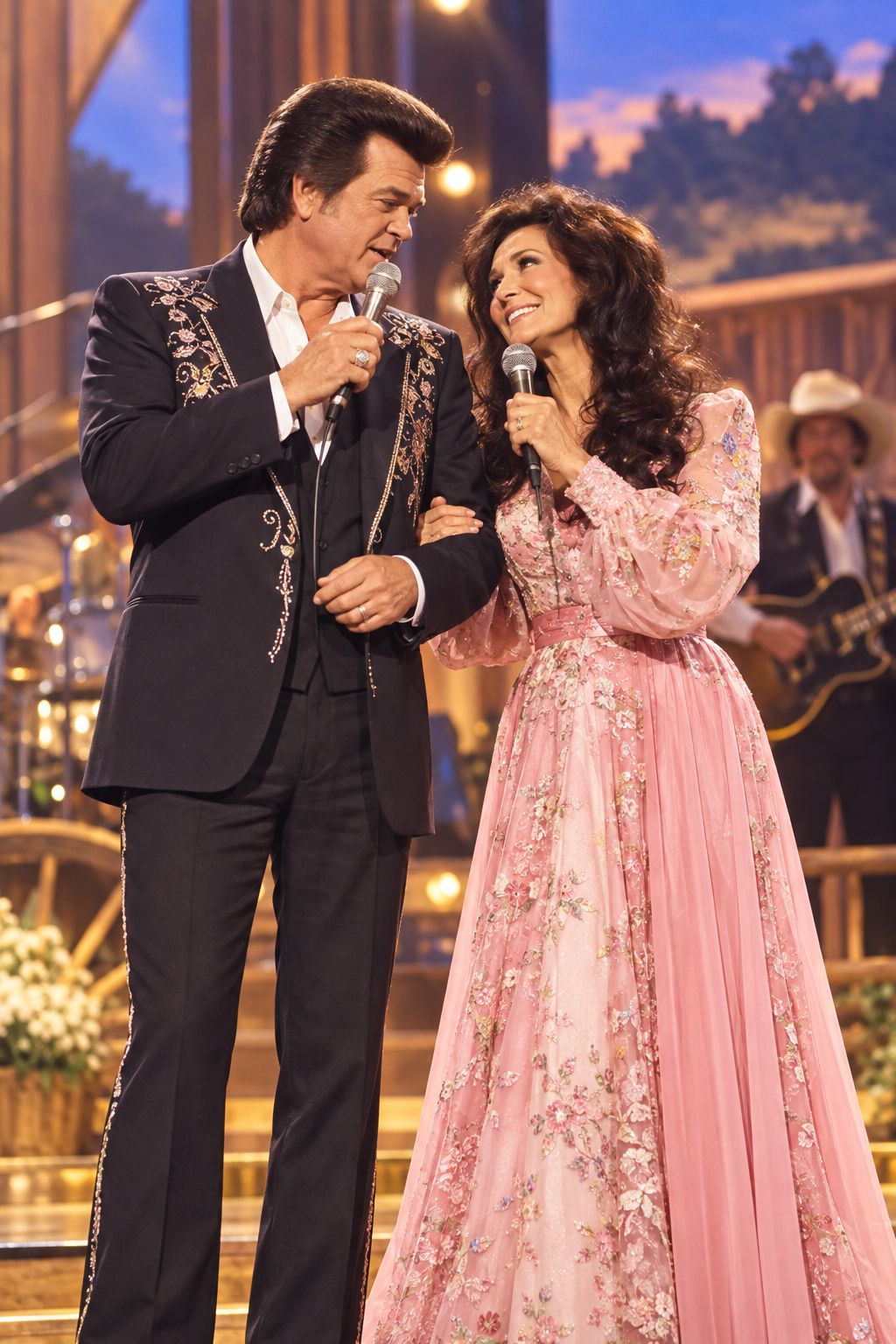
There are country duets that sound good.
And then there are duets that make you feel as if you have accidentally walked into someone else’s private life.
That was the strange, almost impossible magic of Conway Twitty and Loretta Lynn.
When their voices met, it rarely sounded like two famous singers simply sharing a microphone. It sounded like two people arguing, forgiving, teasing, longing, regretting, and falling back into the same complicated relationship—all within three or four minutes.
Their partnership produced some of the most memorable recordings in country music, including “After the Fire Is Gone,” “Lead Me On,” “Louisiana Woman, Mississippi Man,” “As Soon as I Hang Up the Phone,” and “Feelins’.” They recorded 11 studio albums together between 1971 and 1988, while their first major duet, “After the Fire Is Gone,” immediately reached No. 1 and won a Grammy.
But numbers alone cannot explain why their music still feels so alive.
The real secret was something much harder to manufacture.
They knew how to make a song feel like a conversation between two human beings.
The Magic Started With Contrast
Conway Twitty and Loretta Lynn could hardly have been more different vocally.
Twitty possessed a deep, controlled, almost hypnotic delivery. His voice could sound confident one moment and wounded the next. The Country Music Hall of Fame describes his singing as intensely emotional, with a style that often combined passion, guilt, romance, and complicated relationships.
Loretta, meanwhile, brought something earthy and unmistakably personal.
Her voice did not sound manufactured. It sounded lived-in.
She had grown up in Kentucky’s coal-mining country and built her career by turning personal experiences, struggles, relationships, and observations into songs. The Country Music Hall of Fame notes that Lynn’s greatest strength was her insistence on telling her own truth in a way audiences could recognize as their own.
Put those two voices together and something extraordinary happened.
Twitty sounded like the man trying to explain himself.
Lynn sounded like the woman who wasn’t necessarily going to let him get away with it.
That tension became musical electricity.
The magic wasn’t that Conway and Loretta sounded alike. It was that they sounded completely different—and somehow belonged together.
They Didn’t Sing At Each Other. They Sang To Each Other.
This may be the biggest secret behind their success.
Many duets follow a simple formula: one singer takes a verse, the other answers, and then both join together for the chorus.
Twitty and Lynn often went further.
Their best recordings felt like scenes from a relationship.
Listen to the emotional architecture of “After the Fire Is Gone.”
The song isn’t simply about romance. It’s about emotional emptiness, temptation, and the dangerous attraction between two people who know they are crossing a line.
That made the recording feel uncomfortable in the best possible way.
You weren’t just hearing two voices.
You were overhearing two people confess something.
And because Twitty’s voice carried such restrained intensity while Lynn could inject vulnerability and defiance into the same story, the emotional tension became almost cinematic.
Their first No. 1 duet in 1971 established the formula that would define their partnership.
Loretta Brought the Truth. Conway Brought the Mystery.
There was another fascinating element to their chemistry.
Loretta Lynn often sounded emotionally transparent.
Conway Twitty often sounded like he was hiding something.
That difference gave their recordings layers.
When Lynn sang, listeners could hear the emotional stakes immediately. When Twitty entered, there was often a sense that another side of the story was coming.
It created suspense.
And suspense is one of the most powerful tools in storytelling.
Country music has always thrived on stories about imperfect people. Broken marriages. Secret relationships. Jealousy. Regret. Desire. Forgiveness.
Twitty and Lynn understood that audiences didn’t need perfect characters.
They needed believable ones.
Their songs were populated by people who made mistakes and then had to live with them.
That is why their recordings didn’t feel like polished fantasy.
They felt like life.
“Louisiana Woman, Mississippi Man” Revealed Another Side of Their Chemistry
If “After the Fire Is Gone” showed the darker, more complicated side of their partnership, “Louisiana Woman, Mississippi Man” showed how playful and energetic they could be.
The song became another No. 1 hit, and its 1973 album also reached No. 1 on the country charts. Loretta later recalled that her husband, Mooney Lynn, helped bring the song to their attention.
And listen to the structure.
It moves almost like a flirtatious argument.
One singer declares something.
The other answers.
Then the two voices come together.
It’s not just harmony.
It’s interaction.
PBS’s American Masters captured the essence of their sound through comments from Garth Brooks and Trisha Yearwood, who emphasized that when the two voices came together, they created an energy that neither could produce alone.
That’s an important distinction.
A great duet isn’t simply:
Voice A + Voice B = Harmony.
The greatest duets create something new:
Voice A + Voice B = Chemistry.
And Conway and Loretta had chemistry in abundance.
They Trusted the Drama of Silence
Another overlooked part of their magic was restraint.
Conway Twitty was famous for his minimalist performance style. The Country Music Hall of Fame notes that for years he avoided excessive talking onstage, interviews, music-business parties, television appearances, and even encores. His approach was built around understatement and mystery.
That personality carried naturally into his music.
He didn’t need to oversell every emotion.
Sometimes the quietness made the emotion stronger.
Loretta could push the story forward, while Conway could pull back.
She could expose the wound.
He could linger over it.
She could sound angry.
He could sound guilty.
And somewhere between those two emotional positions, the listener found themselves.
Their Chemistry Wasn’t an Accident
Behind the apparent spontaneity was an extraordinary level of instinct.
Their partnership faced skepticism from people who worried the pairing might not work. But the two singers ultimately trusted the music. Contemporary accounts of their partnership describe resistance from others before the duo proved itself with hit after hit.
That confidence mattered.
Because neither artist needed to dominate the other.
They had already established themselves individually.
Loretta was a major star.
Conway was a major star.
So when they came together, there was less need for ego.
They could concentrate on the story.
That may be the greatest lesson from their partnership.
When two great singers stop trying to prove who is better, they can start discovering what they can create together.
Four Years of Dominance
The industry noticed.
From 1972 through 1975, Conway Twitty and Loretta Lynn were named CMA Vocal Duo of the Year four consecutive times. They also earned a Grammy for “After the Fire Is Gone.”
Their run wasn’t simply about one hit.
It was consistency.
They could move from heartbreak to temptation, from humor to passion, from playful Southern storytelling to emotionally devastating relationship drama.
And audiences followed them.
The duo ultimately recorded 11 studio albums together, demonstrating that their chemistry wasn’t a one-song accident.
It was a genuine artistic partnership.
The Most Powerful Ingredient Was Vulnerability
Perhaps the biggest reason their music survives is that neither singer was afraid of emotional messiness.
Modern music often tries to make heartbreak sound beautiful.
Twitty and Lynn often made heartbreak sound ugly.
And that was precisely why it was beautiful.
Their characters weren’t always noble.
Their relationships weren’t always healthy.
Their choices weren’t always wise.
But they were recognizable.
A listener could hear one of their songs and think:
I’ve been there.
I know someone like that.
I shouldn’t understand this—but I do.
That is the point at which a country song stops being entertainment and becomes memory.
Why Their Duets Still Matter
Conway Twitty died in 1993, while Loretta Lynn died in 2022. Yet the emotional blueprint they created continues to influence how country singers approach duets.
Their legacy has even continued through their grandchildren, Tre Twitty and Tayla Lynn, who perform together as Twitty & Lynn and have brought songs such as “Louisiana Woman, Mississippi Man” to new audiences.
But perhaps the most important legacy isn’t a chart statistic or an award.
It is the feeling.
When Conway sang, you believed there was something he wasn’t saying.
When Loretta answered, you believed she already knew.
And when their voices finally joined together, the emotional distance between those two characters disappeared.
That’s why their duets remain unforgettable.
They weren’t simply singing harmonies.
They were telling stories about people who loved each other even when love wasn’t simple.
And perhaps that is the secret behind their magic.
Conway Twitty and Loretta Lynn understood something every great country artist eventually discovers:
The most powerful love songs aren’t about perfect love. They’re about the complicated, fragile, sometimes painful love that real people recognize.
That is why decades later, the opening notes of one of their duets can still stop a listener in their tracks.
The voices may belong to another era.
The stories do not.
And somewhere between Conway’s low, aching delivery and Loretta’s fearless emotional honesty, two legendary voices created something that country music rarely achieves:
the sound of two hearts trying to tell the truth at the same time.
VIDEO: