 By admin
INTRODUCTION:
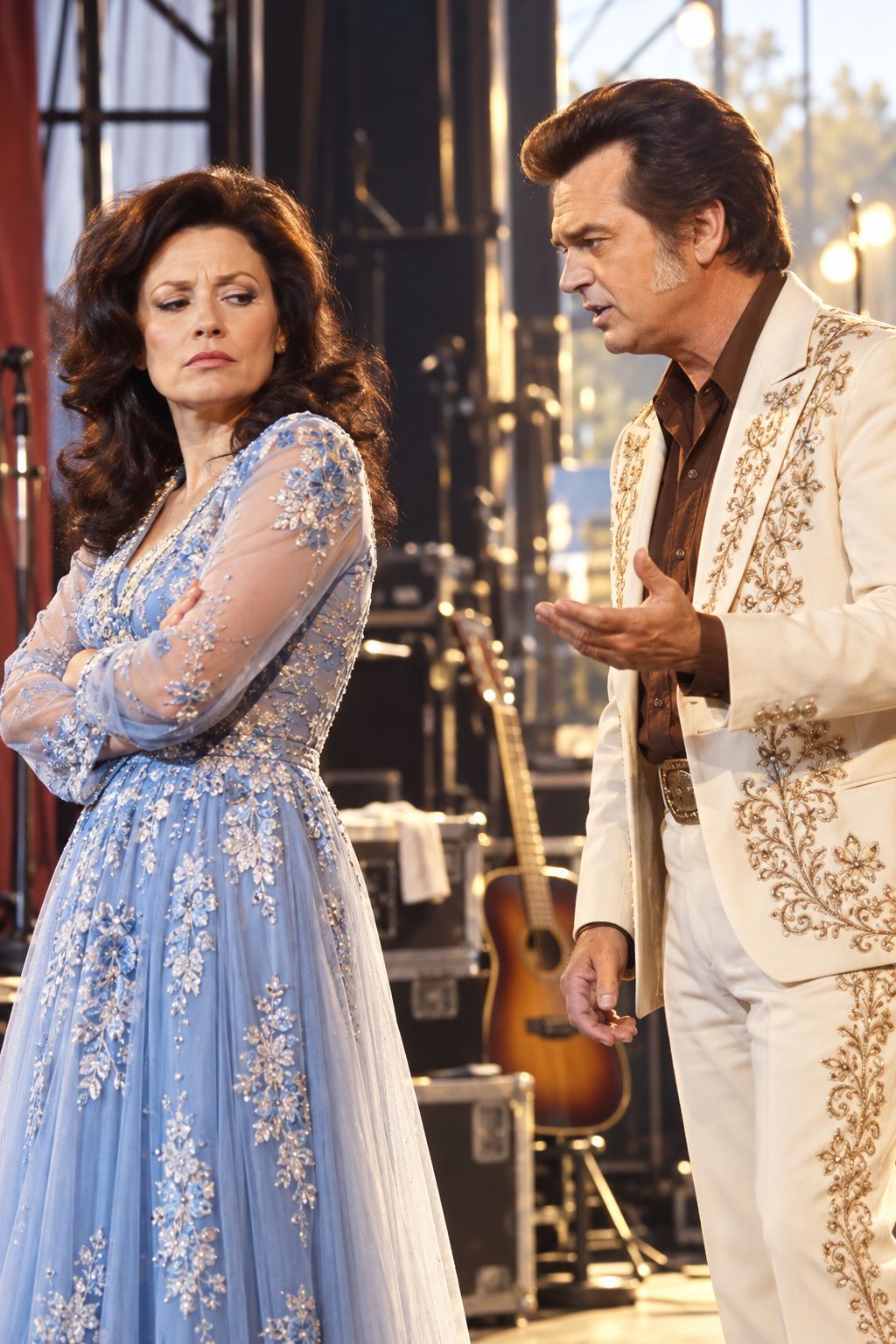
For years, country music fans have been fascinated by the relationship between Conway Twitty and Loretta Lynn.
Their voices sounded almost dangerously intimate. When Conway delivered his smooth, low lines and Loretta answered with that unmistakable emotional fire, it rarely felt like two singers simply performing a song.
It felt like a conversation between two people who knew each other’s hearts.
That was precisely why rumors followed them for decades.
Were they secretly in love? Did jealousy ever enter the picture? And, most intriguingly, was there really a heated argument that caused the legendary duo to stop singing together?
The truth is more complicated—and, in some ways, more heartbreaking.
The Partnership That Felt Too Real
Lynn and Twitty first crossed paths during the late 1960s, and their musical partnership quickly became one of country music’s most successful collaborations.
Their chemistry was undeniable.
Songs such as “After the Fire Is Gone,” “Lead Me On,” “Louisiana Woman, Mississippi Man,” and “As Soon as I Hang Up the Phone” didn’t sound like ordinary duets. They sounded like emotional dramas unfolding in real time.
“After the Fire Is Gone,” in particular, helped create the mythology surrounding them. The song portrayed two married people caught in an affair, and the performance was so convincing that some listeners began believing the chemistry was more than acting.
But Loretta herself repeatedly rejected that interpretation.
“Everybody thought me and Conway had a thing going. And that’s the farthest from the truth.”
According to Lynn, they were friends—not lovers. She also emphasized that her husband, Doolittle Lynn, genuinely liked Conway and considered him a close friend.
That detail matters.
Because it changes the story from forbidden romance to something arguably more powerful: two artists who trusted each other enough to convincingly portray emotions that weren’t necessarily their own.
The Rumors Became Almost Impossible to Escape
The more convincing their performances became, the more difficult it was for the public to separate fiction from reality.
Their songs were filled with temptation, jealousy, longing, marriage problems and emotional betrayal.
And fans naturally wondered:
Could two people sing like that without feeling something?
The answer was yes—but the speculation never completely disappeared.
A 2000-era Nashville Scene retrospective noted how rumors about Conway and Loretta had persisted for years, including speculation involving Doolittle Lynn and even accusations that Loretta had somehow contributed to problems in Conway’s first marriage. The publication also pointed to “Lead Me On” as one of the recordings that particularly fueled those fantasies.
Yet there is an important distinction between the emotional intensity of their performances and evidence of a real romantic relationship.
The evidence overwhelmingly supports the former.
So What About the Famous Argument?
This is where the story becomes especially interesting.
Modern retellings sometimes present a dramatic version of events: Conway and Loretta supposedly had a major private confrontation, emotions exploded, and the argument ultimately caused them to stop performing together.
It is a sensational story.
But there is a problem.
There is no solid, widely verified historical evidence establishing one specific explosive argument as the reason their partnership ended.
In fact, the documented timeline makes the “one argument suddenly ended everything” version difficult to defend.
Loretta Lynn’s official site notes that Conway and Loretta stopped touring together full-time in 1981. But that is not the same thing as saying they had a secret falling-out that permanently destroyed their friendship.
And contemporary archival material paints a different picture.
A Billboard feature from 1978 described their partnership as being built on mutual admiration. Conway called Loretta one of his best friends in the business, while both artists had deliberately limited their joint recording schedule so their individual careers would not suffer.
That decision reveals something important.
Their separation wasn’t necessarily the dramatic breakup fans wanted it to be.
It may have been the natural consequence of two enormous solo careers, changing touring demands, personal responsibilities and the realities of an industry that had already given them an extraordinary run together.
They Were Never Just a Duo
This is perhaps the biggest misconception.
Conway Twitty wasn’t simply Loretta Lynn’s duet partner.
He was a superstar in his own right.
And Loretta was already one of country music’s most important female artists.
Their partnership worked partly because neither needed the other to survive.
That made the collaboration special.
They weren’t two struggling performers clinging to a successful formula. They were two established stars choosing to make something together.
They even reportedly agreed to record only about one duet album per year so their individual careers wouldn’t be damaged. Despite that restraint, they collected a remarkable run of hits and won the Country Music Association’s Duo of the Year award four consecutive times.
That is not the history of a partnership constantly collapsing under personal conflict.
It is the history of two powerful artists protecting both the collaboration and their individual identities.
The Real Emotional Conflict May Have Been Offstage
There is another reason the argument story has survived.
Their music was designed around conflict.
Listen to the characters in their songs.
They disagree.
They desire each other.
They resist temptation.
They accuse.
They forgive.
They walk away.
Then they come back.
The brilliance of Conway and Loretta was that they could make those fictional conflicts feel painfully authentic.
Consider “As Soon as I Hang Up the Phone.” The unusual recording featured Loretta singing while Conway delivered his part as spoken dialogue, with the two performers even recording from separate rooms connected by telephone. The song became another No. 1 country hit.
That kind of performance required enormous trust.
And it helps explain why audiences sometimes assumed the emotional arguments in their songs must have reflected real life.
They didn’t necessarily.
They were simply extraordinarily good at making fiction feel like memory.
Doolittle Lynn Was Part of the Story, Too
Perhaps one of the most overlooked details is the role of Loretta’s husband.
Doolittle wasn’t an outsider suspiciously watching his wife work with Conway.
Quite the opposite.
He actually helped bring some of their biggest musical successes to life.
Loretta recalled that Doolittle found the song “Louisiana Woman, Mississippi Man” and believed it would be perfect for the pair. He became a genuine supporter of Conway, and Loretta later described Conway as the only artist in country music that her husband particularly cared about.
That makes the old secret-romance narrative even harder to sustain.
If there was tension surrounding their friendship, it certainly wasn’t as simple as the classic “jealous husband” story.
Why Did They Stop Touring Together?
The simplest explanation may also be the least dramatic.
Life changed.
By the early 1980s, both artists had enormous careers of their own.
Touring together required schedules to align. Recording together meant sacrificing studio time that could be devoted to solo projects. Family responsibilities, business decisions and changing musical trends also mattered.
Their full-time touring partnership eventually ended.
But ending a touring partnership is not necessarily the same thing as ending a friendship.
And that distinction is crucial.
The surviving accounts suggest that the affection between them endured.
Years later, Loretta remembered Conway warmly, including the friendship between Conway and Doolittle. When Conway died in 1993, Loretta was dealing with her husband’s heart surgery at the time and recalled seeing Conway arrive at the hospital. Her memories were filled not with bitterness, but with affection and laughter.
That’s hardly the picture of two people whose relationship had been destroyed by an unforgivable backstage argument.
The Mystery May Never Have Had a Dramatic Answer
Perhaps that’s what makes their story so enduring.
Fans want a final revelation.
They want the hidden argument.
The slammed door.
The angry words.
The moment one legend supposedly turned to the other and said, “That’s it. We’re done.”
But sometimes history doesn’t provide that scene.
Sometimes the truth is quieter.
Two people create something extraordinary together.
They become inseparable professionally.
The world starts projecting a romance onto them.
Their careers grow.
Their lives change.
And eventually, they simply don’t stand on the same stage as often anymore.
That doesn’t make the story less emotional.
It makes it more human.
The greatest mystery of Conway Twitty and Loretta Lynn may not be why they stopped singing together—but how two voices could create such convincing heartbreak without actually living the heartbreak they sang about.
Their legacy wasn’t built on a secret affair.
It wasn’t built on a scandal.
It was built on trust, timing, musical instinct and an almost unbelievable ability to make millions of people believe, for three minutes at a time, that they were listening to something private.
And perhaps that is the real secret behind their “sudden break.”
There may never have been one explosive argument that ended everything.
There may simply have been a partnership that reached its natural end—while the music they created together continued living long after the two voices stopped meeting onstage.
Even decades later, listeners still hear those opening notes and wonder the same thing:
Were Conway and Loretta simply acting—or were we witnessing something neither of them could completely explain?
Maybe we’ll never know.
And in country music, sometimes the unanswered questions become part of the song.
VIDEO: