 By admin
INTRODUCTION:
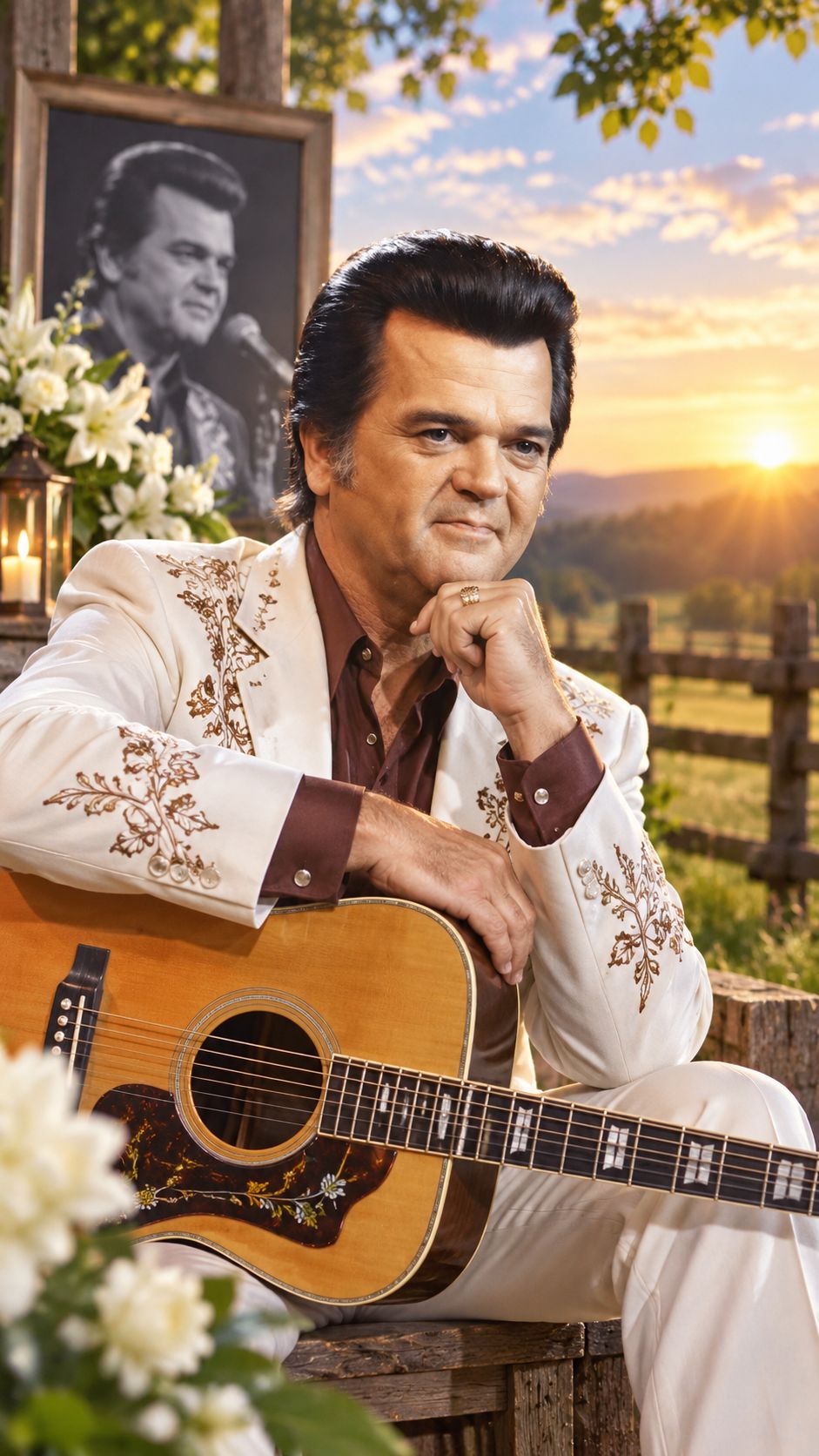
There are certain voices in country music that seem impossible to replace.
You can hear the first few notes and immediately know who is singing. You can hear the ache in the delivery, the pause between words, the quiet confidence behind a lyric—and suddenly an entire era comes rushing back.
Conway Twitty had that kind of voice.
On June 5, 1993, country music lost one of its most distinctive stars when Twitty died suddenly at just 59 years old. He had been traveling from a performance in Branson, Missouri, toward Nashville and the upcoming Fan Fair celebration when tragedy struck. According to the Country Music Hall of Fame, Twitty died from a stomach aneurysm.
The shock was enormous.
But perhaps what made his passing so heartbreaking was that Twitty did not feel like an artist whose story was finished.
He was still creating. Still performing. Still evolving.
And somehow, the man who had spent decades singing about heartbreak, desire, regret and impossible love was suddenly gone himself.
“Country music didn’t simply lose a superstar. It lost one of its most unmistakable voices.”
The Man Behind the Name
Long before he became Conway Twitty, he was Harold Lloyd Jenkins, born September 1, 1933, in Friars Point, Mississippi.
Music found him early.
He learned guitar from his grandfather and a neighborhood blues singer, and by the age of 12 he was already broadcasting on radio in Arkansas. Baseball briefly appeared to offer another future—he was even scouted by the Philadelphia Phillies—but music ultimately won.
Then came rock ’n’ roll.
After hearing Elvis Presley, Twitty traveled to Memphis and pursued a career in the new sound exploding across America. He eventually created the stage name Conway Twitty by combining the names of Conway, Arkansas, and Twitty, Texas.
In 1958, everything changed.
“It’s Only Make Believe” became a million-selling sensation and transformed Twitty into a major pop and rockabilly star. He even appeared in films during his early-1960s teen-idol period.
But somewhere beneath the rock ’n’ roll success was a country singer waiting to come home.
He Didn’t Just Enter Country Music—He Reinvented Himself
Twitty wanted to make country records.
That decision was not necessarily obvious to everyone around him.
He had already achieved major success in pop music, and country radio initially viewed him with skepticism. But Twitty persisted.
In 1968, “The Image of Me” broke into the country Top Ten.
Then came “Next in Line.”
It became the first of what would ultimately be 40 No. 1 Billboard country hits—a staggering achievement that helped define his place in music history.
And this is where the Conway Twitty story becomes extraordinary.
He didn’t simply switch genres.
He became one of country music’s defining storytellers.
His songs were filled with complicated people making complicated decisions. They were about love that had gone wrong, marriages under pressure, temptation, loneliness, guilt and the desperate hope that something broken could still be repaired.
Songs such as “Hello Darlin’,” “Fifteen Years Ago,” “You’ve Never Been This Far Before,” “There’s a Honky Tonk Angel,” and “Linda on My Mind” became part of his signature repertoire.
Twitty understood something fundamental about country music:
The best heartbreak songs don’t just tell you that someone is hurting. They make you feel like you’re the one who caused the hurt.
That Voice Could Make a Simple Lyric Feel Like a Confession
Twitty wasn’t known for excessive theatrics.
In fact, his power often came from restraint.
His delivery could sound conversational one moment and devastating the next. He knew exactly when to lean into a word, when to hold a note and when to let silence carry part of the emotion.
That intimacy was one reason his concerts developed such a passionate following.
The Country Music Hall of Fame notes that Twitty’s audiences could resemble religious revivals, and comedian Jerry Clower famously dubbed him the “High Priest of Country Music.”
That nickname says more than it might seem.
Fans didn’t simply listen to Conway Twitty.
They believed him.
When he sang about regret, you believed the regret.
When he sang about desire, you felt the tension.
When he sang about losing someone, it sounded as though he had personally lived through the loss.
Conway Twitty and Loretta Lynn: A Partnership for the Ages
Then there was Loretta Lynn.
Together, Twitty and Lynn created one of country music’s most memorable partnerships.
Their voices were different, but somehow they fit perfectly.
Their recordings were full of tension, humor, vulnerability and emotional realism. They weren’t simply two famous singers sharing a microphone. They sounded like two people caught inside the same complicated relationship.
Their collaborations produced classics including “After the Fire Is Gone,” “Louisiana Woman, Mississippi Man” and “Feelin’s.”
The partnership earned them a Grammy and four CMA Awards.
Their chemistry became part of country music mythology.
And even decades later, those recordings remain powerful because they never sound emotionally safe.
Someone is always risking something.
Someone might leave.
Someone might betray someone.
Someone might still be desperately in love.
That was Conway Twitty’s world.
And country music loved him for it.
He Never Stopped Changing
Perhaps one of the most remarkable things about Twitty’s career was his refusal to remain frozen in one era.
In the late 1970s and 1980s, he experimented with rock, soul and outlaw influences. His sound evolved. His appearance changed. His approach to television and interviews changed as well.
Songs such as “I’d Love to Lay You Down” and “Tight Fittin’ Jeans” demonstrated that Twitty could remain commercially relevant while adapting to a changing country audience.
He also became an important supporter of other musicians.
The Country Music Hall of Fame points out that artists including Vince Gill, Kathy Mattea, Naomi Judd and Reba McEntire benefited from his encouragement. His concern for songwriters earned him another unforgettable description:
“The best friend a song ever had.”
That may be one of the most fitting ways to remember him.
Because Twitty didn’t merely sing songs.
He understood them.
Then, Suddenly, He Was Gone
By the beginning of the 1990s, Conway Twitty was still making an impact.
He returned to the country Top Ten with songs including “Crazy in Love” and “I Couldn’t See You Leavin’.” He was not a forgotten legend living in the past. He was still part of the present.
Then came June 5, 1993.
Twitty had performed in Branson and was traveling toward Nashville. The destination was Fan Fair, one of country music’s major gatherings.
He never made it.
A stomach aneurysm suddenly ended the life of a man who had spent more than three decades becoming one of the most recognizable voices in American music.
He was only 59.
The timing made the tragedy even harder to comprehend.
He had plans.
He had music.
He had audiences waiting.
He had more stories to tell.
The Cruel Irony of “Final Touches”
Perhaps one of the eeriest details of Twitty’s final chapter is the title of an album he had recorded before his death.
It was called Final Touches.
The title was never intended to be a farewell.
But after his death, it became difficult for fans not to hear something haunting in those words.
Final touches.
A final chapter.
A final recording.
A final goodbye that nobody knew was coming.
His last recording session included a duet with Sam Moore on “Rainy Night in Georgia,” later released on Rhythm, Country & Blues in 1994.
Music, in that sense, preserved something death could not take away.
His voice remained.
The Legacy Outlived the Man
Conway Twitty was inducted into the Country Music Hall of Fame in 1999, six years after his death.
But the real measure of his legacy isn’t a plaque on a wall.
It’s what happens when one of his songs starts playing.
A listener who wasn’t even alive when Twitty died can still recognize the emotion.
A country fan can still hear “Hello Darlin’” and understand immediately why this man mattered.
A singer can study his phrasing.
A songwriter can study his storytelling.
A fan can simply close their eyes and listen.
And for a few minutes, Conway Twitty is not gone.
He’s right there.
Behind the microphone.
Telling another story about love that went wrong.
About a heart that refuses to let go.
About the complicated human emotions that country music has always understood better than almost any other genre.
“The years took Conway Twitty from the stage, but they never took his voice from country music.”
June 5, 1993, was the day country music lost Conway Twitty.
But it wasn’t the day Conway Twitty disappeared.
Because legends don’t disappear when the microphone goes silent.
They remain in the records.
They remain in the memories.
They remain in the voices of the artists they influenced.
And they remain in that unmistakable moment when an old country song comes through the speakers and makes you stop whatever you’re doing.
You listen.
You remember.
And suddenly, 33 years later, Conway Twitty is singing again.
VIDEO: