 By admin
INTRODUCTION:
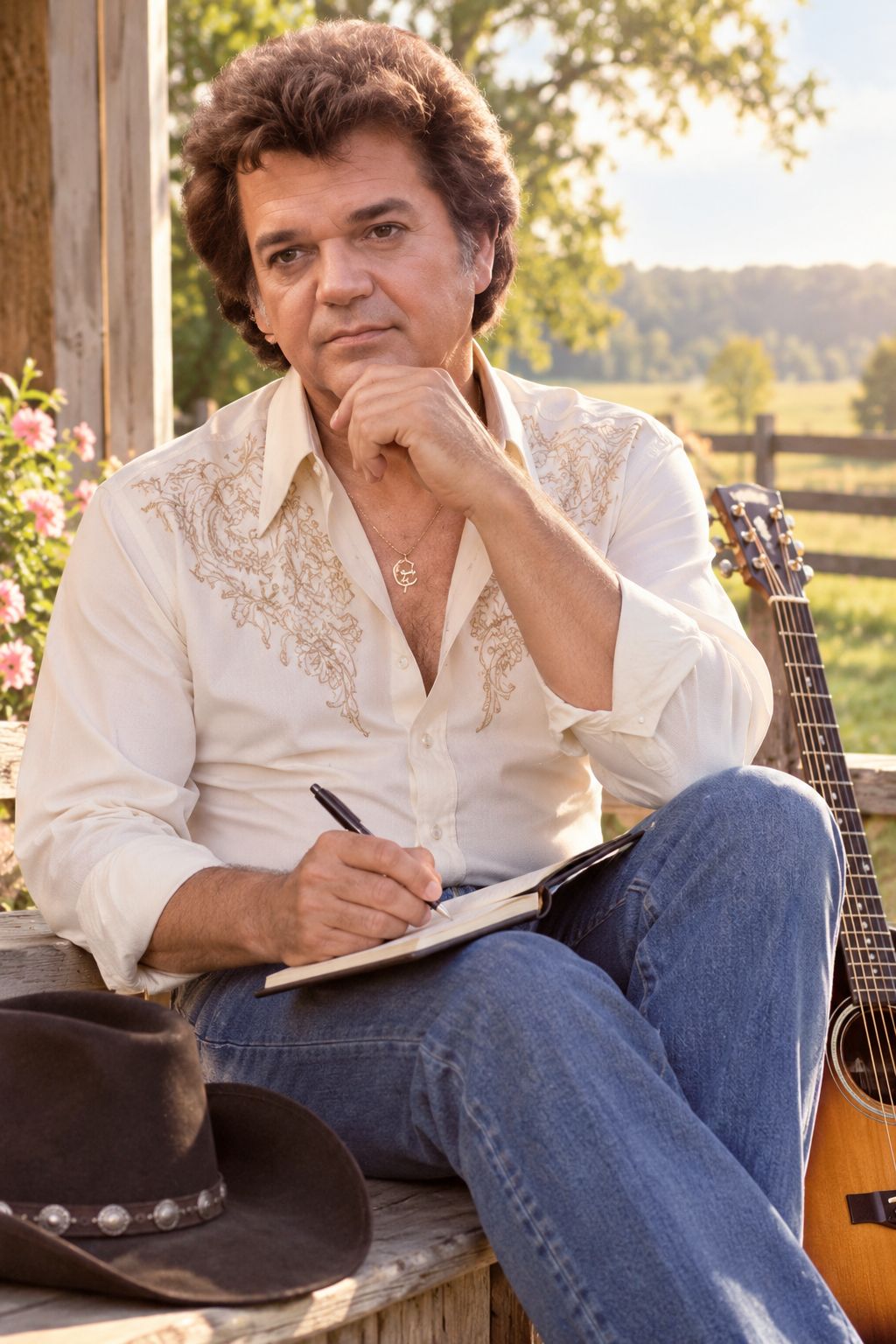
There are some names that sound as though they were invented for the spotlight.
Conway Twitty was one of them.
It had rhythm. Mystery. Southern flavor. It sounded like a man who belonged on a jukebox, under neon lights, singing about heartbreak at midnight.
But before the world knew Conway Twitty, there was simply Harold Lloyd Jenkins—a Mississippi-born boy who grew up around the Mississippi River, learned guitar as a child, played radio as a youngster, dreamed about baseball, and eventually found himself chasing the explosive new sound of rock ’n’ roll.
And the story of how Harold Jenkins became Conway Twitty wasn’t merely a marketing trick.
It was the beginning of one of the most remarkable acts of reinvention in American country music.


The Boy Behind the Name
Harold Lloyd Jenkins was born September 1, 1933, in Friars Point, Mississippi.
Music entered his life early.
According to the Country Music Hall of Fame, Jenkins learned guitar from his grandfather and a neighborhood blues musician and was already broadcasting on Arkansas radio at the age of 12. His family eventually moved to Helena, Arkansas, where his musical ambitions began taking shape.
He wasn’t just a kid dreaming about becoming famous.
He was already performing.
But his life could have gone in several completely different directions.
Baseball was one possibility. Jenkins was a gifted athlete and reportedly received an opportunity with the Philadelphia Phillies before military service interrupted that path. While serving overseas, he continued making music, performing with a band and keeping his artistic ambitions alive.
Then Elvis Presley changed everything.
When Jenkins heard the emerging sound of rock ’n’ roll, the musical world suddenly seemed to be moving underneath his feet.
He headed for Memphis and Sun Records.
And that is where Harold Jenkins began disappearing—and Conway Twitty began taking shape.
Why “Harold Jenkins” Wasn’t Enough
The 1950s music business was becoming brutally competitive.
Every week, record companies and disc jockeys were bombarded with new performers hoping for their chance.
Harold Jenkins was talented.
But his manager, Don Seat, believed talent wasn’t the only problem.
The name itself needed to stand out.
One historical account explains that Jenkins was initially reluctant to abandon his birth name because he wanted people back home to know that Harold Jenkins had made it. But he eventually accepted that a distinctive name could help him cut through the crowded pop market.
That decision reveals something important about the young singer.
He wasn’t ashamed of Harold Jenkins.
He understood that Harold Jenkins was the person—and Conway Twitty was the performer.
The distinction would become central to his career.
“You needed a unique name to catch their attention.”
It was a remarkably modern realization.
Before social media, before viral branding, before artists carefully constructed identities for different audiences, Jenkins understood something every successful entertainer eventually learns:
People have to remember you before they can love you.
The Map That Created a Legend
So where did “Conway Twitty” come from?
The answer is almost wonderfully ordinary.
A map.
The accepted account is that Jenkins combined Conway, Arkansas, with Twitty, Texas, creating a name that sounded completely different from Harold Jenkins. The Country Music Hall of Fame confirms this origin.
The Nashville Songwriters Hall of Fame gives the same explanation: in 1957, Jenkins changed his professional name to Conway Twitty using those two place names.
There are variations in the story of exactly who first suggested the name, but the essential history is clear: the name was deliberately constructed to be memorable.
And memorable it was.
“Harold Jenkins” sounded like a man you might meet at the local diner.
“Conway Twitty” sounded like a star.
And the new name arrived at exactly the right moment.
The Transformation Was More Than a Name
Here’s where the story gets fascinating.
Conway Twitty wasn’t simply created because Harold Jenkins wanted to sound cooler.
The new name came as he was trying to enter the exploding world of rock ’n’ roll.
He had been influenced by Elvis, and his early recordings reflected that era’s sound. His Sun Records recordings weren’t initially released, although Jenkins did write “Rock House,” which was recorded by Roy Orbison.
Eventually, the newly renamed Conway Twitty found his breakthrough.
In 1958, “It’s Only Make Believe” became a massive hit.
It reached No. 1 and transformed him into a teen idol. His official biography says the song ultimately sold millions of copies and topped charts internationally.
Suddenly, the invented name wasn’t merely memorable.
It was famous.
The name was now attached to screaming teenagers, radio hits, movies and a rapidly growing reputation.
Hollywood even took notice.
The fictional rock star Conrad Birdie in Bye Bye Birdie was created with Twitty’s teen-idol image in mind.
Think about that for a moment.
A man named Harold Jenkins changed his name to create a stage identity.
Then that stage identity became so recognizable that popular culture created fictional characters around it.
That’s the power of a persona.
But Harold Jenkins Was Still There
Perhaps the most emotional part of the story is that Conway Twitty never completely escaped Harold Jenkins.
In fact, the deeper he went into music, the more he seemed to return to the roots of the boy behind the stage name.
Country music had always been part of him.
Even while he was succeeding as a rock-and-roll star, Twitty continued writing country songs and eventually felt the pull of the genre he had loved all along.
After roughly eight years in rock ’n’ roll, he made a dramatic transition toward country.
And here’s the remarkable thing:
He kept the name.
He could have attempted to separate his country career from the rock star persona.
But Conway Twitty had become bigger than the original experiment.
It had become his professional identity.
According to historical accounts, he even considered using Harold Jenkins for country recordings while keeping Conway Twitty for rock records—but ultimately abandoned that idea and continued as Conway Twitty.
That decision would change country music forever.
From Teen Idol to “The High Priest of Country Music”
The man who had once been marketed as a rock-and-roll heartthrob eventually became one of country music’s most recognizable voices.
The transformation wasn’t instantaneous.
Country DJs initially viewed him with skepticism because he was a former pop and rock star. But Twitty persisted. In 1968, “The Image of Me” broke into the country Top Ten, and his country career began accelerating.
Then came the songs.
“Hello Darlin’.”
“Linda on My Mind.”
“Don’t Take It Away.”
“You’ve Never Been This Far Before.”
“Tight Fittin’ Jeans.”
And, of course, his extraordinary run of collaborations with Loretta Lynn.
The Country Music Hall of Fame notes that Twitty ultimately became one of country music’s most diverse stylists, with 11 No. 1 hits that he wrote himself. He was inducted into the Hall of Fame in 1999.
The Nashville Songwriters Hall of Fame similarly celebrates him as one of the great interpreters of songs, noting that he wrote a significant number of his own No. 1 country hits.
The irony is beautiful.
A name invented to help him become a rock star eventually became the name attached to one of country music’s greatest careers.
The Persona Became a Shield
There was another dimension to Conway Twitty’s persona.
He rarely behaved like an entertainer desperate for attention.
Instead, he cultivated mystery.
His official biography describes him as an entertainer known for understatement and mystery, even earning the nickname “The High Priest of Country Music.” He avoided excessive stage banter and preferred allowing the songs to carry the emotional communication.
That approach made the name even more powerful.
Conway Twitty didn’t need to explain Conway Twitty.
The voice did it.
The songs did it.
The silhouette, the clothes, the stage presence and the carefully controlled performances did it.
And somewhere behind all of that was still Harold Jenkins—the Mississippi boy who had once picked up a guitar and dreamed of a life in music.
“I do talk, but the communication is through my music.” — Conway Twitty
That quote may explain the entire philosophy behind the persona.
He didn’t need to tell audiences who he was.
He wanted them to feel it.
The Greatest Reinvention Wasn’t the Name
It’s tempting to tell this story as though Conway Twitty simply changed his name and became famous.
But that’s too easy.
The name opened the door.
The talent kept him inside.
A clever stage name cannot create a five-decade career by itself.
It cannot write songs.
It cannot sell millions of records.
It cannot survive changing musical fashions.
And it certainly cannot transform a former rockabilly singer into one of country music’s most enduring romantic voices.
Harold Jenkins created Conway Twitty.
But Conway Twitty had to prove himself every night.
That’s why the name matters.
It wasn’t an attempt to erase his past.
It was an attempt to give his future a shape.
Harold Jenkins Never Really Disappeared
When Conway Twitty died in 1993 at just 59, the world mourned the country superstar.
But beneath the famous name was still the same boy from Mississippi.
The boy who played guitar.
The boy who sang on local radio.
The athlete whose baseball dreams were interrupted.
The young man who heard Elvis and decided he needed to chase music.
The ambitious performer who looked at a map and understood that sometimes, if you want the world to remember you, you have to give the world something unforgettable to remember.
That was Conway Twitty.
Not merely a name.
Not merely a costume.
Not merely a marketing invention.
It was the stage identity of Harold Lloyd Jenkins—a persona that began as a calculated gamble and ultimately became inseparable from one of the greatest careers country music has ever known.
And perhaps that’s the most fascinating truth of all:
Conway Twitty wasn’t born Conway Twitty.
He built him.
One song.
One stage.
One decision at a time.
And somewhere along the way, the invented name became real enough to become immortal.
VIDEO: