 By admin
INTRODUCTION:
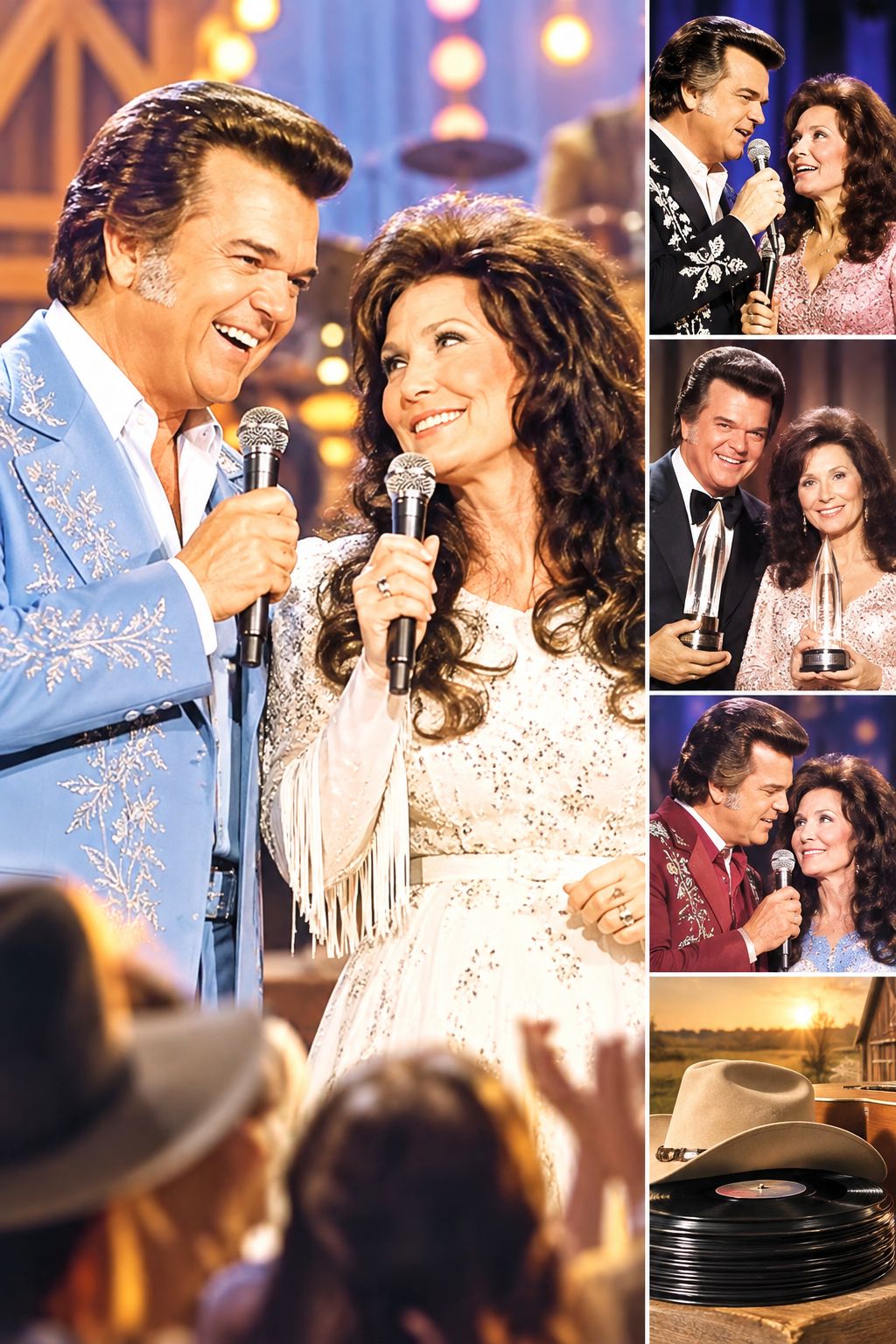
There are country duos that sound good together.
And then there are duos that seem destined to exist.
When Conway Twitty and Loretta Lynn stepped behind a microphone, something happened that neither artist could quite create alone. His deep, aching voice met her fearless Appalachian fire, and suddenly a simple country song could sound like an entire marriage falling apart—or two people desperately trying to save one.
What makes their story so remarkable is that both stars were already legends before they became a team.
Twitty had transformed himself from a rock-and-roll sensation into one of Nashville’s most powerful country singers. Lynn had risen from a two-room cabin in Kentucky to become one of the most influential women in country music. Yet together, they created something that went far beyond another successful recording partnership.
They became a phenomenon.
And for several years, they practically owned the country-duet world.
Two Completely Different Roads to Nashville
Before Conway Twitty became Conway Twitty, he was Harold Lloyd Jenkins, a Mississippi-born musician who had already tasted enormous success in rock and roll.
His 1958 recording of “It’s Only Make Believe” became a No. 1 Billboard Hot 100 hit. But Twitty eventually made one of the most remarkable career transformations in popular music: he left his rock persona behind and built an extraordinary second life in country music. The Country Music Hall of Fame credits him with 40 Billboard country No. 1 hits during his career.
Loretta Lynn’s path could hardly have been more different.
She grew up in Butcher Hollow, Kentucky, in a poor coal-mining family. Married at 15, she became a mother while still a teenager and eventually began performing around Washington state before making her way into Nashville. Her determination was legendary. Early in her career, she and her husband drove from station to station promoting her records themselves.
These weren’t two manufactured stars.
They were survivors.
And perhaps that’s why their music connected so deeply.
Then Came the Meeting Neither One Forgot
The story gets almost too perfect.
Lynn was already a Conway Twitty fan before they became friends.
In a 1978 Billboard feature, both singers remembered their first meeting. Twitty recalled being told by producer Owen Bradley that Lynn wanted to meet him. Lynn, meanwhile, remembered being stunned when she learned that the man recording nearby was the same Conway Twitty whose records she had loved.
There was an immediate mutual admiration.
That mattered.
Because the chemistry between them wasn’t manufactured by record executives trying to assemble a profitable male-female act.
They genuinely respected one another.
During a European tour, the idea of recording together began to take shape. They eventually entered the studio, and what began almost casually became one of country music’s most successful partnerships.
And then they recorded the song that changed everything.
“After the Fire Is Gone” Changed the Game
In 1971, Conway Twitty and Loretta Lynn released “After the Fire Is Gone.”
The song wasn’t innocent.
It wasn’t polished romance.
It was about desire, temptation, loneliness and the dangerous space between what people want and what they know they should want.
That was precisely where Twitty and Lynn were unbeatable.
His voice sounded like regret.
Hers sounded like defiance.
Together, they sounded like two people who understood exactly what they were doing—and knew exactly how complicated it was.
The song reached No. 1, launching what the Country Music Hall of Fame describes as one of the most successful duet teams in country music history.
And they weren’t finished.
“After the Fire Is Gone” wasn’t simply a hit. It was the moment Nashville discovered what happened when two already-great storytellers stopped competing for the spotlight and started sharing it.
They Didn’t Just Make Hits. They Built a Dynasty.
The numbers tell part of the story.
The duo recorded 11 studio albums, according to PBS’s American Masters, with five No. 1 songs coming from five different albums. Their first No. 1 duet was “After the Fire Is Gone,” followed by other classics such as “Lead Me On” and “Louisiana Woman, Mississippi Man.”
Their 1973 album Louisiana Woman, Mississippi Man reached No. 1 on the country albums chart, while its title track also topped the country singles chart.
Then came perhaps their most extraordinary run of recognition.
From 1972 through 1975, Conway Twitty and Loretta Lynn won the Country Music Association’s Vocal Duo of the Year four consecutive times.
Think about that.
Four years.
Four awards.
Four consecutive confirmations that what they were doing wasn’t a fluke.
They had become the standard by which country duets were measured.
The Secret Was Their Differences
The magic wasn’t that Twitty and Lynn sounded identical.
It was the opposite.
They sounded completely different.
Twitty brought a smooth, controlled masculinity that could turn a single phrase into a confession. Lynn brought a conversational intensity that made every lyric feel like something she’d actually lived.
He could sound guilty.
She could sound furious.
He could sound vulnerable.
She could sound unconvinced.
And when they sang together, the listener became an invisible witness to the argument.
That is why songs like “Lead Me On,” “Louisiana Woman, Mississippi Man,” and “Feelins’” still feel dramatically alive decades later. The Country Music Hall of Fame specifically identifies these recordings among their signature collaborations.
They weren’t merely singing at each other.
They were responding to each other.
Loretta Was Breaking Barriers on Her Own
It’s important not to let the duet story overshadow what Loretta Lynn had already accomplished.
She was not simply “the woman singing beside Conway Twitty.”
She was one of the most groundbreaking female artists country music had ever produced.
PBS notes that Lynn accumulated 79 charting records, including 52 Top 10s and 16 No. 1s, while her direct, woman-centered songwriting transformed the possibilities for female artists in country music.
In 1972, she became the first woman to win the CMA Entertainer of the Year award.
That context makes the Twitty partnership even more impressive.
She didn’t need Conway to become a star.
And Conway didn’t need Loretta to become a star.
They simply became something bigger together.
And Conway Was No Ordinary Partner
Twitty was already operating at an almost absurd level of success.
The Country Music Hall of Fame notes that his career survived five decades of changing musical fashions, and that he had more country No. 1 records than any country artist had achieved at the time.
He was also a prolific songwriter, with 11 of his No. 1 hits being self-penned according to the Hall of Fame.
His career was enormous.
Yet when he stood beside Lynn, he didn’t try to overpower her.
That may have been one of his greatest gifts.
He understood that the best duet isn’t about one singer winning.
It’s about creating tension between two voices.
They Even Became Business Partners
Their relationship extended beyond the recording studio.
In that 1978 Billboard interview, Twitty described himself and Lynn as close friends and business partners. The two were involved with United Talent, demonstrating that their professional relationship had developed into something much broader than simply making records together.
That is a remarkable detail.
Because by then, they had become more than collaborators.
They were part of each other’s professional worlds.
And yet, the emotional center remained the music.
The Tragedy Behind the Legacy
Conway Twitty died unexpectedly in 1993 at only 59 years old.
Loretta Lynn continued recording and performing for decades, eventually becoming one of the most honored figures in American country music. She died in 2022 at age 90.
Time changed.
Music changed.
Nashville changed.
But those recordings remained.
That is the strange thing about Conway and Loretta.
Their songs were often about relationships ending, temptation, regret and the fragile promises people make to one another.
Yet the partnership itself endured in the only way music truly can.
On record.
Every time “After the Fire Is Gone” plays, their voices meet again.
Every time “Louisiana Woman, Mississippi Man” comes on, the old chemistry returns.
Every time “Feelins’” begins, two voices from another era suddenly sound completely alive.
The Real Record They Shattered
It’s tempting to measure Conway Twitty and Loretta Lynn only through chart positions, awards and No. 1 singles.
But their greatest achievement wasn’t a number.
It was influence.
They proved that a male-female country duet could be complicated, adult, funny, sensual, heartbreaking and honest without sacrificing commercial success.
They proved that two enormous personalities could share the same microphone without diminishing either one.
And perhaps most importantly, they showed future generations that chemistry cannot be manufactured.
You can find two famous singers.
You can give them a great song.
You can put them in a studio.
But you cannot guarantee magic.
Conway Twitty and Loretta Lynn had it.
He brought the ache. She brought the truth. Together, they turned country music into a conversation between two hearts that refused to stay quiet.
That’s why their partnership still matters.
They didn’t simply make country-music history.
They made country music feel personal.
And decades later, that may be the most powerful record of all.
VIDEO: