 By admin
INTRODUCTION:
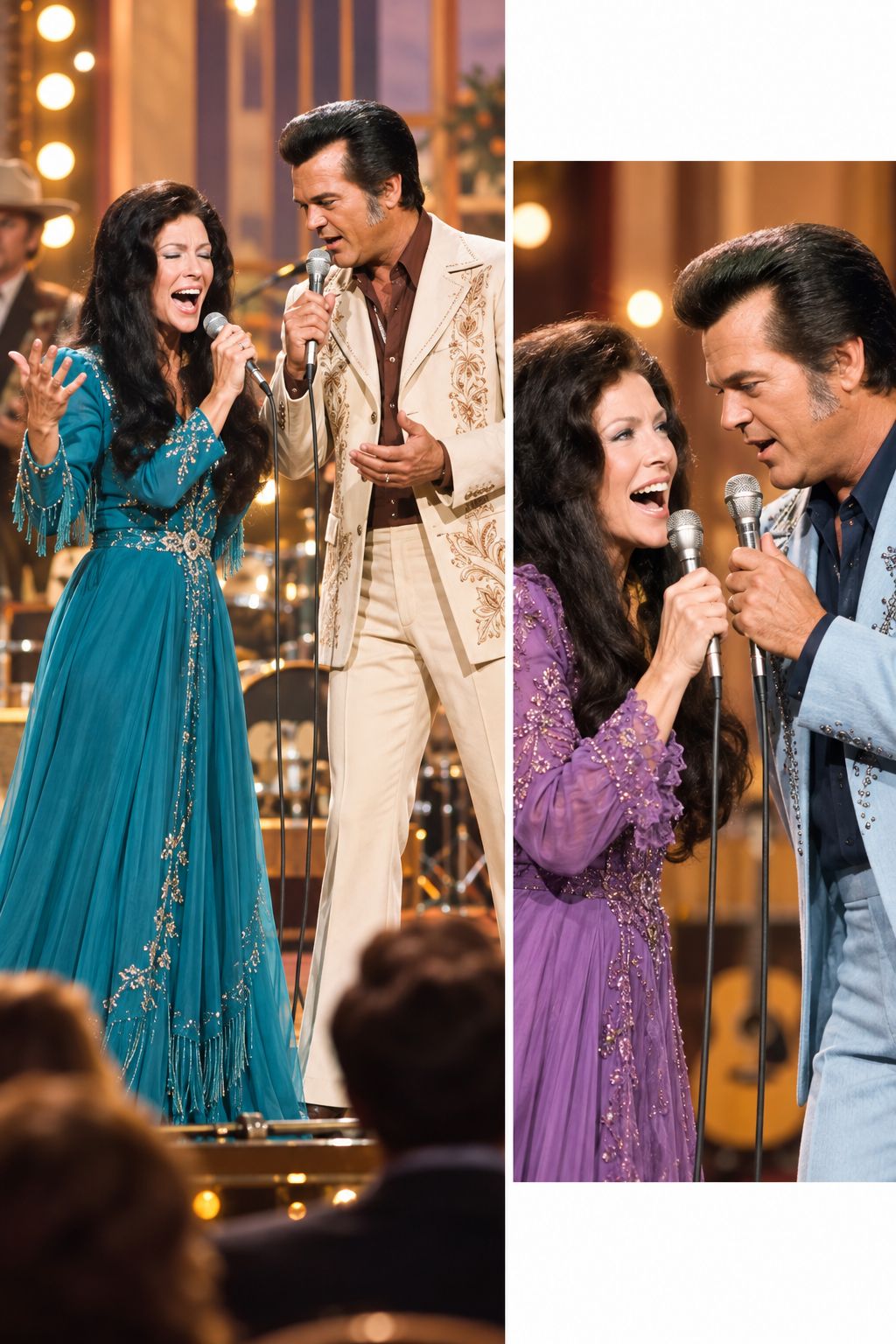
There are country duets that sound pleasant.
And then there are duets that sound like two lives colliding.
When Conway Twitty and Loretta Lynn stepped up to a microphone, something happened that could not be manufactured by producers, record executives, or even the finest Nashville musicians. Their voices seemed to challenge one another, tease one another, answer one another—and, somehow, turn emotional friction into musical magic.
Between 1971 and the late 1970s, Twitty and Lynn created one of the most successful partnerships in country music history. They released a remarkable run of albums, produced five consecutive No. 1 country singles, and won the Country Music Association’s Vocal Duo of the Year award four years in a row from 1972 through 1975.
But statistics don’t explain why their records still feel alive.
For that, you have to listen between the notes.
The Meeting of Two Completely Different Forces
By the time Conway Twitty and Loretta Lynn began recording together, neither was a newcomer.
Twitty had already reinvented himself from a rock-and-roll star into one of country music’s most formidable hitmakers. His voice carried a distinctive combination of restraint, longing, confidence, and vulnerability. The Country Music Hall of Fame notes that he eventually accumulated an extraordinary 40 No. 1 Billboard country hits.
Lynn, meanwhile, had become one of country music’s most powerful female voices. Her songs frequently addressed marriage, jealousy, independence, hardship, and women’s experiences with an honesty that could be both funny and brutally direct.
Then came their first major duet hit: “After the Fire Is Gone.”
Released in 1971, the song immediately established that this partnership was going to be different. It wasn’t simply a male singer and a female singer taking turns at the microphone.
It was a conversation.
A dangerous one.
He sounded like temptation. She sounded like resistance. And somewhere between those two voices, the song caught fire.
“After the Fire Is Gone” became their first No. 1 country hit and later earned them a Grammy.
And suddenly, Nashville had discovered a pairing that seemed almost impossible to duplicate.
Why Their Voices Worked So Well Together
The secret wasn’t that Twitty and Lynn sounded alike.
It was the opposite.
They sounded completely different.
Twitty’s lower register brought weight and darkness. Lynn’s voice could cut through that darkness with a sharp, unmistakably Appalachian-country edge.
That contrast created tension.
And tension is often the secret ingredient in great storytelling.
Listen to a Twitty-Lynn duet and you rarely feel as though you’re hearing two people simply singing the same song. Instead, it feels like you’re overhearing an argument, confession, flirtation, marriage, breakup, or forbidden conversation.
PBS’s American Masters highlighted precisely this quality when discussing the duo’s performances, noting how their voices and synchronized phrasing created an effect that was difficult to reproduce when either singer performed alone.
That is the difference between singing together and acting together through music.
The “Tension” Wasn’t Necessarily Personal
Stories about legendary musical partnerships often become exaggerated over time.
People want to believe that if two singers sound emotionally explosive together, they must have been fighting backstage.
But the reality surrounding Conway and Loretta was more interesting.
Lynn herself later rejected the idea that she and Twitty were romantically involved. She described him as a friend and recalled that her husband, Mooney Lynn, genuinely liked Twitty.
That matters.
Because the chemistry audiences heard wasn’t necessarily the result of a secret romance.
It was performance chemistry.
They understood how to inhabit a song.
They knew how to leave space for the other singer. They knew when to push forward and when to pull back. Most importantly, they knew how to make a lyric feel like something happening right now.
That’s an extraordinary skill.
Then Came “Louisiana Woman, Mississippi Man”
If “After the Fire Is Gone” proved they could create emotional electricity, “Louisiana Woman, Mississippi Man” proved they could turn that electricity into pure entertainment.
The song arrived in 1973 and became one of their signature performances.
Its premise was simple: two lovers separated by geography but refusing to let a river keep them apart.
Yet Twitty and Lynn performed it with such personality that the song became almost theatrical.
“Hey, Louisiana woman…”
“Mississippi man…”
The call-and-response structure gave them room to become characters rather than merely vocalists.
PBS notes that Lynn credited her husband-manager Doo with finding the song for the pair while they were touring. The song became the title track of their 1973 album, which reached No. 1 on the country chart.
And there was another crucial ingredient:
fun.
Their recordings weren’t always heavy.
They could be mischievous.
They could be provocative.
They could sound like two married people bickering in the kitchen—or two lovers desperately trying to find a way back to each other.
That emotional range made the partnership extraordinarily durable.
Five No. 1 Hits in a Row
The numbers become almost unbelievable.
Between 1971 and 1975, Conway Twitty and Loretta Lynn scored five consecutive No. 1 country hits:
- “After the Fire Is Gone”
- “Lead Me On”
- “Louisiana Woman, Mississippi Man”
- “As Soon as I Hang Up the Phone”
- “Feelins’”
All five reached the top of the country chart.
This wasn’t a one-song miracle.
It was a pattern.
And patterns are what separate successful collaborations from legendary ones.
Their partnership ultimately produced 11 studio albums between 1971 and 1988, according to PBS.
Loretta Lynn’s official discography also documents a long sequence of albums with Twitty, beginning with We Only Make Believe in 1971 and continuing through the late 1970s and beyond.
“Feelins’” Showed How Powerful Their Emotional Acting Could Become
Then came “Feelins’.”
This was a different kind of duet.
Instead of relying primarily on playful banter, the song leaned into emotional vulnerability.
And that was where their partnership became almost cinematic.
Twitty could sound wounded without losing his masculine authority.
Lynn could sound vulnerable without surrendering her strength.
That balance was rare.
Country music has always understood heartbreak, but Twitty and Lynn understood something deeper:
heartbreak becomes more powerful when both people have something to lose.
Their best performances didn’t tell you who was right.
They made you feel why both people were hurting.
The Studio Was Their Theater
One of the great misconceptions about classic country recording is that the magic happened only onstage.
For Conway and Loretta, the studio itself became a kind of theater.
The microphone was the stage.
The lyric was the script.
The other singer was the scene partner.
And every pause mattered.
A great duet requires an unusual kind of discipline. You cannot simply overpower the other voice. You have to listen.
That may be one of the most important reasons their recordings continue to work.
They listened to each other.
Twitty’s understated approach complemented Lynn’s more conversational emotional delivery. His style was famously controlled; the Country Music Hall of Fame describes his stage persona as dramatic and minimalist, while his recordings carried intense emotion beneath that restraint.
Lynn could then push against that restraint.
The result was friction.
And friction created heat.
What Audiences Thought They Were Hearing
Part of the magic was that listeners could project their own stories onto the recordings.
A husband heard his marriage.
A wife heard an argument she had never been brave enough to have.
A lonely person heard longing.
A young couple heard passion.
Someone going through heartbreak heard two people trying to save something that might already be broken.
That universality explains why their songs survived long after the original recording sessions.
The records weren’t merely about Conway and Loretta.
They were about everybody.
The Partnership Became a Standard
Their success wasn’t just measured in record sales and chart positions.
They became an institution.
The Country Music Hall of Fame records that Lynn and Twitty won CMA Vocal Duo of the Year four consecutive times from 1972 through 1975.
And their influence continues to echo through later generations of country performers.
When modern artists attempt classic country duets, they’re often chasing the same basic formula:
Two distinctive voices.
One compelling story.
A little conflict.
A little tenderness.
And enough silence between the lines for the audience to imagine what happens next.
The Tragedy of What Was Lost
Perhaps the most haunting part of their story is that the partnership eventually ended as a regular touring collaboration.
They stopped touring together full-time in 1981.
Twitty died in 1993.
Loretta Lynn continued her remarkable career for decades.
But that particular musical chemistry could never truly be recreated.
You can hire another singer.
You can reproduce an arrangement.
You can imitate the harmony.
You cannot reproduce history.
Because Conway and Loretta weren’t simply two great voices.
They were two personalities meeting at exactly the right moment in country music.
Why the Fire Still Burns
The greatest duets aren’t necessarily the ones with the most technically perfect vocals.
They’re the ones where you can hear something happening.
A glance.
A challenge.
A secret.
A wound.
A joke.
A plea.
Conway Twitty and Loretta Lynn understood that instinctively.
Their voices didn’t simply blend.
They collided.
And from that collision came some of the most memorable country music ever recorded.
The real magic wasn’t that Conway Twitty and Loretta Lynn sounded perfect together.
It was that they sounded believable together.
That’s why “After the Fire Is Gone” still feels dangerous.
Why “Louisiana Woman, Mississippi Man” still feels joyful.
Why “Lead Me On” still feels emotionally complicated.
Why “Feelins’” still hurts.
And why, decades later, listeners continue to hear something almost impossible to manufacture in a recording studio:
two legendary artists making each other better.
The charts can measure five consecutive No. 1 hits.
Awards can measure four straight CMA victories.
Discographies can count the albums.
But none of those numbers can fully capture what happened when Conway Twitty and Loretta Lynn stood together behind the microphone.
They didn’t just make country records.
They created conversations that generations of listeners are still eavesdropping on.
VIDEO: