 By admin
INTRODUCTION:
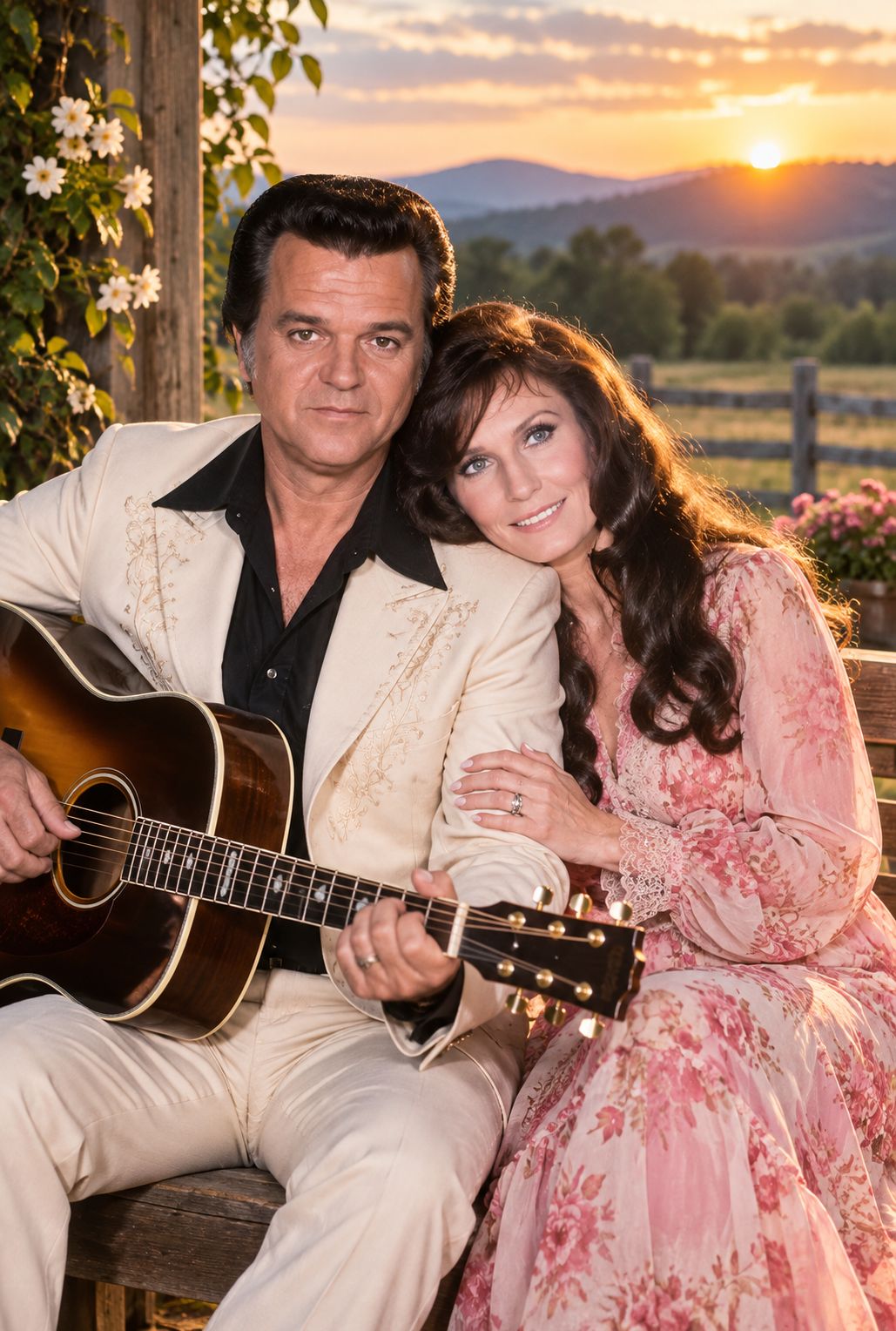
There are country songs that tell a love story.
And then there are songs that make listeners wonder whether the love story might have been real.
Few musical partnerships ever created that kind of illusion more powerfully than Conway Twitty and Loretta Lynn. For nearly two decades, their voices turned temptation, secrecy, regret, desire, marriage, and heartbreak into some of country music’s most unforgettable recordings.
The irony?
The more convincing they sounded as forbidden lovers, the more people wanted to believe they were actually involved.
But the real story is considerably more complicated—and, in some ways, more fascinating.
Because behind the microphones were two married country stars, two separate families, and a professional partnership so emotionally convincing that audiences sometimes struggled to distinguish the characters in the songs from the people singing them.
Between 1971 and 1988, Lynn and Twitty recorded 11 studio albums together and produced five No. 1 country singles. Their partnership became one of the most successful male-female collaborations in country music history.
And some of their biggest hits sounded almost dangerously intimate.
The Song That Started the Rumors
When Conway Twitty and Loretta Lynn recorded “After the Fire Is Gone,” they weren’t singing about a wholesome country romance.
They were portraying two people who find comfort in each other after the passion has disappeared from their respective homes.
The emotional premise was explosive: What happens when the love inside a marriage goes cold, but the desire for intimacy doesn’t disappear?
The song became their first No. 1 duet in 1971.
And almost immediately, the performance created a problem neither artist could completely control.
People believed them.
Not just musically.
Personally.
Loretta Lynn later acknowledged that audiences assumed there was something romantic happening between her and Twitty simply because of the songs they performed together. In an interview with Terry Gross, Lynn laughed at the idea but made her position clear: they were friends, not lovers.
“Everybody thought me and Conway had a thing going.”
That misunderstanding would follow them for years.
And the reason was simple: they were extraordinarily good at pretending.
Their Chemistry Was Real—Just Not the Way People Thought
This is where the story becomes more interesting.
The chemistry between Conway and Loretta wasn’t imaginary.
It was absolutely real.
But chemistry doesn’t automatically mean romance.
Sometimes it means trust.
Sometimes it means timing.
Sometimes two performers simply understand instinctively how to make the other person better.
Conway knew when to soften his voice. Loretta knew when to push back. He could sound vulnerable without becoming sentimental. She could sound wounded without losing her strength.
Together, they created the sensation of overhearing a private argument between two people who had known each other for years.
Garth Brooks later described the effect of their voices as creating something that neither artist could produce alone.
That was their secret.
They weren’t simply singing at each other.
They were reacting to each other.
A pause from Loretta could change the meaning of Conway’s next line. A slight change in Conway’s delivery could make Loretta sound more defensive, more vulnerable—or more tempted.
That is acting.
But it is also musicianship of an extraordinarily high level.
And Then Came “Louisiana Woman, Mississippi Man”
If “After the Fire Is Gone” made audiences suspicious, “Louisiana Woman, Mississippi Man” gave them another reason to become obsessed.
The song transformed the pair into lovers separated by geography but determined to be together.
The title itself sounded like a declaration of forbidden romance.
The recording became a No. 1 hit, and the album of the same name also reached No. 1 on the country chart.
Onstage, the illusion became even stronger.
Their performances weren’t stiff or distant. They teased each other. They exchanged knowing looks. They played with the emotional tension inside the lyrics.
And audiences naturally filled in the blanks.
If two people could sing about wanting each other with that much conviction, surely there had to be something behind it.
Except there wasn’t.
According to Lynn, the real relationship was built on friendship—and remarkably, her husband, Oliver “Doolittle” Lynn, was comfortable with Conway.
Loretta even recalled that her husband genuinely liked Twitty and enjoyed joking with him.
That detail completely changes the story.
The supposed love triangle wasn’t really a triangle at all.
It was a strange combination of marriage, friendship, performance, and imagination.
The Men and Women Behind the Characters
This is perhaps the most important part of understanding their music.
When Conway and Loretta sang about infidelity, they weren’t necessarily confessing anything.
They were portraying characters.
Country music has always thrived on that distinction.
A singer can perform a murder ballad without being a murderer. A singer can sing about divorce without ending a marriage. And a singer can portray forbidden love without having an affair.
Yet Conway and Loretta were so believable that the line became blurry.
Their music wasn’t sanitized.
It dealt with uncomfortable subjects that many people experienced but rarely discussed openly.
Loneliness inside marriage.
Emotional distance.
Temptation.
Regret.
The feeling of being loved by someone who isn’t your spouse.
And the terrifying realization that a relationship can look perfectly intact from the outside while quietly falling apart on the inside.
That’s why their songs felt dangerous.
They weren’t fantasy in the traditional sense.
They were possibilities.
“The Letter” Took the Story Even Further
Their 1976 song “The Letter” was another example of how dramatically they could inhabit complicated relationships.
Rather than simply presenting a straightforward love song, it unfolded like a miniature drama, with Conway and Loretta trading spoken passages.
The song dealt with betrayal, separation, and the possibility of reconnecting after years apart. It peaked at No. 3 on the Billboard Hot Country Singles chart.
This was part of what made their partnership so unusual.
They weren’t merely harmonizing.
They were acting through music.
Every song became a little stage play.
Conway was often the wounded or conflicted man.
Loretta could be the woman who had been hurt, tempted, disappointed, or emotionally torn.
And millions of listeners became the audience.
Did the Songs Actually Threaten Their Marriages?
This is where sensational stories often go too far.
There is no solid evidence that Conway Twitty and Loretta Lynn were secretly having an affair or that their duet partnership literally destroyed their marriages.
In fact, the surviving firsthand accounts point in the opposite direction.
Lynn repeatedly rejected the idea of a romantic relationship with Conway. She described him as a friend and spoke warmly about the relationship between Conway and her husband.
So the more accurate—and arguably more compelling—story isn’t that two marriages were destroyed by a secret romance.
It’s that two married performers created music so emotionally convincing that audiences began writing a romance for them that didn’t exist.
That’s a very different kind of forbidden chemistry.
The Real Danger Was the Illusion
Imagine being Loretta Lynn.
You’re married.
You’re standing beside another married country star.
Then you sing a song about meeting him in secret because the love has disappeared at home.
The audience screams.
Radio stations play it.
People buy the record.
And strangers start asking whether you’re really in love.
Then you go home and return to your actual life.
The next night, you perform the same fantasy again.
That requires an extraordinary ability to separate the performer from the person.
Conway and Loretta had it.
Perhaps that’s why the partnership lasted so long.
They understood the difference between emotional truth and literal truth.
The emotions were real.
The characters weren’t.
Why Their Music Still Feels Dangerous Today
More than 50 years after “After the Fire Is Gone,” the recordings still possess an uncomfortable intimacy.
That’s because the central question hasn’t disappeared.
What happens when someone feels lonely inside a relationship?
What happens when attraction appears at exactly the wrong moment?
What happens when the person who understands you isn’t the person waiting for you at home?
Those questions aren’t limited to the 1970s.
They’re timeless.
And Conway Twitty and Loretta Lynn understood something that many modern recordings sometimes forget:
A great love song doesn’t have to tell you what happened. It only has to make you wonder what could have happened.
Their voices did exactly that.
The Most Powerful Twist of All
Perhaps the greatest irony is that the rumors may actually have helped preserve the magic.
Fans wondered.
They speculated.
They watched for clues.
They listened for hidden confessions.
And every time Conway and Loretta stepped behind a microphone, they gave the audience another reason to believe that maybe—just maybe—the characters were closer to reality than anyone admitted.
But Loretta’s own words point toward a different truth.
“I loved Conway as a friend, and my husband loved him.”
That may be the most important sentence in the entire story.
Because it reveals what made their partnership extraordinary.
They didn’t need to be lovers to sound like lovers.
They needed trust.
They needed musical instinct.
They needed the courage to sing about uncomfortable emotions without confusing those emotions with their own lives.
And they needed the remarkable ability to walk offstage when the song ended and return to reality.
That is why the story of Conway Twitty and Loretta Lynn remains so fascinating.
The chemistry was forbidden—but not because they were secretly together.
It was forbidden because their music allowed millions of people to imagine a relationship that neither of them actually lived.
And perhaps that’s the greatest power country music has ever possessed:
Two voices.
One microphone.
A fictional love story.
And an audience willing to believe it was real.
VIDEO: