 By admin
INTRDUCTION:
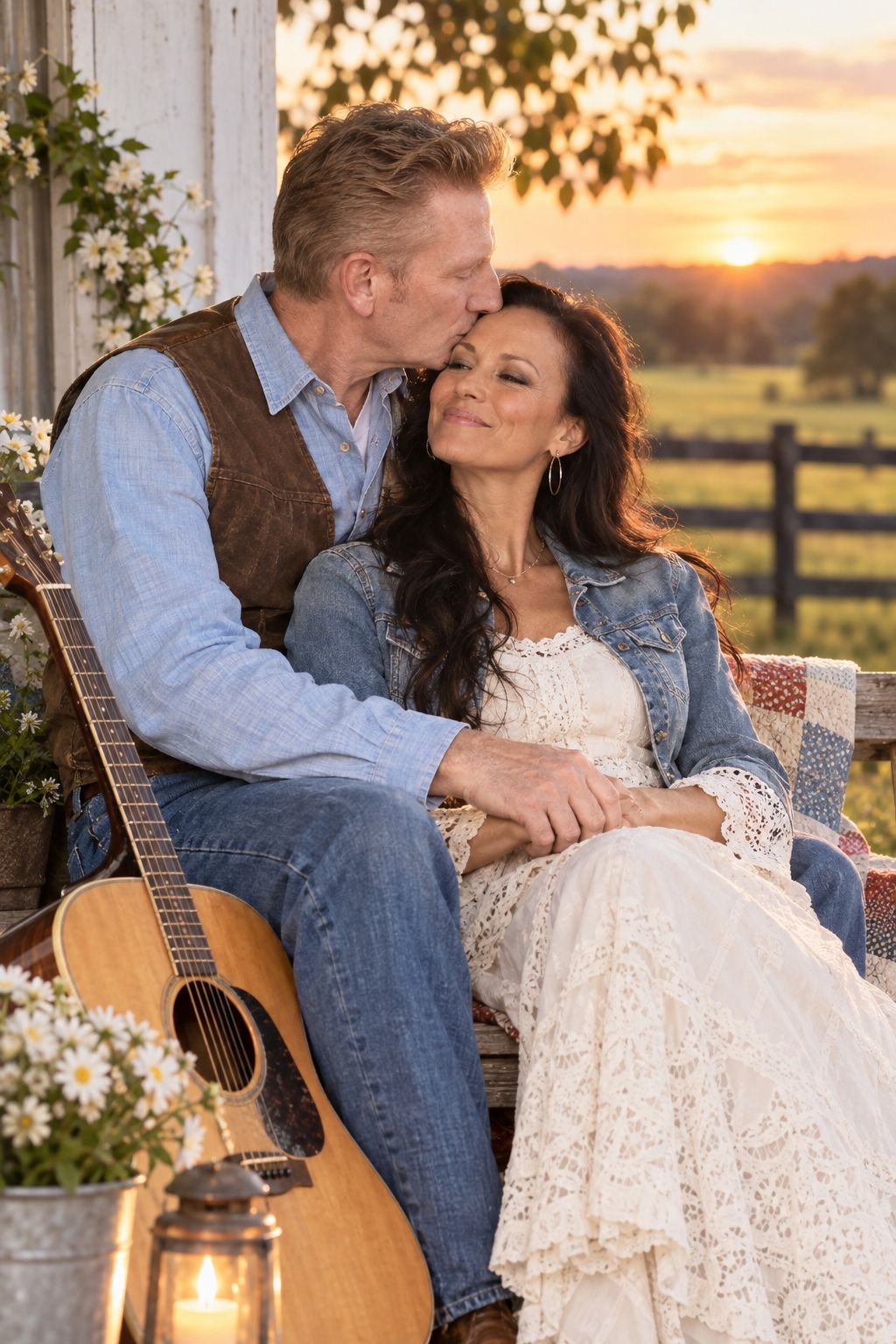
There are love stories built on red carpets, sold-out arenas, and glamorous photographs.
And then there are love stories that become powerful precisely because they happen far away from the spotlight.
Joey and Rory Feek belonged to the second kind.
To country music fans, they were more than a husband-and-wife duo. They were a portrait of devotion stripped of celebrity polish—a partnership shaped by music, faith, family, laughter, hardship, and ultimately an unimaginable goodbye.
Their story did not become unforgettable because life was kind to them.
It became unforgettable because they continued choosing each other when life was anything but kind.
“Their greatest love song was never written for radio. It was the way they lived when nobody was watching.”
Before the Tragedy, There Was a Love Story
Joey and Rory’s story began in Nashville, where countless aspiring musicians arrive dreaming of discovering something extraordinary.
Joey Martin Feek was a gifted singer whose voice carried the unmistakable warmth and vulnerability of traditional country music. Rory Feek was a songwriter, performer, and storyteller who had already spent years building a career behind the scenes.
When their paths crossed, something clicked.
But theirs was never simply a musical partnership.
They married in 2002, and their relationship gradually became the foundation of everything they created together. Their music reflected their lives: simple, intimate, sometimes humorous, sometimes heartbreaking.
When they eventually became known professionally as Joey + Rory, audiences responded to something that felt increasingly rare in modern entertainment.
They believed in the beauty of ordinary life.
Their songs often centered on marriage, family, home, faith, and the little moments that can become precious precisely because they seem insignificant at first.
That authenticity became their greatest strength.
And then came the news that would change everything.
The Diagnosis That Changed Their World
In 2014, Joey was diagnosed with cervical cancer.
She underwent treatment, surgery, and chemotherapy, and for a time, there was reason to hope that she had beaten the disease.
But cancer returned.
By 2015, the couple was facing a devastating reality: Joey’s illness was terminal.
For a couple whose professional life revolved around performing together, the future suddenly became less about career plans and more about time.
How much time did they have?
How many birthdays?
How many mornings?
How many songs?
How many ordinary dinners at home?
Those questions transformed the way audiences saw them.
Their fans were no longer simply watching country musicians.
They were watching two people trying to preserve a life together while knowing that life was slipping away.
And somehow, they continued to create beauty.
“When I’m Gone” Became Something More Than a Song
Joey recorded “When I’m Gone” during the final chapter of her life, and its emotional impact was unlike an ordinary country recording.
The song sounded like a conversation across an inevitable separation.
Its meaning was especially painful because listeners knew what Joey and Rory were facing.
There was no theatrical attempt to hide the reality.
No pretending that everything would magically work out.
Instead, the couple allowed their music to acknowledge grief before the goodbye had even arrived.
That honesty made their final recordings extraordinarily powerful.
“They didn’t sing as though heartbreak was something happening to someone else. They sang from inside it.”
Joey’s voice became increasingly fragile, but that fragility gave her performances a quality that technical perfection could never provide.
Every breath seemed to matter.
Every lyric carried weight.
Every note sounded like something worth preserving.
Their Love Was Bigger Than Their Music
The temptation when discussing Joey and Rory is to focus exclusively on their songs.
But doing so misses the heart of their story.
Their greatest legacy wasn’t a chart position.
It was the way they demonstrated partnership.
Rory became Joey’s caregiver, husband, best friend, and emotional anchor. Joey, despite the physical devastation of cancer, remained deeply concerned about Rory, their daughter, and the family they had built.
They weren’t presented as a perfect couple living a perfect life.
They argued.
They laughed.
They struggled.
They worried.
They experienced exhaustion and fear.
That imperfection made their devotion believable.
Their story wasn’t “true love means never suffering.”
It was closer to:
True love means remaining present when suffering arrives.
The Photograph That Broke America’s Heart
As Joey’s condition worsened, Rory documented portions of their family life through writing and photography.
Those images gave fans an intimate glimpse into a world far removed from the stage.
There were quiet moments at home.
Family gatherings.
Their daughter Indiana.
Joey’s changing appearance.
And Rory’s determination to make the remaining days meaningful.
One of the most moving elements of the story was how the couple continued celebrating life even while death was approaching.
They created memories deliberately.
They photographed moments.
They prayed.
They sang.
They laughed.
They spent time together.
In another family, these might have been ordinary activities.
For Joey and Rory, they became priceless.
The Wedding Anniversary That Became a Farewell
One of the most heartbreaking chapters came in October 2015, when Joey and Rory marked their anniversary while Joey’s health was deteriorating.
There was something almost unbearably poetic about celebrating a marriage while knowing one partner might not have much time left.
Yet that was precisely the point.
They weren’t celebrating because they had been promised forever.
They were celebrating because they had already been given something extraordinary.
A marriage.
A child.
A home.
A body of music.
A collection of memories.
And years of choosing one another.
“Forever stopped being a number. It became every moment they had already shared.”
Joey eventually entered hospice care.
On March 4, 2016, she died at age 40.
Rory was left to face a world that had suddenly become impossibly different.
What Happened After Joey Was Gone?
This is where Joey and Rory’s story becomes even more complicated.
Because losing someone doesn’t mean the relationship ends.
The person is gone.
The conversations change.
The physical presence disappears.
But love remains embedded in routines, photographs, music, memories, and the child they shared.
Rory continued raising their daughter and preserving Joey’s legacy.
He also continued telling their story.
For many fans, that became part of the healing process.
They had followed Joey’s illness.
They had cried with the family.
They had listened to the final songs.
And now they watched Rory attempt to rebuild a life without the woman who had been at its center.
That process was not presented as a neat Hollywood ending.
There was no magical moment when grief disappeared.
Instead, Rory demonstrated something much more honest:
You can continue living without betraying the person you lost.
Why Their Story Still Resonates
Country music has always been obsessed with love and loss.
From broken marriages to lonely highways, country songs have traditionally given emotional language to experiences people don’t always know how to express.
But Joey and Rory brought something different.
Their relationship blurred the boundary between the country song and the life behind it.
They didn’t merely sing about devotion.
They demonstrated it.
They didn’t merely record songs about family.
They built their lives around family.
And when tragedy arrived, they didn’t abandon the values that had defined them.
That’s why their story continues to resonate.
In an entertainment culture often dominated by spectacle, Joey and Rory offered something quieter.
Something almost radical in its simplicity.
A husband holding his wife’s hand.
A mother singing to her child.
A couple recording music in the middle of uncertainty.
A family choosing gratitude even when grief was unavoidable.
The Meaning of “Till Death Do Us Part”
Wedding vows often contain the phrase “till death do us part.”
For many people, it is simply familiar language.
For Joey and Rory, those words eventually became painfully literal.
But their story also revealed something deeper.
Death ended Joey’s physical presence.
It did not erase the marriage.
It did not erase the songs.
It did not erase their daughter.
It did not erase the memories.
And it certainly did not erase the love.
Perhaps that’s the greatest lesson Joey and Rory left behind.
True love isn’t proven when everything is easy.
It is revealed when there is nothing left to gain except another moment together.
When the future becomes uncertain, love becomes less about promises and more about presence.
When the world tells you to look away from pain, love sometimes means staying.
When there are no guarantees of tomorrow, love means making today count.
“Joey and Rory didn’t redefine true love by showing us a perfect marriage. They redefined it by showing us what devotion looks like when perfection is no longer possible.”
Years later, their story remains one of the most emotionally powerful chapters in contemporary country music.
Not because they escaped tragedy.
They didn’t.
Not because their love conquered death.
It couldn’t.
But because, for a while, they stood together at the edge of something neither could stop—and chose to fill that remaining time with music, family, faith, and love.
And perhaps that’s what makes their story timeless.
The greatest love stories aren’t always the ones that last the longest.
Sometimes they’re the ones that teach us how to love fiercely while we still have the chance.
VIDEO: