 By admin
INTRODUCTION:
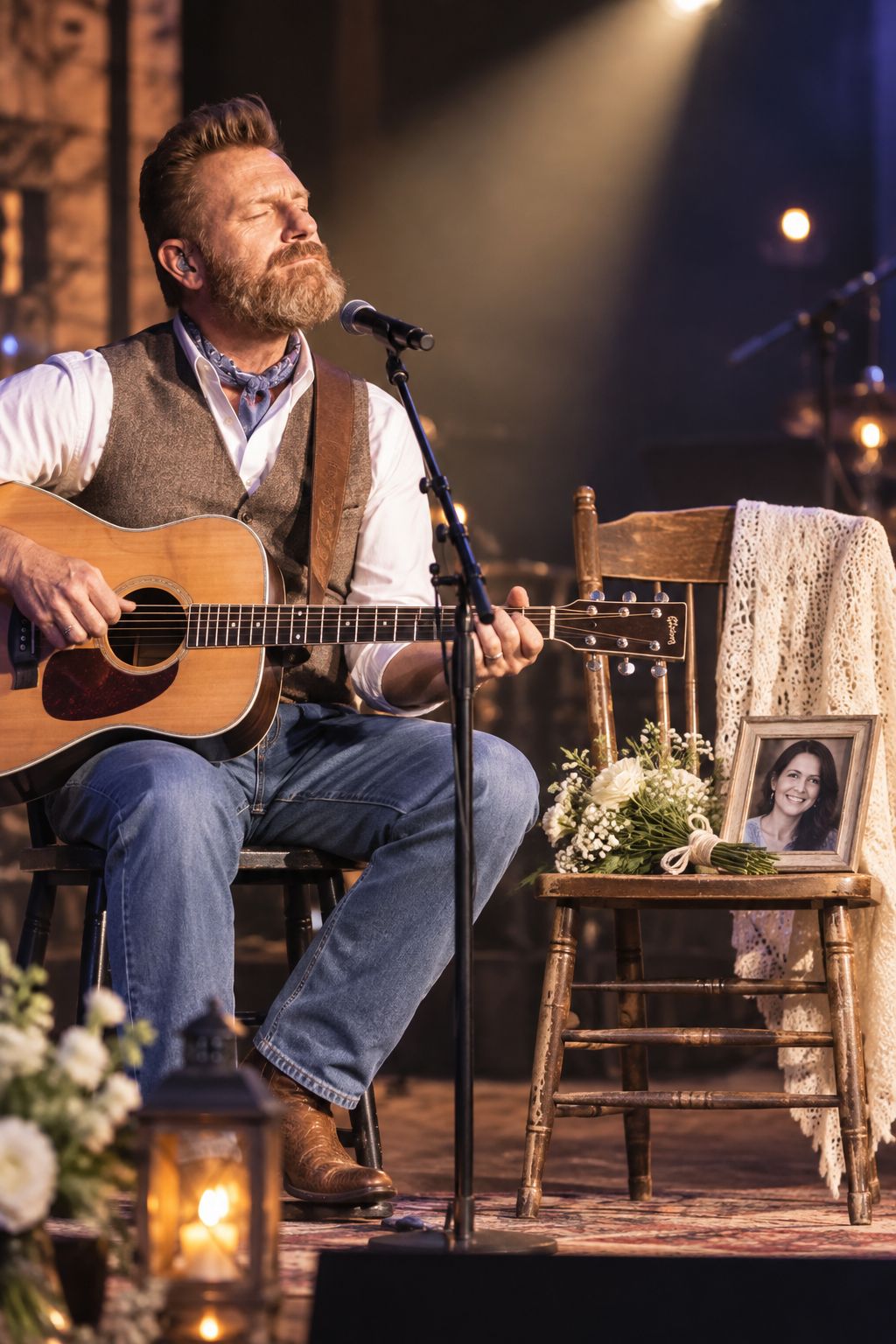
There are moments in country music when silence says more than a thousand lyrics ever could.
For Rory Feek, stepping onto a stage after Joey’s death was never simply a return to performing. It was an encounter with everything that was missing.
For years, audiences had watched Joey and Rory Feek perform as one of country music’s most beloved husband-and-wife duos. Their music was intimate, homespun and deeply personal. They did not merely sing about love—they lived it in front of their audience.
Then, in March 2016, Joey died at 40 after a two-year battle with cervical cancer.
And suddenly, the man who had spent years standing beside her had to decide whether there was any reason to stand onstage alone.
The answer, at first, was no.
“I don’t want to be on stage without her.”
That wasn’t a publicity line. It reflected something much deeper about Rory’s relationship with music. He had never seemed driven by the spotlight in the way many performers are. In fact, before Joey + Rory became a nationally recognized act, Rory was already an accomplished songwriter whose songs had been recorded by artists including Blake Shelton, Tracy Byrd, Collin Raye and others.
Performing beside Joey was different.
He loved watching her perform.
And that distinction would become crucial after she was gone.
He Never Thought the Stage Belonged to Him Alone
The story of Joey + Rory had always been unusual.
They married in 2002, and their musical partnership emerged almost unexpectedly when they auditioned for CMT’s Can You Duet? in 2008. They eventually became one of the show’s finalists and launched a recording career together.
But their appeal wasn’t manufactured chemistry.
It was marriage.
They looked at one another while singing. They laughed. They teased each other. Their imperfections became part of the charm.
The audience wasn’t simply watching two country singers.
It was watching a husband and wife.
That made the empty space beside Rory almost impossible to ignore.
In 2016, shortly after Joey’s death, Rory told CBS that performing without her wasn’t something he wanted to do. He explained that he hadn’t loved being onstage for its own sake.
He loved being beside Joey.
“I loved to stand next to her.”
And then came the line that may explain his entire relationship with performance:
“I just had the best seat in the house, to watch the world discover my wife.”
That sentence changes the way you hear Rory’s later solo performances.
Because when he eventually returned to the stage, he wasn’t simply learning how to sing without a duet partner.
He was learning how to be a performer when the person he most wanted to impress was no longer sitting beside him.
The First Song After Joey Was Almost Too Much
For more than a year, Rory largely stepped away from performing.
Then something unexpectedly small brought music back into his life.
He heard a church group singing one of the songs he and Joey had recorded. Later that night, after putting daughter Indiana to bed, Rory took Joey’s guitar down from the wall.
He began playing.
One song became several.
He reportedly sang around a dozen songs before putting the guitar away.
There was no grand comeback announcement.
No dramatic stage production.
Just a widower, a guitar and memories.
Eventually, Rory made his first public performance since Joey’s death during a 2017 appearance on CBS This Morning. He performed “I Like the Sound of That,” a song he and Joey had sung together and one he had co-written years earlier.
The performance became difficult to watch—not because it was technically imperfect, but because of what the song represented.
The lyrics were written from the perspective of a couple imagining a future together.
Now Rory was singing them alone.
At one point, emotion overtook him and he had to stop and gather himself before continuing.
That wasn’t weakness.
It was the sound of memory colliding with reality.
The Empty Chair Was More Than a Metaphor
When fans describe Rory’s solo performances as heartbreaking, it’s easy to reduce the story to grief.
But his situation was more complicated.
He wasn’t simply mourning his wife.
He was mourning a musical identity.
For nearly a decade, “Rory Feek” and “Joey + Rory” had become intertwined. Their voices were intertwined. Their stories were intertwined. Their audience was intertwined.
And then one half of that equation disappeared.
By 2017, Rory had begun cautiously considering what music might look like without Joey. By 2018, he was performing again, including intimate shows at the barn concert hall on his Tennessee farm. These performances were not conventional concerts; they combined storytelling, music, family memories and reflections on life after loss.
His manager described the experience as something closer to a storytelling presentation with music than a traditional concert.
That distinction matters.
Rory wasn’t trying to replace Joey.
He wasn’t trying to recreate Joey + Rory.
He was trying to tell the truth about what happened next.
“Surreal and Strange” Was the Reality of Coming Back
When Rory eventually discussed returning to the stage, he didn’t pretend it felt normal.
It didn’t.
He described getting back out there as:
“Surreal and strange, a little wrong in some ways.”
Yet he also said there was something strangely familiar about it.
That contradiction is perhaps the most honest description of grief in music.
Something can feel wrong and familiar at the same time.
The microphone is still there.
The guitar is still there.
The audience is still there.
The songs are still there.
But the person who made those things feel complete is gone.
And that creates an extraordinary emotional tension.
Every familiar chord carries two meanings: what the song was—and what it has become.
Rory Wasn’t Leaving Joey Behind
One of the most moving aspects of Rory’s return was that he didn’t treat moving forward as forgetting.
Quite the opposite.
More than two years after Joey’s death, he told CBS:
“I feel just as married and just as in love.”
He also said that Joey remained as much a part of their life as she had been before her death.
That philosophy shaped his performances.
Instead of trying to erase the past, Rory carried it onto the stage.
His stories became part of the music.
His memories became part of the show.
And the silence surrounding certain songs became part of the performance too.
That’s what makes his solo work so different from a conventional comeback.
Most artists return to the stage to reclaim their career.
Rory returned to discover whether music could still have a place in his life.
The Farm Became a Different Kind of Stage
There is something fitting about Rory’s return happening partly at the couple’s Tennessee farm.
The farm had been more than a home. It was part of the Joey + Rory story.
Their barn had been transformed into a concert venue during their career, creating an intimate setting where audiences could experience the couple’s music in an environment that felt more like someone’s living room than an arena.
After Joey died, that same environment carried a different emotional weight.
The barn remained.
The songs remained.
The memories remained.
But one voice was missing.
Rory’s later shows embraced that reality rather than hiding from it. His performances incorporated stories about his life, his family and what he had experienced since Joey’s death.
In other words, the empty space became part of the story.
The Most Painful Audience Was Sometimes the One He Couldn’t See
Every performer eventually learns to read a crowd.
Applause.
Laughter.
Silence.
Tears.
But grief creates another audience—the invisible one.
For Rory, Joey remained emotionally present even when physically absent.
He visited her gravesite frequently. He described having a place there for both his coffee and hers, continuing a private ritual of sharing coffee together.
That image tells us something important about his music.
His relationship with Joey did not end when the curtain came down.
It simply changed location.
The duet that once happened beneath stage lights could now happen in memory.
Country Music Has Always Understood the Language of Loss
Country music has a long tradition of turning heartbreak into song.
But Rory’s story is different because the heartbreak wasn’t something he invented for a three-minute record.
He lived it.
He documented it.
And eventually, he sang through it.
His journey demonstrates why some of the most powerful country performances aren’t necessarily the loudest ones.
Sometimes it’s the tremble in a voice.
Sometimes it’s the pause between lines.
Sometimes it’s the chair beside the singer that remains empty.
And sometimes the most devastating moment is when the singer manages to finish the song.
He Didn’t Really “Go Solo”
Perhaps that’s the greatest misunderstanding of Rory Feek’s return.
From a distance, it looks like a solo career.
But emotionally, it never really was.
Joey remained woven into the stories, songs and memories he shared with audiences.
Rory wasn’t replacing a duet.
He was carrying one half of it forward.
That is a very different thing.
His music after Joey became less about proving that he could survive alone and more about showing that love doesn’t necessarily disappear when a person does.
The voice may be gone.
The partnership may look different.
The stage may suddenly feel enormous.
But the relationship can remain.
And perhaps that’s why Rory’s performances have resonated so deeply with fans.
They aren’t really watching a man sing alone.
They’re watching a man learn how to carry a lifetime of love into a future he never expected to live.
The chair beside him may be empty.
But the story isn’t.
And neither, ultimately, is the music.
VIDEO: