 By admin
INTRODUCTION:
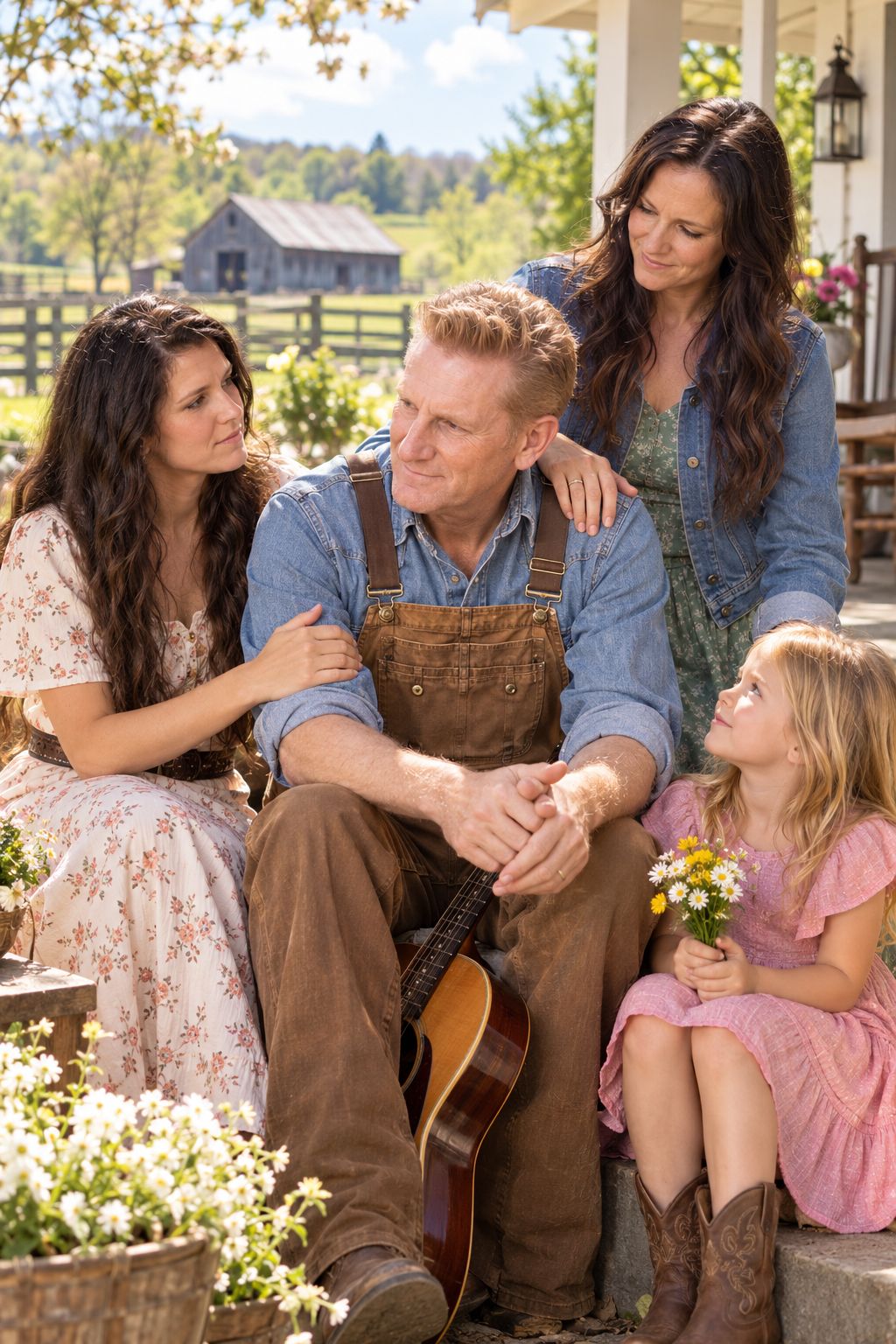
For years, Rory Feek was portrayed through one of country music’s most emotionally powerful stories: the songwriter who found love with Joey, built a life on a Tennessee farm, watched his wife battle cancer, and then faced the impossible task of raising their young daughter, Indiana, after Joey’s death.
But there is another family story—one that is considerably more complicated.
Long before Joey + Rory became a beloved country duo, Rory was already a father. His older daughters, Heidi and Hopie, were born in the 1980s, and Rory eventually raised them as a single father after his marriage to their mother, Tamara Gilmer, ended.
That history matters.
Because when people look at the current estrangement between Rory and his older daughters, it can be tempting to see only the most recent controversy. The reality is that the fractures appear to run much deeper, touching questions of childhood, identity, faith, family boundaries, privacy, and—perhaps most painfully—the relationship between three sisters who once shared a life.
And there is one uncomfortable truth at the center of it all:
This is not simply a story about a father and two daughters who stopped getting along. It is a story about a family whose understanding of one another has changed over decades.
Before Joey, There Were Heidi and Hopie
Rory’s life as a father began years before the public knew him as half of Joey + Rory.
Heidi was born in 1986 and Hopie in 1988. After Rory and Tamara separated, Rory ultimately became the primary parent to both girls. He later described those years as formative—not only for his daughters, but for himself.
In a CBS interview, Rory reflected on that period with unusual humility, saying he believed his daughters had, in many ways, raised him while he was raising them.
That line is easy to overlook, but it reveals something important.
Rory’s relationship with Heidi and Hopie was never a footnote to his life. They were there before the farmhouse, before Joey, before the television appearances and before millions of people knew his name.
They were part of the version of Rory that existed before the fairy-tale country-music narrative.
And that makes the later conflict much harder to understand through a simple good-guy-versus-bad-guy lens.
Then Came Joey—and a New Family Chapter
When Rory met Joey, his daughters did not disappear from the story.
Instead, another family was formed.
Rory and Joey married in 2002 and eventually welcomed Indiana in 2014. Joey’s illness and death in 2016 transformed the family once again. Rory suddenly became a widower and a single father to a young daughter.
But the emotional landscape was complicated even then.
Only days after Joey died, Hopie had a deeply personal conversation with her father about her sexuality. She was afraid he would reject her, particularly because of his conservative Christian beliefs.
Rory later acknowledged that his first internal reaction was not the unconditional acceptance Hopie desperately needed at that moment. But he also described the struggle that followed inside himself and ultimately said his responsibility was to love his daughter even when he did not understand or agree with everything about her life.
That moment is significant because it illustrates the fundamental tension that would continue to define their relationship.
Rory’s identity is deeply rooted in faith and traditional beliefs.
His daughters developed identities and perspectives that did not always fit comfortably inside those beliefs.
Love remained.
Agreement did not.
And those are very different things.
The DNA Revelation Changed the Meaning of “Father”
Then came a revelation that could have shattered almost any family.
In 2025, Hopie revealed that a DNA test showed Rory was not her biological father.
The news was shocking because Rory had spent decades raising Hopie as his daughter. He later acknowledged that he had wondered about her biological parentage years earlier, but had nevertheless chosen to raise her as his own.
Rory’s public response was emotionally direct: the DNA result did not change his love for Hopie.
In one sense, it reinforced the idea that fatherhood is about much more than biology.
But the revelation also exposed an older wound.
Hopie objected to aspects of the way Rory publicly discussed the family’s history, particularly details involving her mother and deeply personal conversations. She later said that her relationship with Rory was broken not because of the DNA revelation itself, but because of how intimate experiences had been made public and because she wanted professional family therapy to help them navigate the relationship.
That distinction is crucial.
The problem was not simply:
“You aren’t my biological father.”
It was closer to:
“You are the man who raised me, and therefore what happens between us still matters enormously.”
That is a much more painful problem.
Then Everything Came Back to Indiana
The most serious rupture developed around Indiana.
Heidi and Hopie have publicly expressed concerns about their younger sister’s relationship with them and about Rory’s decisions concerning her care. In 2024, they took legal action involving access to Indiana; because Indiana is a minor, details of the proceedings have not been publicly disclosed in full. Rory has disputed their characterization of events and has said differences in worldview played a role in limiting contact.
This is where the story becomes especially difficult.
Because Indiana is not merely a subject in the dispute.
She is the youngest sister.
And she has lived through the loss of her mother, the death of Joey, and the enormous changes that followed.
Rory has said publicly that Indiana misses Heidi and Hopie and asks about them.
Meanwhile, Heidi and Hopie have expressed their own fears about losing contact with their sister.
That creates a heartbreaking paradox.
Two sides can sincerely believe they are protecting the same child while reaching radically different conclusions about what protection requires.
Sometimes a family fight becomes most tragic when everyone involved believes they are acting out of love.
Childhood Memories Have Also Returned to the Surface
The present conflict has prompted Heidi and Hopie to speak publicly about painful memories from their childhood, including allegations of neglect and mistreatment.
These are serious allegations, and they should not be treated as established facts simply because they have been publicly repeated.
Rory has offered different accounts of some of the incidents described, including an episode involving Heidi’s childhood injury. He has not agreed with the daughters’ characterization of his parenting.
That disagreement itself tells us something important.
Families do not remember childhood in identical ways.
A parent may remember doing what he believed was reasonable under difficult circumstances.
A child may remember the same event as abandonment, fear, or not being heard.
Both memories can feel completely real to the people carrying them.
And decades later, those competing memories can become almost impossible to reconcile without honest conversation and, potentially, professional help.
The Public Nature of Their Pain Makes Everything Worse
There is another dimension outsiders often underestimate: Rory’s life has been lived publicly for years.
His grief was public.
His marriage was public.
His daughter’s childhood was public.
His music was public.
His faith was public.
And now, unfortunately, aspects of his family conflict are public too.
That creates a dangerous cycle.
One person tells their story.
Another responds.
Fans choose sides.
Social media amplifies the strongest accusation.
And suddenly a deeply personal family disagreement becomes entertainment for strangers.
Hopie has specifically objected to personal conversations being published, while Rory has continued to share his perspective through his writing and public platforms.
That doesn’t automatically make one side right and the other wrong.
But it does explain why reconciliation becomes harder.
Once private pain becomes public record, taking back the words is nearly impossible.
And Then Came Indiana’s Health Crisis
The family conflict became even more emotionally charged in 2026 when Indiana underwent open-heart surgery and subsequently experienced serious medical complications.
Rory shared details of her health crisis publicly.
Heidi and Hopie responded critically, arguing that their sister’s vulnerable medical moments were being publicly documented without her ability to consent and expressing distress that they learned about aspects of the situation through social media.
Again, the disagreement reveals two radically different perspectives.
Rory appears to view sharing Indiana’s journey as part of his role as her father and as a way of allowing others to understand what the family is experiencing.
His older daughters see the same public exposure as a violation of their sister’s privacy.
The underlying question is not merely about social media.
It is about who gets to tell Indiana’s story.
And that question has become symbolic of the larger family fracture.
The Most Complicated Part: They Still Love Him
Perhaps the most revealing aspect of this entire story is that Heidi and Hopie’s public criticism does not necessarily mean they have stopped loving their father.
Hopie has explicitly said she loves Rory and always will, while also describing the relationship as broken and saying she believes professional help is needed.
That may be the most heartbreaking sentence in the entire saga.
Because estrangement is rarely the opposite of love.
Sometimes it is what happens when love becomes too painful to navigate.
A daughter can be furious with her father and still desperately want him to change.
A father can believe he is protecting his child while simultaneously failing to understand why his other daughters feel wounded.
And sisters can fight for access to one another because their bond means more to them than the disagreement that separated them.
Rory’s Story Is Not Simply a Tragedy—or a Redemption Story
Country music loves simple narratives.
The broken man finds redemption.
The widower carries on.
The father protects his child.
The family survives hardship.
But real families do not always follow the structure of a country song.
Rory Feek’s relationship with Heidi and Hopie contains love, history, faith, disagreement, painful memories, biological surprises, grief, and competing definitions of what it means to be a parent.
There is no responsible way to reduce all of that to a headline declaring one person the villain.
There are allegations that remain disputed.
There are legal matters whose details are not public.
There are private conversations outsiders will never fully know.
And there are three sisters whose lives are forever connected, regardless of what happens between their father and his older daughters.
Perhaps the saddest possibility is that everyone involved may genuinely want the same thing—family—while having completely different ideas about how to get there.
The deepest wounds in families are rarely created by strangers. They come from people who mattered enough to hurt us in the first place.
For Rory, Heidi, and Hopie, the question may no longer be whether they love one another.
The evidence suggests that love is still there.
The harder question is whether they can find a way to live with the things they cannot agree on—and whether they can stop telling the story only from their own side long enough to hear the pain on the other side.
Because beneath the headlines, court filings, interviews, social-media posts, and DNA revelations is something much simpler and much more human:
A father raised two girls.
Those girls grew into women.
Life changed all of them.
And now, after decades of shared memories, they are trying to figure out whether love alone is enough to bring a family back together.
VIDEO: