 By admin
INTRODUCTION:
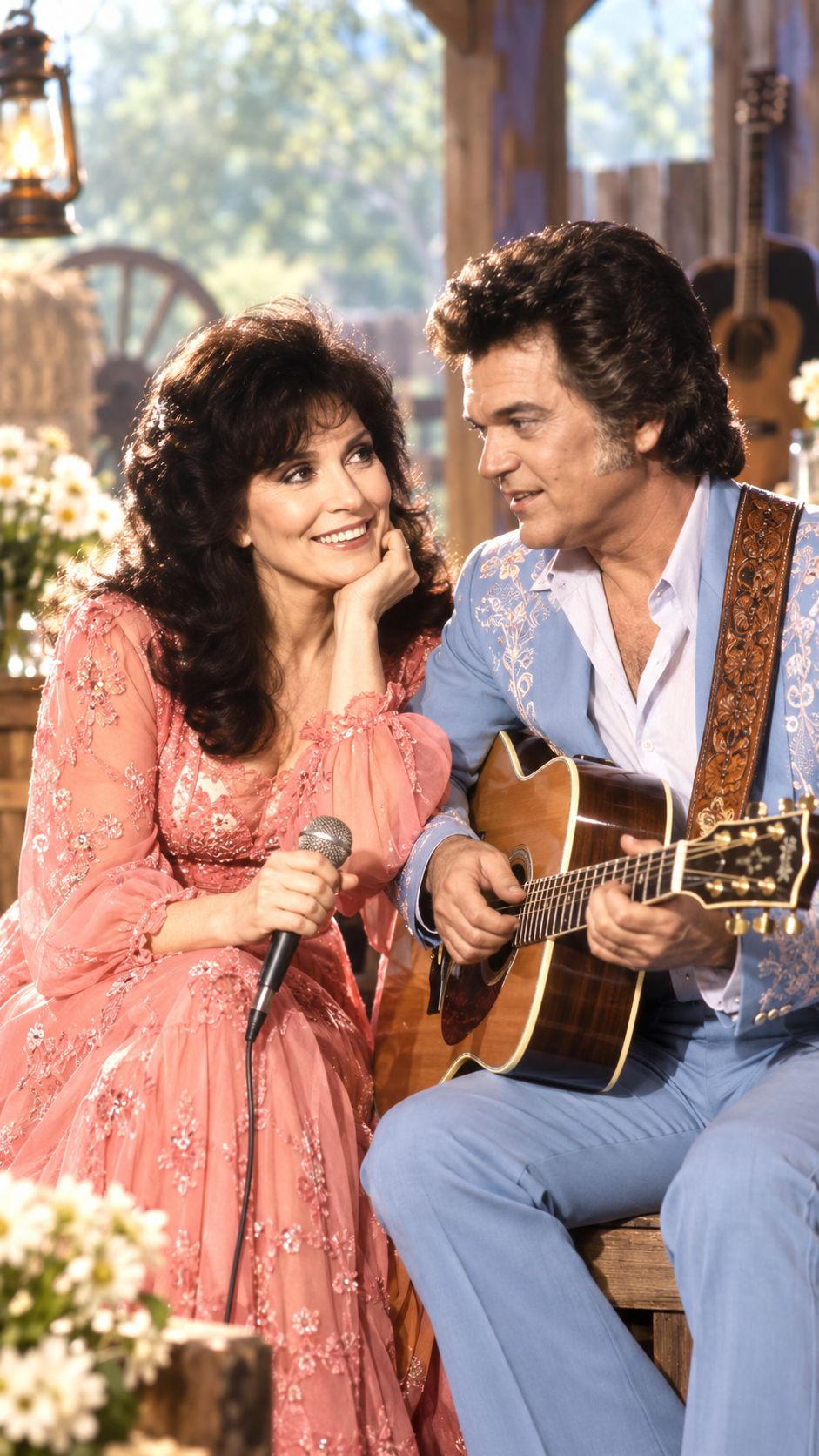
There are country music partnerships that sound good together.
And then there are partnerships that seem to create an entirely different world whenever two voices meet.
Conway Twitty and Loretta Lynn belonged to the second category.
When their voices collided in the early 1970s, something happened that neither singer could have manufactured through technique alone. Conway brought a deep, controlled, almost conversational intensity. Loretta answered with a voice that could sound vulnerable one moment and fiercely defiant the next. Together, they could make a three-minute country song feel like an entire relationship unfolding behind a closed door.
Their recordings became so convincing that listeners sometimes wondered whether the emotions in the songs reflected something deeper between the two singers.
But the real story was more interesting.
It was not a secret romance.
It was the extraordinary musical understanding between two performers who knew exactly how to make a song feel lived-in.
The Beginning Was Almost Accidental
By the time Conway Twitty and Loretta Lynn began recording together, neither was an unknown quantity.
Lynn had already established herself as one of country music’s most distinctive female voices and songwriters. Her songs drew heavily from real-life experiences, family, marriage, hardship, jealousy, independence, and the complicated emotional world of working-class relationships. The Country Music Hall of Fame describes her career as one built on her willingness to tell her own truth rather than hide behind the conventions of the era.
Twitty, meanwhile, had traveled an unusual road from rock and roll to country music. By the time he became a country superstar, his intensely emotional delivery had become one of his trademarks. The Country Music Hall of Fame notes that he ultimately recorded forty No. 1 Billboard country hits during his career.
Yet the partnership between them was not necessarily some grand master plan.
According to Loretta Lynn herself, she and Conway began singing together in dressing rooms while they were overseas with a touring group.
They liked what they heard.
So they decided to try it in the studio.
That simple experiment became one of country music’s most enduring collaborations.
“Me and Conway started singing in the dressing rooms.”
Lynn later recalled that they brought the idea back to producer Owen Bradley, who liked the combination and encouraged them to record together.
Sometimes music history changes because somebody has a brilliant strategy.
Sometimes it happens because two voices sound unexpectedly right together.
Then Came “After the Fire Is Gone”
The breakthrough arrived with “After the Fire Is Gone.”
Released in 1971, the song immediately established what would become the defining emotional territory of the duo.
The premise was complicated: two people trapped in relationships where the passion has disappeared, finding comfort somewhere they perhaps should not.
That was dangerous material for mainstream country music.
But Conway and Loretta did not sing it like actors reading lines.
They sang it like two people confessing something they were barely willing to admit.
The result was their first No. 1 duet.
The Country Music Hall of Fame identifies “After the Fire Is Gone” as the song that launched one of the most successful duet teams in country music history.
And the song created another phenomenon.
People began wondering whether the chemistry they heard was real.
Loretta eventually addressed that speculation directly.
She explained that she and Conway were friends—not lovers—and acknowledged that the nature of their songs caused people to assume otherwise.
That distinction matters.
The chemistry was real.
The romance was part of the performance.
And that may actually make the achievement more impressive.
The Secret Was Not Romance. It Was Contrast.
Listen closely to their recordings and one of the most fascinating things becomes apparent:
They rarely sound identical emotionally.
That is precisely why they work.
Conway often sounds restrained. His voice carries the weight of a man who knows exactly what he wants but understands the consequences.
Loretta, on the other hand, could make a lyric sound like a personal confrontation. Her phrasing could contain tenderness, suspicion, frustration, pride, or heartbreak.
Put those personalities together and the songs became conversations.
Not just harmonies.
Conversations.
One singer would make a declaration.
The other would challenge it.
One would sound tempted.
The other would sound cautious.
Then, suddenly, they would meet on the same line.
That moment of vocal unity became one of their trademarks.
The magic wasn’t that Conway and Loretta sounded alike.
The magic was that they sounded different—and somehow belonged together.
That is one reason their recordings have remained recognizable decades later.
They Turned Conflict Into Harmony
Country music has always understood the power of disagreement.
Marriage, temptation, jealousy, separation, regret, reconciliation—these are not clean emotions.
They overlap.
And Conway Twitty and Loretta Lynn understood that better than almost anyone.
Their songs frequently placed two perspectives against each other.
The listener wasn’t simply hearing a love song.
The listener was hearing both sides of an emotional argument.
That became especially powerful in “Louisiana Woman, Mississippi Man.”
The song transformed geography into romance, creating two characters who belonged to different places but seemed determined to overcome the distance between them.
The accompanying album became a No. 1 country album, while the title track also reached No. 1. PBS notes that Lynn’s husband and manager, Mooney Lynn, found the song for the pair.
That detail reveals something important.
Their success wasn’t created by two singers simply standing beside one another.
There was an entire musical team behind the scenes—songwriters, producers, musicians, managers, and arrangers—helping find material that could exploit the unique relationship between their voices.
But Conway and Loretta were the emotional center.
The Awards Confirmed What Fans Already Heard
The public response was extraordinary.
According to the Country Music Hall of Fame, Loretta Lynn and Conway Twitty won the CMA Vocal Duo of the Year award four consecutive times from 1972 through 1975.
The Songwriters Hall of Fame records an even broader picture of their chart success: the pair had fourteen chart singles together and a remarkable run of five No. 1 duets between 1971 and 1975, including “After the Fire Is Gone,” “Lead Me On,” “Louisiana Woman, Mississippi Man,” “As Soon as I Hang Up the Phone,” and “Feelin’s.”
They also made eleven studio albums together between 1971 and 1988, according to PBS.
Those numbers tell the business story.
But numbers cannot completely explain why the recordings remain emotionally memorable.
For that, you have to listen.
“Feelin’s” Revealed Another Side
If “After the Fire Is Gone” represented temptation, “Feelin’s” showed just how naturally the two singers could inhabit emotional uncertainty.
The power came from restraint.
Neither performer needed to oversing.
Conway’s lower register created gravity underneath Loretta’s brighter, more conversational voice. Their harmonies could sound almost effortless because each singer left room for the other.
That is a crucial lesson in great duet singing:
Sometimes the strongest harmony is created by knowing when not to sing.
They understood space.
They understood timing.
Most importantly, they understood character.
The Partnership Outlived the Moment
One of the most remarkable aspects of the Conway-Loretta partnership is how long it lasted.
Their recording relationship continued for years, long after the novelty of seeing two superstar country singers together had disappeared.
That longevity suggests the partnership was more than a clever record-company idea.
It worked because the musical foundation was strong enough to survive changing trends.
Conway continued evolving as a solo artist, while Loretta remained one of country music’s most influential voices. Their careers were enormous independently.
Yet whenever they returned to the microphone together, the old chemistry remained.
That is rare.
Many famous pairings work for a particular moment.
Conway and Loretta created something that could return to life whenever the right song appeared.
What Fans Sometimes Miss
There is a temptation to look back at their performances and search for hidden romance.
But doing so can obscure the more fascinating truth.
Loretta herself said they were friends.
The intimacy was musical.
The tension belonged to the characters.
The heartbreak belonged to the lyrics.
The magic belonged to the performance.
And perhaps that is the real secret behind their partnership.
They were not pretending to be themselves.
They were becoming the people inside the songs.
“The chemistry was not a confession. It was craftsmanship.”
That distinction is important because great country music often depends on emotional storytelling. A singer does not have to experience every situation personally to make an audience believe it.
They have to understand the emotion.
Conway understood longing.
Loretta understood confrontation.
Both understood heartbreak.
And together, they understood how to turn those emotions into dialogue.
A Legacy That Still Sounds Alive
Conway Twitty died unexpectedly in 1993, ending a career that had stretched across decades and multiple musical eras. The Country Music Hall of Fame notes that he died on June 5, 1993, after becoming one of country music’s most successful recording artists.
Loretta Lynn continued carrying her own extraordinary legacy until her death in 2022. She had already become a Country Music Hall of Fame member, a pioneering songwriter, and one of the defining voices of American country music.
But their recordings together remain frozen in a different kind of time.
There is Conway’s voice.
There is Loretta’s answer.
There is the pause between them.
And then comes the harmony.
Decades later, that harmony still feels strangely intimate.
Not because it reveals a secret love story.
Because it reveals something even more difficult to create:
two completely different artists discovering that their voices could tell the same emotional truth.
That was the real secret behind the harmony.
Not romance.
Not publicity.
Not coincidence.
It was chemistry built from contrast, trust, timing, storytelling, and an almost instinctive understanding of what the other singer would do next.
And perhaps that is why, whenever Conway Twitty and Loretta Lynn begin singing together, the listener doesn’t simply hear two legendary country stars.
They hear a conversation that somehow never ended.
VIDEO: