 By admin
INTRODUCTION:
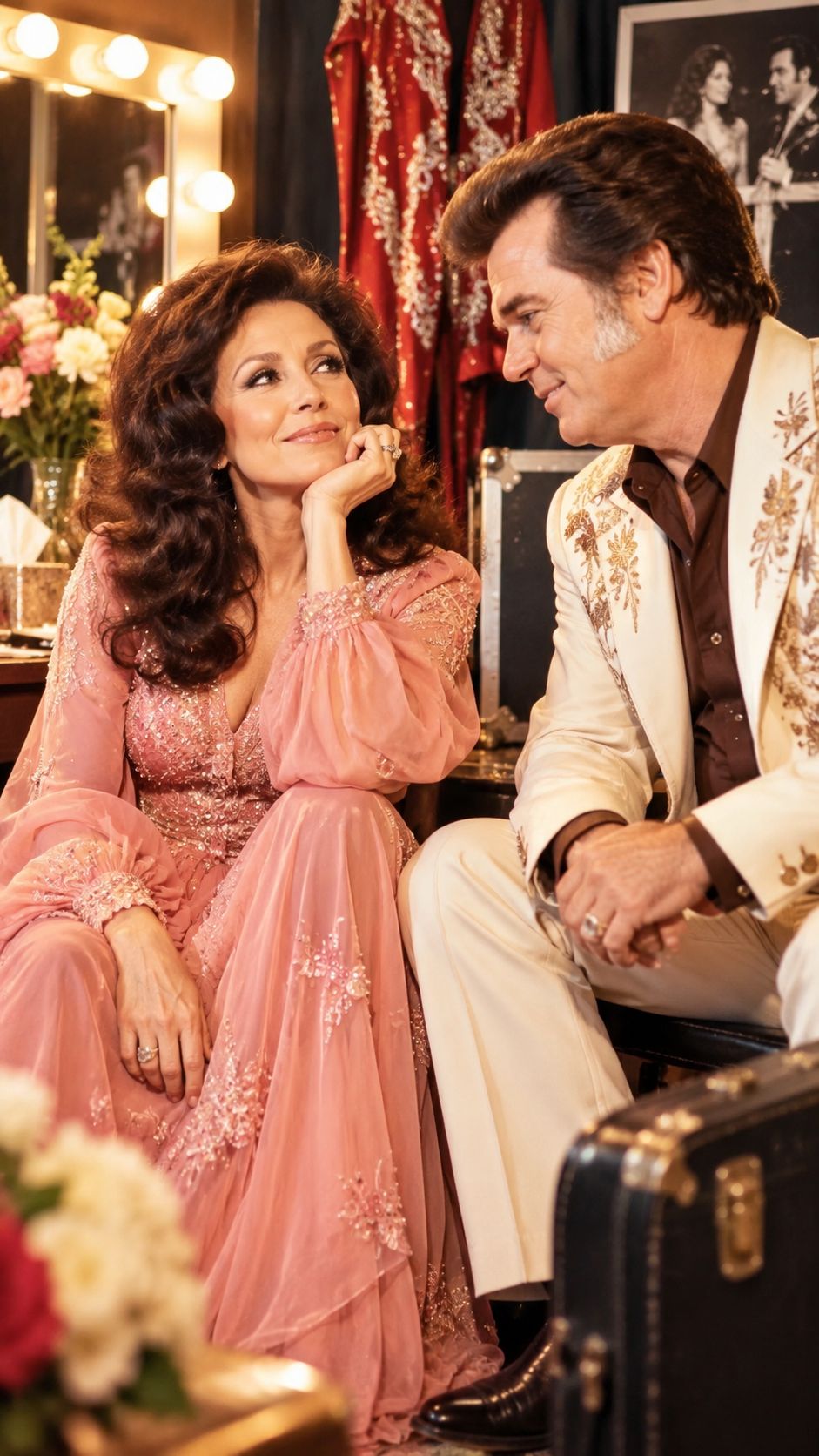
There are some stories in country music that refuse to disappear.
They survive decades after the final concert, long after the records have stopped climbing the charts and long after the stars who created them have left the stage. The story surrounding Conway Twitty and Loretta Lynn is one of those stories.
For years, fans wondered whether their extraordinary chemistry was more than music.
They looked at the way Conway Twitty and Loretta Lynn exchanged glances onstage. They listened to the suggestive lyrics of songs such as “After the Fire Is Gone.” They watched two married country stars perform complicated stories about temptation, loneliness, forbidden love, and emotional betrayal — and they wondered whether the emotion was acting at all.
The rumors became so persistent that some listeners eventually treated speculation as fact.
But when the surviving interviews, historical accounts, and statements from the artists themselves are examined, a different story emerges.
And ironically, the real story may be more fascinating than the scandal.
The “secret affair” made for a dramatic story. The documented friendship was something far more enduring.
The Rumor Began With the Music
To understand why people believed there was something happening behind the scenes, you have to understand the songs.
Conway Twitty and Loretta Lynn were not simply two singers standing beside each other and dividing up vocal lines. They created characters.
Their first major collaborative hit, “After the Fire Is Gone,” arrived in 1971 and immediately established the emotional formula that would define their partnership. The song was built around two people whose relationships at home had lost their passion and who found themselves drawn toward each other.
That was not subtle material.
And then there were their performances.
They sang as though they were having a private conversation in front of thousands of people. Their voices moved between tenderness, frustration, teasing, desire, regret, and humor. The result could feel almost uncomfortably intimate.
The Country Music Hall of Fame records that “After the Fire Is Gone” launched one of the most successful duet teams in country music history, followed by hits including “Lead Me On,” “Louisiana Woman, Mississippi Man,” and “Feelins’.”
Between 1971 and 1988, the pair released 11 studio albums together and charted 12 singles, including five No. 1 country hits.
That kind of success naturally made people curious.
But the more convincing they became as performers, the more dangerous the assumption became.
Fans began confusing the emotional truth of a song with the literal truth of the singers’ lives.
“Everybody Thought Me and Conway Had a Thing Going”
Loretta eventually addressed the rumors directly.
In an interview preserved by PBS’s American Masters, Lynn rejected the idea that she and Twitty had been romantically involved.
“Everybody thought me and Conway had a thing going.”
Then she made her position even clearer: she said that was the farthest thing from the truth and described Conway as a friend. She also explained that her husband, Oliver “Doolittle” Lynn, respected Twitty and was comfortable with their friendship.
That detail is important because it changes the entire interpretation of their relationship.
The rumor suggests secrecy.
The documented accounts suggest familiarity.
The rumor suggests forbidden romance.
The evidence points instead toward two performers who trusted one another enough to create extraordinarily believable musical drama.
That distinction matters.
Conway Had an Answer Too
Conway Twitty was similarly direct.
Historical material preserved by the University of Nevada, Las Vegas includes an account in which Twitty described Loretta as one of his best friends in the music business and explicitly denied that anything romantic had happened between them.
That same historical account reveals something fascinating about the origin of the partnership.
Their relationship was rooted in mutual admiration.
Conway had admired Loretta’s work. Loretta had admired Conway’s music. Their first collaborative experiences grew out of that professional respect rather than a secret romantic arrangement.
In other words, the chemistry did not need an affair to exist.
It needed talent.
And they had plenty of it.
The Stage Was Where the “Scandal” Lived
Perhaps the biggest misunderstanding surrounding Conway Twitty and Loretta Lynn comes from their ability to blur the line between performer and character.
When they sang about forbidden love, they made the audience believe the characters were real.
When they argued through a lyric, it sounded like an actual argument.
When Conway leaned into a line and Loretta answered him with that unmistakable vocal personality, the moment felt spontaneous.
But that was the craft.
Their stage relationship was almost theatrical.
The Boot has described their performances as near-theatrical interpretations, noting that their chemistry moved effortlessly from humor to heartbreak and romantic ballads.
That is precisely why the rumors became so powerful.
They were convincing because they were good.
“After the Fire Is Gone” Became the Perfect Fuel
Few songs did more to feed the speculation than “After the Fire Is Gone.”
The story is about two people meeting secretly after the passion has disappeared from their marriages. The lyrics are intentionally provocative.
For listeners who already suspected something between Conway and Loretta, the song seemed almost like a confession disguised as entertainment.
But that interpretation ignores one of the oldest traditions in country music: storytelling through characters.
Country singers routinely inhabit people whose lives are nothing like their own.
A singer can perform the role of a cheating husband without being one.
A woman can sing about leaving a marriage without leaving hers.
Two artists can portray forbidden love without sharing forbidden love themselves.
And in Conway and Loretta’s case, the evidence suggests exactly that.
Recent retrospective coverage of “After the Fire Is Gone” has again noted that the song’s lyrics and the pair’s chemistry sparked false rumors of an affair.
The rumor survived because the performance worked.
That may be the greatest compliment the duo ever received.
Their Friendship Was Real — And That Was Enough
There is a temptation to believe that every legendary musical partnership must contain a secret romance.
But sometimes friendship creates a different kind of intimacy.
Conway Twitty and Loretta Lynn understood each other’s timing.
They knew when to push a lyric and when to hold back.
They knew when a joke would make a performance lighter and when silence would make it heavier.
They had spent years learning how the other artist breathed, phrased, reacted, and performed.
That familiarity cannot simply be manufactured in a recording studio.
It develops over time.
And their professional relationship lasted for years.
The Country Music Hall of Fame notes that Lynn and Twitty won the CMA Vocal Duo of the Year award four consecutive times, from 1972 through 1975.
Their partnership became so iconic that later generations of their families eventually built a performing act around their legacy. Tre Twitty and Tayla Lynn — Conway’s grandson and Loretta’s granddaughter — have continued performing songs associated with their grandparents, demonstrating just how deeply the musical partnership became woven into both families’ histories.
That legacy is difficult to reconcile with the idea that their story was fundamentally built around a hidden scandal.
So What Was the “Scandalous Truth”?
Perhaps the most surprising answer is that there may not have been a scandalous secret at all.
The real revelation is how completely Conway Twitty and Loretta Lynn fooled their audience.
They made millions of people believe that the emotions inside their songs were happening between the two singers themselves.
That is not evidence of an affair.
It is evidence of extraordinary performance.
They didn’t have to live the scandal to make America believe it. They only had to sing it convincingly.
And perhaps that is why the rumors have lasted so long.
If their performances had sounded ordinary, nobody would have cared.
If their voices had lacked chemistry, nobody would have wondered.
If their songs had been forgettable, there would have been no mystery.
Instead, they created something so emotionally convincing that decades later, people are still asking what happened when the microphones were turned off.
The Mystery That Refuses to Die
There will always be fans who prefer the more dramatic version of the story.
It is human nature.
A secret romance makes a legend feel more dangerous. A forbidden relationship creates suspense. A hidden affair gives familiar songs an entirely different emotional meaning.
But history asks a different question:
What can actually be supported?
In this case, the strongest documented evidence points toward friendship, mutual respect, and an extraordinary professional partnership — not a proven secret affair. Loretta herself rejected the romantic interpretation, while Conway similarly described their relationship as friendship.
That does not make their story boring.
It makes it remarkable.
Two people walked onto a stage and convinced generations of listeners that they were living the very stories they were singing.
They created tension without betraying their friendship.
They created intimacy without requiring romance.
They created a musical partnership powerful enough to become part of country music history.
And perhaps the greatest twist is this:
The rumors became part of their legend precisely because the two artists were so good at making fiction feel like truth.
The scandal was in the songs.
The magic was in the performance.
And the relationship behind it all appears, from the documented record, to have been something much simpler — and perhaps much more meaningful:
two legendary country artists who trusted each other enough to make millions of people believe.
VIDEO: