 By admin
INTRODUCTION:
And then there are songs that do more than tell a story.
They uncover one.
They take a feeling that most people would rather hide—the memory of someone from long ago, the ache that never completely disappeared, the strange power of a name spoken after years of silence—and place it directly in front of you.
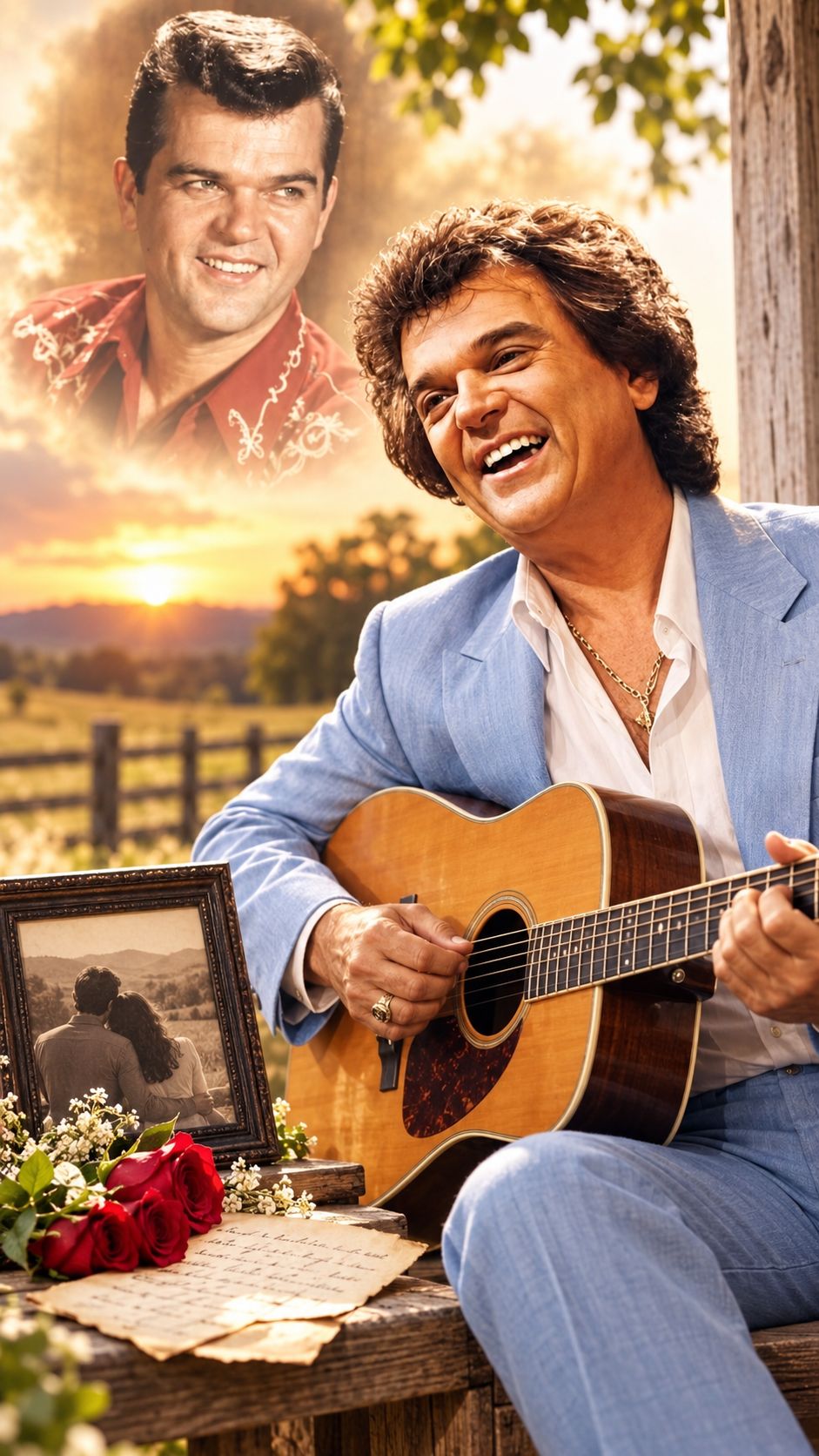
That is what Conway Twitty’s “Fifteen Years Ago” did.
Released in 1970, the song arrived at a fascinating moment in Twitty’s career. He had already transformed himself from a rock-and-roll star into one of country music’s most commanding voices, and his emotional ballads were beginning to establish the identity that would define much of his legacy. “Fifteen Years Ago,” written by Raymond Smith, became Twitty’s fifth No. 1 country single, spending one week at the top of the U.S. country chart and 16 weeks overall.
But the numbers only tell part of the story.
The real power of the song lies in what happens inside the narrator’s heart.
A MEMORY THAT WAS NEVER REALLY GONE
Imagine a man who has spent fifteen years convincing himself that the past is safely buried.
He has moved forward.
He has built another life.
He has a wife who loves him. He has made promises. He has responsibilities. He has learned, as adults often do, how to place old memories into carefully sealed boxes.
Then, unexpectedly, somebody mentions a woman’s name.
That’s all it takes.
One name.
One moment.
And suddenly fifteen years disappear.
The premise of “Fifteen Years Ago” is remarkably simple. The narrator encounters someone who has recently spoken with the woman he once loved. That brief conversation forces the old relationship back into his mind, and he discovers something uncomfortable: time has not erased the feeling as completely as he thought.
That idea was incredibly effective because it did not depend on an elaborate plot.
There is no dramatic reunion.
No grand declaration.
No Hollywood ending.
Instead, there is something much more painfully believable.
A memory.
Sometimes the past doesn’t return because we invite it back. Sometimes it returns because somebody simply says a name.
That emotional detail is where the genius of the song lives.
THE STORY BEHIND THE SONG
The history of “Fifteen Years Ago” is almost as fascinating as the story contained within the record.
Songwriter Raymond Smith had started writing country songs when he was young but eventually moved into radio, managing a “beautiful music” station in Greenville, Tennessee.
Then something happened that reignited his desire to write country music.
Smith attended a Jack Greene concert.
The sound of the steel guitar and Greene’s country delivery inspired him to begin working on a song. According to a later account of the song’s history, Smith wrote most of “Fifteen Years Ago” the following day.
The song initially had a much smaller life than it would eventually achieve.
Smith paid for a recording himself and released it independently. It received airplay in several markets, including Knoxville, where radio station WIVK helped bring the record to local attention.
Then fate intervened.
When Conway Twitty was performing at a Knoxville nightclub, a WIVK disc jockey who knew Smith suggested that Twitty listen to the song.
Twitty could have ignored it.
He didn’t.
He wanted to hear the record immediately.
According to the account of the song’s history, Twitty insisted that someone retrieve the recording from the radio station that night. He listened to it and was immediately convinced that he wanted to record it himself.
That decision changed everything.
CONWAY HEARD SOMETHING IN IT
There was something almost instinctive about Twitty’s response.
By 1970, Conway Twitty had already proven that he could make heartbreak sound personal. His transition from rock and pop into country had produced a remarkable second act, and songs such as “Hello Darlin’” had established the emotional vocabulary that would become synonymous with his country career.
The Country Music Hall of Fame describes Twitty’s country recordings as intensely emotional performances, highlighting songs including “Hello Darlin’” and “Fifteen Years Ago” as important examples of his style.
And “Fifteen Years Ago” gave him precisely the kind of emotional material he could inhabit.
He wasn’t merely singing about a man remembering someone.
He sounded like that man.
The recording took place at Bradley’s Barn in Mount Juliet, Tennessee, with legendary producer Owen Bradley at the helm. The session featured some of Nashville’s celebrated musicians, including guitarist Grady Martin, pianist Larry Butler, steel guitarist John Hughey, bassist Bob Moore, and background vocalists including The Jordanaires.
That combination gave the song the classic Nashville atmosphere of the period—but Twitty’s voice remained at the center.
And that was exactly where it needed to be.
THE MOST PAINFUL PART ISN’T THE LOST LOVE
One of the reasons “Fifteen Years Ago” remains so emotionally effective is that the narrator isn’t simply lonely.
He’s conflicted.
He has a present life.
He has a wife.
He has promised her forever.
Yet somewhere beneath that respectable adult life sits an unresolved emotional memory.
That creates the song’s deepest tension.
The narrator isn’t necessarily asking for the past to return.
He isn’t necessarily planning to leave his present behind.
He simply cannot deny that the old love still occupies a corner of his heart.
And that is much more complicated.
The tragedy isn’t always losing someone. Sometimes it’s discovering that you never completely stopped loving them.
Country music has always understood that emotional contradiction.
The genre has never required its characters to be perfect. Its greatest songs often live in the uncomfortable spaces between loyalty and desire, memory and reality, regret and acceptance.
Twitty understood those spaces exceptionally well.
WHY THE SONG HIT SO HARD IN 1970
When “Fifteen Years Ago” reached No. 1 on the country chart in November 1970, it was not simply another successful Conway Twitty single. It became another piece of the emotional architecture that would define his career.
The album Fifteen Years Ago itself reached No. 4 on the country album chart, demonstrating how strongly Twitty’s audience connected with this era of his music.
But perhaps the most important achievement was something less measurable.
The song gave listeners permission to admit something they might never say aloud.
That memories can survive.
That a person can build a new life and still remember an old one.
That time can soften pain without necessarily destroying love.
And that the human heart doesn’t always follow the calendar.
CONWAY TWITTY’S VOICE MADE THE MEMORY FEEL REAL
Technically, the song is restrained.
There is no need for vocal gymnastics.
Twitty doesn’t have to shout.
He doesn’t have to oversell the emotion.
Instead, his delivery carries the weight of someone trying desperately to maintain composure.
That was one of Twitty’s greatest gifts.
He understood that sometimes the quieter a heartbreak becomes, the more devastating it sounds.
His country career would eventually produce an extraordinary number of No. 1 hits—40 according to the Country Music Hall of Fame—and many of his most successful recordings revolved around emotionally complicated relationships, guilt, longing and lost love.
“Fifteen Years Ago” fits naturally into that tradition.
But it has its own particular sadness.
This isn’t heartbreak from yesterday.
It’s heartbreak from fifteen years ago.
And somehow, it still hurts.
THE PASSAGE OF TIME BECOMES THE VILLAIN
The title itself is brilliant.
“Fifteen Years Ago.”
Not “Yesterday.”
Not “Once.”
Not “Long Ago.”
Fifteen years.
A precise number.
Long enough for an entire life to change.
Long enough for people to marry, raise families, move towns, change careers and grow older.
And yet the narrator discovers that emotional time does not always move at the same speed as ordinary time.
That is why the song remains relatable decades later.
Everyone has something that belongs to “fifteen years ago.”
Maybe it is a person.
Maybe it is a house.
Maybe it is a friendship.
Maybe it is a version of themselves that no longer exists.
Sometimes all it takes is an old photograph, a familiar street, a song on the radio—or someone’s casual mention of a name—to bring that entire world rushing back.
THE SONG’S LEGACY
Twitty’s recording was not the final chapter for “Fifteen Years Ago.”
The song was subsequently recorded by other artists, including Charley Pride and The Statler Brothers. Decades later, John Prine and Lee Ann Womack recorded it as a duet for Prine’s 2016 album For Better, Or Worse.
That continued interest says something important.
Great country songs are rarely trapped inside the year in which they were released.
They travel.
They find new voices.
They find new listeners.
And they keep discovering people who understand exactly what the songwriter was trying to say.
Because the emotional question at the heart of “Fifteen Years Ago” has no expiration date:
What if the person you thought you had forgotten was never really forgotten at all?
WHY CONWAY TWITTY STILL MATTERS
More than three decades after Twitty’s death in 1993, his recordings continue to demonstrate why his voice became one of the defining sounds of country music’s golden era.
His career was unusual. He had already conquered pop and rock before reinventing himself as a country superstar. His first country No. 1 came with “Next in Line,” and he continued building a remarkable run of country hits throughout the 1970s and beyond.
But statistics cannot fully explain his endurance.
People remember Conway Twitty because he made complicated emotions sound simple.
He could take guilt and make it conversational.
He could take desire and make it vulnerable.
He could take regret and make it sing.
And with “Fifteen Years Ago,” he took one of the most universal experiences imaginable—the sudden return of an old love—and turned it into a three-minute emotional confession.
Fifteen years can change a life. They cannot always change a heart.
Perhaps that’s why the song still feels so intimate.
It doesn’t tell us that the past should
VIDEO: