 By admin
INTRODUCTION:
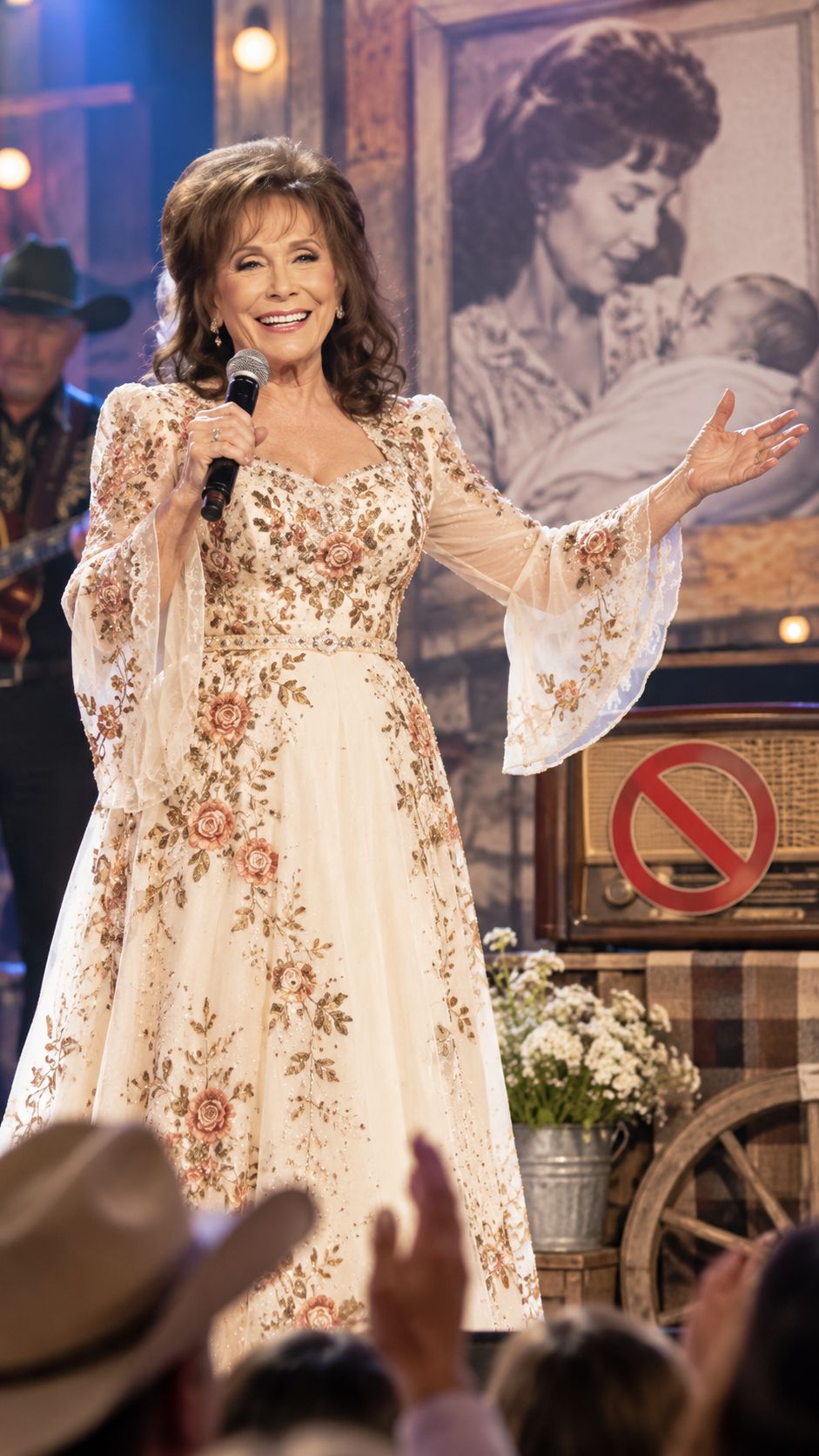
In 1975, country music had a problem.
Not with heartbreak. Not with cheating. Not with whiskey, loneliness, poverty, or husbands who came home smelling like trouble.
Country music had already made room for all of that.
The problem was a tiny object that had changed millions of women’s lives: the birth-control pill.
And when Loretta Lynn decided to sing about it without whispering, apologizing, or hiding behind euphemisms, some radio stations decided that the song had gone too far.
The song was called “The Pill.”
It would become one of the most controversial recordings of Lynn’s career—and one of the clearest examples of how country music could transform an ordinary woman’s private frustration into a national conversation. Released in 1975 after being recorded several years earlier, the song confronted contraception, marriage, motherhood, and female autonomy with a combination of humor, rebellion, and unmistakable country storytelling.
And radio did not know what to do with it.
The Woman Behind the Controversy
To understand why “The Pill” landed like a thunderclap, you have to understand Loretta Lynn herself.
She wasn’t an outsider pretending to understand rural women.
She had lived the realities she sang about.
Lynn married young and became a mother early. Her songs repeatedly drew from the complicated world of marriage, motherhood, economic hardship, infidelity, and the expectations placed on women.
That authenticity was part of her power.
When Lynn sang about a woman feeling trapped, listeners didn’t hear a distant celebrity lecturing them. They heard somebody who understood the kitchen, the nursery, the doctor’s office, the bills, and the exhaustion.
That history gave “The Pill” an unusual emotional force.
The song’s fictional narrator is a wife who has spent years becoming pregnant while her husband continues living his life with considerably more freedom. Now, contraception has changed the balance.
For the first time, she feels that she has some control over what happens next.
That was the revolutionary idea hiding inside the comedy.
The song wasn’t simply about contraception. It was about a woman discovering that motherhood did not have to mean surrendering every other part of herself.
That distinction matters.
Lynn wasn’t attacking motherhood. In fact, her public comments about the song made clear that she loved her children. The argument was about choice and spacing pregnancies—not about rejecting family itself. The New Yorker noted Lynn’s own explanation that if she had possessed access to the pill earlier, she would have used it, while emphasizing that she would never trade her children.
Why Radio Stations Panicked
The birth-control pill had been available in the United States since 1960.
By 1975, it wasn’t exactly a secret.
But talking openly about contraception was another matter.
Especially in country music.
Country radio served audiences that included deeply conservative communities, churches, traditional families, and listeners who viewed discussions of sexuality and reproductive choices as private matters.
Then along came Loretta Lynn.
And she didn’t sing about the subject like a medical textbook.
She made it funny.
She made it catchy.
She made it personal.
And she made it impossible to misunderstand.
According to multiple accounts, many country radio stations refused to play “The Pill.” PBS’s American Masters describes the song as both banned and a major hit, while American Songwriter reports that the record was refused by numerous stations when it was released. Some accounts place the number of stations that initially refused the record at more than 60.
The backlash wasn’t limited to radio.
The New Yorker reported that at least one Kentucky preacher denounced the song from the pulpit.
For some listeners, the song represented liberation.
For others, it represented an attack on traditional morality.
And suddenly a three-minute country song had become part of a much larger cultural argument.
The Strange Power of Being Told “No”
Here is where the story becomes almost perfectly country music.
The more people tried to keep “The Pill” away from listeners, the more curious listeners became.
People talked about the record.
They requested it.
They passed it around.
And stations that refused to play it couldn’t prevent people from knowing it existed.
Contemporary accounts describe the song benefiting from word of mouth and underground FM support. People reported in 2026 that the controversy helped fuel sales of roughly 15,000 copies per week during its run.
The irony was impossible to miss.
A song that some gatekeepers considered too controversial for the airwaves was becoming impossible to ignore.
Eventually, the numbers became their own argument.
“The Pill” reached No. 5 on Billboard’s Hot Country Singles chart. It also crossed over to the Billboard Hot 100, reaching No. 70, and became a No. 1 country hit in Canada.
It wasn’t a marginal curiosity.
It was a genuine country hit.
And that forced the industry to confront something uncomfortable:
The audience was listening.
The Stigma Was Bigger Than the Song
The most important part of “The Pill” wasn’t simply that Lynn mentioned birth control.
It was that she placed the subject inside the emotional world of an ordinary married woman.
That was a radical storytelling decision.
For generations, women’s reproductive experiences had often been treated as something to endure quietly.
Pregnancy could be celebrated publicly.
Motherhood could be praised.
But exhaustion, unwanted pregnancy, unequal responsibility, and the desire for control were much harder subjects.
Lynn brought those emotions into a country song.
She didn’t package the woman as perfect.
She didn’t make her saintly.
She made her funny, frustrated, mischievous, and determined.
That made her recognizable.
PBS has described Lynn’s broader body of work as giving voice to women navigating the transition between traditional domestic expectations and a changing society. “The Pill” became one of the most obvious examples of that approach.
And that’s why the song’s legacy extends beyond contraception.
It was about who was allowed to speak.
Loretta Lynn Didn’t Need a Political Speech
Perhaps the cleverest thing about “The Pill” was that Lynn didn’t need to deliver a political lecture.
She told a story.
That’s what country music does at its best.
A woman looks around at her life and realizes something has changed.
Her husband hasn’t necessarily changed.
The world hasn’t necessarily changed.
But she has discovered a new possibility.
And suddenly, the future looks different.
Lynn understood that a story could accomplish something a manifesto couldn’t.
It could make people laugh before they realized they were listening to an argument.
It could make somebody uncomfortable without shouting at them.
And it could make another woman sitting alone in her kitchen think:
I’m not the only one who has felt this way.
That may have been the song’s deepest achievement.
Not Everyone Agreed—and That’s Part of the Story
It would be inaccurate to pretend that America collectively embraced “The Pill.”
It didn’t.
Some listeners were offended.
Some critics considered the song vulgar or inappropriate.
Historical research preserved by Middle Tennessee State University notes that the controversy reached Lynn’s fan community as well, with some fans complaining that the song was “dirty” and had damaged her image.
That resistance is important because it shows how complicated the cultural moment really was.
The song wasn’t operating in an America where everyone had suddenly accepted modern reproductive choices.
It appeared in an America still arguing intensely about gender, religion, marriage, sexuality, and women’s changing roles.
That’s precisely why the record mattered.
It didn’t arrive after the debate had ended.
It arrived while the debate was still raging.
The Myth of the “Permanent Ban”
There’s another important piece of the story that often gets lost in viral retellings.
Today, “The Pill” is sometimes described as having been “banned from country radio for more than 50 years.”
That wording is misleading.
Historical accounts clearly document that numerous stations refused to play the song when it was released. But the record still reached No. 5 on the country chart, and later commentary has challenged the idea that it remained under a universal or permanent country-radio ban.
So the real story is more interesting than the myth.
The song was controversial enough to be rejected by many stations.
Yet it was powerful enough to become a major hit anyway.
That tension tells us far more about Loretta Lynn than the word “banned” ever could.
The Door She Opened
Decades later, the cultural conversation around women in country music continued to evolve.
Artists increasingly addressed subjects that earlier generations might have avoided.
Lynn’s willingness to sing about women’s private realities became part of her larger artistic legacy.
Her songs about divorce, infidelity, marriage, motherhood, sexuality, and double standards repeatedly placed female experiences at the center of country storytelling. PBS and other retrospectives have highlighted how those songs helped create space for later women artists to speak more openly.
“The Pill” therefore wasn’t important simply because it mentioned birth control.
It was important because it treated a woman’s private frustration as worthy of a public song.
That was the breakthrough.
More Than Fifty Years Later
Listen to “The Pill” today and the production may sound unmistakably like 1970s country.
The melody is playful.
The performance is confident.
The humor is obvious.
But underneath that cheerful surface is a woman announcing that her life belongs to her, too.
And perhaps that is why the song has survived.
Not because everyone agreed with it.
Not because every radio station welcomed it.
But because Loretta Lynn understood something fundamental about country music:
Truth doesn’t have to arrive quietly just because the subject makes people uncomfortable.
Sometimes truth walks into the room wearing a smile.
Sometimes it tells a joke.
Sometimes it sings through a microphone.
And sometimes, when the gatekeepers say no, the audience answers by turning the volume up.
Loretta Lynn didn’t erase the stigma surrounding birth control overnight. She did something more lasting: she made a subject many people considered too private, too controversial, or too embarrassing to discuss part of the country-music conversation.
That is the real legacy of “The Pill.”
A controversial song became a cultural document.
A rejected record became a hit.
And a woman who had spent much of her life singing about the realities of motherhood gave millions of listeners permission to consider another reality, too:
That being a mother and wanting control over your own future were not necessarily contradictory.
More than fifty years later, that idea remains at the heart of why Loretta Lynn‘s most controversial song still refuses to disappear.
VIDEO: