 By admin
INTRODUCTION:
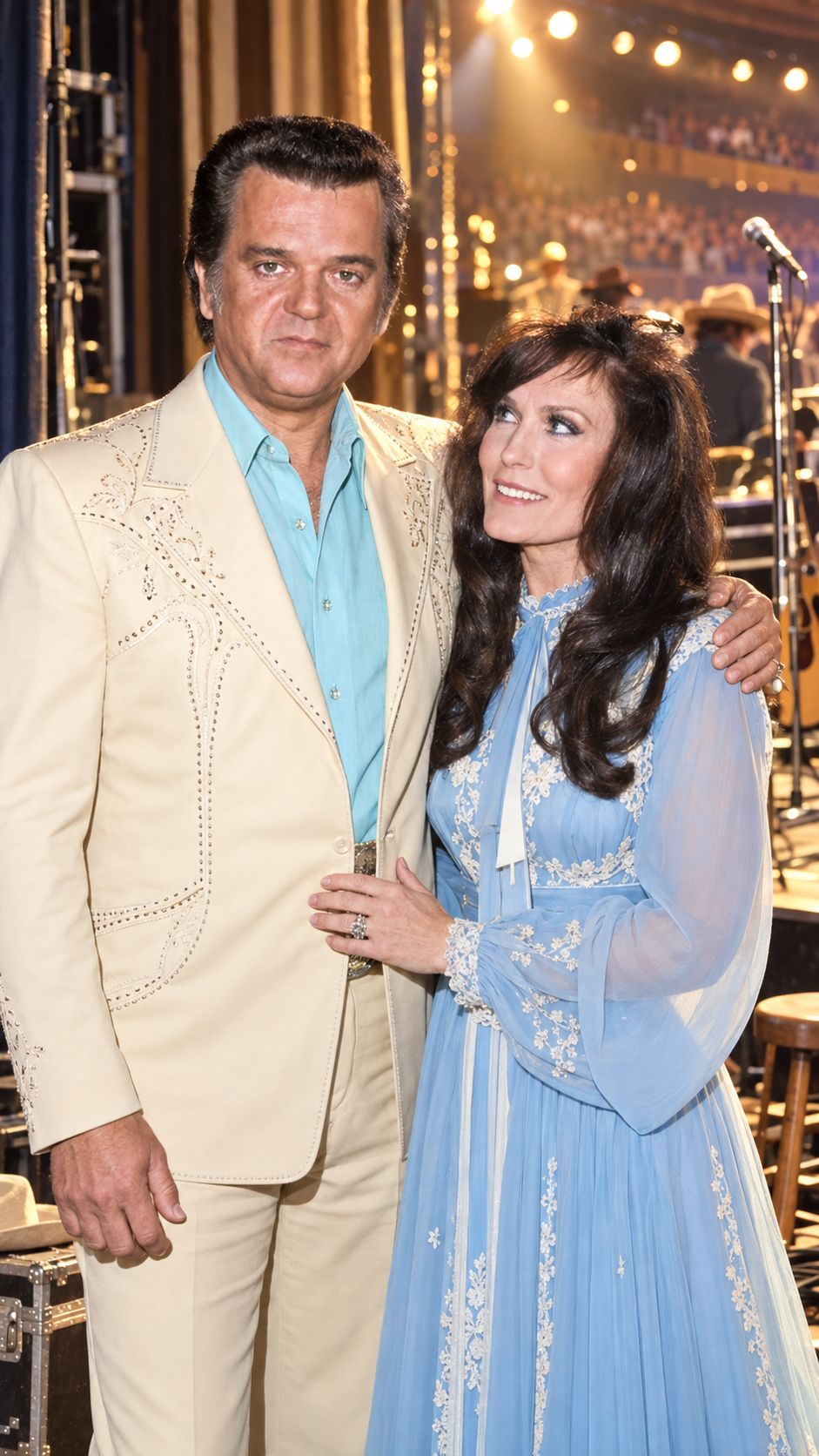
There are moments in country music when two voices meet and create something larger than either artist could have built alone.
For Loretta Lynn and Conway Twitty, that moment came in the early 1970s.
By then, Loretta Lynn was already a major country star. She had transformed the stories of working-class women, marriage, motherhood, hardship, temptation, and survival into songs that millions of listeners understood. She had come from the coal-mining hills of Kentucky and fought her way into Nashville through talent, determination, and an unusually fearless willingness to tell the truth.
But when Conway Twitty entered the picture as her duet partner, something changed.
It wasn’t that Conway created Loretta Lynn’s career. He didn’t. Her achievements were already substantial, and her voice had already made history. The Country Music Hall of Fame notes that Lynn had become one of country music’s most important female performers through her autobiographical songwriting and uncompromising storytelling.
What Conway did was different.
He gave another dimension to a voice that was already powerful.
And together, they created one of the most recognizable partnerships country music has ever known.
“If not for him, I wouldn’t be here.”
Whether understood literally as a quotation or emotionally as a summary of Conway’s importance to Loretta’s story, the sentiment captures something deeper: sometimes an artist doesn’t need someone to discover them. Sometimes they need someone who helps reveal another side of what they already possess.
Before Conway, Loretta Had Already Fought Her Way Into Nashville
The temptation is to tell Loretta Lynn’s story as though Conway Twitty suddenly arrived and rescued her career.
The historical record tells a more complicated story.
Loretta had already survived circumstances that would have discouraged many aspiring performers. Born in Butcher Hollow, Kentucky, she grew up in a coal-mining family and married young. She became a mother while still a teenager, and eventually raised a large family while pursuing a demanding career in country music.
Her breakthrough did not happen overnight.
She worked relentlessly.
She wrote songs from experience.
And she developed a distinctive artistic identity that refused to sound polished at the expense of honesty.
Songs such as “You Ain’t Woman Enough,” “Don’t Come Home A’ Drinkin’,” “Fist City,” and eventually “Coal Miner’s Daughter” established Lynn as a songwriter who could speak directly to women who rarely heard their own lives represented on the radio.
By the time Conway appeared as her duet partner, Loretta wasn’t waiting for somebody to give her a career.
She had already built one.
But Conway helped open a new chapter.
Then Came “After the Fire Is Gone”
In late 1970, Conway Twitty began his professional partnership with Loretta Lynn. Their first major duet, “After the Fire Is Gone,” arrived in 1971 and became a No. 1 country hit.
That record changed the trajectory of their professional relationship.
Their voices were different, but that was exactly why the combination worked.
Loretta brought emotional directness, humor, vulnerability, and a distinctly Appalachian-rooted storytelling style.
Conway brought a darker, smoother, more controlled vocal presence.
Put them together, and the contrast created tension.
They sounded like two people having a conversation rather than two singers simply taking turns.
That quality became central to their appeal.
PBS notes that Lynn and Twitty recorded 11 studio albums together between 1971 and 1988, producing major hits including “After the Fire Is Gone,” “Louisiana Woman, Mississippi Man,” and others. They also won the CMA Vocal Duo of the Year award every year from 1972 through 1975.
That wasn’t a brief experiment.
It became a defining chapter in both careers.
Conway Didn’t Replace Loretta — He Expanded Her Story
This is where the real significance of their partnership can easily be misunderstood.
Conway Twitty did not make Loretta Lynn famous.
Instead, he helped her demonstrate something audiences had not seen from her in quite the same way before.
Her solo songs frequently centered on the perspective of women.
Her duets with Conway created a dialogue.
Suddenly, listeners weren’t hearing only one side of a complicated relationship. They were hearing two sides.
There was longing.
Conflict.
Temptation.
Regret.
Desire.
Resentment.
Forgiveness.
And sometimes the uncomfortable gray areas in between.
Their records allowed Loretta to inhabit a different dramatic space without abandoning the authenticity that had made her famous.
That is one reason their recordings have endured.
The Chemistry Was Powerful — But It Wasn’t the Romance Fans Imagined
The public fascination with Conway and Loretta was enormous.
Their songs could sound intimate enough to make listeners wonder whether the emotional connection between them extended beyond the recording studio.
Loretta herself rejected that interpretation.
In a PBS interview, she explained that people believed she and Conway were romantically involved, but she described him as a friend and emphasized the friendship between Conway and her husband, Doolittle Lynn.
That distinction matters.
Their chemistry was musical.
Their emotional performances were convincing because both singers understood how to inhabit complicated songs.
They didn’t need a secret romance to create believable drama.
They needed two extraordinary voices.
And they had them.
The magic was not that Loretta and Conway became something they weren’t. The magic was that they could make listeners believe completely in the characters inside their songs.
Five No. 1 Hits Became Part of Country Music History
The partnership produced a remarkable run.
Their first No. 1, “After the Fire Is Gone,” was followed by other major hits including “Lead Me On,” “Louisiana Woman, Mississippi Man,” “As Soon as I Hang Up the Phone,” and “Feelins’.” All five became No. 1 country singles between 1971 and 1975.
Their success was not confined to the charts.
They became an awards powerhouse.
The duo won four consecutive CMA Vocal Duo of the Year awards from 1972 through 1975, while “After the Fire Is Gone” earned them a Grammy.
At the same time, Loretta’s solo career continued to flourish.
That is important because it demonstrates the real nature of Conway’s influence.
He wasn’t pulling her away from her identity.
Their partnership existed alongside her individual success.
In fact, 1972 became one of the most extraordinary years of Lynn’s career. She became the first woman to win the CMA Entertainer of the Year award, while also receiving recognition for her work as a solo performer and as part of her partnership with Conway.
So when people talk about Conway changing Loretta’s life, the most accurate interpretation isn’t that he saved a fading career.
It is that he helped make an already historic career even broader.
And Loretta Changed Conway, Too
The influence wasn’t one-directional.
Conway Twitty was already an established country superstar when he began recording with Loretta. The Country Music Hall of Fame credits him with 40 No. 1 Billboard country hits across his career.
But the Loretta partnership added another dimension to his legacy.
His solo recordings often placed him in the role of the emotionally complicated male narrator.
With Loretta, he had to share the story.
He had to listen.
He had to respond.
The songs became conversations rather than monologues.
That balance helped establish the pair as something much more significant than a successful male-female pairing.
They became a template.
Generations of country singers would continue exploring the power of contrasting voices, alternating perspectives, and emotionally complicated duet storytelling.
The Partnership Outlived the Era That Created It
One of the strongest measures of their impact is what happened after their peak years.
Country music changed.
Radio changed.
Production styles changed.
New generations of performers emerged.
But the Conway-Loretta recordings remained recognizable.
Their catalog included 10 studio albums, and their singles produced a long run of Top 10 successes.
More importantly, their songs became part of the historical language of country music.
When later artists discussed classic country duets, Conway and Loretta were impossible to ignore.
Their voices represented an era when country music could be emotionally raw without becoming complicated.
A single verse could feel like an argument overheard through a kitchen wall.
A chorus could sound like two people finally admitting what they had tried not to say.
And that was their gift.
After Conway’s Death, the Meaning Changed
When Conway Twitty died in 1993, country music lost one of its most distinctive voices.
He was only 59.
His death ended a career that had crossed genres and decades, from his early rock-and-roll period to his extraordinary country success.
For Loretta, the loss was also personal.
They had shared years of recording, touring, awards, rehearsals, laughter, arguments inside songs, and countless moments that audiences never saw.
The recordings suddenly became something else.
They were no longer new.
They became memories.
And every time “After the Fire Is Gone” played, listeners weren’t simply hearing a hit from 1971.
They were hearing two people who could never record together again.
That is one of the strange powers of music.
A recording freezes a moment.
The people inside it age.
They disappear.
But the voices remain exactly where they were.
Loretta’s Legacy Was Always Her Own
Loretta Lynn ultimately became much more than half of a legendary duet.
She became a cultural figure in her own right.
Her autobiography, Coal Miner’s Daughter, became a bestseller and was adapted into the acclaimed 1980 film starring Sissy Spacek. Lynn’s songs continued to influence generations of women in country music and beyond.
She was inducted into the Country Music Hall of Fame in 1988.
She continued recording and performing across multiple generations, including the critically acclaimed Van Lear Rose in 2004.
And when she died in 2022 at age 90, the country music world was not mourning simply a former star.
It was mourning an architect of modern country storytelling.
Yet Conway remained woven into that story.
Not as the man who created Loretta Lynn.
Not as someone who owned her success.
But as one of the rare musical partners who helped reveal another side of her artistry.
The Lasting Lesson of Conway and Loretta
Perhaps the most beautiful way to understand their partnership is this:
Loretta Lynn had the story.
Conway Twitty helped her tell part of it differently.
He didn’t erase her voice.
He gave it another voice to push against.
And that difference created magic.
Loretta Lynn could have become a legend without Conway Twitty. But the Loretta-and-Conway story became a legend because their voices found something in each other that neither could create alone.
That is why their recordings still matter.
That is why “After the Fire Is Gone” still carries emotional weight decades later.
And that is why the story of Loretta Lynn and Conway Twitty refuses to disappear.
Their partnership wasn’t simply about hit records.
It was about contrast.
It was about trust.
It was about two artists allowing each other to become more expressive without surrendering their individual identities.
And perhaps that is the greatest legacy of all.
Loretta Lynn’s story belonged to Loretta.
But for one extraordinary stretch of country music history, Conway Twitty helped her tell a few chapters in a way the world had never heard before.
And once those voices met, country music was never quite the same.
VIDEO: