 By admin
INTRODUCTION:
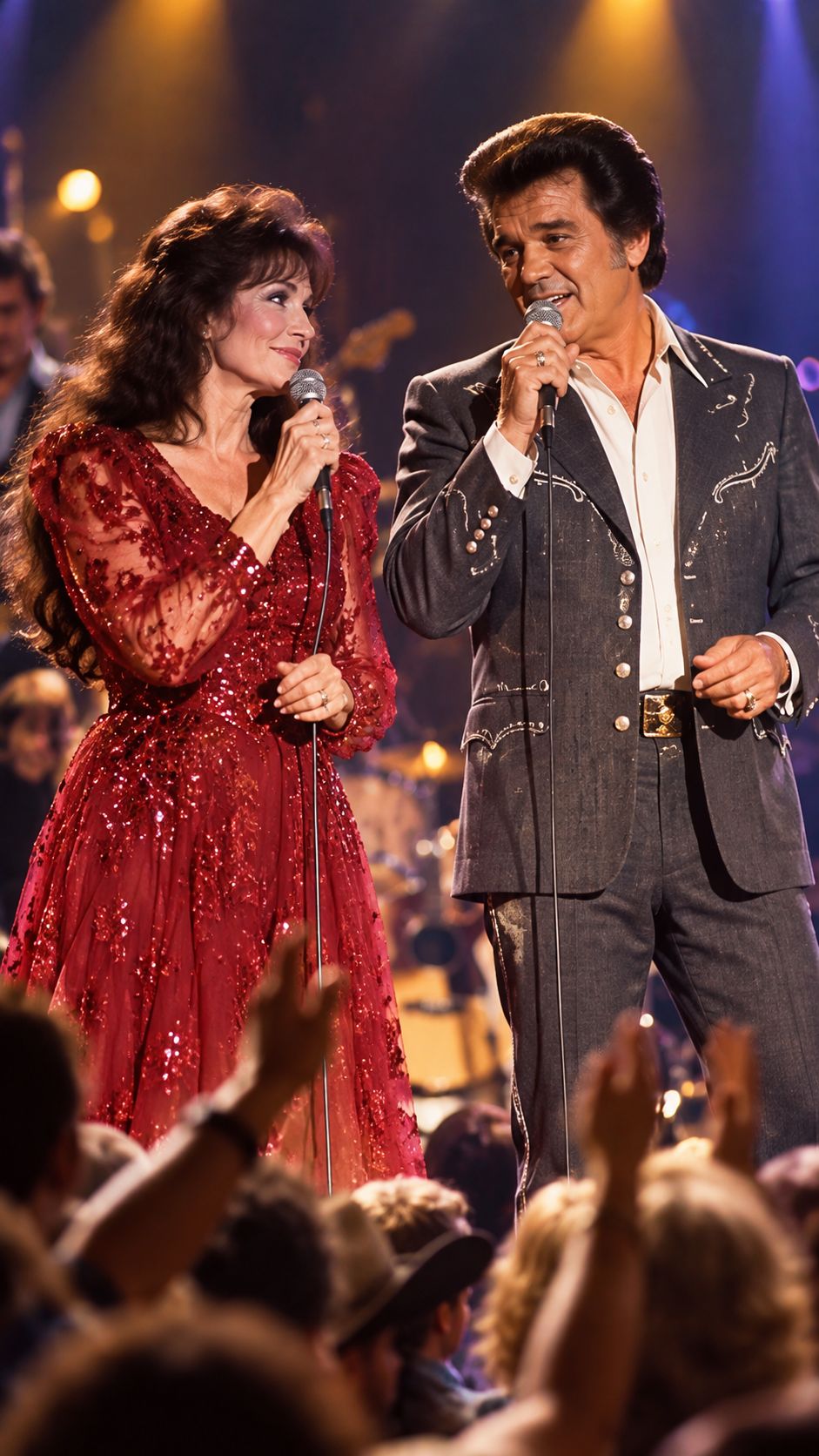
There are moments in country music when a song becomes more than a song. The melody fades into the background, the stage seems to disappear, and what remains is the unmistakable feeling of two voices telling a story that somehow feels like our own. That was the magic of Conway Twitty and Loretta Lynn.
When these two country legends stood together behind a microphone, they did not simply sing about love, heartbreak, arguments, longing, or forgiveness. They transformed those emotions into something almost tangible. Conway Twitty brought a smooth, intimate vocal presence, while Loretta Lynn answered with a voice filled with honesty, strength, vulnerability, and unmistakable country character. Together, they created a musical conversation that felt remarkably human.
Their partnership mattered because it never sounded manufactured. Their performances carried tension, tenderness, humor, and emotional truth. Listeners could hear two people wrestling with complicated feelings rather than simply performing words written on a page.
That is why generations of country fans still remember them. Their greatest recordings remind us that heartbreak can become beautiful when it is shared, that love is rarely simple, and that the most powerful songs are often the ones that tell uncomfortable truths.
The Meeting of Two Completely Different Voices
The brilliance of Conway Twitty and Loretta Lynn was rooted partly in contrast.
Conway Twitty possessed one of the most recognizable voices in country music. His delivery could be soft and conversational one moment, then deeply emotional the next. He understood how to make a lyric sound personal without forcing it.
Loretta Lynn, meanwhile, had a completely different kind of authority. Her voice carried the character of someone who had lived through the stories she sang. There was toughness in it, but also warmth. She could make a single line sound like a confession whispered across a kitchen table.
Put those voices together, and something extraordinary happened.
They did not sound identical—and that was precisely the point.
Their differences created dramatic tension. Conway could sound restrained while Loretta pushed emotionally forward. He might deliver a line with quiet confidence, while she answered with urgency. Instead of competing, they created balance.
The magic was not in making two voices sound alike. It was in making two different voices belong together.
That quality became one of the defining characteristics of their recordings.
The Emotional Architecture of Their Duets
Great duets depend on more than vocal chemistry. They require storytelling.
The songs associated with Conway Twitty and Loretta Lynn often felt like miniature dramas. There were characters, conflicts, misunderstandings, emotional reversals, and moments of tenderness.
Consider the emotional world surrounding songs such as After the Fire Is Gone and As Soon as I Hang Up the Phone. These were not simplistic love songs. They explored complicated relationships and emotions that could not easily be reduced to happy endings.
That complexity gave their music longevity.
Listeners did not necessarily hear perfect relationships. They heard recognizable human beings.
People who had experienced marriage, separation, temptation, regret, loneliness, reconciliation, or impossible decisions could find pieces of their own lives inside those performances.
This was one reason their music connected so strongly with older country audiences. The songs respected emotional complexity rather than pretending every story ended neatly.
Why Conway Twitty Was Such a Powerful Partner for Loretta Lynn
Conway Twitty had already established himself as one of country music’s most successful performers when his partnership with Loretta Lynn became so influential.
His greatest strength as a duet partner was restraint.
He rarely needed to overpower a song. Instead, he allowed space for the emotional exchange. That was especially important when singing with Loretta, whose performances could carry tremendous emotional force.
His voice often functioned almost like an anchor.
When Loretta Lynn became fiery, vulnerable, or confrontational, Conway Twitty could respond with calmness. When he sounded emotionally distant, she could bring warmth and urgency into the conversation.
That dynamic made their performances feel spontaneous.
It sounded less like two stars taking turns singing and more like two people actually speaking to each other.
Why Loretta Lynn Made the Partnership Unforgettable
If Conway Twitty supplied restraint, Loretta Lynn supplied emotional electricity.
Her career had already demonstrated her extraordinary ability to turn everyday experiences into country music stories. She was not afraid of difficult subjects, uncomfortable emotions, or complicated relationships.
That honesty became essential to her work with Conway.
She could sing a lyric about heartbreak without making it sound theatrical. She could express anger without losing vulnerability. She could sound strong without pretending she was never hurt.
That combination made her performances deeply believable.
With Conway Twitty, she found a partner who could match that emotional sophistication without overwhelming it.
The result was a conversation between equals.
The Secret Was in the Silence Between the Lines
One of the most underrated elements of their music was what happened between the words.
A great duet is not simply about singing simultaneously. It is about listening.
Conway Twitty and Loretta Lynn understood this instinctively.
Sometimes the most powerful moment came when one singer stopped and allowed the other voice to enter. That tiny pause created anticipation. It made the listener feel as though an argument, confession, or emotional revelation was unfolding in real time.
Their phrasing also mattered.
A lyric could be technically simple, but the way they delivered it could completely change its meaning. A pause could suggest doubt. A softer note could suggest regret. A stronger response could communicate anger without requiring another word.
This is why their recordings remain fascinating to study decades later.
They understood that emotion lives not only inside lyrics, but also inside timing, tone, breath, and silence.
More Than Entertainment: A Reflection of Real Life
The enduring appeal of Conway Twitty and Loretta Lynn comes down to something much larger than nostalgia.
Their music reflected real life.
Relationships are messy. People make mistakes. Love can coexist with disappointment. Pride can collide with vulnerability. Two people can care deeply for one another and still fail to communicate.
Their songs acknowledged those contradictions.
That made their work especially meaningful to listeners who had lived through similar experiences.
Country music has always been strongest when it tells ordinary stories with extraordinary honesty. Conway and Loretta understood that principle perfectly.
They did not need elaborate concepts.
They needed a microphone, a melody, and a story worth telling.
Why Their Music Still Resonates With New Generations
It might be tempting to think that the appeal of Conway Twitty and Loretta Lynn belongs exclusively to another era.
But emotional truth does not have an expiration date.
A younger listener may know nothing about the recording sessions, television appearances, award ceremonies, or country-music culture surrounding their careers. Yet that listener can still understand the emotions inside the songs.
Heartbreak remains heartbreak.
Love remains complicated.
Loneliness still hurts.
And the desire to be understood remains universal.
That is why their music continues to find new listeners.
The production may sound different from contemporary country. The arrangements may belong to another generation. But the emotional language remains remarkably familiar.
The Legacy of a Partnership That Became Bigger Than the Songs
The legacy of Conway Twitty and Loretta Lynn is not simply a collection of successful recordings.
It is an example of what happens when two extraordinary performers trust each other enough to become vulnerable together.
Their partnership demonstrated that country music does not require complicated storytelling to create powerful drama. Sometimes the strongest story is simply two people trying to tell each other the truth.
That is what made their performances memorable.
And it is why fans continue to return to them.
Conway Twitty and Loretta Lynn did not merely sing about heartbreak—they gave heartbreak a voice.
Their music reminds us that some of the most enduring moments in country music happen when performers stop trying to impress an audience and simply tell the truth.
Decades later, that truth still carries.
The voices may belong to another generation, but the emotions belong to everyone.
And whenever Conway Twitty and Loretta Lynn take the mic again through those timeless recordings, the world still has a reason to listen.
VIDEO: