 By admin
INTRODUCTION:
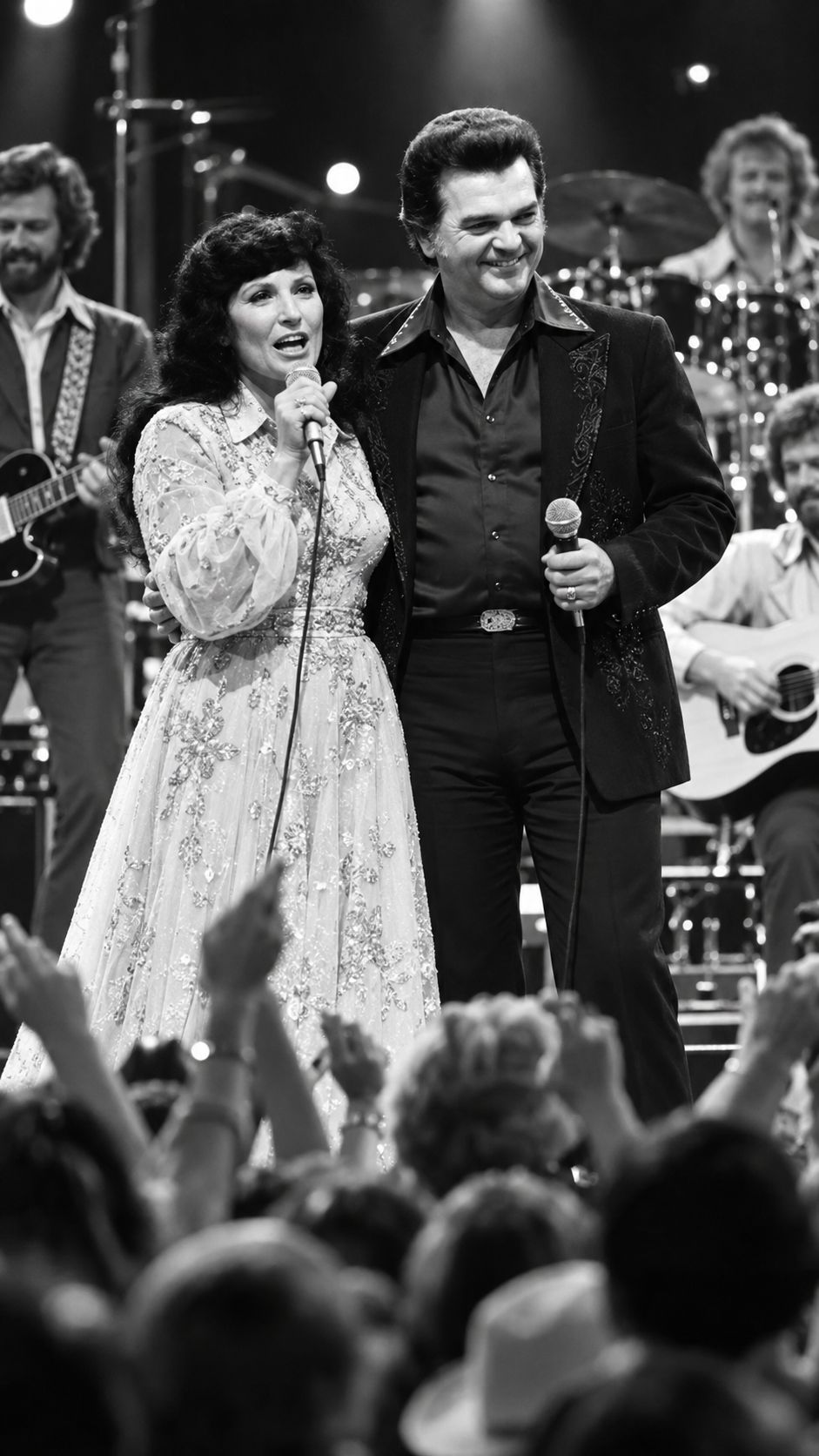
Some songs touch the heart with heartbreaking lyrics, unforgettable melodies, and stories of love that seem almost too beautiful to be true. Others do something just as remarkable: they make people laugh, recognize themselves in the music, and remember that love does not always have to be perfect to be meaningful. Few country songs capture that second kind of magic quite like You’re the Reason Our Kids Are Ugly, the unforgettable duet associated with Conway Twitty and Loretta Lynn.
At a time when country music was filled with songs about lost love, broken promises, and lonely nights, these two legendary performers demonstrated that a husband and wife could turn everyday disagreements into pure entertainment. With a mischievous sense of humor, sharp exchanges, and the kind of natural chemistry that cannot easily be manufactured, they transformed an ordinary family complaint into a musical conversation that audiences could instantly understand.
The brilliance of the song lies in its playful argument. Neither singer wants to accept responsibility, and both seem perfectly happy to point a finger at the other. Beneath the teasing, however, is something warmer: the familiar language of people who know each other well enough to joke about their imperfections.
For generations of country fans, Conway Twitty and Loretta Lynn represented far more than two extraordinary voices. Together, they helped show that country music could be tender, dramatic, funny, and wonderfully human—all within the same unforgettable performance.
And that is precisely why this mischievous classic continues to deserve a place in the conversation about country music’s greatest duets.
1. A SONG THAT DARED TO LAUGH AT THE PERFECT FAMILY
There is something wonderfully rebellious about You’re the Reason Our Kids Are Ugly. Its title is outrageous, its premise is ridiculous, and its humor feels like something overheard at a kitchen table after a long day of work. Yet that simplicity is exactly what makes the song so memorable.
Released in 1978 as part of Honky Tonk Heroes, the song brought together the distinctive personalities of Loretta Lynn and Conway Twitty in a performance that embraced comedy without sacrificing musical quality. Written by L. E. White and Lola Jean Dillon, it became one of the most recognizable humorous entries in the duo’s catalog.
The central joke is immediately understandable. A couple looks at their circumstances and decides that the other person is responsible for practically everything that has gone wrong. The family struggles financially, the responsibilities keep multiplying, and neither partner seems particularly eager to accept blame.
Then comes the outrageous accusation that gives the song its name.
It is the kind of joke that might provoke an argument in real life, but in the hands of Twitty and Lynn, it becomes an affectionate exchange. The two singers do not sound like strangers exchanging insults. They sound like performers who understand the rhythm of a good punchline and know precisely when to let the other person have the last word.
That distinction matters.
Country music has always drawn strength from familiar experiences. Audiences recognize the struggles of paying bills, raising children, growing older, and trying to maintain a relationship when life refuses to cooperate. This song takes those recognizable frustrations and exaggerates them until they become comedy.
Instead of asking listeners to admire a flawless couple, it invites them to laugh at an imperfect one.
And sometimes, that is a much more honest portrait of love.
2. WHY CONWAY TWITTY AND LORETTA LYNN MADE SUCH A PERFECT TEAM


To understand why the song works so well, listeners need to understand the musical personalities of its two performers.
Conway Twitty possessed a rich, unmistakable voice that could make a romantic ballad feel intimate and emotionally complicated. His phrasing often carried a sense of confidence, but he could also deliver a line with a perfectly timed hint of mischief. He knew how to make a listener believe that he meant every word, even when the words were deliberately absurd.
Loretta Lynn, meanwhile, brought a different kind of strength. Her voice was direct, spirited, and grounded in the everyday experiences of ordinary people. She could sound vulnerable without sounding weak, and she could deliver a sharp retort without losing her warmth.
Together, they created a compelling musical contrast.
One voice offered a setup; the other supplied the response. One performer made an accusation; the other found a way to turn the accusation back around. Their exchanges created a sense of movement that kept the song entertaining from beginning to end.
Their partnership was not built on comedy alone. The two had already established themselves as a successful duet team through songs that explored romantic tension, heartbreak, reconciliation, and devotion. Their first major duet success came in the early 1970s, and they went on to record numerous collaborative albums and charting singles.
That musical history gave their comic performances an important advantage: audiences already understood their chemistry.
When Conway Twitty and Loretta Lynn sang a serious love song, they could create emotional tension. When they sang a playful argument, they could create comic tension. In both cases, the appeal came from the interaction between two distinct personalities.
They did not need to sound alike. In fact, their differences were the point.
The result was a duet that felt conversational rather than mechanical. Their voices did more than follow a melody; they portrayed characters, attitudes, and reactions.
That ability to turn a recording into a little dramatic scene is one of the reasons their music continues to attract listeners who appreciate traditional country storytelling.
3. THE SECRET BEHIND THE HUMOR: EVERYDAY LIFE BECOMES ENTERTAINMENT
The title alone might suggest that You’re the Reason Our Kids Are Ugly is simply a novelty song. But dismissing it as a joke misses the craftsmanship behind its appeal.
The song’s humor depends on recognition.
Most listeners have encountered someone who blames another person for an inconvenience. In a relationship, that habit can become a running joke. One person blames the other for the rising bills; the other points to the family’s growing expenses. One complains about personal sacrifices; the other insists that the sacrifices are hardly unique.
The song takes this familiar pattern and pushes it to an absurd extreme.
Its couple cannot agree on who deserves the blame, but neither seems interested in ending the relationship. Their complaints are exaggerated, and the musical exchanges make clear that the argument is part of the entertainment.
The genius is in the contrast between the insults and the affection that survives them.
A genuinely bitter song might use the same complaints to reveal resentment or emotional distance. Here, however, the humor depends on the audience recognizing that the couple’s bickering is not the whole story.
They remain together. They keep talking. They keep finding new reasons to tease each other.
That is what gives the performance its warmth.
The song also reflects the storytelling traditions of classic country music, a genre that has frequently found meaning in ordinary objects and everyday circumstances. Worn-out possessions, household responsibilities, limited money, and family obligations can all become symbols of a much larger human experience.
In this case, the symbols are deliberately funny.
The characters are not living a glamorous fantasy. They are dealing with the realities of an ordinary household, and they respond by turning frustration into entertainment.
For older listeners especially, that setting can evoke memories of a time when humor often served as a way to endure difficult circumstances. Families might not have had everything they wanted, but a shared joke could make a challenging day feel a little lighter.
That does not mean every listener must share the same experiences to appreciate the song. Its premise is universal enough to travel across generations.
Anyone who has watched two people lovingly argue over something trivial can understand the appeal.
4. WHY THE SONG IS MORE THAN A COMEDIC TITLE


A memorable title can attract attention, but it cannot sustain a song for decades by itself.
What keeps this recording alive is the contrast between its deliberately outrageous premise and its underlying message about commitment.
The characters are willing to criticize each other over appearances, money, and the inconveniences of family life. Yet the song repeatedly returns to a much more generous idea: material success and physical appearance are not the only things that matter in a relationship.
That emotional counterweight is essential.
Without it, the song might feel cruel. With it, the teasing becomes a way of acknowledging imperfection without surrendering affection.
This is one of the most interesting characteristics of traditional country storytelling. Many country songs do not present love as an effortless state of happiness. Instead, they show love surviving disappointment, temptation, financial hardship, misunderstandings, and the ordinary disappointments that accumulate over time.
Conway Twitty and Loretta Lynn approached that tradition from a comic angle here.
Their characters are not pretending that everything is wonderful. They are simply refusing to let every frustration become a tragedy.
That approach gives the song a surprising emotional depth. It suggests that a lasting relationship does not necessarily depend on two people agreeing about everything or seeing themselves as perfect partners. Sometimes, it depends on their ability to keep communicating, forgive small imperfections, and laugh together.
Of course, humor is not a solution to every relationship problem. The song is a playful fictional performance, not a guide to handling serious disagreements. Its message works because the complaints are exaggerated for entertainment and the affection remains unmistakable.
Still, the underlying idea is worth remembering.
A couple that can laugh at its own shortcomings may find it easier to recognize that a difficult day does not have to define an entire relationship.
And a song that can communicate that idea in a few minutes, without becoming preachy, has achieved something special.
5. THE MUSICAL ARRANGEMENT THAT LETS THE STORY SHINE
One reason You’re the Reason Our Kids Are Ugly remains approachable is that the musical presentation serves the comedy rather than competing with it.
The recording belongs to the polished but distinctly country sound associated with Nashville during the late 1970s. The arrangement supports the vocal exchange, allowing the lyrics and the performers’ personalities to remain at the center of the experience.
The recording credits include producer Owen Bradley, alongside accomplished Nashville musicians whose contributions helped give the track its professional country sound.
What matters most, however, is how the arrangement supports the timing.
Comedy in music requires more than funny words. It requires pacing. A singer must know when to deliver a line straightforwardly, when to emphasize a particular phrase, and when to leave enough space for the audience to appreciate the joke.
The same principle applies to a successful comedy duet.
If both performers rush through their parts, the humor loses its impact. If the delivery becomes too exaggerated, the song can feel forced. If the music overwhelms the vocals, the story becomes difficult to follow.
Here, the conversational structure allows the back-and-forth to remain clear.
Loretta Lynn and Conway Twitty sound like two people competing to win an argument, but their delivery is controlled enough to keep the humor musical. The exchange feels spontaneous even though the performance is carefully constructed.
That balance is part of the artistry.
It is also a reminder that vocal personality can be just as important as vocal power. A technically impressive singer may deliver every note beautifully, but a performer who understands character, timing, and emotional nuance can make a song feel alive.
Both Lynn and Twitty possessed that ability.
Their voices gave the characters individuality, while the arrangement provided a comfortable framework for their comic exchange.
The result is a recording that listeners can enjoy not only for its title or lyrics, but also for the way its musical elements work together.
6. HOW A PLAYFUL DUET BECAME PART OF COUNTRY MUSIC’S LEGACY
The legacy of You’re the Reason Our Kids Are Ugly becomes clearer when it is placed alongside the broader history of Conway Twitty and Loretta Lynn.
Their partnership demonstrated that a successful country duet could take many forms. It could be a heartbreaking story of separation, a declaration of devotion, a tense romantic conversation, or a playful argument between two people who refuse to admit they are wrong.
That variety helped make their collaboration distinctive.
The pair were particularly effective when a song required them to inhabit different perspectives. Rather than simply alternating verses, they created the impression of two characters responding to each other in real time.
This approach made their recordings feel theatrical without losing their country roots.
Their humorous repertoire also challenged the idea that serious musicians must always deliver serious material. Loretta Lynn was known for her bold storytelling and willingness to address subjects that others avoided. Conway Twitty could deliver deeply emotional romantic performances. Yet both were willing to embrace a song whose principal purpose was to entertain.
That flexibility is a sign of artistic confidence.
A performer who can move between heartbreak and humor without losing credibility understands that audiences respond to emotional honesty in many forms.
The song’s afterlife provides another illustration of its staying power. Later performers have revisited the material, and the musical legacy of the two families has continued through Tre Twitty, Conway’s grandson, and Tayla Lynn, Loretta’s granddaughter, who perform songs associated with their grandparents’ partnership. Their tribute show includes this comic duet alongside more serious classics.
That continuation is meaningful because it allows new audiences to discover the original performers through a living musical tradition.
A song does not need to sound contemporary in every respect to remain relevant. Sometimes, its enduring appeal comes from the fact that its subject has not changed.
People still fall in love. They still form families. They still disagree about money, appearance, responsibilities, and who left something where it should not have been left.
And they still use humor to make those disagreements easier to bear.
In that sense, the song is not merely a reminder of the 1970s. It is a small piece of everyday human experience preserved in a country music recording.
7. WHY TODAY’S COUNTRY FANS CAN STILL CONNECT WITH IT
Modern country music exists in a very different media environment from the one in which Conway Twitty and Loretta Lynn first recorded together.
Songs now compete for attention through streaming platforms, short-form videos, social media clips, playlists, and countless other channels. Listeners can move from one artist to another in seconds.
Yet a song built around a simple, recognizable human interaction can still cut through that noise.
Imagine hearing the title You’re the Reason Our Kids Are Ugly for the first time. Even before the music begins, the title invites curiosity. It sounds outrageous enough to make someone smile, but familiar enough to suggest a story behind the joke.
Then the duet begins, and the humor unfolds through the voices.
That combination makes the song naturally suited to conversation. Listeners can share it with friends, quote its premise, or remember the first time they heard it playing on the radio.
For longtime fans, the song may bring back memories of listening to country music at home, on long drives, or during gatherings with family and friends.
For younger listeners, it offers an introduction to a style of songwriting that places character and storytelling above elaborate production.
Neither group needs to know every detail of Nashville’s musical history to appreciate the exchange.
The song also offers a welcome contrast to the idealized relationships often portrayed in popular entertainment. Its characters are not wealthy, glamorous, or endlessly romantic. They are imperfect people who complain, joke, and carry on.
That makes them recognizable.
And recognition is a powerful ingredient in memorable songwriting.
The continued interest in classic country duets reflects something broader than nostalgia. Many listeners are drawn to music that feels personal, direct, and rooted in ordinary life. They appreciate singers who sound as though they are telling a story rather than simply delivering a polished performance.
Twitty and Lynn understood that principle.
They made the listener feel like a witness to a conversation, and they made the conversation entertaining enough to remember.
That is why the song can still make people smile, even when its original era is long gone.
8. THE GREATEST LESSON: LOVE DOES NOT HAVE TO LOOK PERFECT
Perhaps the most enduring quality of You’re the Reason Our Kids Are Ugly is the way it turns an intentionally ridiculous accusation into a celebration of imperfection.
The characters spend much of the song finding fault with each other. Yet the performance never feels like a final judgment. Their complaints are part of a shared game, and the affection underneath them gives the humor its meaning.
This is where Conway Twitty and Loretta Lynn made the song their own.
They could have treated the lyrics as a collection of jokes. Instead, their contrasting voices gave the exchange personality and helped turn it into a miniature story about a couple navigating ordinary life.
The humor is broad, but the emotional idea is gentle.
No family is perfect. No couple agrees on every detail. Financial worries, personal insecurities, and everyday responsibilities can make even the strongest relationships complicated.
Yet those imperfections do not necessarily erase the affection that brought two people together.
Sometimes, love is expressed through a grand romantic gesture. Sometimes, it appears in a quiet act of kindness. And sometimes, it emerges through a ridiculous argument that ends with both people still sitting at the same kitchen table.
That is the world this song captures.
It does not ask listeners to believe in a flawless marriage. It asks them to recognize the humor in the ordinary, the affection beneath the complaints, and the possibility of finding joy in life’s less glamorous moments.
There is also something wonderfully democratic about that message. The song does not reserve its humor for the rich or famous. Its characters live with familiar limitations, and their frustrations are recognizable to people from many different backgrounds.
That is one of the reasons classic country music continues to resonate across generations.
At its best, it does not make ordinary people feel small. It makes their lives worthy of a song.
And when two performers with the talent and chemistry of Conway Twitty and Loretta Lynn bring that idea to life, even a joke about family resemblance can become an enduring piece of musical storytelling.
CONCLUSION: A COUNTRY CLASSIC THAT NEVER NEEDED TO TAKE ITSELF TOO SERIOUSLY
You’re the Reason Our Kids Are Ugly may not be the first song that comes to mind when people discuss the most emotional performances in country music. It does not rely on a tragic farewell, a broken heart, or a dramatic declaration of eternal devotion.
Instead, it offers something equally valuable: laughter, personality, and an affectionate portrait of imperfect people.
Through the contrasting voices of Conway Twitty and Loretta Lynn, a playful argument becomes an entertaining story about family life, financial pressures, and the ability to find humor in everyday frustrations.
The song also reveals an important truth about their partnership. Their greatest strength was not simply that they could sing together. It was that they could make a listener believe two distinct personalities were having a real conversation.
That quality helped distinguish their duets and remains a major part of their legacy.
Decades later, the title can still raise a smile, the exchanges still invite a laugh, and the affectionate spirit beneath the teasing still feels familiar.
Perhaps that is the real secret of this remarkable recording.
Great country music does not always have to break your heart. Sometimes, it reminds you to laugh with the people you love.
And sometimes, the songs that stay with us longest are the ones that make us smile at ourselves.
VIDEO: