 By admin
INTRODUCTION:
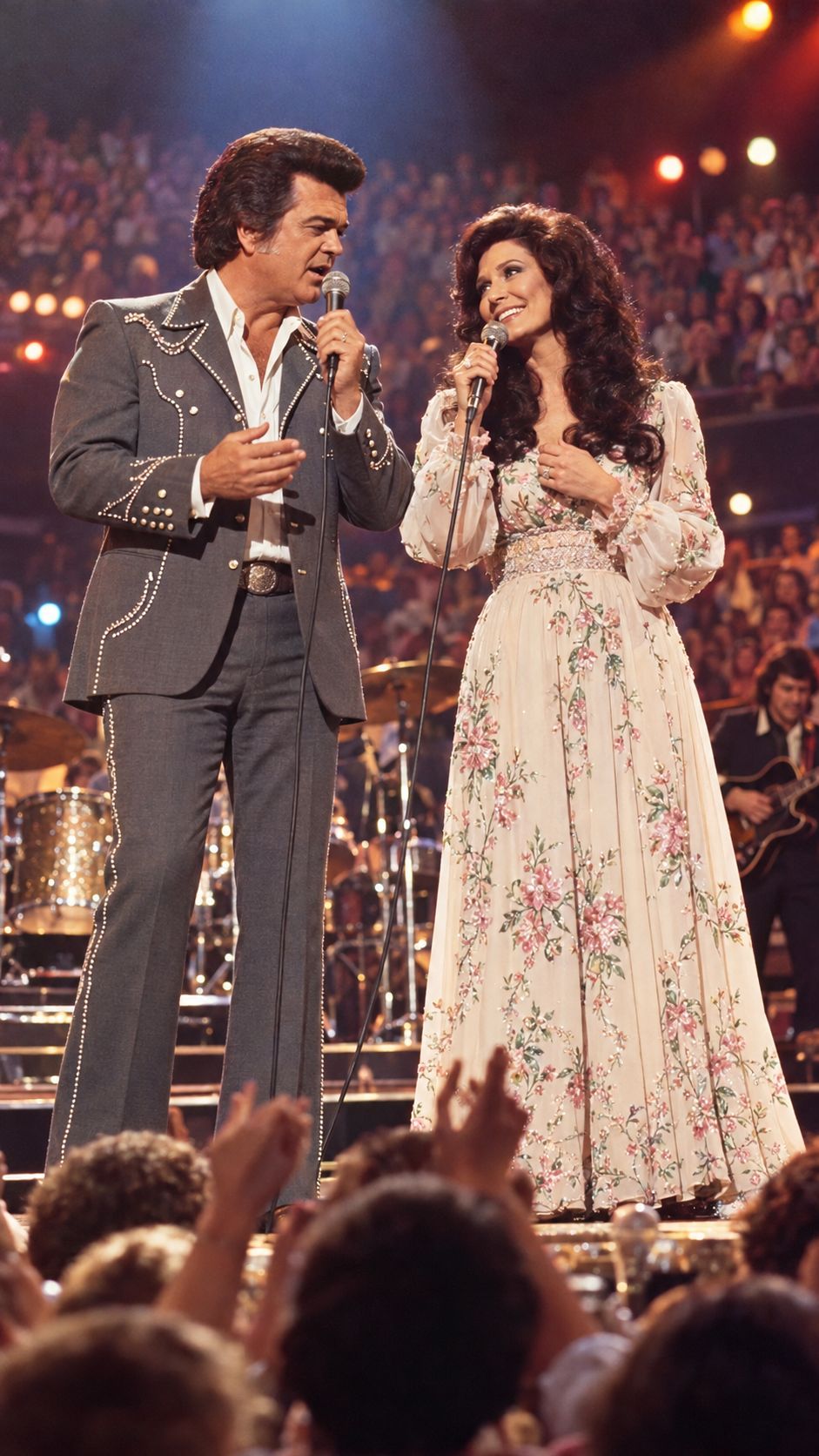
Some songs entertain us for a few minutes. Others reach into the quiet corners of our hearts, awaken memories we thought we had buried, and leave us wondering whether the people singing them are simply performing or revealing something deeply personal. Few country duets capture that mysterious feeling quite like Conway Twitty and Loretta Lynn’s unforgettable recording of After the Fire Is Gone.
From the first exchange between their voices, something extraordinary begins to unfold. There is no need for elaborate production, dramatic gestures, or overwhelming emotion. Instead, two legendary performers create an intimate musical conversation about love, loneliness, temptation, and the painful emptiness that can emerge when a relationship loses its warmth. Their voices seem to understand one another in ways that words alone cannot explain.
For generations of country music fans, the magic of this recording has rested in one fascinating question: How did Conway Twitty and Loretta Lynn make a fictional story feel so achingly believable?
Perhaps the answer lies in the spaces between their words, the tenderness in their delivery, and the tension that builds as their characters confront feelings they cannot easily dismiss. Perhaps it is the way their voices complement one another, creating the impression of two people sharing a secret that the rest of the world was never meant to hear.
Whatever the explanation, After the Fire Is Gone remains a powerful reminder that country music does not need to shout to make an unforgettable statement. Sometimes, all it takes is two extraordinary voices, one complicated story, and the courage to sing about emotions that many people would rather keep hidden.
1. The Song That Made a Private Struggle Sound Universal
When After the Fire Is Gone reached country music audiences in 1971, it offered something more complicated than a conventional love song. Its central theme was not the excitement of falling in love, the happiness of a wedding day, or the comfort of a relationship that had survived every storm.
Instead, it explored what happens when the emotional connection between two people begins to disappear.
The song’s characters find themselves confronting a difficult reality: the relationship they once knew has lost its warmth, yet their desire for affection has not completely vanished. That tension creates the emotional foundation of the recording. It is not simply a story about attraction. It is a story about loneliness, unmet needs, and the dangerous decisions people may consider when love no longer feels the way it once did.
This is where the interpretation by Conway Twitty and Loretta Lynn becomes particularly compelling.
Both singers understood how to communicate complicated feelings without making their performances sound artificial. They knew that audiences did not always need a narrator to explain what was happening. A pause, a change in vocal intensity, or a carefully delivered phrase could communicate more than an entire paragraph of dialogue.
Their recording transforms the song into a conversation between two people who appear to recognize something familiar in each other’s pain.
Listeners can sense the conflict. There is longing, but there is also uncertainty. There is a desire to feel alive again, but there are consequences attached to that desire.
That emotional contradiction gives the song its lasting power.
The most unforgettable country songs do not always offer easy answers. Sometimes, they simply give a voice to the questions people are afraid to ask.
For fans who have experienced disappointment, emotional distance, or the slow transformation of a once-beautiful relationship, the song can feel remarkably personal. Its story may belong to fictional characters, but the feelings behind it are recognizable across generations.
That is one reason After the Fire Is Gone continues to invite discussion long after its original release.
2. Conway Twitty: The Voice That Made Every Emotion Feel Personal

There was something distinctive about the way Conway Twitty approached a country song.
His voice possessed a rich, smooth quality that could make even a restrained performance feel intimate. He did not need to force emotion into every note. Instead, he often allowed the natural character of his voice to carry the meaning, creating the impression that he was speaking directly to one person rather than performing for an audience of thousands.
That quality was essential to After the Fire Is Gone.
The song requires a performer who can communicate attraction without losing sight of the emotional complications surrounding it. A more exaggerated interpretation might have turned the story into melodrama. Conway’s controlled delivery gives it a different kind of intensity.
He sounds measured, thoughtful, and emotionally engaged. His phrasing allows the listener to imagine a man who understands the situation but has not necessarily resolved the conflict within himself.
This ability to inhabit emotionally complicated material was a defining strength of Conway Twitty’s career. His catalog frequently explored romantic uncertainty, heartbreak, temptation, and the vulnerabilities that people often conceal behind ordinary conversations.
He understood that a convincing love song does not always require a perfect romantic hero.
Sometimes, the most interesting character is the person who knows exactly what is at stake but continues to struggle with what the heart wants.
That sensibility gives his contribution to the duet much of its emotional weight.
His voice does not overpower the story. It draws listeners into it.
And when paired with Loretta Lynn, that restraint becomes even more effective. Rather than dominating the performance, Conway creates room for another voice to respond, challenge, and deepen the emotional meaning of the song.
The result is not merely a showcase for his vocal abilities. It is an example of how a great country singer can make a complicated character feel human.
3. Loretta Lynn: The Honesty That Made the Duet Impossible to Ignore

If Conway Twitty brought smoothness and controlled intensity to the recording, Loretta Lynn brought a different kind of emotional honesty.
Her voice had a directness that made listeners feel as though they were hearing the truth from someone who had lived through difficult experiences and had no intention of pretending otherwise.
That quality had already become central to her reputation as one of country music’s most compelling storytellers.
Throughout her career, Loretta Lynn demonstrated an extraordinary ability to sing about women’s experiences with candor, independence, humor, and vulnerability. She was not afraid to explore subjects that traditional romantic songs sometimes avoided, particularly the complicated realities of marriage, desire, disappointment, and the expectations placed on women.
In After the Fire Is Gone, that interpretive strength becomes especially important.
Her performance does not reduce the song’s female character to a simple symbol of temptation. Instead, the emotional circumstances invite listeners to consider a person who is searching for something that appears to have disappeared from her existing relationship.
That distinction matters.
A lesser performance might have treated the story as a straightforward romantic fantasy. Loretta’s presence makes it feel more like a difficult human situation, one involving needs, choices, and emotional consequences.
Her vocal expression also creates a compelling contrast with Conway’s smoother style. Where his delivery can suggest quiet reflection, hers brings a sense of immediacy and personal conviction.
Together, they create the impression of two individuals with distinct emotional perspectives.
Neither voice feels unnecessary. Neither exists merely to decorate the other’s performance.
That balance is one of the reasons Loretta Lynn and Conway Twitty became such a memorable recording partnership. Their musical chemistry depended not on sounding identical, but on sounding convincingly different while remaining emotionally connected.
Loretta’s contribution is essential because she makes the song’s conflict feel like more than a man’s confession. It becomes a conversation between equals, each with a perspective that deserves to be heard.
And that is where the duet becomes truly absorbing.
4. The Chemistry: Why Their Voices Sounded Almost Too Real

The word chemistry is often used to describe successful musical partnerships, but it can sometimes become an easy explanation for something more complicated.
In the case of Conway Twitty and Loretta Lynn, their chemistry was built on identifiable musical qualities: contrasting vocal textures, responsive phrasing, emotional restraint, and a shared understanding of country storytelling.
They did not need to sing every line with the same intensity. In fact, the differences between their performances helped make the duet convincing.
One voice could establish a feeling, while the other seemed to respond to it. A phrase could sound like a confession, only to become more complicated when the next voice entered the conversation.
This back-and-forth structure gave After the Fire Is Gone a dramatic quality that a solo recording could not have created in quite the same way.
The listener is not simply hearing a singer describe a situation. The listener is hearing two characters interact.
That changes the experience entirely.
A solo singer can tell us that a relationship has become lonely. Two singers can make us feel the distance between two people, the attraction that emerges from that distance, and the uncertainty surrounding what happens next.
Their performances also benefit from the absence of excessive vocal theatrics. Neither artist needs to turn every line into a climactic moment. Their restraint allows the underlying story to develop naturally.
This is particularly effective in a song where the emotional stakes are already high.
If every note were delivered at maximum intensity, the recording might lose its realism. Instead, the measured performances allow the tension to accumulate, leaving listeners to interpret the characters’ motivations for themselves.
That openness is part of the magic.
Some fans may hear a song about forbidden attraction. Others may hear a warning about what happens when people neglect the emotional foundations of a relationship. Still others may focus on the sadness that can exist even when two people believe they are searching for happiness.
The performance accommodates all those interpretations without insisting on a single answer.
And although the chemistry can make the story feel intensely personal, it is important to distinguish the performers from the characters they portray. The emotional realism of the recording is evidence of their interpretive skill, not proof that the song describes a private relationship between the two singers.
Their achievement was making a difficult story believable through music.
5. The Meaning Behind the Title: When the Fire Goes Out
The title After the Fire Is Gone is powerful because it expresses an entire emotional situation through a simple image.
Fire can represent passion, excitement, attraction, and the energy that brings two people together. But fire also requires attention. Without care, it can diminish, leaving behind the memory of something that once provided warmth.
That metaphor gives the song a deeper meaning than a story about desire alone.
The real question is not simply whether the characters feel attracted to one another. It is why they find themselves looking for emotional fulfillment outside a relationship that once mattered.
What has changed?
Have affection and communication disappeared? Have everyday responsibilities gradually replaced meaningful connection? Have the characters mistaken familiarity for intimacy, or have they simply reached a point where they no longer know how to repair what has been lost?
The song does not need to provide a detailed history of their relationships to make those questions resonate.
Its central image allows listeners to bring their own experiences to the story.
For someone who has watched a marriage become distant, the fire may represent the tenderness that disappeared somewhere between ordinary responsibilities and unspoken disappointments.
For another listener, it may symbolize the excitement of a new romance that cannot erase the consequences of existing commitments.
For someone else, the song may simply be a reminder that human beings can make complicated choices when they feel unseen or emotionally alone.
That range of interpretation helps explain why the recording remains so interesting to revisit.
The title does not describe the beginning of a romance. It begins after something important has already changed.
That is a much more difficult emotional landscape to explore, and it gives the song a maturity that distinguishes it from uncomplicated love songs.
Sometimes, the saddest part of losing love is not remembering how it ended. It is remembering how alive everything once felt.
The power of the song lies in that contrast between what was and what remains.
6. The Historical Achievement: A Grammy-Winning Country Duet
The success of After the Fire Is Gone was not limited to the emotional reactions of its listeners.
Released in 1971, the recording became a major milestone in the careers of Conway Twitty and Loretta Lynn. It reached No. 1 on the Billboard country chart and earned the duo a Grammy Award for Best Country Performance by a Duo or Group with Vocal at the 14th Annual Grammy Awards in 1972.
Those achievements established the recording as more than a memorable collaboration. It became a defining moment in the history of their partnership.
The timing was significant as well.
Country music had long celebrated duets, but successful partnerships depended on more than bringing two popular singers together. The performers needed complementary voices, an appealing repertoire, and a convincing way of communicating a story.
Conway Twitty and Loretta Lynn possessed all three.
Their collaboration allowed each artist to reveal a different dimension of their talent. Conway’s romantic phrasing gained additional dramatic weight when placed in conversation with Loretta’s direct, expressive delivery. Loretta’s storytelling became even more immediate when another voice could answer her within the same song.
The Grammy recognition confirmed that their collaboration had connected with the industry as well as with audiences.
Yet awards alone do not explain the recording’s endurance.
Many successful songs are closely associated with a particular year, fashion, or cultural moment. Others continue to feel relevant because their central themes are not tied to a specific generation.
After the Fire Is Gone belongs to the latter category.
Its musical presentation is rooted in classic country, but its emotional questions remain recognizable. People still struggle with intimacy, disappointment, temptation, and the difference between being in a relationship and feeling genuinely connected to another person.
The recording’s historical success gave it a permanent place in country music’s story. Its emotional complexity gave listeners a reason to keep returning.
That combination is far more meaningful than a chart position alone.
7. Why Classic Country Fans Still Debate This Song
One of the most interesting things about After the Fire Is Gone is that its emotional impact does not depend on listeners agreeing about its characters.
In fact, disagreement may be part of what makes the song so compelling.
Some listeners may interpret the characters as people who have been neglected and are searching for the affection missing from their lives. Others may see individuals making choices that could deepen the pain of everyone involved.
Both interpretations can coexist because the song presents an emotionally complicated situation rather than a simple moral lesson.
This is an important quality in great storytelling.
The strongest songs often allow listeners to experience conflicting emotions simultaneously. A listener may understand a character’s loneliness without approving of the character’s choices. Someone may recognize the appeal of an unexpected connection while also understanding why acting on that attraction could cause lasting damage.
The result is a song that invites conversation rather than ending it.
That is particularly relevant to modern audiences discovering classic country music through short video clips, nostalgic posts, and discussions about legendary performers.
When a duet sounds this intimate, people naturally want to know what made it work. They listen for vocal details, revisit familiar lyrics, and compare their interpretations with those of other fans.
But the most meaningful discussions often go beyond speculation about the singers themselves.
They ask what the song says about relationships, why its characters feel emotionally believable, and whether the recording portrays desire as an escape or as a symptom of something deeper.
These questions give the song a life beyond nostalgia.
For older listeners, it may evoke memories of hearing the duet when it first became popular. For younger listeners, it may provide an introduction to a period when vocal storytelling was central to country music’s identity.
Different generations can approach the recording from different perspectives while finding common ground in its emotional honesty.
That is one of the most valuable things a classic song can accomplish.
8. The Legacy of Conway Twitty and Loretta Lynn: More Than Two Famous Voices

The enduring partnership between Conway Twitty and Loretta Lynn was built on a shared ability to turn ordinary human experiences into compelling musical drama.
Their work together included other celebrated recordings, among them Louisiana Woman, Mississippi Man and As Soon as I Hang Up the Phone. Each explored a different aspect of romantic storytelling, demonstrating how effectively the singers could move between playful exchanges, emotional vulnerability, and dramatic tension.
After the Fire Is Gone stands apart because its emotional atmosphere is particularly complicated.
Rather than celebrating love in its happiest form, it explores the uncomfortable territory where loneliness, attraction, and personal responsibility intersect.
That choice allowed both performers to demonstrate the depth of their artistry.
They were not simply two recognizable voices sharing a microphone. They were storytellers who understood that a duet could function like a miniature drama, complete with conflicting feelings, unanswered questions, and emotional consequences.
Their partnership also helped establish a standard against which later country duets would be measured.
A successful duet must do more than give each singer an opportunity to shine. It must create a relationship between the voices that makes the song more meaningful than either performance might be alone.
That is exactly what happens here.
The voices complement one another, the story unfolds through their interaction, and the emotional tension emerges without requiring the listener to know anything about the performers’ private lives.
This distinction matters because the most enduring musical partnerships are often remembered through the characters and stories they brought to life.
The audience may begin by admiring the singers. It stays because the performance reveals something about the human experience.
Decades after its release, After the Fire Is Gone remains an example of that achievement.
Its legacy is not simply that it brought two country legends together. It is that their voices created a story listeners could continue interpreting long after the final note had faded.
9. The Final Truth: Why After the Fire Is Gone Still Touches the Heart
What makes After the Fire Is Gone so unforgettable is not merely its melody, its chart success, or the reputation of the two artists who recorded it.
It is the emotional honesty at the center of the performance.
Conway Twitty brings a quiet intensity that makes the song’s male character feel reflective and vulnerable. Loretta Lynn brings clarity and conviction, ensuring that the female character is equally present in the story. Together, they create a musical exchange that feels spontaneous even though it is carefully crafted.
Their voices allow the audience to hear the attraction, but also the uncertainty. They make the characters’ longing understandable without making their situation simple.
And that is why the recording can still feel almost too real.
It touches on a difficult truth: love is not always destroyed by one dramatic moment. Sometimes, emotional distance grows gradually. Sometimes, people remain together while feeling increasingly alone. Sometimes, the desire to feel understood becomes powerful enough to complicate decisions that once seemed straightforward.
The song does not resolve every question, and that may be its greatest strength.
Instead, it leaves listeners with an opportunity to reflect on what keeps relationships alive, what happens when emotional connection fades, and whether passion alone can provide the happiness people are searching for.
For country music fans, it also offers a reminder of what made the genre’s greatest storytellers so extraordinary. They could take a complicated human experience and express it through a melody that remained accessible, memorable, and deeply moving.
Conway Twitty and Loretta Lynn did not need to convince the world that they were living the story they sang. They needed only to make the characters believable.
They succeeded.
And every time a new listener discovers After the Fire Is Gone, the same questions return: What makes two voices sound so perfectly connected? Why does a song recorded more than half a century ago still feel relevant? And how can a few minutes of music capture feelings that people sometimes struggle to explain in a lifetime?
Perhaps the answer is beautifully simple.
The fire in the song may have faded, but the fire in the performance never did.
What do you think makes After the Fire Is Gone so powerful — the haunting story, Conway Twitty’s smooth voice, Loretta Lynn’s emotional honesty, or the extraordinary chemistry between them?
VIDEO: