 By admin
INTRODUCTION:
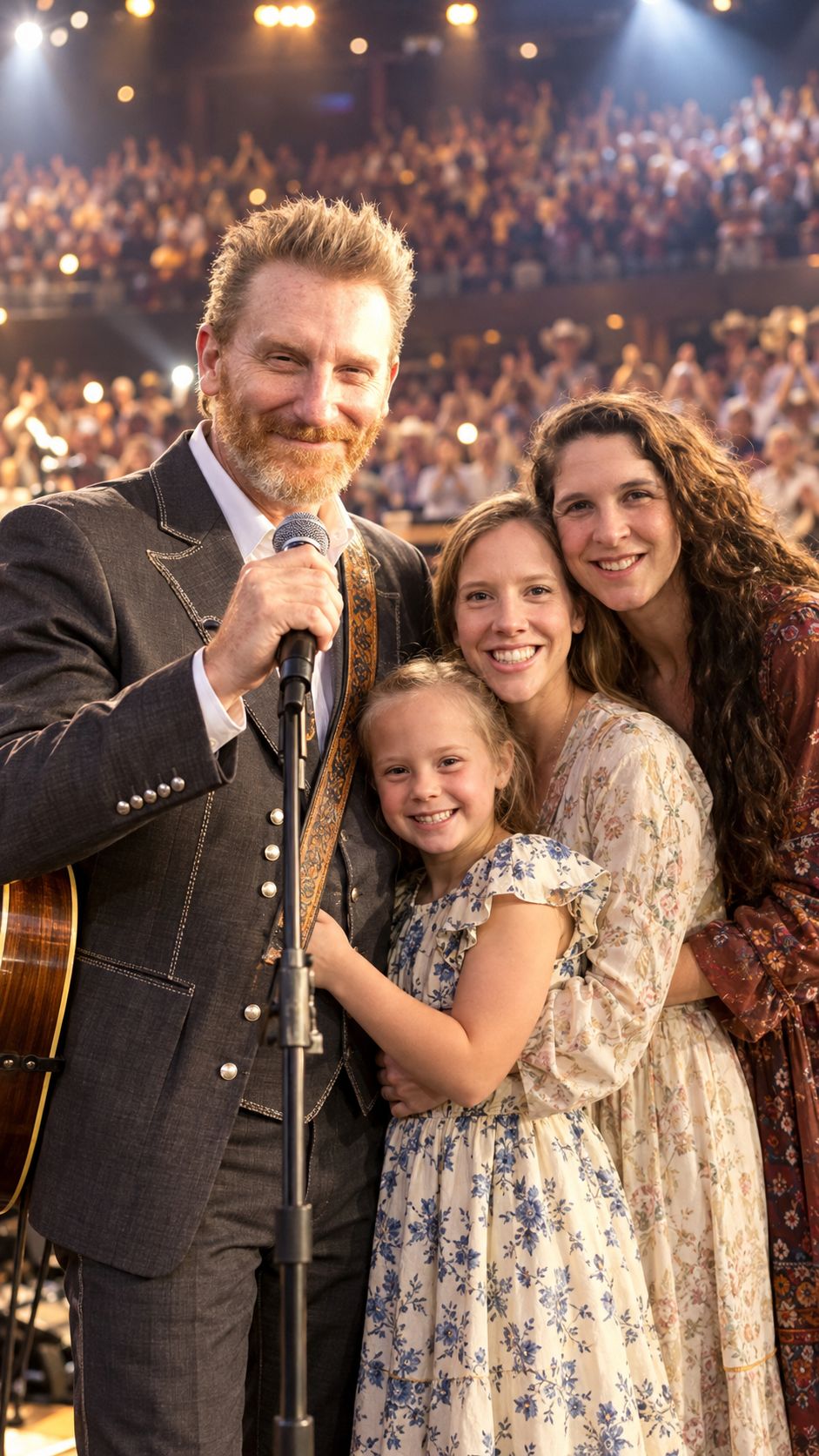
Some stories in country music are remembered for the songs they leave behind. Others remain in the hearts of listeners because the people behind the music face struggles that no melody can fully explain. The story of Rory Feek and his daughters belongs to both worlds—a deeply personal family journey shaped by love, loss, changing relationships, and questions that have captured public attention.
For years, Rory’s life was closely associated with the warmth of traditional country music and the extraordinary love story he shared with Joey Feek, his wife and musical partner. Together, they created music that celebrated family, faith, simplicity, and the enduring power of love. When Joey died in 2016 after her battle with cancer, their story became an especially emotional chapter in the memories of countless fans.
But life did not stop with that heartbreaking loss. Rory continued raising his youngest daughter, Indiana, while his relationships with his older daughters, Heidi and Hopie, became the subject of public discussion and family disagreement. Different perspectives emerged, leaving many observers wondering how one family could experience such different realities.
Behind the headlines lies a more complicated truth: family relationships are rarely as simple as outsiders imagine. To understand the questions surrounding Rory and his daughters, it is necessary to look beyond the emotional pull of social media and consider the human experiences, competing perspectives, and private pain that may exist behind a public story.
THE FAMILY STORY THAT BECAME FAR MORE COMPLICATED THAN FAME
The public’s understanding of Rory Feek has long been shaped by the image of a devoted husband, a father who embraced a quieter life, and a songwriter who found meaning in everyday moments. His music with Joey Feek helped establish that image, but the difficulties surrounding his family have introduced a much more complicated chapter.
At the center of the story are three daughters: Heidi Feek, Hopie Feek, and Indiana Feek. Although they share a family history, their experiences and relationships with their father have not been identical.
Heidi and Hopie are Rory’s older daughters from his relationship with their birth mother, Tamara Gilmer. Indiana is his youngest daughter with Joey, who died in March 2016. The family experienced profound changes long before the current disputes became public, and those changes matter when considering the tensions that followed.
After Joey’s death, Rory continued building a life around fatherhood, music, faith, and the rural lifestyle he valued. Yet the family’s public image could never capture every private conversation, disappointment, or disagreement.
As the years passed, the relationship between Rory and his older daughters deteriorated. What might once have remained a private family struggle became a subject of public debate, with each new statement raising additional questions about what had happened and whether reconciliation remained possible.
The most important distinction is that a family’s public narrative is not the same as its complete private history. Understanding that difference is essential to examining this painful situation fairly.
TWO SIDES OF THE STORY: WHY FATHER AND DAUGHTERS SEE THINGS DIFFERENTLY
One of the most difficult aspects of the Rory Feek family dispute is that the people involved have described their experiences from different perspectives.
Rory has acknowledged publicly that his relationships with Heidi and Hopie became strained. In his own writing, he has discussed disagreements over faith, family values, and the boundaries he believes are necessary when raising Indiana.
From his perspective, decisions about his youngest daughter’s upbringing are part of his responsibility as her father. He has emphasized his desire to raise Indiana according to the principles that matter to him and has defended the community in which he and his family have spent time.
His older daughters, however, have expressed serious concerns about their relationship with their father and their ability to maintain contact with Indiana. They have also challenged aspects of his decisions concerning their younger sister.
These competing perspectives reveal why the dispute is so difficult to resolve through public statements alone.
For a parent, establishing boundaries can feel like protecting a child and maintaining a consistent household. For adult children who disagree with those boundaries, the same decisions may feel exclusionary or deeply hurtful.
Neither interpretation automatically establishes the complete truth.
Family disagreements often involve more than one genuine experience of the same events. A parent may remember sacrifices made over decades, while an adult child remembers moments of disappointment that were never adequately addressed. Both perspectives can be emotionally significant without either one providing the entire picture.
That is why it would be unfair to reduce this story to a simple contest between a wronged father and ungrateful daughters—or between daughters seeking justice and a father who refuses to listen.
The available public accounts do not answer every question, and some matters remain private or subject to legal proceedings.
What they do demonstrate is that the relationships have suffered considerable strain, and that the people involved have not reached a shared understanding of how to move forward.
HEIDI FEEK: THE OLDEST DAUGHTER’S CONCERNS
Heidi Feek has become one of the most outspoken voices in the family dispute.
Her concerns have extended beyond her personal relationship with Rory to questions about Indiana’s welfare, the family’s association with the religious community known as Homestead Heritage, and the circumstances under which her younger sister is being raised.
In 2024, the dispute escalated into legal action involving Indiana’s care and contact with her older sisters. Heidi also raised concerns publicly about the community associated with her father. Rory rejected the negative characterizations of the community and defended the people with whom he and his family had developed relationships.
It is important to distinguish between allegations, responses, and established findings. Public accusations do not, by themselves, prove wrongdoing, and a denial does not independently resolve every concern.
For Heidi, the conflict appears to involve a combination of family estrangement, disagreements about Indiana’s upbringing, and concerns she believes deserve attention.
Yet the public cannot fully know the private experiences that shaped her position. Nor should her statements be treated as a complete record of every event simply because they have attracted widespread attention.
The same caution applies when considering Rory’s responses.
What makes Heidi’s position especially emotional for observers is the involvement of a younger sibling. Disagreements between parents and adult children can be painful enough, but when those disagreements affect contact between siblings, the consequences can extend across generations.
The central question is not merely whether Heidi and Rory agree. It is whether their disagreements can eventually be addressed in a way that respects the relevant legal boundaries, protects Indiana’s well-being, and allows family relationships to heal where possible.
That outcome may require something neither side can achieve through public declarations alone: a willingness to address difficult questions privately, with appropriate professional or legal guidance when necessary.
HOPIE FEEK: A DIFFERENT KIND OF FAMILY RECKONING
While Heidi Feek has spoken forcefully about the ongoing family dispute, Hopie Feek has also shared her perspective on the emotional distance between herself and her father.
Her story includes another deeply personal development that added complexity to an already difficult family history.
In February 2025, Rory publicly described a conversation with Hopie in which she told him that genetic testing had indicated he was not her biological father. According to his account, the discovery followed her reconnection with her birth mother and information about her biological parentage.
The revelation raised questions about identity, family history, and the meaning of parenthood.
For Rory, the news meant confronting an unexpected change in how he understood a relationship that had existed since Hopie’s childhood. For Hopie, learning about her biological origins was a personal experience with implications that cannot be fully understood from the outside.
But one important distinction deserves attention: biological parentage and the emotional reality of raising a child are not the same thing.
A DNA result can establish a biological relationship, but it cannot erase years of shared experiences, family memories, or the feelings that develop between a child and the person who raises her.
At the same time, the discovery of previously unknown family information can prompt someone to reconsider their identity and the stories they have been told about their past.
It is possible for these two realities to coexist.
The news did not automatically resolve the existing tensions between Hopie and Rory. Instead, it became another layer in a relationship already affected by years of distance and disagreement.
For readers following the story, it is tempting to interpret the revelation as the missing explanation for everything that followed. That would be too simplistic.
The biological discovery may help explain certain emotional complications, but it cannot independently account for every disagreement or determine who is responsible for the family’s current difficulties.
Hopie’s experience deserves to be understood as its own personal journey rather than reduced to a dramatic twist in a country music family’s story.
INDIANA FEEK: THE YOUNGEST DAUGHTER AT THE CENTER OF THE CONCERNS
Perhaps the most sensitive part of the entire situation involves Indiana Feek, Rory and Joey’s youngest daughter.
Born in 2014 with Down syndrome, Indiana became familiar to many fans through the family’s public reflections on life after Joey’s illness and death. For followers of Rory’s story, she represents both the continuation of Joey’s legacy and a new chapter in her father’s life.
However, Indiana is also a child who deserves privacy, dignity, and the opportunity to grow without becoming responsible for resolving adult disagreements.
In 2026, public attention intensified after Rory shared updates about Indiana’s open-heart surgery in June and subsequent medical complications in July. He described a frightening period during which she required further hospital treatment.
The health crisis prompted renewed criticism from Heidi and Hopie, who objected to the publication of photographs and details from Indiana’s vulnerable medical moments. They questioned whether sharing those details publicly was appropriate, particularly when Indiana could not necessarily provide meaningful consent to every aspect of her story being shared.
Rory’s public updates, meanwhile, reflected his account of an alarming medical experience involving his daughter.
These reactions expose a difficult question for parents who share family life online: Where should the boundary between public storytelling and a child’s privacy be drawn?
Some parents document difficult experiences to communicate with supporters, preserve memories, or explain what their family is enduring. Others argue that even well-intentioned sharing can expose a child to attention she did not choose and may not fully understand.
The tension becomes especially significant when medical information is involved.
A child’s health is not merely a dramatic event in a parent’s life. It is also deeply personal information about an individual who will eventually grow into an adult with her own preferences about privacy.
There is no need to assume that every public update has harmful intentions to recognize the importance of this concern. Likewise, criticism of a parent’s decisions should not automatically be treated as proof of exploitation.
The more constructive question is whether the child’s immediate needs, long-term dignity, and best interests remain at the center of every decision.
For Indiana’s sake, that question deserves more attention than the competing personalities involved.
FAITH, FAMILY VALUES, AND THE COST OF DISAGREEMENT
Another important element of the Rory Feek family story is the role of faith and personal values.
Rory has spoken openly about his conservative Christian beliefs and how they influence his decisions. He has also described disagreements with his older daughters over their differing perspectives and expectations.
Faith can provide families with a shared foundation, a sense of purpose, and a source of comfort during grief. But differences in religious beliefs can also become difficult when family members disagree about how those beliefs should shape relationships, parenting, and personal freedom.
For adult children, establishing their own values is a normal part of becoming independent individuals. For parents, accepting that independence may be challenging, particularly when they believe certain principles are essential to their children’s well-being.
Neither challenge is unique to the Feek family.
What makes the situation particularly painful is that disagreements about beliefs can gradually become disagreements about belonging. A conversation that begins with a difference of opinion may eventually feel like a judgment of someone’s character, choices, or place within the family.
Once that happens, compromise becomes much harder.
People stop listening for understanding and begin listening for evidence that the other person is wrong.
In Rory’s case, his public explanations have emphasized his convictions and his responsibility for Indiana. His daughters have expressed concerns that extend beyond simple differences of opinion, including their relationship with their father and their access to their younger sister.
Those issues should not be collapsed into a single argument about religion.
A family’s conflict can involve values, past experiences, expectations, communication failures, and disagreements about practical decisions all at once.
Respecting someone’s beliefs does not require accepting every decision they make. Equally, disagreeing with a family member does not automatically mean that person lacks love or concern.
A meaningful resolution would require the people involved to identify the specific problems that need to be addressed, rather than expecting a broad declaration of love or faith to settle every disagreement.
WHEN PRIVATE PAIN BECOMES PUBLIC DEBATE
The role of social media has made the Feek family dispute especially difficult to follow.
In an earlier era, family disagreements of this kind might have remained largely private. Today, a blog post, an interview, or a short social media statement can reach thousands of people within hours.
Followers may feel emotionally invested because they have spent years listening to an artist’s music, watching family milestones, and hearing stories about love and loss.
That emotional connection is understandable. It can also create the illusion that fans know a family more intimately than they actually do.
They may feel certain they understand a father’s intentions or a daughter’s pain because they have followed the public narrative. But social media provides fragments, not complete access to private conversations, legal evidence, or the emotional history behind every disagreement.
The danger is that audiences begin treating uncertainty as an invitation to choose sides.
A father becomes a villain or a hero. A daughter becomes a victim or an antagonist. Every new statement is interpreted as proof of an existing belief.
Meanwhile, the actual people involved must live with the consequences of that judgment.
The legal dimension of the dispute makes restraint even more important. Publicly reported proceedings involving family contact and allegations concerning the community associated with Rory have added another layer of complexity. The public record does not justify assuming that every allegation has been proven or that every concern has been resolved.
A responsible discussion must leave room for facts that are not publicly available.
This is not an argument against accountability or honest reporting. It is a reminder that accountability depends on evidence, context, and fair consideration—not the number of comments supporting one side.
Sometimes the most thoughtful response to a painful family story is to resist the urge to turn it into entertainment.
THE QUESTIONS FANS STILL WANT ANSWERED
Several questions remain at the heart of the story, and none can be answered honestly through speculation alone.
Can Rory and his older daughters rebuild their relationship?
Reconciliation is possible, but it cannot be guaranteed. It may require time, honest conversations, changed behavior, and a willingness to acknowledge each other’s experiences without demanding immediate agreement.
Will Heidi and Hopie be able to maintain a relationship with Indiana?
That question involves sensitive family and legal circumstances. The details cannot responsibly be resolved through public commentary, and Indiana’s well-being must remain central to any decisions affecting her relationships.
How should Rory share his family’s story with the public?
This question reaches beyond one family. Parents who build a public presence around their children must continually consider the difference between sharing their own experiences and disclosing information that belongs primarily to a child.
Can a family move forward when its members remember the past differently?
It can, but doing so requires more than choosing one account and dismissing the others. Families sometimes begin healing by accepting that they have different memories of painful events and then working carefully toward a more constructive relationship.
Finally, there is the question that may matter most: Can love survive a period in which family members no longer trust one another?
Love may remain, but trust requires rebuilding. It develops through consistent actions, respect for boundaries, and the willingness to listen even when a conversation is uncomfortable.
The public may never learn every detail of what happened within the Feek family. Nor is the public necessarily entitled to every detail.
What matters is whether the people involved can find a way to move beyond the cycle of accusation, defense, and renewed hurt.
BEYOND THE HEADLINES: WHAT THIS STORY REALLY REVEALS
The story of Rory Feek, Heidi Feek, Hopie Feek, and Indiana Feek is painful partly because it challenges the comforting idea that love, faith, and shared history will always be enough to hold a family together.
Rory’s public identity has been closely connected to enduring love and the emotional legacy of Joey. His older daughters have their own experiences and concerns, and their relationship with him has become a deeply contested subject. Indiana, meanwhile, deserves to be recognized as a child with her own future—not simply as the center of an adult dispute.
All these realities can exist simultaneously.
A family can have a meaningful history and still experience profound estrangement. A parent can love a child and make decisions that the child finds hurtful. Adult children can have legitimate concerns while still facing difficult questions about how those concerns are expressed and pursued.
Acknowledging these possibilities does not settle the dispute. It allows for a more humane understanding of it.
For country music fans, there may be a temptation to connect the family’s current struggles to the themes of the songs Rory and Joey made together. Their music celebrated loyalty, commitment, faith, and the beauty of ordinary life. Those themes still resonate, but real life rarely follows the neat emotional arc of a song.
There is no guaranteed final verse in which every misunderstanding disappears and every relationship returns to what it once was.
Sometimes healing begins with a conversation. Sometimes it requires professional help, legal clarity, or time apart. Sometimes people who love one another must first learn how to disagree without causing further harm.
Whatever happens next, the most meaningful outcome would not be a public victory for one side.
It would be a future in which Rory, Heidi, Hopie, and Indiana can experience greater peace, with the younger generation protected from unnecessary public pressure and the adults given room to address their differences responsibly.
Until then, the story remains unfinished.
And perhaps that is the most important lesson hidden beneath the headlines: a family’s deepest struggles cannot always be understood from the outside, and the most compassionate response is not always to decide who is right.
Sometimes it is to recognize the pain, respect the uncertainty, and hope that the people involved can find a better way forward.
VIDEO: