 By admin
INTRODUCTION:
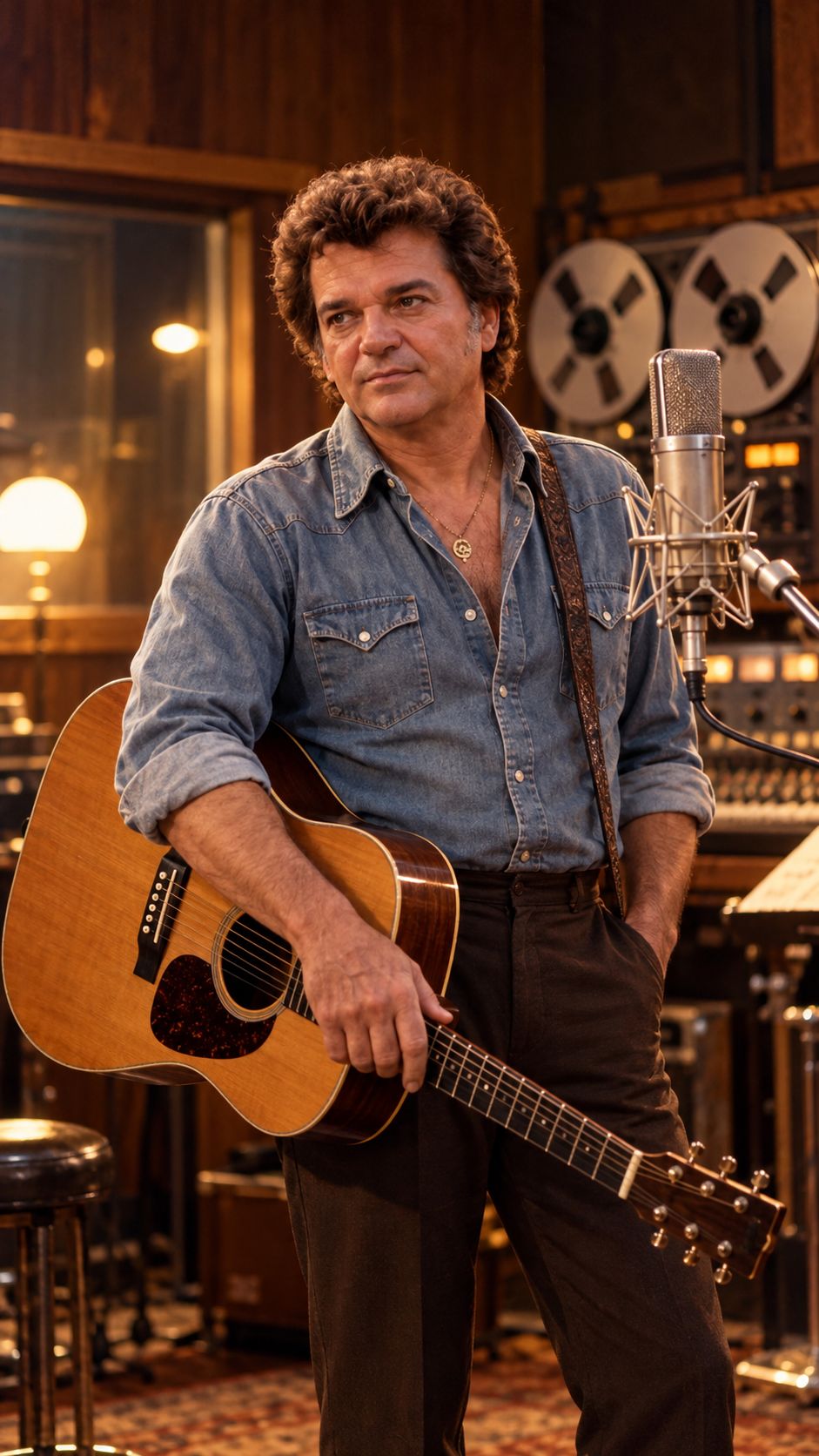
There was a time when country music could make an entire nation stop and listen—not because every song was comfortable, but because the best ones dared to say what people were thinking, feeling, and sometimes struggling to admit aloud. In 1973, Conway Twitty stood at a fascinating crossroads in American music, carrying a voice that could turn heartbreak into poetry and an ordinary melody into something unforgettable. He was more than a singer with a smooth baritone. He was an artist who understood that the most powerful songs often live somewhere between desire and regret, tradition and change, and the truth people share privately and the words they hesitate to speak in public.
The early 1970s were a transformative period for country music. Nashville was evolving, audiences were changing, and performers were discovering new ways to explore complicated relationships, personal freedom, and the emotional realities of everyday life. Against this backdrop, Conway Twitty became one of the genre’s most compelling storytellers, capable of making intimate subjects sound both deeply personal and universally recognizable.
But what happens when a song challenges the boundaries of what country music is supposed to say? Does controversy destroy its message, or does it make listeners pay closer attention?
The story behind Conway’s daring musical legacy invites us to look beyond sensational headlines and rediscover the complicated relationship between music, morality, and American culture. Because sometimes, the songs that make people uncomfortable are precisely the songs they remember longest.
THE CONTROVERSIAL HIT THAT PUSHED COUNTRY MUSIC INTO UNCOMFORTABLE TERRITORY
The song at the center of this story was “You’ve Never Been This Far Before,” released by Conway Twitty in 1973. It became one of the most talked-about recordings of his career, not because it followed every rule of traditional country music, but because it challenged the expectations surrounding romance, intimacy, and what a country singer could openly express.
The song reached No. 1 on the American country chart and remained there for three weeks. It also crossed over to the pop charts, reaching No. 22 on the Billboard Hot 100. Yet its success was accompanied by controversy: some conservative radio programmers objected to its sexually suggestive lyrics and refused to play it.
That tension between commercial success and moral discomfort made the recording particularly memorable.
America had not unanimously rejected the song. Rather, certain gatekeepers attempted to keep it off their stations while listeners continued to embrace it. And that distinction matters, because the real story is not that an entire country tried to silence one man. It is that a song could become a major hit while challenging the standards imposed by parts of the very industry that helped make it famous.
1. 1973: A CHANGING AMERICA WAS LISTENING
To understand why the song generated such a strong reaction, we must return to the cultural atmosphere of the early 1970s.
American society was undergoing profound changes. Traditional expectations surrounding marriage, relationships, personal freedom, and public morality were increasingly being questioned. Popular music was reflecting those changes, sometimes gently and sometimes with startling directness.
Country music, however, occupied a distinctive position in this cultural conversation.
Nashville had built its reputation on songs about family, faith, heartbreak, loyalty, hard work, and the consequences of human decisions. Those subjects were never as simple as they sometimes appeared. Country storytellers had long explored adultery, jealousy, loneliness, temptation, and broken promises. The difference was often in how directly those subjects were presented.
Artists such as Loretta Lynn, Merle Haggard, Tammy Wynette, and Johnny Cash had demonstrated that country music could confront uncomfortable realities without abandoning its storytelling traditions.
Conway Twitty understood this balance exceptionally well.
His songs frequently explored the emotional complications of adult relationships. He possessed a smooth, intimate baritone that could make a confession sound like a conversation between two people who had forgotten the rest of the world existed.
In 1973, that quality became particularly important.
“You’ve Never Been This Far Before” did not depend on a political speech or a public confrontation to make its impact. Instead, it placed listeners inside an intimate moment between two people, using romantic tension and suggestive language to communicate an experience that some radio programmers considered inappropriate for their audiences.
The controversy emerged from the contrast between the song’s understated musical presentation and the implications of its lyrics.
For traditionalists, that contrast could feel unsettling. For other listeners, it was precisely what made the recording compelling.
2. THE VOICE THAT MADE A WHISPER FEEL LIKE A CONFESSION


One of the most fascinating aspects of Conway Twitty’s artistry was his ability to communicate emotion without relying on exaggerated vocal theatrics.
He did not need to shout to command attention. He could lower his voice, stretch a phrase, or pause at exactly the right moment and allow the listener’s imagination to do the rest.
That technique was particularly effective in “You’ve Never Been This Far Before.”
The recording’s appeal lies in the tension between what is spoken and what is suggested. Rather than turning the subject into an explicit declaration, Twitty delivers the material with a controlled, almost conversational intimacy.
His vocal performance invites listeners to feel as though they are overhearing something private.
This is where the song’s artistic significance becomes more interesting than its reputation for controversy.
A less accomplished performer might have approached the same material as a provocation, relying on shock value to attract attention. Twitty, by contrast, brought the instincts of a seasoned storyteller. He understood that anticipation, hesitation, and emotional vulnerability could be more powerful than directness alone.
Sometimes the most daring song is not the one that says everything out loud, but the one that makes listeners recognize what has been left unsaid.
That principle helped distinguish Conway Twitty from artists whose reputations depended primarily on novelty or rebellion.
His musical identity was rooted in emotional connection. Even when his material approached subjects that made some listeners uncomfortable, his delivery remained recognizable: warm, measured, and deeply personal.
The result was a recording that challenged boundaries without abandoning the musical language that country audiences already loved.
3. WHY SOME RADIO STATIONS REFUSED TO PLAY IT
The controversy surrounding “You’ve Never Been This Far Before” was not simply a matter of individual taste. It also revealed how much influence radio programmers exercised over the public’s access to music.
In the 1970s, radio remained one of the most important ways for country artists to reach a mass audience. A station’s decision to add a single to its playlist could help propel a recording toward national recognition. A decision to exclude it could make success significantly more difficult.
For broadcasters serving conservative communities, lyrics that suggested sexual intimacy outside conventional public boundaries could present a programming dilemma.
Some programmers worried about offending listeners, alienating advertisers, or compromising their station’s image. Others believed that certain subjects simply did not belong on country radio.
The objections to Twitty’s song reflected those concerns.
But there is an important distinction between a song facing resistance from some stations and an officially prohibited recording being banned nationwide. The available historical accounts support the former description, not the idea that the entire United States collectively outlawed the song.
That distinction does not make the controversy insignificant. In some ways, it makes the story more revealing.
The song succeeded despite resistance from portions of the radio establishment. Its popularity demonstrated that the tastes of listeners could differ from the judgments of the people deciding what those listeners should hear.
And that tension has followed popular music across generations.
Artists challenge conventions. Gatekeepers decide what is acceptable. Audiences make their own judgments.
Sometimes, the audience’s response is the loudest statement of all.
4. THE UNEXPECTED PARADOX: A CONTROVERSIAL SONG BECAME A MAJOR HIT

The commercial performance of “You’ve Never Been This Far Before” is one of the strongest reasons its story deserves to be remembered.
The single reached the top of the country chart for three weeks in September 1973. It also reached No. 22 on the Billboard Hot 100, marking a significant crossover achievement for Twitty.
These accomplishments made the song far more than a fleeting controversy.
It was a genuine hit.
The recording demonstrated that audiences could respond enthusiastically to a song even when some broadcasters questioned its suitability. Its success also reinforced Twitty’s position as one of the most commercially effective country singers of his era.
He had already established himself with recordings such as “Hello Darlin’” and “She Needs Someone to Hold Her (When She Cries).” The 1973 hit expanded that reputation by showing how convincingly he could inhabit material that pushed against the genre’s public image.
The paradox was striking: the very qualities that made the song controversial also helped distinguish it from safer, more conventional releases.
Listeners were not necessarily searching for scandal. Many were responding to the recording’s emotional atmosphere, the singer’s unmistakable voice, and the sense that the song addressed a private human experience with unusual candor.
Controversy may have increased curiosity, but curiosity alone cannot explain a record’s staying power.
The song also had to connect.
And it did.
5. COUNTRY MUSIC’S MOST IMPORTANT BOUNDARIES WERE OFTEN EMOTIONAL
The story of Conway Twitty becomes even more compelling when we consider the broader tradition of country music.
Country has never been exclusively about polite subjects. Beneath its familiar melodies and recognizable instruments lies a long history of songs about difficult choices, forbidden relationships, social judgment, and the consequences of desire.
Consider Loretta Lynn’s “The Pill,” which confronted women’s reproductive freedom and challenged prevailing social expectations. Or “Rated ‘X’,” which explored the stigma faced by divorced women. Both songs demonstrated that country music could become a platform for challenging assumptions about morality and gender.
Those recordings approached their subjects differently from Twitty’s romantic ballad, but they shared an important characteristic: they placed complicated human experiences at the center of popular music.
Twitty’s contribution was subtler.
He did not need to present himself as a public crusader. His willingness to record emotionally intimate material was itself a reminder that country music could accommodate more than one definition of respectable storytelling.
The genre’s traditions were never entirely static. They evolved as artists introduced new perspectives, audiences changed, and subjects once considered too uncomfortable gradually entered mainstream conversation.
That evolution is one reason the music of the 1970s remains so fascinating.
The era contained artists who celebrated traditional values alongside performers who challenged them. Sometimes those impulses existed within the same artist, the same album, or even the same song.
Country music was not abandoning its roots. It was discovering how much those roots could accommodate.
6. CONWAY TWITTY AND THE ART OF SINGING ABOUT WHAT PEOPLE FEEL


To reduce Conway Twitty’s legacy to one controversial recording would overlook the remarkable breadth of his career.
He began his musical journey in rock and roll, achieving enormous early success with “It’s Only Make Believe” in 1958. Later, he established himself as a country music powerhouse, earning an extraordinary run of chart successes and becoming one of Nashville’s most recognizable voices.
His partnership with Loretta Lynn further strengthened his legacy. Together, they recorded memorable duets such as “After the Fire Is Gone,” “Lead Me On,” and “Louisiana Woman, Mississippi Man.” Their musical chemistry helped define a celebrated chapter in country duet history.
Across these different phases of his career, one quality remained consistent: Twitty knew how to make a song feel personal.
He could sing about separation without sounding distant, longing without sounding theatrical, and romantic uncertainty without making it seem abstract.
That emotional directness helps explain why listeners continue to revisit his recordings.
People rarely return to old songs simply because a controversy once surrounded them. They return because the music still gives them something they recognize in themselves.
A melody brings back a particular summer. A familiar voice recalls someone they loved. A lyric suddenly means something different after years of experience.
In that sense, “You’ve Never Been This Far Before” became part of a larger story about the power of country music to bring private emotions into public life.
The song challenged certain boundaries, but it also revealed something fundamental about Twitty’s artistry: he could make an intimate story feel universal.
7. WHY THE SONG STILL MATTERS DECADES LATER
More than half a century after its release, “You’ve Never Been This Far Before” remains a revealing example of the complicated relationship between music and cultural expectations.
Today’s listeners encounter the song in a different environment. Music is widely accessible, and audiences can discover recordings without depending on a single radio programmer’s approval.
That difference makes the resistance the song encountered particularly interesting.
In 1973, a station’s refusal to play a record could meaningfully limit its exposure. Today, the same controversy might unfold across social media, where criticism, curiosity, and enthusiastic recommendations can spread simultaneously.
Yet the underlying question has not disappeared.
Who decides what is appropriate for public consumption? Should artists avoid difficult subjects to preserve tradition? Or should they be allowed to explore the full range of human experience, even when their work makes some people uncomfortable?
There are no simple answers, and country music has never offered only one.
The enduring appeal of Conway Twitty suggests that audiences often appreciate honesty when it is delivered with artistry and emotional conviction. A song can challenge conventional expectations without losing its connection to the people who hear it.
That is the distinction between a recording that briefly attracts attention and one that becomes part of a lasting musical legacy.
The first depends on the moment.
The second survives it.
8. THE LEGACY OF A SONG THAT REFUSED TO DISAPPEAR
Perhaps the most remarkable part of this story is not the controversy itself, but what happened alongside it.
“You’ve Never Been This Far Before” became a major country hit. It reached listeners beyond the genre’s traditional boundaries, demonstrated the commercial potential of more provocative romantic storytelling, and reinforced Conway Twitty’s reputation as a performer who understood the emotional power of restraint.
It did not need every radio station’s approval to succeed.
Nor did it need to become a universal anthem of rebellion.
Its significance rests in something more specific: it showed that country music could make room for a song that some gatekeepers considered too daring while audiences continued to find meaning in it.
That is a valuable reminder about the genre’s history.
Country music has always belonged to the people who listen to it as much as to the artists who create it. Its traditions are carried forward through memory, family, heartbreak, celebration, and the songs people choose to keep.
Some recordings are remembered because they won awards. Others survive because they tell a story that never quite loses its relevance.
Conway Twitty’s 1973 hit managed to do both something commercially remarkable and something culturally revealing.
The controversy may have helped shape its reputation, but the music gave that reputation a reason to endure.
And perhaps that is the most fitting legacy of all.
A song does not have to please everyone to matter. Sometimes, it only has to be honest enough to make people stop, listen, and decide for themselves.
THE QUESTION THAT STILL DIVIDES COUNTRY MUSIC FANS
Think back to the country songs you heard growing up—the records playing in the family car, the voices drifting from an old radio, and the melodies that seemed to understand feelings you could not yet put into words.
For many fans, the golden years of country music were special precisely because artists were willing to take emotional risks. They sang about imperfect people, complicated relationships, and subjects that did not always fit neatly into society’s expectations.
Conway Twitty understood that tradition. His controversial 1973 hit remains a reminder that the history of country music is not just a story of melodies and chart positions. It is also a story of changing attitudes, artistic courage, and listeners who decide for themselves which songs deserve to be remembered.
So let us settle one question among country music fans:
Do you remember when country music wasn’t afraid to take risks?
And what do you think today—should artists continue pushing boundaries, even when their songs make people uncomfortable?
If you remember Conway Twitty, or if you believe classic country music had a special kind of honesty, share your thoughts. The conversation about what makes a country song timeless is one worth keeping alive
VIDEO: