 By admin
INTRODUCTION:
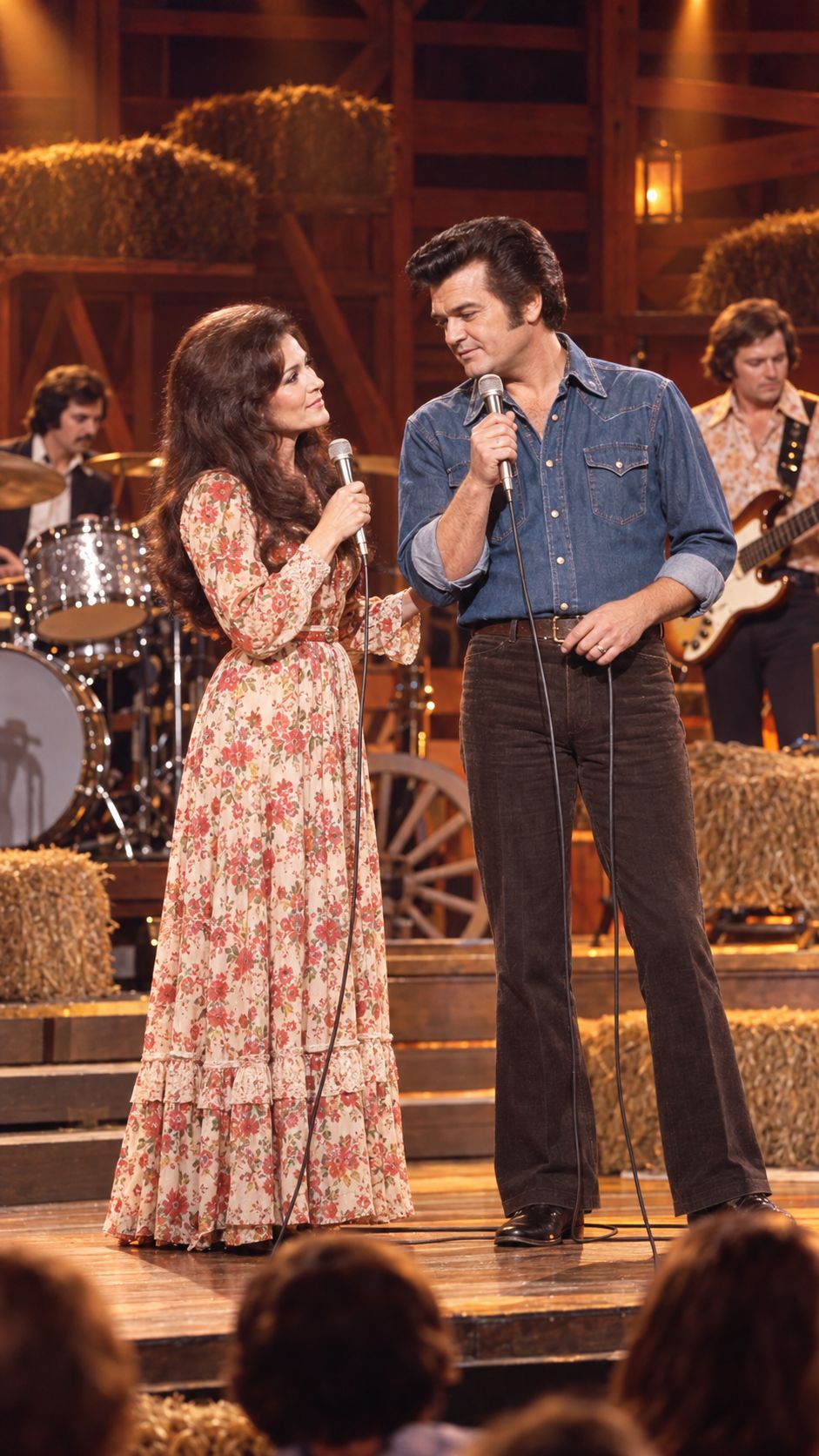
Some country songs tell a story. Others make you feel as though you have accidentally overheard a private conversation that was never meant for the world to hear. And then there are songs like “As Soon as I Hang Up the Phone,” the unforgettable recording by Conway Twitty and Loretta Lynn, which transformed an ordinary telephone call into one of the most emotionally powerful moments in classic country music.
Released in 1974, the song demonstrated something extraordinary about these two country legends: they did not need elaborate production, dramatic orchestration, or complicated storytelling to capture the human heart. They needed only two distinctive voices, a telephone conversation, and the courage to let heartbreak unfold in real time.
What followed was more than another successful duet. It was a masterclass in vocal chemistry, dramatic timing, and the emotional storytelling that helped define an era of country music.
But what made this recording so unforgettable? Why does the song continue to resonate with listeners who remember the golden age of country music, as well as younger fans discovering its emotional power for the first time?
The answer lies in the remarkable way Conway and Loretta turned a familiar human experience into something that felt almost unbearably personal.
THE BRILLIANT IDEA: MAKING THE LISTENER FEEL LIKE A WITNESS
Country music has always understood the emotional importance of everyday moments. A lonely highway, an empty kitchen, a wedding ring, or a voice coming through a telephone can carry the weight of an entire relationship.
In “As Soon as I Hang Up the Phone,” the telephone becomes much more than a prop. It becomes the center of an emotional world in which words can be spoken, but the truth behind them is much harder to escape.
Think about the vulnerability of a telephone conversation. You cannot see the other person’s complete expression. You cannot read every movement of their hands or every change in their eyes. You have only their voice, their pauses, their choice of words, and the silence that follows.
That limitation is precisely what makes the song so effective.
The listener is drawn into a conversation where affection, uncertainty, and emotional distance seem to occupy the same space. Every exchange feels consequential because the characters are not simply singing about a relationship. They are attempting to communicate within it.
And that distinction changes everything.
“Sometimes the most heartbreaking conversations are the ones in which people say everything except what they truly mean.”
That is the emotional territory this recording explores so convincingly. It allows listeners to recognize the familiar tension between wanting to hold on and sensing that something precious may already be slipping away.
The song’s genius is not that it invents an unfamiliar kind of pain. It takes a familiar kind of pain and presents it with such intimacy that the listener begins remembering personal moments of their own.
CONWAY TWITTY: THE VOICE THAT COULD MAKE SILENCE FEEL HEAVY
By the time this duet appeared, Conway Twitty had established himself as one of country music’s most recognizable interpreters of romantic longing.
His voice possessed a special quality. It could sound confident without becoming cold, tender without becoming weak, and restrained without losing emotional intensity.
Conway understood that a powerful performance did not always require a powerful vocal display.
Sometimes the most effective choice was to soften a phrase. Sometimes it was to allow a line to unfold naturally, almost as though he were speaking to one person rather than performing for an audience of thousands.
That approach was particularly valuable in a song built around a telephone conversation.
A singer who pushed every phrase toward maximum drama might have made the performance feel theatrical. Conway’s strength was his ability to let emotion emerge gradually, giving the listener room to sense what was happening beneath the words.
His delivery also carried the unmistakable warmth that made his romantic recordings so enduring. Even when a situation became painful, his voice could preserve a sense of closeness.
That closeness is important because heartbreak is rarely a simple matter of loving someone or no longer loving them. Often, the most difficult relationships are those in which affection remains, but something else has changed.
Conway could communicate that contradiction with remarkable economy.
He did not need to explain every feeling. His phrasing could suggest the uncertainty, hesitation, and emotional weight that the words alone might not fully express.
This was one of the qualities that made him such a compelling duet partner for Loretta Lynn.
LORETTA LYNN: THE EMOTIONAL HONESTY THAT MADE EVERY WORD MATTER
If Conway brought warmth and romantic restraint, Loretta Lynn brought a different kind of emotional authority.
Loretta had built her career on songs that treated women’s experiences as worthy of direct, honest attention. She could sing about love, betrayal, family, independence, and disappointment without making those experiences seem distant or abstract.
Her voice carried character. There was a natural conversational quality to her delivery, but there was also strength beneath its plainspoken surface.
She could sound vulnerable without surrendering her dignity.
That combination was essential to the success of “As Soon as I Hang Up the Phone.”
The song depends on the impression that a real person is speaking through a moment of emotional uncertainty. The performance must feel immediate enough to draw the listener in, yet controlled enough to remain musically compelling.
Loretta was exceptionally well suited to that balance.
Her phrasing could make a line sound like an admission rather than a rehearsed lyric. The listener could imagine the thought forming as the words were spoken, creating the sensation of overhearing something deeply personal.
This was not simply a matter of singing beautifully. It was a matter of making the performance believable.
“The strongest country performances do not ask you to admire the singer’s pain. They make you recognize the pain because you have felt something like it yourself.”
Loretta’s greatest contribution to this kind of storytelling was her ability to make emotional honesty sound natural.
She did not have to abandon her strength to express vulnerability. Instead, the vulnerability became more convincing because the strength was still there.
And beside Conway, that quality gave the song its emotional balance.
WHY THEIR VOCAL CHEMISTRY WAS SO DIFFICULT TO REPLICATE
The partnership between Conway Twitty and Loretta Lynn became one of the defining collaborations in classic country music for a reason.
Their voices were different enough to create contrast, yet compatible enough to make their recordings feel unified.
Conway’s smooth, intimate delivery complemented Loretta’s direct, expressive style. He could bring a sense of calm to an emotionally complicated moment, while she could introduce a sharper edge of feeling that prevented the performance from becoming too comfortable.
Neither voice needed to overpower the other.
That is a crucial element of successful duet singing. Two talented performers can sing the same song and still fail to create a believable relationship. If both singers constantly reach for the spotlight, the emotional story becomes secondary to the performance itself.
Conway and Loretta understood the importance of serving the song.
Their contrasting vocal personalities created the impression of two individuals approaching the same situation from different emotional positions. The listener could hear the relationship through the contrast itself.
This is what made their duets feel like conversations rather than two solo performances placed next to each other.
In “As Soon as I Hang Up the Phone,” that conversational quality becomes the central attraction. The recording invites the audience to pay attention to the emotional movement between the voices, not simply to the beauty of either voice in isolation.
The result is a performance that feels intimate even when heard through speakers, a car radio, or headphones decades after its original release.
And that intimacy is difficult to manufacture.
It comes from timing, restraint, contrast, and the ability to make another singer’s contribution feel essential to the story.
THE ART OF EMOTIONAL TIMING: WHY THE SONG NEVER FEELS LIKE AN ORDINARY DUET
One of the most important ingredients in the song’s effectiveness is its dramatic structure.
Traditional country duets often allow two singers to exchange verses before joining together in a chorus. The appeal comes from the harmony, the contrast between the voices, and the satisfying sense of musical unity.
This recording works with a different kind of tension.
Its telephone-conversation format places the listener inside a developing situation. Instead of experiencing the song only as a sequence of verses and choruses, the audience follows an exchange that carries its own emotional momentum.
Every response matters because it follows another person’s words.
Every shift in tone can change how the previous line is understood.
And every moment of apparent reassurance can make the underlying uncertainty more painful.
This is the difference between a song that describes an emotion and a song that dramatizes one.
The arrangement and vocal delivery support the sense of unfolding action. The listener is encouraged to follow the conversation as it develops, rather than simply waiting for the next musical highlight.
That approach gives the recording a theatrical quality without stripping away its country roots.
The story remains grounded in recognizable human behavior: people trying to explain themselves, people struggling to understand one another, and people searching for reassurance when reassurance may no longer be enough.
“A heartbreaking song does not always need a dramatic ending. Sometimes the tension comes from knowing that one conversation cannot repair everything that has gone wrong.”
That is why the song remains so compelling. Its emotional impact comes from the tension between what is being said and what the listener senses beneath the surface.
1974: A MOMENT WHEN COUNTRY MUSIC MADE ROOM FOR REAL HUMAN DRAMA
The early 1970s were an important period for country music. Traditional sounds remained powerful, but artists and songwriters were also finding new ways to bring personal storytelling into the recording studio.
The genre’s enduring strength was its ability to make intimate experiences feel universal.
A listener did not have to be a famous musician, live in Nashville, or understand the business of country music to recognize the emotions in a song about a complicated relationship.
That accessibility helped make Conway and Loretta such an effective pairing.
Their performances did not depend on glamour or elaborate mythology. Their appeal came from the suggestion that the people in their songs were dealing with the same questions ordinary people faced at home.
What happens when love becomes complicated?
What do you say when the truth is difficult to express?
How do you continue a conversation when neither person knows exactly what the other needs to hear?
These questions have no expiration date.
In 1974, “As Soon as I Hang Up the Phone” offered country audiences a distinctive way to experience those questions through music. Its success helped demonstrate that a duet could be built around dramatic storytelling as effectively as around vocal harmony.
The recording reached No. 1 on Billboard’s Hot Country Singles chart, becoming another major achievement for the celebrated Conway Twitty and Loretta Lynn partnership.
Its chart success mattered, but its larger significance lies in what it revealed about the genre.
Country music did not need to make human relationships simple in order to make them entertaining. It could embrace uncertainty, conflicting feelings, and emotional vulnerability while remaining accessible to a broad audience.
That willingness to tell complicated stories is one reason classic country recordings continue to find new listeners.
BEHIND THE HEARTBREAK: WHY THE TELEPHONE STILL FEELS SO PERSONAL
For listeners who remember the 1970s, the telephone may carry memories of its own.
Before instant messaging and video calls, a telephone conversation often required patience. You waited for someone to answer. You listened for familiar sounds. You wondered whether the person on the other end was telling you everything.
A ringing telephone could bring excitement, relief, fear, or disappointment.
And once a difficult conversation began, there was something uniquely painful about the possibility of ending it without finding the words that might have changed everything.
That cultural context adds another layer to the song’s emotional appeal.
Yet its central idea remains just as recognizable today.
A modern listener may communicate through text messages or video calls, but the fundamental problem is unchanged. Technology can connect two people without resolving the distance between them.
A conversation can continue while understanding disappears.
Words can be exchanged without either person feeling truly heard.
And sometimes, the end of a call becomes a symbol of everything that remains unsaid.
The song’s telephone is therefore more than a period detail. It represents the fragile space between two people attempting to communicate across emotional uncertainty.
That is why the recording can still feel personal to listeners who were not even born when it first appeared.
The technology has changed. The emotions have not.
WHY CONWAY AND LORETTA’S PARTNERSHIP BECAME PART OF COUNTRY MUSIC HISTORY
The legacy of Conway Twitty and Loretta Lynn cannot be reduced to a single song. Their collaboration produced a remarkable series of successful recordings, including “After the Fire Is Gone,” “Lead Me On,” and “Louisiana Woman, Mississippi Man.”
Each revealed a different aspect of their partnership.
Some emphasized romantic tension. Others highlighted playful exchanges, contrasting personalities, or the pleasure of hearing two distinctive voices meet in harmony.
Together, these recordings created a body of work that helped define what a great country duet could accomplish.
Their success was not simply a result of putting two famous singers in the same studio.
It depended on the relationship between their voices and the way each performer responded to the material. Their differences became strengths because the songs gave those differences a purpose.
Conway could suggest tenderness without losing his characteristic composure. Loretta could express vulnerability without sacrificing her directness. Together, they could create the impression of a relationship that existed beyond the boundaries of the recording.
That is a rare achievement.
The most memorable duets do not merely combine two voices. They create a third element: the relationship that emerges when those voices interact.
In “As Soon as I Hang Up the Phone,” that relationship becomes the story itself.
The listener is not simply hearing Conway and Loretta sing. The listener is following two emotional perspectives as they move through a difficult exchange.
This is the kind of musical storytelling that can survive changing trends because its foundation is human rather than fashionable.
THE SECRET TO ITS LASTING POWER: IT SOUNDS LIKE SOMETHING THAT COULD HAPPEN TO ANYONE
There is a temptation to assume that a classic recording remains popular because of nostalgia alone.
Nostalgia certainly plays a role. A familiar melody can bring back memories of parents, grandparents, childhood road trips, old radios, and evenings when country music seemed to fill every corner of the house.
But nostalgia cannot fully explain why certain recordings continue to affect people who have no personal memories of their original release.
Something more fundamental is at work.
“As Soon as I Hang Up the Phone” takes a small, recognizable human situation and gives it emotional depth. It does not require an elaborate fictional universe or an extraordinary event. It asks the listener to pay attention to the feelings that can exist inside a single conversation.
That is an especially powerful approach because listeners bring their own experiences to the music.
One person may remember a relationship that slowly fell apart. Another may think about a difficult goodbye. Someone else may remember a phone call that offered hope when life felt uncertain.
The song does not need to tell every listener exactly what to remember.
It creates the space in which those memories can surface.
“The songs we carry for a lifetime are often the ones that give a melody to feelings we never quite knew how to explain.”
This is one of the greatest gifts of classic country music. It can turn a private feeling into a shared experience without making that feeling any less personal.
Conway and Loretta understood how to create that connection. Their voices invite listeners into the story, but the emotional meaning ultimately belongs to the people listening.
THE FINAL VERDICT: A COUNTRY CLASSIC THAT UNDERSTOOD THE POWER OF TWO VOICES
More than five decades after its release, “As Soon as I Hang Up the Phone” remains an outstanding example of how country music can transform an ordinary situation into compelling emotional drama.
Its achievement rests on several elements working together: a memorable premise, conversational storytelling, careful dramatic pacing, and the contrasting vocal strengths of Conway Twitty and Loretta Lynn.
Conway brought the warmth and restraint that made the exchange feel intimate. Loretta brought the expressive honesty that made the emotional stakes believable. Their partnership allowed the song to unfold like a private moment rather than a conventional duet.
That combination is what gives the recording its lasting character.
It reminds us that heartbreak does not always arrive with shouting, slammed doors, or dramatic declarations. Sometimes it begins with a familiar voice, a difficult question, and the hope that a conversation might somehow make things right.
And sometimes, even when the conversation ends, the feelings remain.
Perhaps that is why this song continues to matter. It captures the uncomfortable truth that communication and understanding are not always the same thing. Two people can hear each other perfectly and still struggle to reach the emotional place they both need.
In the hands of Conway Twitty and Loretta Lynn, that simple idea became something unforgettable.
Their voices did more than tell a story. They made listeners feel the fragile distance between love and loss, between reassurance and uncertainty, and between the words people say and the feelings they cannot fully express.
That is the hidden art of their partnership.
And that is why “As Soon as I Hang Up the Phone” deserves its place among the memorable achievements of classic country music.
WHAT DO YOU THINK?
Was “As Soon as I Hang Up the Phone” one of the most emotionally powerful duets Conway Twitty and Loretta Lynn ever recorded, or do you believe “After the Fire Is Gone” or “Lead Me On” deserves that honor?
Share your favorite Conway and Loretta duet in the comments. If their music has ever reminded you of someone you loved, a memory you still carry, or a moment you will never forget, tell us why.
Because the greatest country songs do something remarkable: they remind us that even when time moves forward, some feelings never really leave us.
VIDEO: