 By admin
 Watch the video at the end of this article.

Introduction
The Bee Gees: A Legacy of Brilliance, Backlash, Triumph, and Tragedy
A sweeping look at the extraordinary lives of Barry, Robin, Maurice, and Andy Gibb
Few music stories rise and fall with the force, intensity, and emotional weight of the Bee Gees’ saga. Their journey—spanning global superstardom, public backlash, reinvention, loss, and resilience—is one of those rare odysseys that feels almost unbelievable until you hear it in full. Across five decades, the four Gibb brothers—Barry, Robin, Maurice, and the youngest, Andy—experienced heights matched by few artists and heartbreaks endured by even fewer. Their tale is a living testament to talent, family, and the unbreakable human spirit.
4. Barry Gibb: The Visionary Who Carried the Torch

As the eldest brother, Barry Gibb became the Bee Gees’ creative anchor. At the height of disco mania during Saturday Night Fever in 1977, his unmistakable falsetto became synonymous with the Bee Gees’ sound. But when the disco craze collapsed just as rapidly as it had exploded, the Bee Gees found themselves on the wrong side of pop culture. By the early 1980s, American radio programmers wouldn’t even give their new music a chance.
The fall was steep—from global number ones to almost total radio silence.
Yet Barry refused to let the group fade into obscurity. Instead, he adapted. Reinventing himself behind the scenes, he wrote and produced major hits for other artists, proving the Bee Gees’ musical genius extended far beyond disco.
He co-wrote and produced Barbra Streisand’s 1980 Guilty album, including the number one single “Woman in Love.” He penned Dionne Warwick’s hit “Heartbreaker,” a global top-ten success. In 1983, he produced Dolly Parton and Kenny Rogers’ country-pop classic “Islands in the Stream,” another chart-topper. And he helped craft “Chain Reaction” for Diana Ross, giving her a UK number one in 1985.
Even without performing, Barry kept the Bee Gees at the forefront of global pop.
By 1987, perseverance paid off. “You Win Again” reached number one in the UK, making the Bee Gees the first group to score number-one hits in three different decades—the 60s, 70s, and 80s. They continued recording and touring through the 1990s, culminating in their 1997 induction into the Rock and Roll Hall of Fame.
But tragedy struck in 1988 when their youngest brother, Andy, died at only 30. The brothers honored him with the tribute “Wish You Were Here” on their 1989 album One. Another devastating blow followed in 2003 when Maurice died unexpectedly at 53. Barry and Robin retired the group name, knowing the Bee Gees could only ever exist as the three brothers together.
Barry carried on with remarkable strength, accepting the Grammy Legend Award with Robin in 2003. They reunited for select performances until Robin’s passing in 2012. Barry, now the last surviving Gibb brother, has continued to write, record, and honor his family’s legacy. He released a solo album in 2016 and earned a country-tinged hit in 2021 through modern collaborations.
In 2018, Queen Elizabeth II knighted him, making him Sir Barry Gibb for his services to music and charity.
Today, well into his late 70s, his voice may have softened, but his passion remains undimmed. As the final torchbearer of the Bee Gees’ legacy, Barry continues to represent the strength, artistry, and resilience that defined the Gibb family.
3. Robin Gibb: The Haunting Voice and Quiet Fighter

Robin Gibb—Barry’s fraternal twin, born 35 minutes apart from Maurice—brought a distinctive vibrato that became one of the Bee Gees’ defining elements. His career included major solo success in the 1980s, particularly with the synth-pop hit “Juliet,” and he often served as lead vocalist on some of the group’s most emotional classics.
Like his brothers, Robin faced the challenges of the early 1980s disco backlash. With mainstream radio turning away, he redirected his creative energy into solo projects and charitable work. Between 2008 and 2011, he served as president of the Heritage Foundation and dedicated himself to establishing the Bomber Command Memorial in London—one of his proudest accomplishments.
But personal tragedy followed him throughout his life. Andy’s death in 1988 deeply affected him. The sudden loss of his twin Maurice in 2003 was, by Robin’s own admission, the greatest pain he had ever known.
Still, he kept creating. In 2012, he completed the classical project Titanic Requiem with his son RJ, even as his health deteriorated. Robin battled colorectal cancer beginning in 2011, undergoing surgeries and treatments while maintaining a hopeful public presence. In early 2012, after slipping into a coma due to pneumonia, he shocked doctors by waking up—one final display of the perseverance that had defined him.
Robin Gibb passed away on May 20, 2012, at age 62. His funeral brought together family, friends, and luminaries to honor his gentle spirit and unforgettable voice. A 2014 posthumous album, 50 St. Catherine’s Drive, offered fans one last opportunity to hear him—its title a tender nod to the Gibb family’s childhood home.
2. Maurice Gibb: The Heart and Soul of the Bee Gees
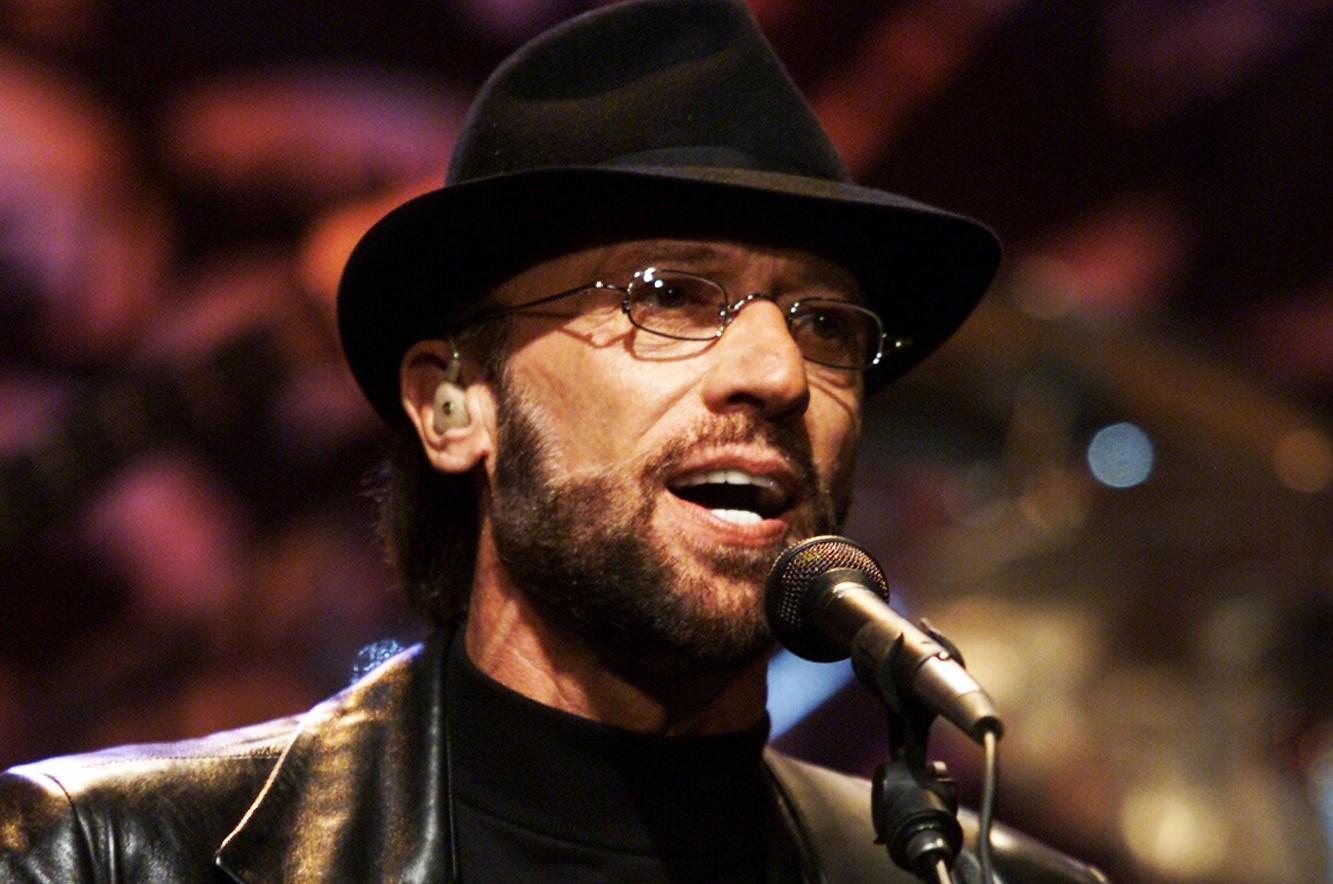
Often called the “quiet Gibb,” Maurice was the emotional center of the Bee Gees. A multi-instrumentalist who played bass, guitar, keyboards, and more, he kept the group musically tight and emotionally grounded. His humor, optimism, and diplomacy held Barry and Robin together through decades of creative tension.
But fame brought private battles. Under the pressure of global superstardom in the late 1970s, Maurice developed a drinking problem that worsened through the early 1980s. With support, he sought treatment, joined Alcoholics Anonymous, and achieved lasting sobriety in the 1990s—marking a personal turning point.
Free from addiction, Maurice blossomed. Fans remember his energy on stage, his joking introductions, and his infectious “Boogie!” shouts during live performances of “Night Fever.” He relished his roles as husband, father, musician, painter, and family peacemaker.
Everything changed in January 2003. Maurice was hospitalized with severe stomach pain caused by a twisted section of his intestine. Before doctors could successfully treat him, he went into cardiac arrest and died at age 53. The suddenness of his death stunned the world.
The Bee Gees ended that day. Barry and Robin retired the name, knowing Maurice’s warmth and harmonies were irreplaceable.
His legacy endures through his children—especially his daughter Samantha, who continues making music—and through every Bee Gees song where his harmonies add depth and magic. Maurice may not have craved the spotlight, but the Bee Gees would never have soared so high without him.
1. Andy Gibb: The Meteoric Rise and Devastating Fall

Andy Gibb, the youngest of the brothers, never officially joined the Bee Gees during his lifetime, yet his story remains one of the most emotionally powerful pieces of their family history.
At just 19, Andy became a global teen idol. Between 1977 and 1978, he achieved a stunning record: his first three singles all reached number one on the Billboard Hot 100:
-
“I Just Want to Be Your Everything” (1977)
-
“Love Is Thicker Than Water” (1977)
-
“Shadow Dancing” (1978)
He became the first solo artist ever to accomplish such a feat.
But behind the meteoric success lay immense personal struggles. Andy succumbed to cocaine addiction early in his 20s, and the pressures of show business overwhelmed him. By the early 1980s, both changing musical trends and his addiction derailed his career. He lost high-profile jobs, missed performances, and saw his relationship with actress Victoria Principal collapse.
By 1987, he was bankrupt.
But early 1988 brought hope. Andy was sober, excited about new music, and—most symbolically—was set to join Barry, Robin, and Maurice as the fourth Bee Gee for the first time. The brothers were thrilled at the prospect.
The new beginning never came. Days after his 30th birthday, Andy fell ill with chest pains and was rushed to the hospital in Oxford. On March 10, 1988, he died of myocarditis—an inflammation of the heart muscle likely worsened by years of drug use. Though the immediate cause wasn’t an overdose, the damage had been done.
Andy’s death shattered the Gibb family. Fans worldwide mourned the loss of the boyish, golden-voiced star who seemed destined for greatness.
The Legacy That Remains
The Bee Gees’ story is one of unparalleled musical achievement, but also one of resilience, brotherhood, and heartbreaking loss. Barry Gibb now stands as the last surviving brother—a living archive of their triumphs and tragedies. Through every performance, every tribute, and every new piece of music, he keeps alive the harmonies that once moved the world.
The story of the Gibb brothers is not just one of fame, but of humanity: extraordinary talent, family devotion, and courage in the face of overwhelming pain. Their music endures, their influence remains vast, and their legacy continues to shine—beautiful, fragile, and unforgettable.