 By admin
 INTRODUCTION: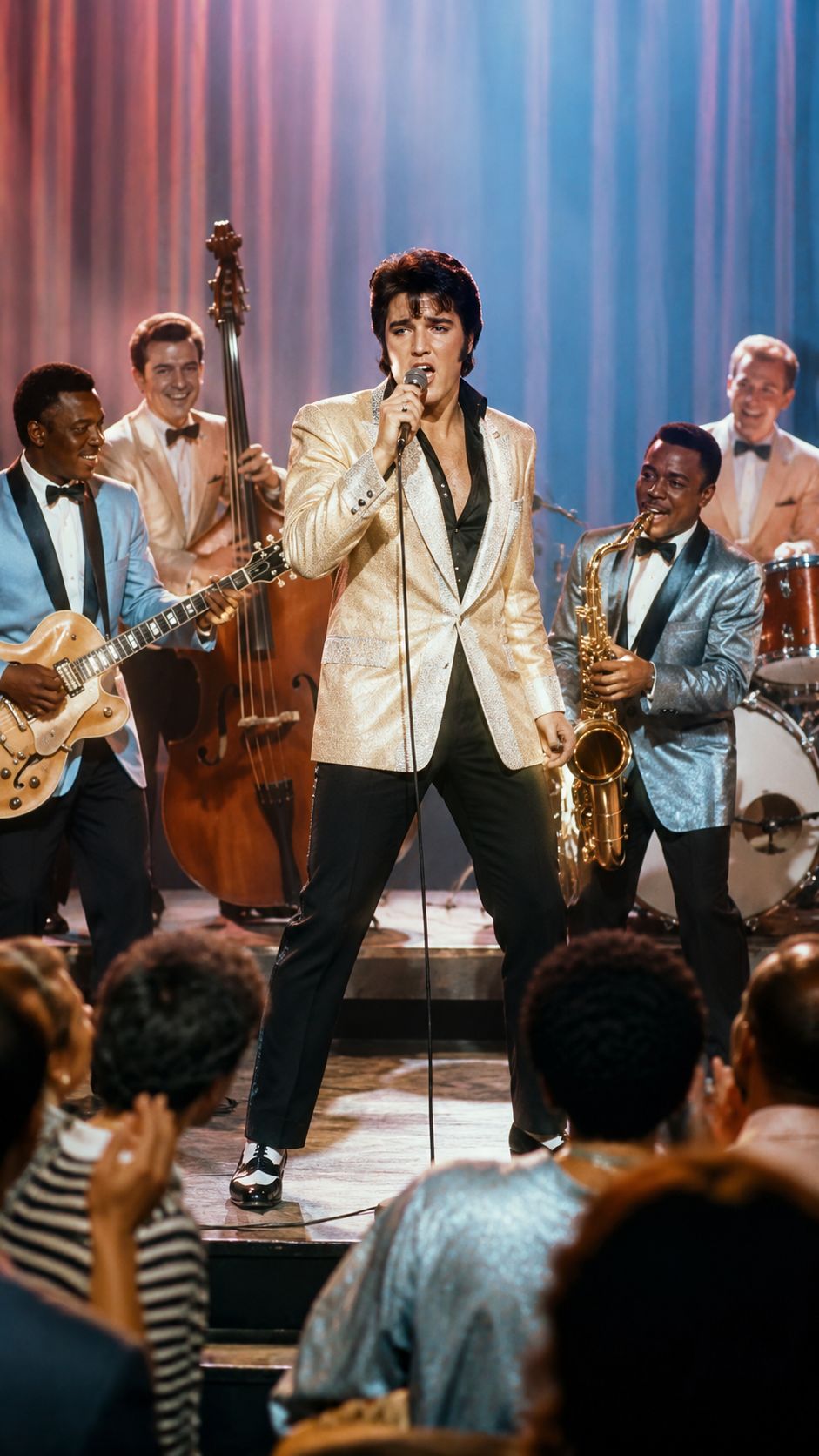
Few figures in American music history have inspired as much admiration, controversy, and cultural debate as Elvis Presley. To some, he was the undisputed King of Rock and Roll. To others, he represented a complicated chapter in the story of race, culture, and artistic influence in the United States. Yet beyond the headlines and arguments lies a deeper truth: Elvis Presley emerged at a moment when America was sharply divided, and his music became one of the most powerful bridges ever built between Black and White musical traditions.
Born in the segregated South, Elvis Presley grew up surrounded by sounds that crossed invisible racial boundaries. He listened to Gospel, absorbed the emotional power of Blues, felt the rhythm of Rhythm and Blues, and embraced the storytelling traditions of Country Music. These influences would eventually collide inside one extraordinary performer whose voice carried echoes of multiple musical worlds.
What made Elvis Presley revolutionary was not merely his success. It was his ability to introduce millions of White listeners to sounds rooted in Black America while simultaneously helping transform popular music into something entirely new. His rise reflected both the beauty and complexity of cultural exchange in a nation struggling with racial divisions.
The story of Elvis Presley is ultimately the story of music proving stronger than barriers society tried to enforce.
The Musical Landscape Before Elvis
To understand the impact of Elvis Presley, it is essential to understand America during the 1940s and early 1950s. The country remained deeply segregated. Radio stations often catered to separate audiences. Record labels marketed music according to race. Black artists dominated genres such as Blues, Rhythm and Blues, and many forms of Gospel, while White audiences largely consumed Country Music, pop standards, and traditional folk sounds.
Despite this separation, musical influences constantly flowed across racial lines. Black musicians inspired White performers, and White musicians borrowed from Black traditions. However, mainstream America often failed to recognize these connections.
The seeds of Rock and Roll were already being planted by pioneering Black artists such as Chuck Berry, Little Richard, Fats Domino, and Big Mama Thornton. Their recordings carried infectious rhythms, emotional intensity, and a rebellious spirit that would eventually reshape popular culture.
Yet much of White America remained disconnected from these artists.
That would soon change.
Elvis’s Musical Education in Memphis
Growing up in Memphis, Elvis Presley was exposed to a rich musical environment unlike almost anywhere else in America.
He attended church services filled with passionate Gospel singing. He listened to Black musicians on local radio stations. He spent time on Beale Street, where the sounds of Blues and Rhythm and Blues filled the air. At the same time, he remained deeply connected to the traditions of Country Music that shaped Southern White culture.
This unique upbringing allowed Elvis Presley to hear music not as separate racial categories but as interconnected forms of expression.
Years later, he openly acknowledged his influences.
“The music I’ve always liked is both Black and White.”
That simple statement captured the essence of his artistic identity.
Rather than choosing one tradition over another, Elvis Presley absorbed them all.
The Sun Records Revolution
The turning point came when Elvis Presley entered the legendary Sun Records studio under producer Sam Phillips.
Phillips famously believed that if he could find a White performer who captured the emotional power and rhythmic energy of Black music, he could transform the industry.
In 1954, that possibility became reality with That’s All Right.
Originally recorded by Arthur Crudup, a Black Blues artist, the song sounded radically different in Elvis Presley’s hands. His version blended Blues, Country Music, and youthful energy into a sound that seemed entirely fresh.
The record shocked listeners.
White audiences heard something unlike traditional country music.
Black audiences recognized familiar rhythms and emotions.
A new musical language had arrived.
The Birth of Rock and Roll’s Biggest Cultural Connector
As Elvis Presley exploded into national fame, his recordings introduced millions of listeners to musical styles they might never have encountered otherwise.
Songs such as Hound Dog, Heartbreak Hotel, Mystery Train, and Jailhouse Rock carried strong influences from Blues, Rhythm and Blues, and Gospel traditions.
Many White teenagers who became obsessed with Elvis Presley soon began exploring the music that inspired him. This curiosity opened doors to Black artists whose work had previously been marginalized by mainstream media.
The result was a subtle but significant cultural shift.
Music became a meeting place.
Young listeners increasingly cared less about racial categories and more about emotional connection.
For many teenagers of the 1950s, the voice of Elvis Presley became the first sound that challenged the invisible walls separating Black and White America.
This transformation did not solve racial inequality. It did not erase segregation.
But it created conversations that previously seemed impossible.
The Controversy That Still Exists Today
No discussion of Elvis Presley is complete without acknowledging controversy.
Critics have long argued that he benefited from a music industry that often rewarded White performers more generously than Black innovators. Many Black artists who helped create the foundation of Rock and Roll never achieved the same level of commercial success.
These concerns are legitimate and remain an important part of the historical conversation.
Yet many musicians who knew the industry firsthand offered a more nuanced perspective.
Elvis Presley consistently praised Black artists and openly discussed their influence on his work. He never claimed to invent Rock and Roll. Instead, he frequently pointed to the musicians who inspired him.
His role was not that of a creator working in isolation.
He was a translator between worlds.
He became a cultural conduit through which sounds rooted in Black musical traditions reached enormous new audiences.
The distinction matters.
Gospel: The Hidden Connection
One of the most overlooked aspects of Elvis Presley’s career is his deep love for Gospel Music.
Throughout his life, he often described gospel recordings as his favorite music. Albums such as His Hand in Mine revealed a side of his artistry that transcended commercial success.
Gospel itself had long served as a musical bridge between Black and White communities. Both traditions shared spiritual themes, emotional expression, and powerful vocal techniques.
When Elvis Presley performed gospel songs, listeners heard influences that connected directly back to Black church traditions as well as Southern White congregational music.
This shared spiritual foundation became another pathway through which music crossed racial boundaries.
A Legacy Bigger Than One Artist
Today, modern music exists in a world where genre boundaries feel increasingly irrelevant. Artists routinely blend Country Music, Hip-Hop, Blues, Rock, Pop, and Gospel influences.
That creative freedom owes much to pioneers who challenged rigid categories.
Elvis Presley was one of the most visible and influential figures in that transformation.
His success demonstrated that audiences could embrace music born from multiple traditions. His recordings helped expose mainstream America to sounds it had previously ignored. His career highlighted both the possibilities and complications of cultural exchange.
Most importantly, he showed that music possesses a unique power to connect people who might otherwise remain separated by fear, prejudice, or misunderstanding.
Long before politicians found common ground, musicians were already building bridges through rhythm, melody, and emotion.
That may be the most enduring lesson of Elvis Presley’s legacy.
His greatest achievement was not simply becoming the King of Rock and Roll. It was helping reveal that America’s musical heartbeat had always been shared. The sounds of Black and White traditions were never truly separate. Through his voice, millions finally heard how deeply connected they had always been.