 By admin
INTRODUCTION:
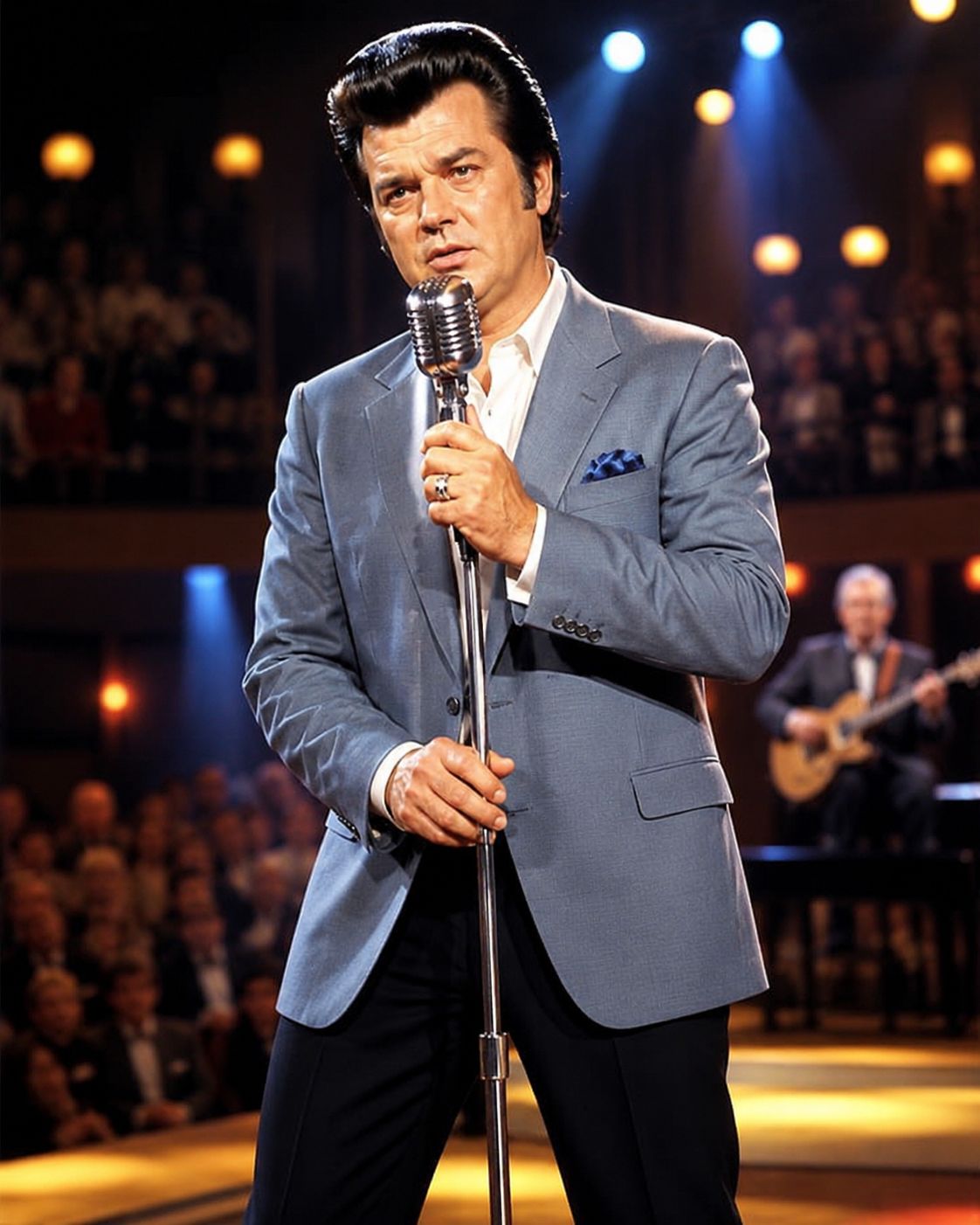
There are voices that become famous, voices that define an era, and then there are voices that seem to belong to every generation. Conway Twitty possessed one of those rare voices. Whether he was singing about the ache of lost love, the excitement of a new romance, the struggles of ordinary people, or the mysteries of life, he had an extraordinary ability to make listeners feel as though he were singing directly to them.
For millions of country music fans, Conway will forever be remembered as the man behind unforgettable classics such as Hello Darlin’, Linda on My Mind, and It’s Only Make Believe. His legendary partnership with Loretta Lynn also produced some of the most beloved duets in country music history. Yet, behind those familiar recordings lies a musical treasure chest that many listeners have barely explored.
Conway was never simply a romantic balladeer. He was a rock-and-roll pioneer, a gifted songwriter, an adventurous interpreter of different musical styles, and a storyteller whose performances could transform an ordinary song into something unforgettable.
His remarkable career stretched across decades, reaching audiences far beyond traditional country music. And although he passed away in 1993, his recordings continue finding new listeners.
So, which songs deserve another spin?
Here are 15 extraordinary Conway Twitty recordings that remind us why his musical legacy remains impossible to replace.
15. BOOGIE GRASS BAND (1978) — WHEN COUNTRY MUSIC MET BLUEGRASS AND SOUTHERN ROCK
One of the most fascinating things about Conway Twitty was his refusal to remain confined within a single musical category. While many artists became comfortable repeating the formula that had made them successful, Conway continued exploring different sounds.
Boogie Grass Band is a perfect example of that adventurous spirit.
Inspired by his admiration for Bill Monroe, the legendary Father of Bluegrass, Conway embraced a musical direction that blended traditional country influences with energetic bluegrass instrumentation and Southern rock attitude.
The result was something wonderfully unexpected.
The song reached No. 2 on the Billboard country chart, proving that Conway could take a musical risk without losing the audience that had followed him for years.
What makes this recording particularly special is its energy. Instead of relying on the slow, emotional delivery associated with many of his romantic hits, Conway sounds playful, confident, and completely at home with the driving rhythm.
It also reminds listeners that country music has always been a conversation between different musical traditions.
For younger fans who know Conway primarily through his ballads, this recording offers an entirely different introduction to his personality.
14. THE IMAGE OF ME (1968) — THE BEGINNING OF ANOTHER GREAT CHAPTER
Before Conway became one of Nashville’s most dependable hitmakers, he had to establish himself within a country music industry that was constantly changing.
The Image of Me, written by Wayne Kemp, represented an important milestone in that journey.
Reaching No. 5 on Billboard’s country chart, the recording became Conway’s first Top 10 country hit on that chart.
Its importance goes beyond its commercial achievement. It demonstrated that the former rock-and-roll sensation could successfully embrace the traditional Nashville sound without sacrificing the distinctive vocal personality that had made him famous.
There is something particularly appealing about this performance. Conway doesn’t need elaborate production or dramatic vocal tricks. His delivery is controlled, expressive, and emotionally convincing.
The song also captures a period when country music was increasingly embracing sophisticated arrangements while retaining the emotional honesty that defined its greatest recordings.
For listeners interested in understanding how Conway developed into a country superstar, The Image of Me deserves an essential place in the conversation.
13. THIS TIME I’VE HURT HER MORE THAN SHE LOVES ME (1976) — A MASTERCLASS IN HEARTBREAK
Some country songs describe heartbreak. Others make listeners feel as though they are experiencing it themselves.
This Time I’ve Hurt Her More Than She Loves Me belongs firmly in the second category.
Written by Earl Thomas Conley and recorded by Conway in 1976, this emotional honky-tonk masterpiece became another No. 1 country hit.
The song explores a painful realization: sometimes the person who has caused the most damage is the same person who finally understands what losing love truly means.
That emotional contradiction gave Conway plenty of room to demonstrate his remarkable interpretive abilities.
His performance never feels exaggerated. Instead, he allows the lyrics to carry the emotional weight, carefully balancing regret, vulnerability, and resignation.
The fiddle work of Johnny Gimble adds another layer of traditional country beauty, giving the recording the unmistakable character of classic Nashville music.
There is also an important historical connection here. Conway’s willingness to record material from emerging songwriters helped open doors for talented artists who would later establish their own successful careers.
This recording is a reminder that great singers do more than interpret songs. Sometimes, they help introduce the next generation of great songwriters to the world.
12. I MAY NEVER GET TO HEAVEN (1979) — WHEN A VOICE BECOMES AN EMOTIONAL INSTRUMENT
Few singers could communicate romantic vulnerability quite like Conway Twitty.
On I May Never Get to Heaven, co-written by Bill Anderson, he delivers a performance that demonstrates exactly why his voice became so recognizable.
The composition had already been recorded by other notable performers, including Don Gibson and Aretha Franklin. Yet Conway approached it with a distinctive emotional sensitivity that made the song feel entirely his own.
Featured on his acclaimed album Cross Winds, the recording climbed to No. 1 on the country chart.
Listen carefully to the way Conway handles the melody. His voice moves naturally between tenderness and emotional intensity, never making the performance sound forced.
He understood that the most powerful romantic songs are not necessarily about grand declarations. Often, they are about the quiet fears, imperfections, and uncertainties that exist inside real relationships.
That understanding helped make his recordings so enduring.
For listeners discovering Conway through streaming services today, this song provides a wonderful example of his ability to transform a beautiful composition into a deeply personal experience.
11. BABY’S GONE (1973) — THE SONGWRITER BEHIND THE SUPERSTAR
Many fans remember Conway Twitty as one of the greatest interpreters of country songs.
However, his own songwriting deserves considerably more recognition.
Baby’s Gone, featured on the Gold-certified album You’ve Never Been This Far Before, reveals another side of his artistic personality.
The recording became one of the 18 No. 1 hits Conway achieved with songs he had written himself.
That accomplishment is particularly impressive when considering the number of talented songwriters working in Nashville during his most successful years.
The song captures the emptiness that follows the departure of someone deeply loved. There is no unnecessary drama in its emotional message. Instead, the sadness comes from the ordinary details of a life that suddenly feels incomplete.
Conway understood that heartbreak was not always loud.
Sometimes, it was the silence after someone walked away.
His voice gives that silence a musical identity.
For fans who have never explored his songwriting catalog, Baby’s Gone is an excellent starting point.
10. WHAT AM I LIVING FOR (1960) — THE ROCK-AND-ROLL SOUL THAT NEVER DISAPPEARED
Before country radio embraced him as one of its biggest stars, Conway had already established himself as a major voice in the world of rock and roll.
What Am I Living For, originally associated with Chuck Willis, demonstrates the extraordinary range of his early musical influences.
Released during the period when his rock-and-roll identity was still developing, Conway’s interpretation reached No. 26 on the Billboard Hot 100.
The performance is particularly interesting because it highlights his connection to rhythm and blues.
There is a warmth and richness in his vocal delivery that goes beyond the boundaries of traditional country singing. His phrasing carries the emotional influence of Southern soul, while the melody allows him to demonstrate the versatility that would later become one of his greatest strengths.
His album R&B ’63 provides further evidence of his appreciation for rhythm and blues.
For younger listeners who associate Conway exclusively with Nashville, this recording can be a revelation.
It reminds us that his musical identity was shaped by a much broader American musical landscape.
9. IT’S TRUE LOVE — WITH LORETTA LYNN (1980) — THE MAGIC OF TWO LEGENDARY VOICES
There are musical partnerships that work because two singers sound alike.
And then there are partnerships that become unforgettable because two completely different voices create something extraordinary together.
Conway Twitty and Loretta Lynn belonged to the second category.
Their collaboration produced five Billboard No. 1 country singles, a Grammy Award, and four CMA Vocal Duo of the Year awards.
Among their beautiful recordings is It’s True Love, a song that deserves far more attention than its No. 5 chart peak might suggest.
What made this partnership so special was the natural relationship between their voices.
Conway brought his smooth, warm vocal delivery, while Loretta contributed her unmistakable strength, personality, and emotional directness.
Neither singer needed to overpower the other.
Instead, they created the impression of two people having a genuine conversation through music.
That quality is especially important in romantic duets. Listeners must believe the emotions being expressed, and Conway and Loretta possessed an extraordinary ability to make their performances feel authentic.
Their musical chemistry remains one of the most treasured chapters in classic country history.
And It’s True Love deserves to be remembered as another beautiful piece of that legacy.
8. DESPERADO LOVE (1986) — THE FINAL NO. 1 AND A NEW VOCAL CHAPTER
By the middle of the 1980s, Conway Twitty had already accomplished what most recording artists could only dream about.
He had become a country music institution.
Yet he was still evolving.
Desperado Love, written by Sammy Johns, became Conway’s final No. 1 hit on Billboard’s country singles chart.
The recording arrived during an interesting period in his career. After quitting a nearly two-decade cigarette habit in 1985, Conway began demonstrating renewed vocal flexibility and a different level of vocal confidence.
The song showcases a slightly refreshed sound while retaining the emotional characteristics that made him recognizable.
Its appeal comes from the combination of an infectious melody, confident storytelling, and Conway’s unmistakable interpretation.
By this stage, he knew exactly how to connect with country radio without sounding as though he were simply repeating the past.
The achievement of reaching another No. 1 during the 1980s was a fitting demonstration of his extraordinary longevity.
For longtime fans, Desperado Love represents the closing of an important chapter in his chart-topping career.
For younger listeners, it proves that Conway’s greatest years were not limited to the 1970s.
7. WHO WILL PRAY FOR ME (1973) — THE SPIRITUAL SIDE OF CONWAY TWITTY
It is easy to forget that the man who recorded some of country music’s most romantic ballads also possessed a deep appreciation for gospel music.
His 1973 album Clinging to a Saving Hand remains a fascinating example of that spiritual dimension.
Rather than relying exclusively on familiar traditional hymns, Conway explored contemporary spiritual compositions that addressed faith, family, and the struggles of everyday life.
Who Will Pray for Me is among the album’s most touching selections.
Its emotional focus on the importance of a mother’s love gives the recording a universal quality.
Regardless of a listener’s background, the song touches on something deeply familiar: the comfort of knowing that someone cares enough to pray for you.
Conway’s delivery is particularly effective because he approaches the material with sincerity rather than theatricality.
His voice carries the emotional weight without distracting from the message.
It is also a reminder that his musical interests extended far beyond the romantic material that dominated much of his commercial career.
For anyone wishing to understand the complete Conway Twitty, this gospel recording deserves another listen.
6. THERE’S A HONKY TONK ANGEL (WHO’LL TAKE ME BACK IN) (1974) — A COUNTRY CLASSIC WITH A SURPRISING LEGACY
Written by Troy Seals and Denny Rice, this recording became one of the defining performances of Conway’s mid-1970s career.
There’s a Honky Tonk Angel (Who’ll Take Me Back In) reached No. 1 and was recognized by Radio & Records as its 1974 Country Single of the Year.
The song captures the emotional atmosphere of traditional honky-tonk country music, where loneliness, complicated relationships, and the search for comfort often meet.
Conway’s voice gives the composition an unmistakable sense of authority.
He doesn’t merely sing the words. He makes the listener believe in the character behind them.
The song’s legacy became even more interesting when Elvis Presley recorded his own version.
For Conway, having a song associated with his success interpreted by an entertainer of Elvis’s stature was a remarkable connection between two musical worlds.
Both men had emerged during the transformative years of rock and roll before becoming influential figures in their respective musical traditions.
Their connection through this composition illustrates just how closely the histories of country and popular music are intertwined.
5. LONG BLACK TRAIN (1959) — THE ROCKABILLY ROOTS OF A COUNTRY LEGEND
Before the polished Nashville arrangements and unforgettable romantic ballads, there was a young Conway Twitty experimenting with the energetic sounds of early rockabilly.
Long Black Train offers a fascinating glimpse into that period.
Written by Conway himself, the composition was originally recorded at Sun Records in Memphis in 1956 before a new version appeared on MGM Records in 1959.
Although it never achieved the commercial recognition of his biggest hits, the recording is historically important.
The sound reflects the musical atmosphere of the late 1950s, when performers such as Elvis Presley, Johnny Cash, and Carl Perkins were helping reshape American popular music.
Conway was part of that exciting musical generation.
What makes this song especially interesting is the opportunity to hear his early artistic instincts before the country music industry fully embraced him.
There is a rawness and youthful energy that contrasts beautifully with the smoother vocal style of his later recordings.
It also demonstrates that Conway was not simply a country singer who occasionally experimented with rock and roll.
He was part of the generation that helped establish the foundations of modern popular music.
4. LOST IN THE FEELING (1983) — THE BEAUTY OF PURE COUNTRY MUSIC
During the 1980s, country music was experiencing significant changes.
Pop influences were becoming increasingly popular, and artists were experimenting with different production styles.
Conway Twitty embraced some of these developments while continuing to demonstrate his deep appreciation for traditional country music.
Lost in the Feeling, written by Lewis Anderson, is an outstanding example.
The recording features the beautiful steel guitar work of John Hughey and mandolin playing by Ricky Skaggs, creating an arrangement that feels both sophisticated and deeply rooted in country tradition.
The instrumental performances are important, but Conway’s voice remains the heart of the recording.
He understands the emotional atmosphere of the composition and gives every phrase the space it needs.
His interpretation is neither rushed nor exaggerated.
Instead, it draws listeners into the song gradually, allowing the melody and instrumentation to create an intimate musical experience.
This is precisely why Conway remained so respected among musicians and country music fans.
He could embrace contemporary sounds without abandoning the traditional qualities that made him special.
Lost in the Feeling deserves recognition as one of the finest examples of that balance.
3. A BRIDGE THAT JUST WON’T BURN (1980) — A PERFORMANCE THAT DESERVED EVEN MORE
Some recordings become famous because they reach No. 1.
Others become treasured because their emotional quality survives long after their chart positions have been forgotten.
A Bridge That Just Won’t Burn, written by Roger Murrah and Jim McBride, belongs to the latter category.
Released in 1980, the recording reached No. 3 on Billboard’s country chart and No. 2 on Cash Box.
Yet those numbers hardly communicate the extraordinary quality of Conway’s performance.
The composition explores the difficult emotional connections that can remain between two people even after a relationship has experienced disappointment and distance.
It is a subject Conway understood exceptionally well as a performer.
His vocal delivery is controlled but deeply expressive. He never sounds as though he is trying to convince the audience to feel something.
Instead, he allows the emotional meaning of the song to emerge naturally.
The result is one of those recordings that becomes more impressive with repeated listening.
Its chart position may have prevented it from joining the long list of Conway’s No. 1 hits, but that should never diminish its importance.
Sometimes, the songs that narrowly miss the top become the ones longtime fans treasure most.
2. SATURDAY NIGHT SPECIAL (1988) — THE STORYTELLER TAKES CENTER STAGE
By the late 1980s, Conway Twitty had nothing left to prove commercially.
He had already established himself as one of the most successful recording artists in country music history.
But rather than simply repeat his earlier formula, he continued searching for interesting material.
Saturday Night Special, written by Dewayne Blackwell and Larry Bastian, demonstrates that willingness to experiment.
The song presents an unusual story involving lost love and an unexpected rediscovery in a pawnshop.
It is a colorful narrative that gives Conway an opportunity to showcase his personality as much as his vocal ability.
What makes the recording enjoyable is its storytelling.
Conway understood that a great country song should take listeners somewhere. It should introduce characters, establish a situation, create curiosity, and deliver an emotional payoff.
That instinct was part of what made him such an effective interpreter of songs.
He could make an unusual storyline sound completely believable.
Saturday Night Special also reminds us that Conway’s creativity remained active during the later years of his career.
He was not simply protecting an established reputation.
He was still making music, exploring new material, and entertaining the audience that had supported him for decades.
1. PLAY GUITAR, PLAY (1977) — THE OVERLOOKED MASTERPIECE THAT REVEALS THE REAL CONWAY TWITTY
At the top of this list is a recording that deserves considerably more recognition whenever discussions of Conway’s musical achievements take place.
Play Guitar, Play is not simply another country song.
It is a compelling example of Conway’s extraordinary storytelling ability.
Written by Conway himself, the outlaw-themed composition introduces a mysterious central character whose circumstances gradually draw listeners into an intriguing narrative.
One of its most interesting qualities is what Conway chooses not to reveal.
The precise nature of the character’s crime remains unclear, leaving room for listeners to interpret the story in their own way.
That ambiguity gives the recording a cinematic quality.
Rather than explaining every detail, Conway allows the music, lyrics, and atmosphere to create a world inside the listener’s imagination.
His performance is especially effective because he understands the importance of restraint.
He does not need to turn every line into a dramatic declaration. Instead, he builds the emotional tension gradually, making the story increasingly compelling.
The song also challenges the familiar image of Conway as exclusively a singer of romantic ballads.
He was capable of exploring darker narratives, creating memorable characters, and delivering performances that belonged to the broader storytelling tradition of country music.
When people discuss the outlaw movement, names such as Waylon Jennings, Willie Nelson, Hank Williams Jr., and Tanya Tucker frequently dominate the conversation.
But recordings such as Play Guitar, Play demonstrate why Conway deserves a place in discussions about the musical diversity of that era.
It is a remarkable reminder that his talents extended far beyond the romantic songs that made him famous.
And that is precisely why this recording deserves the No. 1 position.
KEEPING CONWAY TWITTY’S MUSICAL LEGACY ALIVE — 15 SONGS, ONE EXTRAORDINARY VOICE
Looking back at these 15 recordings, one thing becomes abundantly clear: Conway Twitty was never an artist who could be fully understood through a handful of greatest hits.
His career represented several different chapters in American music history.
He began as a young performer influenced by the emerging sounds of rockabilly and rhythm and blues. He eventually became one of Nashville’s most dependable hitmakers, recording romantic ballads, traditional honky-tonk songs, gospel compositions, and adventurous musical experiments.
He also demonstrated an extraordinary ability to identify strong material and give it a distinctive interpretation.
His songwriting contributions deserve recognition, too. Songs such as Baby’s Gone and Play Guitar, Play reveal a creative mind that understood how to communicate emotion and construct compelling musical stories.
And then there was his partnership with Loretta Lynn.
Together, they created a musical legacy that remains among the most beloved collaborations in country music history. Their recordings continue to remind listeners that great musical chemistry cannot be manufactured.
It must be felt.
Perhaps the most remarkable part of Conway’s story is that his music continues reaching people who were not even born when he was at the height of his popularity.
Older fans revisit their favorite records, younger listeners discover his voice through streaming platforms, and new generations begin to understand why his name remains so important.
That is the true measure of a musical legend.
Not simply how many awards he received, how many records he sold, or how many times his songs reached the top of the charts.
It is whether his music still means something to people.
And decades after his passing in 1993, Conway Twitty continues to make people laugh, remember, fall in love, and sometimes cry.
His voice may no longer fill concert halls, but through the recordings he left behind, his presence remains remarkably close.
The greatest singers do not simply leave behind songs. They leave behind memories that generations of listeners carry with them.
And Conway Twitty certainly did that.
WHAT DO YOU THINK? 🎶
Would you introduce these 15 recordings to younger generations as a starting point for discovering the extraordinary musical world of Conway Twitty?
Which song deserves the most attention from today’s country music fans?
Would you choose Play Guitar, Play, Lost in the Feeling, I May Never Get to Heaven, or one of his unforgettable duets with Loretta Lynn?
And most importantly, which overlooked Conway Twitty song would YOU add to this list?
Share your favorite in the comments. Let’s keep the music of a true country legend alive for generations to come. ❤️