 By admin
INTRODUCTION:
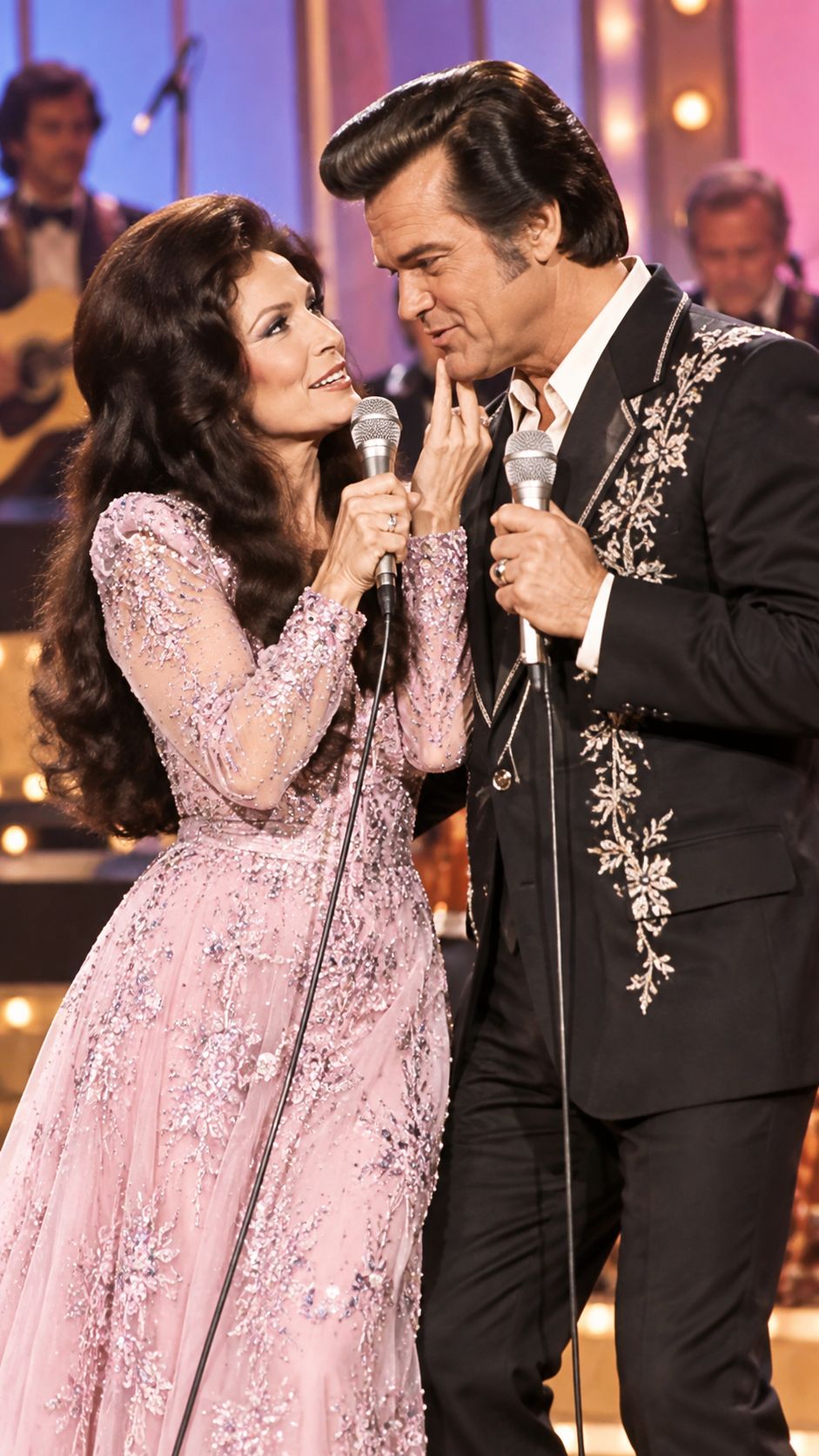
There was something almost dangerous about putting Loretta Lynn and Conway Twitty on the same stage.
Not because they were secretly lovers—Loretta herself repeatedly rejected that idea—but because they were so convincing at making audiences believe the emotional world of their songs. Their voices could sound flirtatious, wounded, jealous, playful, or deeply intimate within the space of a few minutes. PBS notes that the pair recorded 11 studio albums together between 1971 and 1988 and produced five No. 1 songs, while Loretta later explained that their apparent romantic chemistry was simply part of their musical partnership.
That distinction matters.
Some stories about the pair have grown more dramatic through decades of retelling, and not every viral claim about a supposed on-air confrontation or scandal can be independently verified. But there were performances in which Loretta and Conway deliberately pushed the emotional boundaries of country-duet performance—and audiences responded because the two artists understood exactly how far they could take a moment.
Here are three of the most memorable ways they appeared to “cross the line.”
1. When the Lyrics Became Almost Too Personal
Imagine sitting in a television audience during the golden age of country music.
The stage is polished. The cameras are rolling. The orchestra is ready.
Then Loretta Lynn and Conway Twitty begin singing.
Suddenly, the atmosphere changes.
Their signature duets were not innocent little love songs. “After the Fire Is Gone”, for example, was built around two people admitting that something had disappeared from a relationship and looking outside it for emotional fulfillment. The song became the duo’s first No. 1 country hit in 1971.
That was bold material for its era.
And Loretta and Conway didn’t sing it like two detached professionals reading lyrics from a page.
They looked at each other.
They responded to each other’s lines.
They allowed pauses to breathe.
They made the listener feel as though they were overhearing a private conversation.
“That was the secret: they didn’t merely sing the lyrics. They made the audience believe them.”
That realism created one of the biggest misconceptions surrounding their partnership.
People assumed that if two singers could portray forbidden attraction that convincingly, there had to be something happening behind the scenes.
But Loretta eventually addressed exactly that speculation.
She explained that people thought she and Conway “had a thing going,” while emphasizing that she loved him as a friend and that her husband, Doo Lynn, respected him as well.
So the “line” they crossed wasn’t necessarily a personal one.
It was an artistic line.
They made fictional emotion feel almost uncomfortably real.
And that may have been even more impressive.
2. When Loretta Turned a Duet Into a Conversation
The second kind of boundary came from the way Loretta Lynn and Conway Twitty interacted with one another between the lyrics.
Their performances could feel less like two singers performing at an audience and more like two characters having an argument in front of thousands of people.
That was particularly powerful with songs such as “Louisiana Woman, Mississippi Man.”
The song’s premise already creates tension: two lovers separated by geography, arguing playfully about their identities and devotion.
When Loretta and Conway performed it, the contrast between their voices gave the song an almost theatrical quality.
She could sound stubborn.
He could sound confident.
She pushed back.
He answered.
And the audience became part of the argument.
The partnership became so recognizable that decades later, descendants Tre Twitty and Tayla Lynn built a touring show around recreating that musical chemistry. Loretta’s official site describes how audiences react to the younger pair’s performances because they can evoke the feeling of their grandparents’ original partnership.
That tells us something important about the original act.
The chemistry wasn’t accidental.
It was part of the performance language.
And sometimes Loretta appeared to enjoy teasing Conway, challenging him, or playing the stubborn woman opposite his confident persona.
Those moments could make audiences laugh—but they also made the songs feel spontaneous.
A 1978 Washington Post review of a concert featuring both artists, for example, specifically noted Lynn joining Twitty for “Feelins”, while a later Los Angeles Times review described the pair closing a 1987 concert with “As Soon As I Hang Up the Phone” and revisiting several of their collaborations.
That wasn’t just a concert strategy.
It was storytelling.
They understood that the audience didn’t simply want to hear two famous voices.
They wanted to watch Loretta and Conway become characters.
And once they did, almost anything could happen inside the emotional boundaries of the song.
3. When Their Chemistry Made People Forget They Were Watching a Performance
This may have been the most powerful “crossing the line” of all.
Not a shocking confession.
Not a secret romance.
Not a scandal.
Simply the moment when Loretta Lynn and Conway Twitty became so believable that viewers forgot where the performance ended and reality began.
Their partnership was extraordinarily successful.
PBS records that they won the Country Music Association’s Vocal Duo of the Year award every year from 1972 through 1975. Their 1973 album “Louisiana Woman, Mississippi Man” reached No. 1 on the country album chart, while its title song also topped the country singles chart.
By then, audiences knew exactly what they were getting.
Or thought they did.
Then Loretta would look toward Conway.
Conway would answer with that unmistakable voice.
And suddenly the room felt different.
That’s the extraordinary thing about great country music: sometimes the smallest gesture carries more emotional weight than a dramatic declaration.
A glance.
A smile.
A pause before a line.
A slight change in vocal tone.
Those details were enough to make generations of fans wonder whether the connection was more complicated than the official story.
But Loretta’s own testimony provides an important corrective.
She didn’t describe Conway as a secret romantic partner.
She described him as a friend.
And that makes their story, in some ways, even more remarkable.
“The magic wasn’t that Loretta Lynn and Conway Twitty were secretly in love. The magic was that they could make millions of people believe two fictional characters were.”
That is an enormous artistic achievement.
Why Audiences Still Talk About Them
More than three decades after Conway Twitty’s death in 1993, the fascination hasn’t disappeared.
Why?
Because Loretta Lynn and Conway Twitty represented something that is increasingly rare in modern entertainment: two performers who trusted the power of implication.
They didn’t need to explain every emotion.
They didn’t need elaborate choreography.
They didn’t need a manufactured controversy.
Their voices did the work.
Their songs created the tension.
And their personalities supplied the spark.
The emotional ambiguity was especially powerful because country music has always been fascinated with complicated relationships—marriage, betrayal, temptation, loneliness, regret, reconciliation, and forbidden desire.
Loretta understood those themes intimately as a songwriter.
Conway understood how to inhabit them vocally.
Together, they created a musical world where a simple glance could feel like a confession.
That is why the most sensational stories surrounding them should be approached carefully.
Some modern retellings describe supposed confrontations, secret romances, or explosive television incidents without providing reliable primary evidence. Recent online stories have amplified some of these claims, but dramatic storytelling should not be mistaken for historical documentation. The stronger evidence comes from surviving performances, contemporary reviews, archival recordings, and the artists’ own words.
And those sources already give us plenty.
We don’t need to invent a scandal to understand why this partnership mattered.
The Real Shock Was Their Believability
Perhaps the biggest misconception about Loretta Lynn and Conway Twitty is that their chemistry needs a secret explanation.
It doesn’t.
They were professionals who understood emotional storytelling at an extraordinary level.
They knew exactly how to make a lyric sound personal.
They knew how to turn a duet into dialogue.
And they knew that sometimes the most powerful thing an artist can do is leave the audience wondering what was real.
That’s why decades later, people still watch their performances and ask the same question:
Were they really that close?
The historical answer is much simpler.
They were exceptionally close musical collaborators and friends. Loretta herself rejected the idea that their stage chemistry meant a secret romantic relationship.
But artistically?
They crossed the line again and again.
They crossed the line between singing and acting.
Between performance and storytelling.
Between fiction and reality.
And perhaps most importantly, they crossed the line between hearing a song and feeling like you were witnessing someone’s private life.
That is why Loretta Lynn and Conway Twitty remain one of country music’s most unforgettable partnerships.
“The audience wasn’t shocked because Loretta and Conway revealed a secret. They were shocked because, for a few unforgettable minutes, the performance felt too real to be only a performance.”
And that may be the greatest compliment two country singers could ever receive.
VIDEO: